EN — English
 TR — Türkçe
 DE — Deutsch
 RU — Русский
 FR — Français
 ES — Español
 AR — العربية
 SR — Српски

UAE Crushed Sand & Chippings Crusher and Screener Plant 200-300 TPH
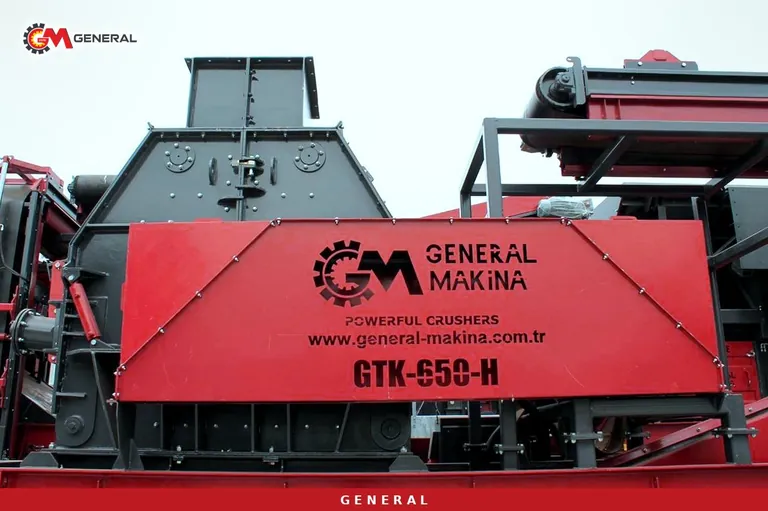
In the United Arab Emirates, a ready-mix producer or road contractor usually wants two things from the same quarry: crushed sand to replace natural concrete sand, and chippings in several sizes. Both come from the same rock and the same line, yet each one takes its share from the other. Tighten the tertiary stage to raise the sand yield and the 12-19 mm chippings shrink; give priority to chippings and the sand stockpile runs down. This article explains how a crusher and screener plant fed at 200-300 TPH balances these two products in UAE quarries, which real models can build it, and what to watch on site.
All model and capacity figures here are taken from our product catalogue. We give no information about any specific quarry, tender or specification in the Emirates. Confirm the applicable gradation and sand quality limits with the project consultant and with the specification of the relevant municipality or roads authority.
Managing the product split when sand and chippings share one line
The final product percentages of a crushing and screening plant are not accidental. The primary crusher setting, the closed side setting of the second stage and the rotor speed of the last stage together decide how much of the feed tonnage ends up as 0-5 mm and how much stays in the coarser fractions. The screen apertures then make the last adjustment.
Settings that raise the sand share
Returning part of the 5-12 and 12-19 mm oversize to the last stage by conveyor is the most direct way to increase sand output. On a tertiary impact crusher, a higher rotor speed and a narrower gap at the breaker plates push in the same direction. On a VSI the rotor tip speed and the cascade (by-pass) ratio are adjusted: opening the by-pass keeps the cubical shape but lowers the sand yield.
Settings that protect chipping shape
Flaky and elongated particles are rejected in road and concrete chippings. Keeping the cone or impact second stage choke-fed increases inter-particle breakage and improves shape. Running the crusher half empty lowers sand output and makes chippings flakier at the same time. That is why the match between feeder rate and crusher capacity influences the product split as much as the screen does.
A hypothetical example: about one third of a 250 TPH feed is wanted as 0-5 mm, but the first pass delivers only one fifth. Closing that gap means recirculated oversize rides on the last stage as extra load. This extra tonnage must be added on top of the nominal feed when the last stage machine is sized. The formula is simple: last stage load = material arriving from the first pass that is not undersize + recirculated material.
In Hajar Mountains quarries the rock chooses the crusher
A large share of aggregate quarries in the Emirates sits in Fujairah and Ras Al Khaimah, along the foothills of the Hajar Mountains. Gabbro and other hard ophiolitic rocks are found in this belt alongside limestone quarries. The two rock groups behave very differently inside a crusher, so the same capacity calls for two separate plant layouts.
In hard, abrasive rock such as gabbro, machines that break by impact consume wear parts quickly. Here a chain made of a jaw crusher (compression) at the primary, a cone crusher at the second stage and a VSI running rock-on-rock at the final stage works out cheaper per tonne. Limestone reverses the picture: a primary impact crusher gives a high reduction ratio in one stage, and a tertiary impact crusher makes sand and fine chippings at a low cost.
A sample decides which group a quarry really belongs to. Choosing a model before silica content and abrasiveness are tested turns into an expensive surprise at the first wear part change. We recommend sending a representative sample of a few kilograms at the quotation stage.
Matching real models to 200-300 TPH
The table below lists catalogue models that cover the 200-300 TPH feed band, stage by stage. Model-specific capacities of the cone crusher are given per project, so that cell is left blank.
| Stage | Model | Capacity (t/h) | Feed (mm) | Power |
|---|---|---|---|---|
| Feeding | GNR 110 grizzly feeder | 200-300 | up to 1500 | 2×7.5 kW |
| Primary (hard rock) | GNRK 110 jaw crusher | 200-350 | Opening 1100×850 | 110/132 kW |
| Primary (limestone) | GNR PDK02 impact crusher | 200-300 | 900 | 200 kW |
| Secondary (hard rock) | General cone crusher | — | 50-250 | 90-500 kW range |
| Tertiary (limestone) | GNR 150 tertiary crusher | 200-300 | 150 | 250 kW |
| Sand stage (hard rock) | GNR 900 VSI | 80-210 | 50-55 | 2×200 kW |
| Screening | GNR 2060 circular screen | — | — | 18.5 kW |
| Wheeled option | General 02 | 250-300 | 1000 | 660 kVA |
| Wheeled sand unit | GNR-MVSI 900 | 90-180 | 50 | 850 kVA |
Stationary layout
For an investment that will stay in one quarry for years, stationary crushing plants allow more screen decks and a wider stockpile layout. In a gabbro quarry, the chain of GNR 110 feeder, GNRK 110 jaw crusher, cone crusher and GNR 900 VSI handles 80-210 TPH at the last stage. If the sand target goes beyond that, the VSI stage is split into two units, or part of the oversize goes straight to the chippings stockpile. In a limestone quarry, pairing the PDK02 with the GNR 150 tertiary crusher covers the 200-300 TPH band with two stages on one line.
Wheeled layout
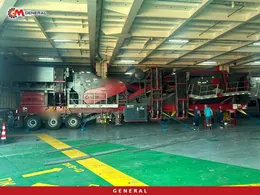
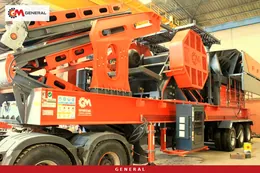
When the quarry permit is short or the line will move to another emirate after a project ends, wheeled mobile crushing plants make more sense. The General 02 runs at 250-300 TPH and separates 0-5, 5-12, 12-19 and 19-40 mm fractions on its 2000×5000 mm, 4-deck screen. To raise the sand share in hard rock, a GNR-MVSI 900 is added behind it; this unit delivers 0-3, 3-5 and 5-12 mm. Because the General 02 uses an impact crusher at the primary, wear part consumption in very abrasive rock such as gabbro must be assessed separately together with the sample.
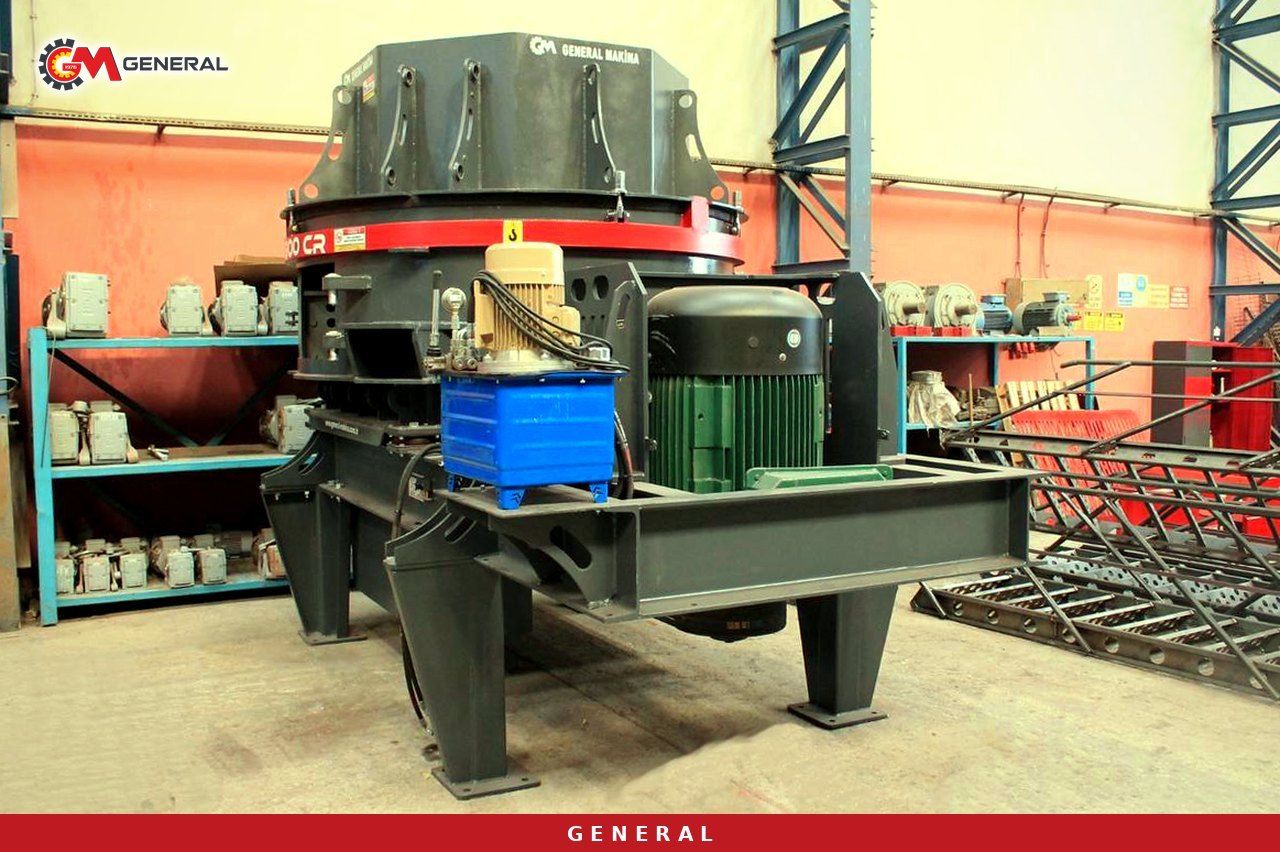
The two machines in the photos: tertiary impact versus VSI
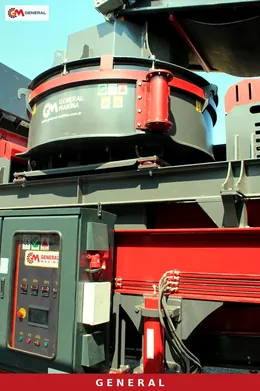
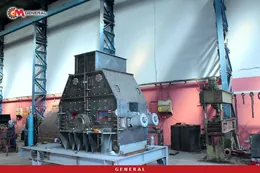
The GTK-650-H tertiary crusher in the cover photo and the vertical shaft impactor above do the same job with different physics. In the tertiary impact crusher a horizontal rotor hits the material and throws it against breaker plates. It accepts feed up to 150 mm and produces sand and fine chippings together in limestone. In low-abrasion rock, wear cost per tonne stays reasonable.
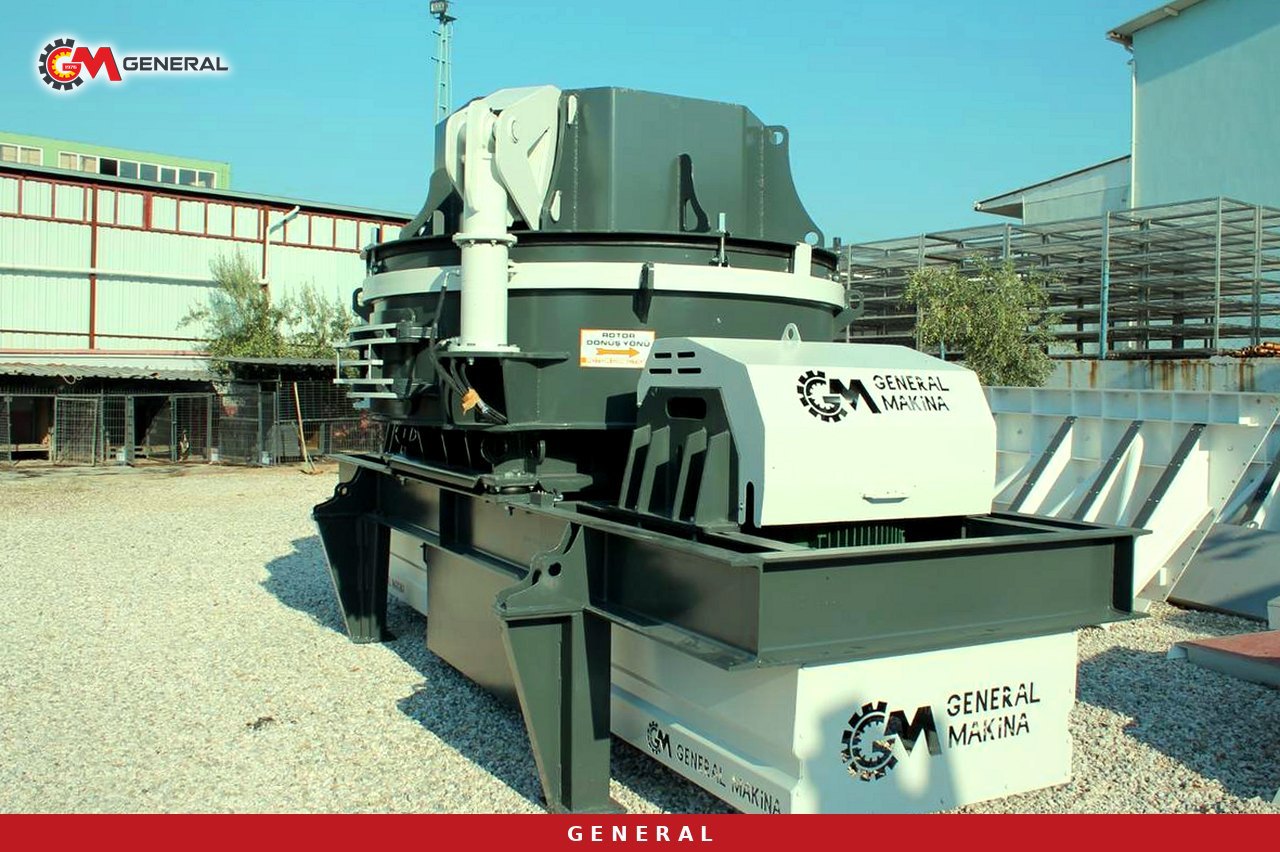
The GNR series VSI accelerates material with a vertical rotor and throws it onto its own rock bed or onto anvils. Its feed size is small (50-55 mm on the GNR 900), so it sits behind the cone crusher. In rock-on-rock mode metal wear drops, which is why it is preferred for siliceous material such as gabbro, basalt and river gravel. Sand particle shape affects the water demand of a concrete mix, so concrete producers in the Emirates watch this stage closely.
Operating in a hot, dusty quarry with limited water
In UAE summers, midday heat strains equipment and crews at the same time. Shift planning, motor and gearbox cooling, hydraulic oil temperature and air filter change intervals belong in the operating instructions. On wheeled plants, generator airflow direction and dust intake are considered together with wind direction when the set-up spot is chosen.
The fines content of crushed sand is one of the measures that decides whether the sand is accepted in concrete. Where water is scarce, dry screening and air classification are evaluated first. If washing is needed, the GNR screw sand washer works at 50-250 TPH with 0-50 mm feed, and it should come with a water recovery and settling pond plan. Dust suppression at transfer points, belt covers and screen enclosures are measures that can be selected per project.
On logistics, machines travel by sea from Türkiye to ports such as Jebel Ali or Khalifa and then by road to the quarry. Foundation drawings for a stationary line, or ground bearing conditions for a wheeled line, should be settled in advance.
Information to gather before requesting a quote
- Quarry location (emirate and approximate area) and rock type; a representative sample if possible.
- Hourly feed target and daily operating hours.
- Required sand and chipping fractions with the approximate sales share of each.
- Fines and particle shape limits for sand stated in the specification.
- Power source: grid connection or generator.
- Water access and whether washing is planned.
- Permit duration and the chance the line will be relocated later.
Frequently asked questions
Can one line produce both sand and chippings?
Yes. With the right screen decks and a return conveyor, the same line makes 0-5 mm sand together with 5-12, 12-19 and 19-40 mm chippings. The split is changed through the tertiary stage setting and the recirculation rate.
Is a tertiary impact crusher suitable for gabbro?
It will crush it, but wear part consumption rises in siliceous, abrasive rock. For such rock, running a VSI in rock-on-rock mode at the final stage is more economical. The decision should follow a sample test.
What warranty and certificates apply?
Our machines are manufactured with ISO 9001 and CE certification and carry a 1-year warranty, wear parts excluded. We have been manufacturing in Izmir since 1976, and the Middle East is one of our export regions.
What determines the price?
The number of stages, crusher types, screen decks, wheeled or stationary choice, washing unit, generator needs and delivery scope set the price. A quote prepared with this information is specific to the project.
Summary
Success with a 200-300 TPH crushed sand and chippings line in the UAE depends on fixing the ratio between the two products at the start and choosing crushers to suit the quarry rock. An impact chain suits limestone; a jaw, cone and VSI chain suits gabbro. Send your sample, fraction list and site details through our contact pageand our engineers will work out the models and plant layout with you.
Definitions of technical terms: Glossary