EN — English
 TR — Türkçe
 DE — Deutsch
 RU — Русский
 FR — Français
 ES — Español
 AR — العربية
 SR — Српски

Africa Sandstorm-Proof Crusher and Screener Plant 100-200 TPH
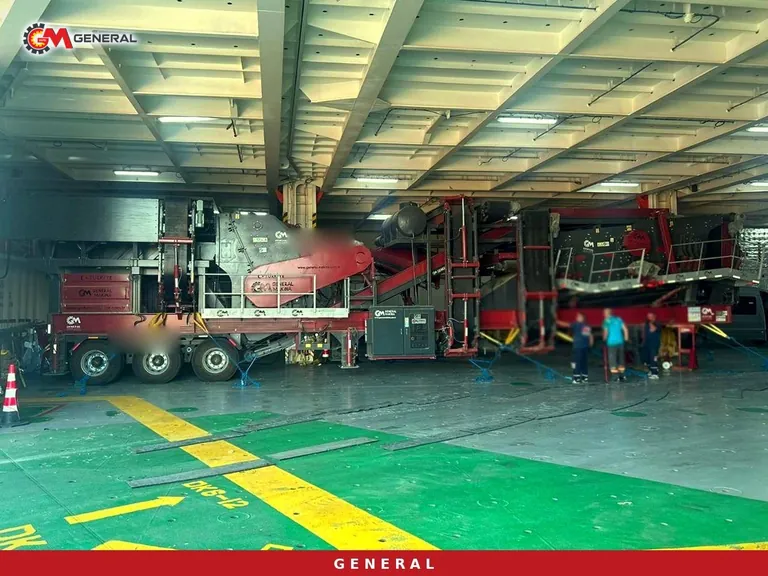
For a quarry in Africa, a sandstorm is really two problems. The first is the event itself: visibility collapses, the wind drives fine sand along the ground for hours and the plant has to be stopped. The second is the quiet damage it leaves behind: dust packed into the generator air filter, the control panel, the screen bearings and the conveyor idlers returns a few weeks later as overheating, vibration and unplanned downtime. A "sandstorm-proof" crushing and screening plant is therefore not a machine that keeps producing in the middle of a storm. It is one that can be secured within minutes before the storm arrives and put back under load after a short clean-up once it has passed. This article works through the real models in our range for a 100-200 TPH target, the points where dust gets into the machine, the measures that can be added per project and a storm routine that actually works on site.
Storms and everyday dust need different answers
Sudan and Chad see wall-shaped storms known as haboobs, North Africa gets hot, dry winds off the desert, and the arid plains of the Horn of Africa have seasonal dust clouds. What they share is a sand-and-dust mix that is much finer than the dust a crusher makes itself and travels much further. It slips past seals and gaskets, blinds filter media quickly and turns into an abrasive paste once it meets grease.
Everyday dust is continuous and its sources are predictable: the moment a truck tips into the feeder, the crusher discharge, conveyor transfer points and the screen deck. Spraying, covers and a disciplined maintenance routine are enough to manage it. A storm is an event, and the main defence against it is site preparation rather than hardware. Keeping these two headings apart when writing the purchase specification stops money going into equipment that will not help, and prevents the protection that is really needed from being left out.
Matching models and rock types at 100-200 TPH
The rock crushed in Africa's dry belts covers a wide range: limestone and sandstone in coastal and inland basins, granite and gneiss on the old shield areas, basalt in volcanic regions. Abrasiveness decides the crusher type; the daily aggregate demand in the contract decides the capacity band. The table below uses only values published on our product pages.
| Model | Capacity | Max. feed | Crusher line-up | Screen | Generator | Weight |
|---|---|---|---|---|---|---|
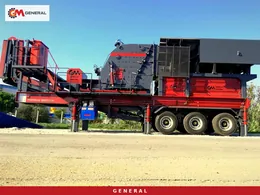
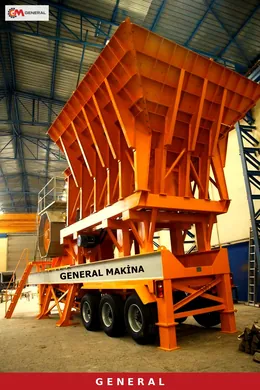
| General 800 | 80-150 t/h | 600 mm | PDK 1280 primary impact | 1300×4000 mm, 3 decks | 450 kVA | 35,000 kg |
| General 01 | 120-180 t/h | 700 mm | GPS 1210 impact (primary + secondary) | 1600×5000 mm, 4 decks | 550 kVA | 55,000 kg |
| General 944 | 120-180 t/h | 800 mm | GPJ 90 jaw + GM430 cone | 1600×5000 mm, 3 decks | 550 kVA | 70,000 kg |
| General 950 | 120-180 t/h | 800 mm | GPJ 90 jaw + DMK01 impact | 1600×5000 mm, 3 decks | 600 kVA | 70,000 kg |
| GNR-MC110 (twin chassis) | 200-300 t/h | 900 mm | GPJ 110 jaw + DMK03 impact | 2000×6000 mm, 4 decks | 750 kVA | 2 × 55,000 kg |
Limestone and sandstone: General 800 or General 01
In low-abrasion sedimentary rock, impact crushing is economical and gives a cubical product. If the work stays in the lower half of the band, General 800 (80-150 t/h) may be enough; above 150 t/h the General 01 (120-180 t/h) leaves a more comfortable margin. Its 4-deck screen separates four products, 0-5, 5-12, 12-19 and 19-40 mm, in one pass. On a dusty site that has a practical meaning: road and concrete aggregate come out without a separate screening unit and the extra transfers that go with it, and every transfer point you avoid is one less dust source to suppress. The same model was used in the 150 t/h General 01 project we delivered to Algeria.
Granite, gneiss and basalt: General 944 or General 950
In high-silica rock, the wear parts of an impact rotor are consumed quickly. Here the GPJ 90 jaw primary is followed either by a cone secondary (General 944) or by an impact secondary (General 950). The cone works by compression and stretches metal life in abrasive stone; the DMK01 impact secondary gives higher reduction and a more cubical grain. Both accept 800 mm feed and run in the 120-180 t/h band. From a dust point of view the difference is that compression crushing usually produces fewer fines, so there is less dust to suppress at the crusher discharge.
Contracts that push towards 200 TPH
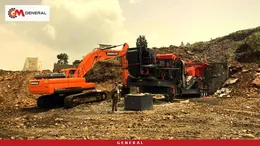
Single-chassis models top out at 180 t/h. If a steady 200 t/h is required there are two routes: the twin-chassis GNR-MC110 (200-300 t/h, 900 mm feed) or two 120-180 t/h units working in parallel. On a site with high storm risk the second route has a clear advantage: one unit can stop for filter cleaning or service while the other keeps producing. On the MC110, the primary chassis can run on its own, so it can keep building a coarse stockpile while the secondary group is being cleaned.
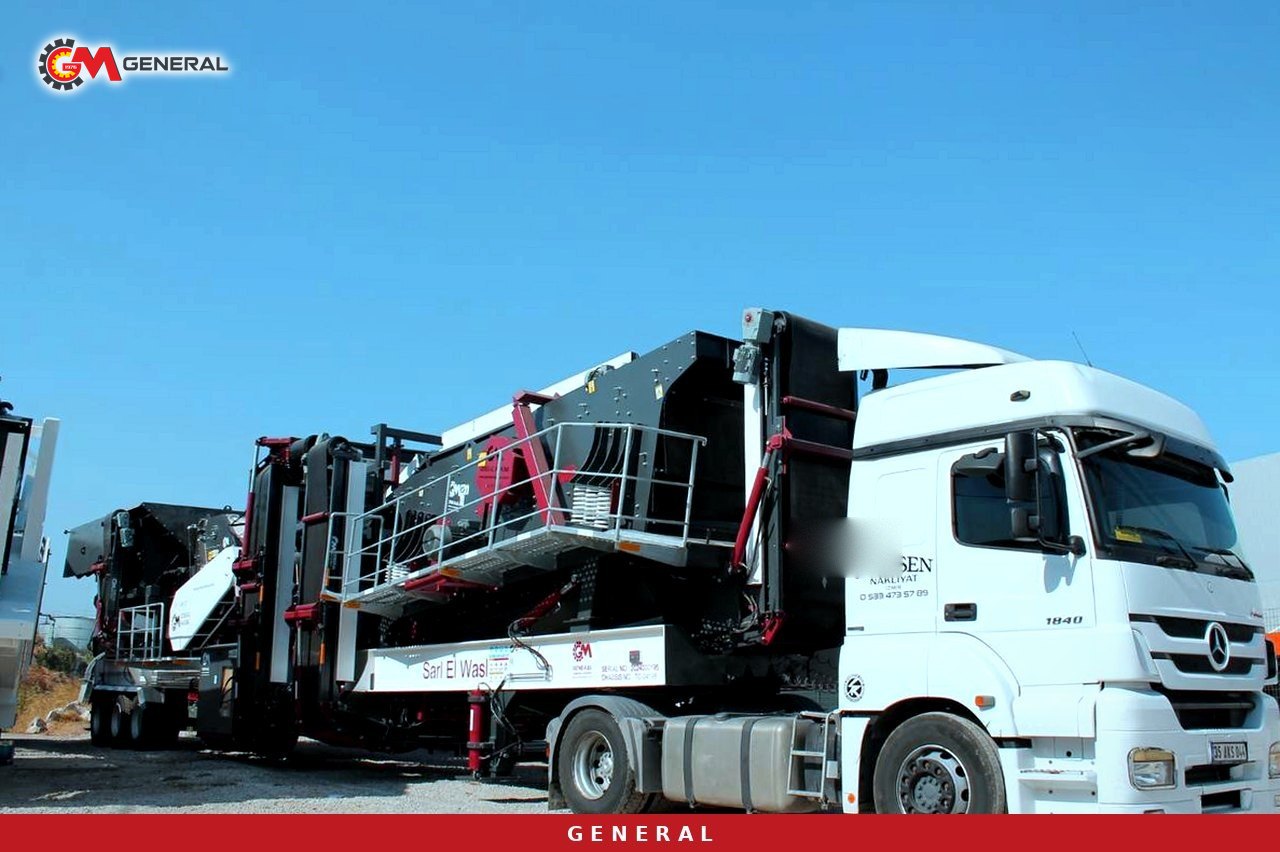
Six places where sand gets into the plant
Post-storm fault records show the damage clustering in the same places every time. Going through these points one by one at quotation stage makes it clear which protection is really needed.
- Generator air intake: the generators, from 450 to 750 kVA depending on the model, draw large volumes of air; when the filter clogs, power drops and the crusher loses speed under load.
- Control panel: air drawn in for cooling carries dust with it; dust on contactors and drive boards leads to heat build-up and faults.
- Screen bearings and vibration drive: sand entering the bearings of a 1600×5000 mm or 2000×6000 mm screen breaks down lubrication and shortens bearing life.
- Conveyor idlers and pulleys: an idler with sand in its bearing stops turning and the belt wears by friction at that point.
- Hydraulic cylinder rods: sand sticking to an oily rod scores the seals when the cylinder retracts.
- Crusher bearing housings: sand in the oil circuit of jaw and cone crushers is the most expensive kind of damage to repair.
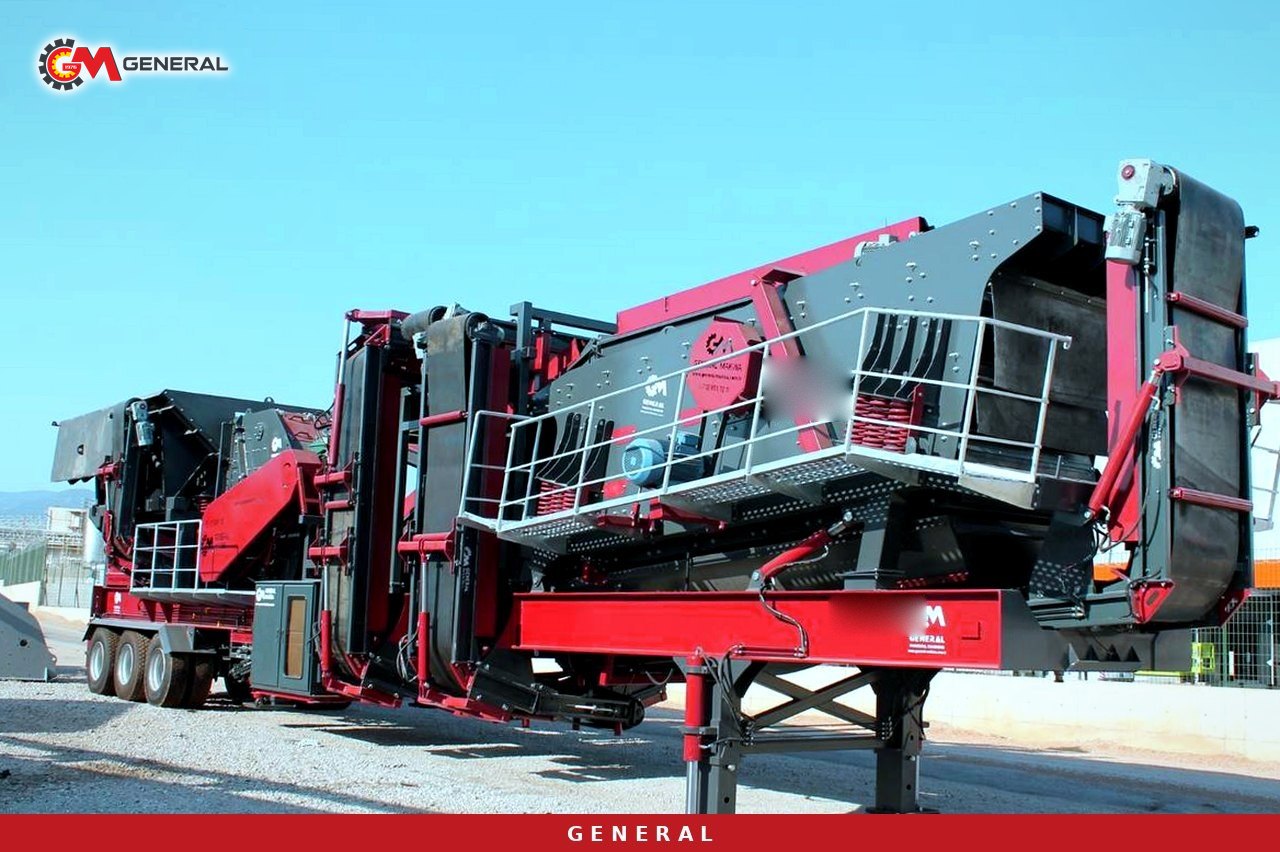
Protection measures selectable per project
None of the measures below means "sandstorm-proof" on its own; which ones go into the quote is decided by a site review and a rock sample. Ask to see every item that is not listed as standard on the product page as a separate line in the quotation.
Feeding and pre-screening
The by-pass grizzly feeder on the General 01 removes fines and soil before they reach the crusher. On dry sites the run-of-mine rock contains wind-blown fine sand; keeping it out of the crusher reduces both wear and dust at the discharge. The fines can be sent to a separate stockpile by their own belt or used as fill.
Dust suppression and enclosed transfers
Fine mist sprays at the crusher discharge and conveyor transfers hold most of the dust in place with little water. Where water arrives by tanker, spraying is limited to the critical points, while belt covers and rubber curtains in transfer chutes cut dust without using any water.
Electrical and engine protection
Filtered ventilation for the panel with a fan that keeps internal pressure above ambient, and a pre-cleaner (cyclone-type) air filter for the generator, are options that can be requested. The touch panel and optional remote monitoring on the General 01 also cut the time an operator spends outside in the dust.
Wear parts
A storm does not change the rock, but silica sand mixed into the feed speeds up wear. Manganese steel and alloy selection for jaw plates, blow bars and cone liners are covered on our spare and wear parts page. On a site far from the port, keeping at least one spare set on hand decides whether a stoppage is measured in hours or weeks.
Site layout and transport with the wind in mind
When positioning a mobile plant, the prevailing wind direction is decisive. If the generator and control panel sit upwind of the crusher and stockpiles, the machine does not inhale its own dust. Stockpile conveyor heads should point downwind, and the finest product, the 0-5 mm pile, should be sheltered by a bund, a row of containers or a natural hollow; otherwise a storm blows the most valuable fraction across the site.
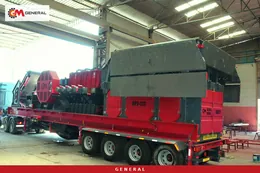
A wheeled chassis also lets you pull the plant back to a more sheltered spot as the storm season approaches. Entry into the country is usually through a seaport; a single-chassis plant can travel on its own wheels aboard a RoRo vessel. Bridge and axle-load limits on the route between port and quarry must be confirmed in advance with the relevant road authority. To compare all models side by side, see our mobile crushing and screening plants category.
Storm routine: stop, protect, restart
Whatever the hardware, what protects the plant in its first storm is a written procedure. The sequence below should be adapted to the site together with the operators during commissioning.
- When the warning comes, stop the feeder and let the crusher and belts run until empty. Stopping with a full crusher means an overload on restart.
- Shut down the crusher, screen and conveyors in order; stop the generator last.
- Lock the panel doors and fit protective caps over the generator air intake and exhaust.
- Move personnel to an enclosed shelter; do not work on the machine during the storm.
- After the storm, check the air filters first and replace them if needed; clean the panel interior with a vacuum rather than compressed air, which only drives the dust deeper.
- Inspect screen bearings, conveyor idlers and hydraulic rods; pump in enough clean grease to push the old grease out.
- Run the plant empty while watching vibration and temperature, then increase the feed step by step.
Frequently asked questions
What hardware does "sandstorm-proof" actually stand for?
The term has no single standard or certificate behind it. For us it means choosing measures such as grizzly pre-screening, dust suppression, enclosed transfers, a filtered panel and generator protection to suit the site, listing them item by item in the quote and backing them with a storm procedure. Our certifications are ISO 9001 and CE; the warranty is 1 year and does not cover wear parts.
On a dusty site, impact or jaw-and-cone?
The rock decides. In limestone and sandstone, impact solutions such as the General 01 or General 800 are economical; in granite and basalt the General 944 (cone) or General 950 (impact secondary) is the better fit. We do not recommend a final model before seeing a laboratory abrasion test and a test crush of a sample.
Is one plant enough for 200 TPH?
Our single-chassis models reach up to 180 t/h. For a steady 200 t/h we suggest the twin-chassis GNR-MC110 (200-300 t/h) or a two-unit combination. Where storms and filter servicing cause frequent stops, two units also provide redundancy.
What drives the price in a quotation?
The model and crusher line-up, whether the generator is in scope, the dust and filter measures chosen, the initial spare parts package and the shipping method are the main items. Once you send the rock type, target fractions and site location, a project-specific quotation is prepared.
Conclusion
For a site in Africa exposed to sandstorms, the right plant is not the one with the highest catalogue tonnage; it is the one built around a crusher line-up that suits the rock, dust measures chosen for the site and a written storm procedure. In the 100-200 TPH band, the choice between General 800, General 01, 944, 950 and, where needed, GNR-MC110 becomes clear with a rock sample and site data. Send us your rock type, target capacity and site location through our contact page and we will work out the configuration and protection list together.
Definitions of technical terms: Glossary