EN — English
 TR — Türkçe
 DE — Deutsch
 RU — Русский
 FR — Français
 ES — Español
 AR — العربية
 SR — Српски

Qatar Limestone Mobile Impact Stone Crushing Plant 120-180 TPH
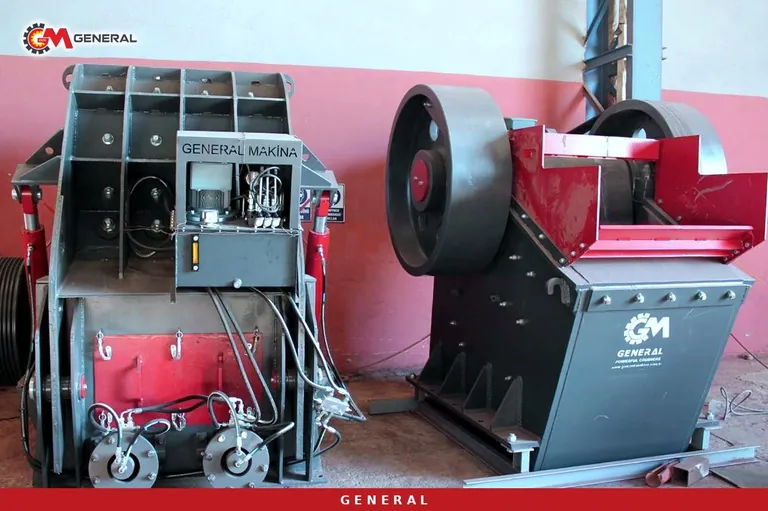
An investor opening a limestone quarry in Qatar, or adding a second line to an existing one, usually starts with three facts: a list of products to sell, a target of roughly 120-180 tonnes per hour, and the likelihood that the plant will move to another plot within a few years. Those three facts make a mobile plant built around an impact (HSI) crusher a strong candidate. Qatar also brings its own questions: soft limestone that is locally cherty or dolomitic, summer heat combined with humidity, fine dust and salt-laden air. This article puts our real models for this capacity band side by side with their figures and explains which site data changes which decision.
Why Qatari limestone suits an impact crusher, and where it fights back
Most of the Qatar peninsula is covered by limestone and dolomite beds. Much of this rock is low in silica and brittle, which places it in the material class where an impact crusher works best. Blow bars on the rotor throw the stone against breaker plates, so the rock breaks by impact rather than compression. The result is a high reduction ratio and a cubical particle. Our product pages give a reduction of up to 20:1 in limestone for the primary impactor and a typical ratio of about 10:1 for the secondary impactor. Getting the same product from a jaw and cone combination usually means adding one more crushing stage.
The difficulty lies in the exceptions, not the average rock. Some Qatari formations contain chert nodules and silicified layers that noticeably speed up blow bar wear. Gypsum and salt crusts appear in some near-surface zones, and low coastal areas have salty ground known as sabkha. If this material ends up in the aggregate, acceptance criteria for concrete are at risk. Before discussing models, we therefore recommend testing a quarry sample for silica content, Los Angeles abrasion value and sulphate-chloride content. Final crusher settings and blow bar alloy are chosen from those results.
Tying the 120-180 TPH target to your product list
The hourly capacity in a brochure is a nominal range valid at a given feed size and closed-circuit setting. Where a plant actually sits in that range on site depends on the post-blast block size, moisture, fines content and the product split you need. That is why it is better to write the target as "daily saleable tonnes and fraction mix" rather than a single number.
A simple formula is enough for a first estimate: required hourly capacity = daily target tonnes ÷ (operating hours × availability). Hypothetical example: a quarry targeting 1,200 tonnes a day, running 10 hours because it pauses for maintenance in the hottest hours, and expecting the plant to produce for 75% of that time needs 1,200 ÷ (10 × 0.75) = 160 t/h. That falls in the upper half of the 120-180 TPH band, which suggests choosing a model with a generous feed opening and screen area.
The product mix is the second factor. A quarry selling mostly road sub-base and fill, and one supplying 5-12 and 12-19 mm chippings to ready-mix plants, need different screen decks and crusher settings at the same tonnage. Sharing your sales ratios at the quotation stage lets us see in advance which fraction will become the bottleneck.
Four candidates, one table: wheeled, tracked and jaw-fronted options
The values below come from the technical data on the relevant product pages. One model below the band is included for comparison; values not given on a page are shown as "—".
| Model | Travel | Crusher | Capacity | Max. feed | Screen | Power unit | Weight |
|---|---|---|---|---|---|---|---|
| General 01 | Wheeled | GPS 1210 impact (primary + secondary) | 120-180 t/h | 700 mm | 1600×5000 mm, 4 decks | 550 kVA | 55,000 kg |
| GM 100 | Tracked | GNR-01 impact, 160 kW | 100-180 t/h | 600 mm | 1500×5500 mm, 3 decks | 450 kVA | 42,000 kg |
| General 950 | Wheeled | GPJ 90 jaw + DMK01 impact | 120-180 t/h | 800 mm | 1600×5000 mm, 3 decks | 600 kVA | 70,000 kg |
| General 800 (lower band) | Wheeled | PDK 1280 primary impact | 80-150 t/h | 600 mm | 1300×4000 mm, 3 decks | 450 kVA | 35,000 kg |
General 01: two stages in one housing, four products
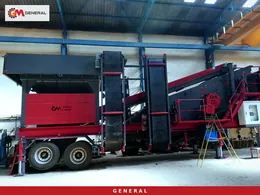
General 01 is a wheeled plant carrying the GPS 1210 triple-pendulum impact crusher on a single chassis. Because the crusher handles primary and secondary work in the same housing, limestone needs no second machine. The 700 mm feed opening accepts medium post-blast blocks without pre-crushing. The 1600×5000 mm four-deck screen separates 0-5 / 5-12 / 12-19 / 19-40 mm fractions in one pass, and oversize returns to the rotor on the return conveyor. The 550 kVA power unit runs the plant independently on a plot without grid connection. For a Qatari quarry selling concrete aggregate and wanting to stock four products at once, this is the first model to look at.
GM 100: tracked option for quarries that relocate often
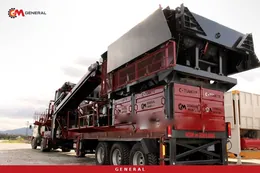
If the quarry face advances quickly or the plant has to move often within the same site, GM 100 should be considered. Its GNR-01 impact crusher is rated at 160 kW; a 3.6 m³ hopper, a 1000×1500 mm grizzly pre-screen and a 1500×5500 mm three-deck integrated screen work in closed circuit. It is self-propelled and needs neither a tractor unit nor ground preparation. With a capacity range of 100-180 t/h, continuous output near the top of the band requires a blasting plan that keeps feed below 600 mm. For other tracked models see the track-mounted mobile crushers page.
General 950: when the limestone has hard bands
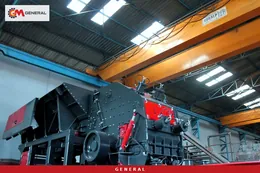
If sample tests show widespread silicified layers, the impactor needs protection from large abrasive blocks. General 950 does this with a GPJ 90 jaw primary: limestone and hard bands are broken in the jaw first, and the DMK01 impact secondary delivers the cubical product. It offers 800 mm feed and a 600 kVA power unit at a weight of 70,000 kg. In clean, pure limestone this extra stage can be an unnecessary burden, so the decision should follow the sample result.
General 800 serves the lower part of the band with 80-150 t/h. If the daily target rises to around 160 t/h as in the example above, it is borderline on its own. All wheeled options can be compared in the mobile crushing and screening plants category.
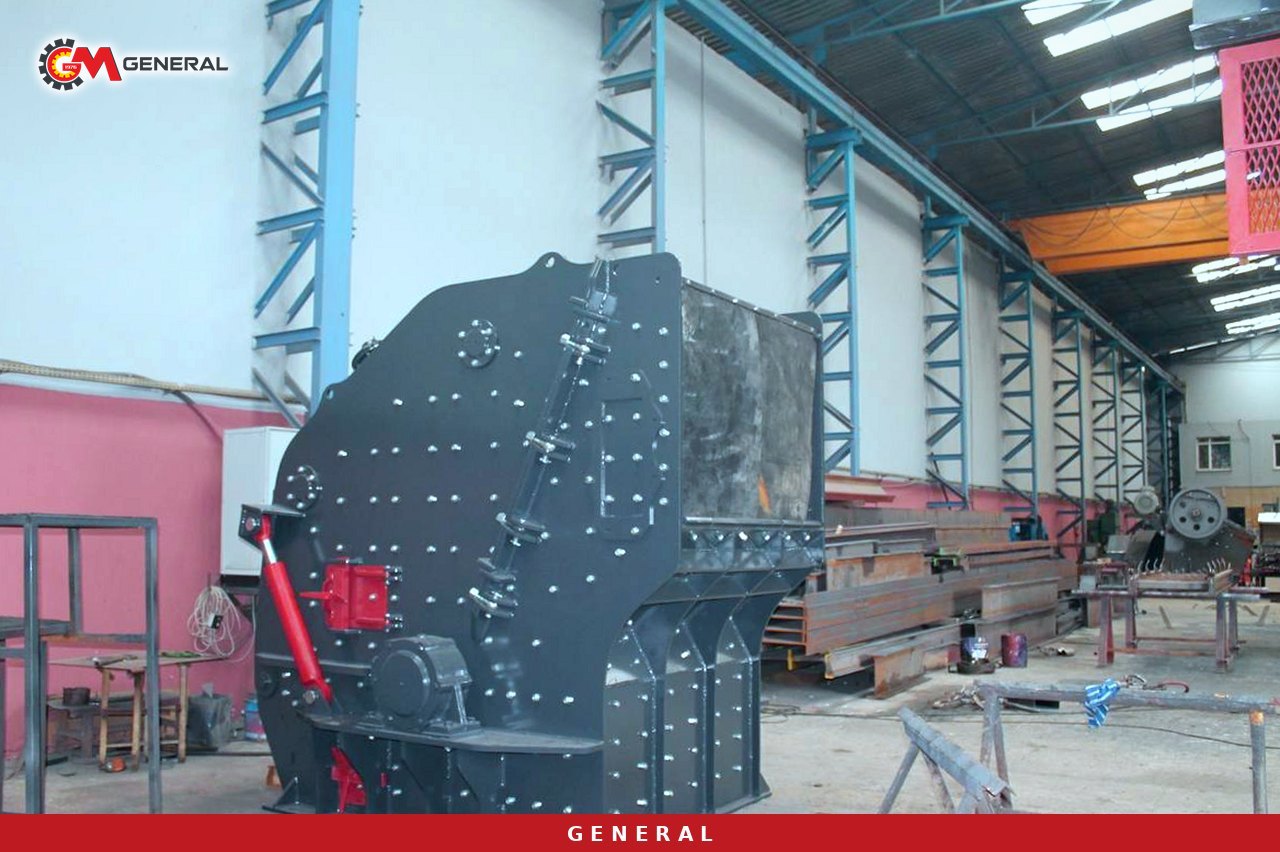
Protecting the impact crusher on a hot, humid and dusty site
In Qatar's summer, heat and coastal humidity rise together, while wind-blown fine dust fills filters quickly. These conditions stress the systems feeding the crusher more than the crusher itself. The measures that keep the "mobile impact" choice sustainable on site are listed below; all are options selectable per project, not standard on every model:
- Power unit cooling and air filtration: ask for a radiator sized for high ambient temperature and a heavy-duty pre-filtered air intake for the generator. Shorten filter change intervals in dusty months.
- Dust suppression: in a water-scarce country, fine mist nozzles at the crusher discharge and conveyor transfer points use less water than heavy spraying. Covered conveyors keep dust at source.
- Electrical panel: an air-conditioned or positive-pressure panel keeps fine dust and moisture away from the drives.
- Corrosion: in salty air, plan regular checks and protective paint touch-ups for exposed bolts, pulley guards and screen tensioning parts.
- Flying stone: a chain curtain at the feed opening keeps fragments thrown back by the rotor inside and improves operator safety.
Blow bar alloy matters as much as climate. Our product page recommends high-chrome white cast iron for clean, abrasive feed and manganese or martensitic steel where tramp metal is a risk. In a quarry with high chert content, predicting part life through sample tests and ordering a spare blow bar set with the first order reduces production losses in the hot season.
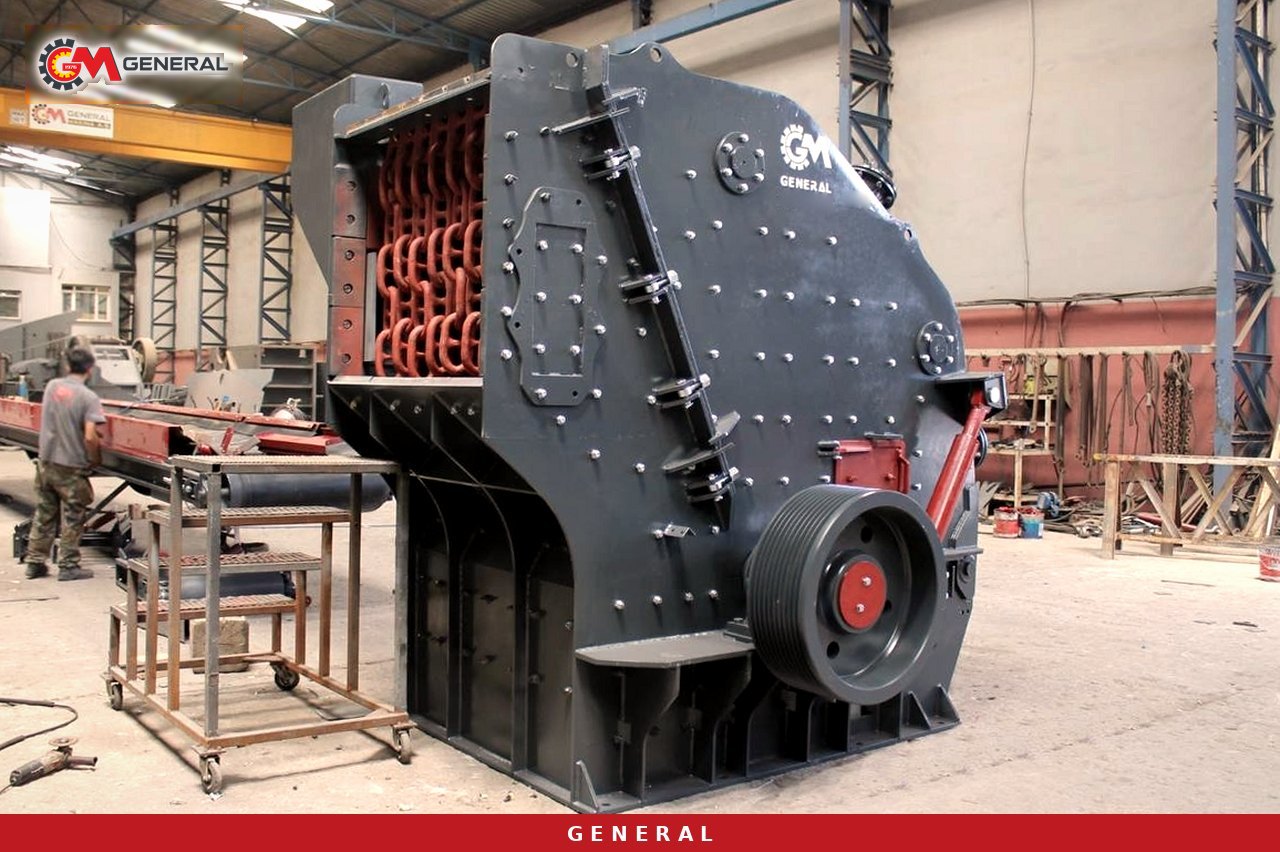
From Izmir to a Qatari quarry: shipping and installation
Wheeled plants are prepared to road-legal dimensions for towing; the transport dimensions of General 01 are 4300×18500×4500 mm. Equipment arriving by sea usually enters the country through Hamad Port and reaches the quarry by road. Confirm height and axle load limits on the route between port and quarry, as well as customs and temporary import rules, with the competent authorities and your freight forwarder. The tracked GM 100 travels on a lowbed trailer and positions itself on its own tracks on site.
On wheeled models, folding hydraulic conveyors and support legs remove the need for a concrete foundation. Even so, level and compacted ground is needed for the plant to run steadily without vibration, especially on loose sabkha-affected soil. In the layout plan, consider the loader access road, stockpile positions and the prevailing wind direction together; keeping dust from drifting towards living quarters or a batching plant lowers the load on the dust suppression system.
Information to collect from the quarry before requesting a quote
To work out the right configuration in a single round, we recommend preparing the following:
- Sample test results: silica content, Los Angeles abrasion value, sulphate and chloride content.
- Largest block size after blasting and the share of fines (soil, gypsum).
- Daily target tonnage and sales ratios per fraction.
- Site plan: plot size, slope, stockpile area and how often the plant will be relocated.
- Energy: whether a grid connection exists or the plant will run on a generator.
- Project specification: aggregate acceptance criteria and environmental permit conditions, as confirmed by the relevant authority.
For a broader comparison of models for this rock, see our article on high-efficiency mobile crushers for limestone.
Frequently asked questions
Is a single impact crusher enough for Qatari limestone?
In clean, low-silica limestone it usually is. The GPS 1210 crusher in General 01 performs primary and secondary work in one housing. If the sample shows dense chert or silicified bands, the jaw-fronted General 950 is the safer choice.
Should I choose wheeled or tracked?
If the plant stays at one point for months and moves to another plot at intervals, a wheeled model is practical for transport. If weekly relocation inside the quarry is needed, the tracked GM 100 saves time.
Does capacity drop in hot weather?
The crusher's mechanical capacity does not change; the limit is usually power unit cooling and filter clogging. Selecting the generator for high ambient temperature and servicing filters more often protects output.
How do I get price and delivery information?
Price depends on the model, screen and conveyor equipment, dust suppression and panel options, and shipping terms. Once you share the list above, a project-specific quotation is prepared.
Conclusion
For a 120-180 TPH limestone target in Qatar, a mobile impact plant is a sound starting point thanks to its cubical product and high reduction ratio. General 01 stands out for a quarry wanting four products from one plant, GM 100 for a quarry that relocates often, and General 950 for limestone with hard bands. What settles the choice is the sample test, the product list and the site plan. Our team has built crushing and screening plants in Izmir since 1976 and supplies ISO 9001 and CE certified equipment with a 1-year warranty excluding wear parts. Send your quarry details through our contact page and we will work out the configuration together.
Definitions of technical terms: Glossary