EN — English
 TR — Türkçe
 DE — Deutsch
 RU — Русский
 FR — Français
 ES — Español
 AR — العربية
 SR — Српски

Tanzania Marble & Calcite Crusher and Screener Plant 60-100 TPH
A marble quarry in Tanzania usually holds two separate product opportunities. The first is construction: white or light-coloured marble chips, decorative aggregate and crushed stone for concrete and plaster. The second is industrial: pure calcite veins that become the first crushing stage of filler raw material for paint, plastics, paper or animal feed. This article explains how a crushing and screening plant producing 60-100 tonnes per hour can serve both markets, which real models fit that band, and what has to be planned along the chain from the port of Dar es Salaam to the quarry face.
All technical values here come only from our own product pages. The real behaviour of your rock is determined by sample tests, and the calcite buyer's whiteness and purity requirements should be confirmed directly with the buyer or the relevant specification.
Marble and calcite from one quarry: two products, two different buyers
Marble is calcite recrystallised by metamorphism, so the two materials behave very similarly in a crusher. Both are brittle, low in abrasiveness and break easily under impact. The difference lies in where the product goes. A construction customer looks at particle shape, grading and dust content. A calcite buyer looks at colour, purity and the absence of foreign matter, and often cares little about particle shape because the material will be milled anyway.
Marble and crystalline limestone formations are known in Tanzania's metamorphic belts. Within a single quarry, however, colour and purity can change from metre to metre. Grey bands, levels carrying mica or graphite and iron-oxide joint fillings reduce the value of calcite. The plant should therefore be designed on the assumption that material from the face can be split into two grades before it ever reaches the crusher.
Grinding mills and micronised powder are outside the scope of this article and of our product range. The line described here reduces calcite to a granule size suitable as mill feed while producing construction aggregate at the same time.
Real models that fit the 60-100 TPH target
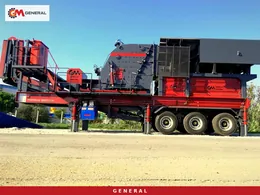
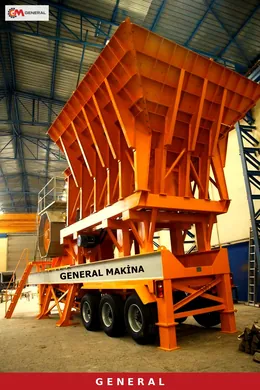
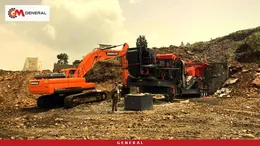
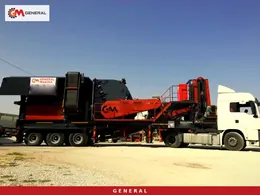
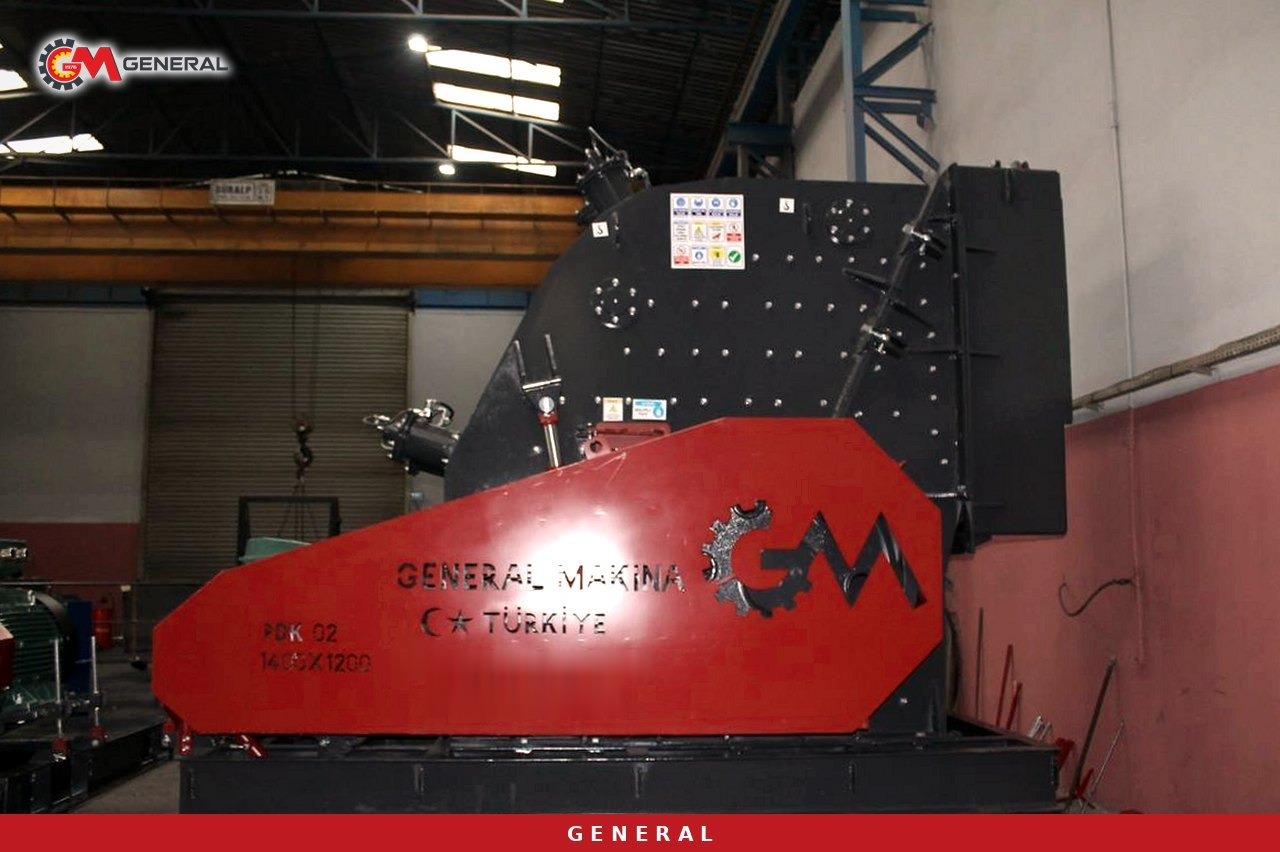
Two of our wheeled plants address this capacity band directly. The General 640 combines a GPJ 60 jaw crusher and a GNR 50 impact crusher on one chassis and works at 60-100 t/h, matching the target in the title exactly. The General 800 delivers 80-150 t/h with a PDK 1280 primary impact crusher; on a brittle rock like marble a single impact stage gives both reduction and a cubical particle.
| Model | Crusher layout | Feed opening | Capacity | Screen / generator | Transport size, weight |
|---|---|---|---|---|---|
| General 640 | GPJ 60 jaw + GNR 50 impact | 500 mm | 60-100 t/h | 1200×4000 mm 3 decks / 300 kVA optional | 3500×17000×4500 mm, 38,000 kg |
| General 800 | PDK 1280 primary impact | 600 mm | 80-150 t/h | 1300×4000 mm 3 decks / 450 kVA | 3600×15500×4500 mm, 35,000 kg |
| GPS-1210 | two-stage HSI, 160 kW | 600 mm | 100-250 t/h | — | stationary line |
| GNR 65 | tertiary impact, 132 kW | 150 mm | 70-130 t/h | — | third stage |
Feed size and the product list decide between them. If blasted blocks often exceed 500 mm, the 600 mm opening of the General 800 reduces secondary breaking. If 19-40 mm is not on the product list and capacity will not exceed 100 t/h, the General 640 is enough. If capacity is later to grow into a stationary line, the two-stage GPS series impact crusher is the next step: the GPS-1210 takes 600 mm feed with a 160 kW motor and runs at 100-250 t/h.
Crushing principle for calcite: why impact comes first
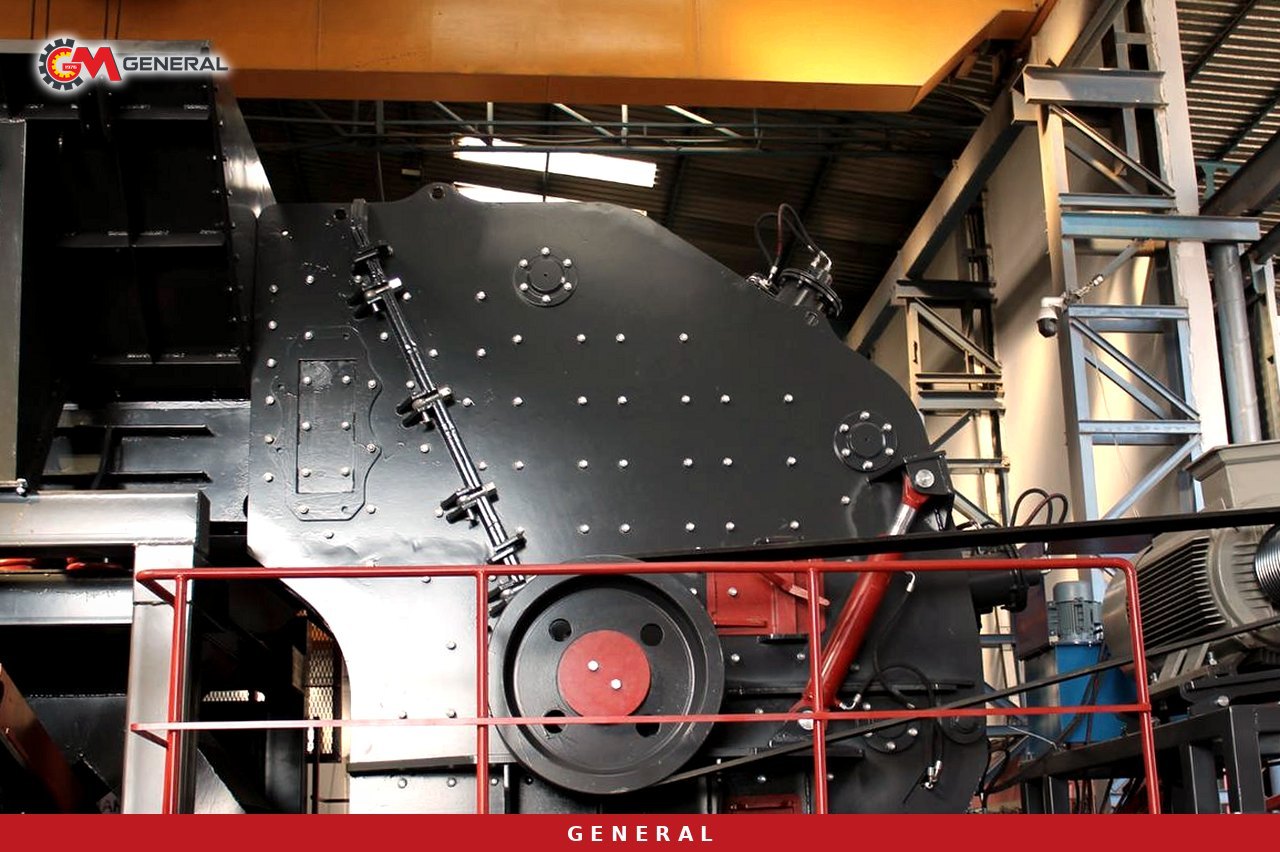
A jaw crusher breaks material by compression; in brittle calcite this can raise the share of flat and elongated particles. In an impact crusher the bars on the rotor throw the stone against the breaker plates and the particle splits by free impact. Thanks to low abrasiveness, blow bar life is not as short as in granite or basalt. For marble and calcite the impact principle is therefore the natural choice, both for product shape and for wear cost per tonne.
When the jaw still earns its place
If the quarry contains quartz veins, chert bands or siliceous interlayers, the picture changes. These materials wear impact bars quickly. In such a quarry the jaw-then-impact layout of the General 640 offers protection: the jaw takes the first reduction of hard pieces and the impactor is left only with shaping. Silica content and abrasion index from the samples are the main inputs for this decision.
When finer granules are required
A calcite buyer may ask for mill feed finer than 0-5 mm or within a narrower range. A third stage is then added. In the GNR tertiary crusher series, the GNR 65 takes 150 mm feed with a 132 kW motor and runs at 70-130 t/h, suitable for fine, cubical product from a low-abrasion material like calcite. Every added stage also raises the load on the screen.
Whiteness and cleanliness: a layout that keeps calcite stock uncontaminated
A few grey particles do no harm in marble aggregate. In calcite filler, a small contamination can lower the value of an entire lot. The plant must therefore be laid out for cleanliness as well as tonnage.
- Campaign operation: Pure calcite and coloured marble are not crushed on the same day. Before a calcite batch the hopper, belts and screen are emptied and residues go to a separate pile.
- Keep soil out of the crusher: A grizzly feeder with by-pass removes overburden soil and clayey fines ahead of the crusher. This material must never reach the calcite stockpile.
- Separate, covered storage: Calcite granules are kept on a concrete-floored, preferably roofed bay rather than in an open yard where wind carries dust and leaves.
- Metal control: Metal from blasting residue or broken parts harms both the crusher and product colour. An overband magnet is a measure that can be selected per project.
- Water use: Water sprays are common for dust suppression on construction aggregate. If a buyer wants dry calcite, belt covers and enclosed transfer points are considered instead.
White calcite dust is very visible on site; dust management should be planned from the start for worker health and neighbouring land. Which measures are standard and which are options is set out in writing, machine by machine, at the quotation stage.
From Dar es Salaam port to the quarry: containers, power and set-up
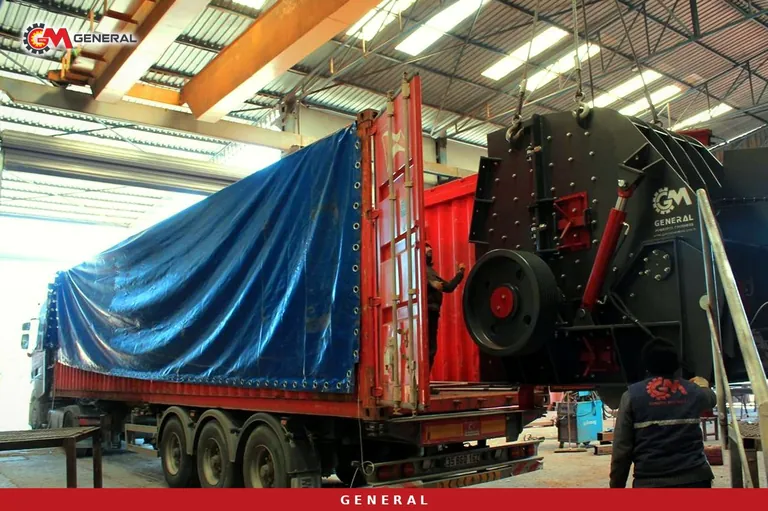
Shipments from Türkiye to Tanzania travel by sea to the port and then by road to the quarry. Wheeled plants move on their own chassis; separate crushers and auxiliary equipment go in containers or on flat racks according to their size. Transport dimensions are listed in the table; bridges, bends and the quarry entrance along the route should be checked against them in advance.
Some quarries lie far from the grid. The General 800 runs on a 450 kVA generator; on the General 640 a 300 kVA generator is optional. Where grid power exists, the generator can be planned as a back-up. In hot, dusty conditions the air filters of generators and motors need frequent checks, so a filter stock should be considered with the first order. The rainy season affects quarry roads and the dryness of calcite stock, so drainage of the stockpile area should be solved before installation.
Our link with Tanzania is not limited to crushing: the Titan 100 mobile concrete batching plant project listed on our site is a General Makina plant delivered to this country. The construction aggregate from your marble quarry can be planned to a quality that feeds such a batching plant.
Information to prepare before ordering
- Several samples taken from different colours and veins of the quarry, with abrasion, compressive strength and chemical analysis results.
- The calcite buyer's particle range, whiteness and purity requirements, plus the target fraction list for construction products.
- Largest block size after blasting and the possibility of secondary breaking.
- Daily operating hours and target tonnage, and the shift pattern that will deliver 60-100 t/h.
- Power source: grid, generator or both.
- Route details from the port to the quarry and the ground conditions at the set-up area.
With this information a concrete comparison can be made between wheeled mobile crushing and screening plants and a line built from individual machines in the crushers category.
Frequently asked questions
Can I also produce calcite powder?
This line crushes and screens calcite down to granule size. Micronised powder needs separate grinding and classifying equipment, which is not part of our range.
Is one plant enough for 60-100 TPH?
Yes. The General 640 covers this band on one chassis; the General 800 leaves headroom at the top with 80-150 t/h. If a tertiary stage is added, capacity is recalculated against the load the screen can carry.
How often are wear parts changed on marble?
Marble and calcite are low in abrasiveness, so blow bar life is longer than on hard rock. The exact interval depends on silica content and operating hours; no figure is given without sample results.
What warranty and certificates apply?
Our machines carry ISO 9001 and CE certification and a 1-year warranty excluding wear parts. The company has been manufacturing in İzmir since 1976.
Conclusion
For a Tanzanian quarry crushing marble and calcite, the most direct answer to the 60-100 TPH band is the General 640; for larger feed and a wider product list it is the General 800. On this brittle, low-abrasion rock the impact principle is an advantage. The commercial value of calcite, however, depends on plant discipline: campaign operation, separate stockpiles and clean feed. Send your sample results and target product list through our contact page and we will prepare the configuration and quotation for your quarry.
Definitions of technical terms: Glossary