EN — English
 TR — Türkçe
 DE — Deutsch
 RU — Русский
 FR — Français
 ES — Español
 AR — العربية
 SR — Српски

Côte d'Ivoire Gold Ore Compact Crusher and Screener Plant 60-100 TPH
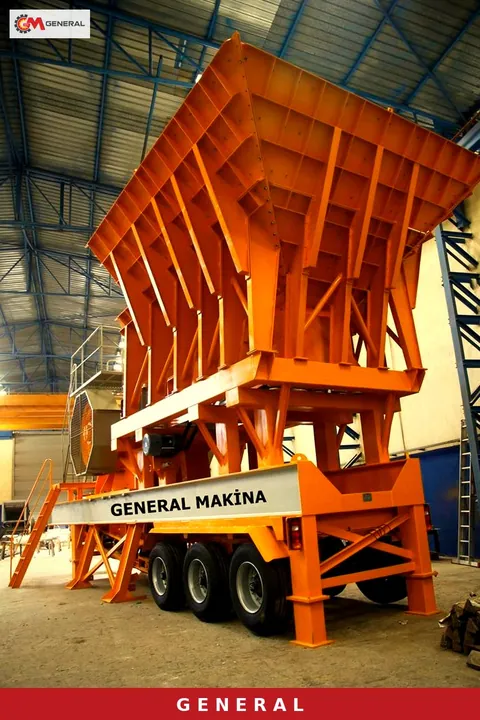
A small or mid-size gold operation in Côte d'Ivoire asks a different crushing question from a major mining house: it needs a machine that crushes a few hundred tonnes of ore a day reliably, can be run by one crew, moves from pit to pit and never starves the milling or leaching circuit. 60-100 tonnes per hour sits right in the middle of that profile. This article compares the real models that cover the band using their published data, explains how ore that changes from a laterite cap to quartz-veined fresh rock shows up at the crusher, and walks through the logistics from port to site as inputs to a purchasing decision.
Ore profile in the Birimian belts: two materials from one pit
Most of the country's gold ground lies in the Birimian greenstone belts of the West African craton. A typical deposit in these belts has a weathered, clay-rich, iron-stained laterite and saprolite cover near surface; deeper down comes hard, fresh rock carrying quartz veins. For a crusher these two materials are almost opposites. Laterite and saprolite are soft but wet and sticky: they bridge in the feed hopper and blind screen meshes. Quartz-veined fresh ore flows dry, but its high silica content eats wear parts quickly.
The material an operation crushes in its first two or three years may therefore not be what it crushes in year five. Machine selection has to account for today's oxide ore and also for the fresh rock that arrives as the open pit deepens. Rather than guessing the hardness, abrasiveness and clay content of a specific pit, we recommend abrasion and crushability tests on representative samples; the machine offer is then firmed up on those results.
From a daily ore target to hourly capacity
Gold operations usually plan in tonnes per day, while crushers are selected in tonnes per hour. A simple relation links the two: required hourly capacity = daily ore target ÷ hours of actual crushing. The term to watch is "actual crushing hours": meal breaks, truck waiting, setting adjustments and lubrication time are all deducted from the shift length.
A hypothetical example: an operation targeting 600 tonnes of ore per day that can actually crush for 8 hours on a single shift needs 600 ÷ 8 = 75 tph. If the same operation moves to two shifts, the requirement halves; a smaller machine may then look sufficient, but since throughput can drop once fresh rock arrives, staying in the upper half of the band is the safer choice. A 60-100 tph target is the typical outcome of this kind of planning.
Two real layouts that cover the band
Within the General Makina range the 60-100 tph window can be met in two ways: a single-chassis closed-circuit plant, or a staged layout that brings two separate mobile units together. The table below compares both options using only values stated on the product pages.
| Parameter | General 640 (single chassis) | GNR 90 primary unit + M-DMK 01 (two chassis) |
|---|---|---|
| Capacity | 60-100 tph | GNR 90: 70-180 t/h; M-DMK 01: 120-180 t/h |
| Crushers | GPJ 60 jaw + GNR 50 impactor | GNRK 90 jaw + M-DMK 01 impactor |
| Maximum feed | 500 mm | Primary unit series 0-1100 mm; secondary 0-350 mm |
| Product | 0-5 / 5-12 / 12-19 mm | Primary 0-250 mm; secondary 0-50 mm |
| Screen | 1200×4000 mm, triple-deck | (separate screening unit needed) |
| Generator | 300 kVA (optional) | — |
| Weight | 38,000 kg | 25,000 kg + 32,000 kg |
| Transport dimensions | 3500×17000×4500 mm | — |
General 640: closed circuit on one chassis
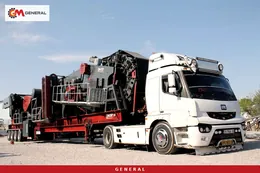
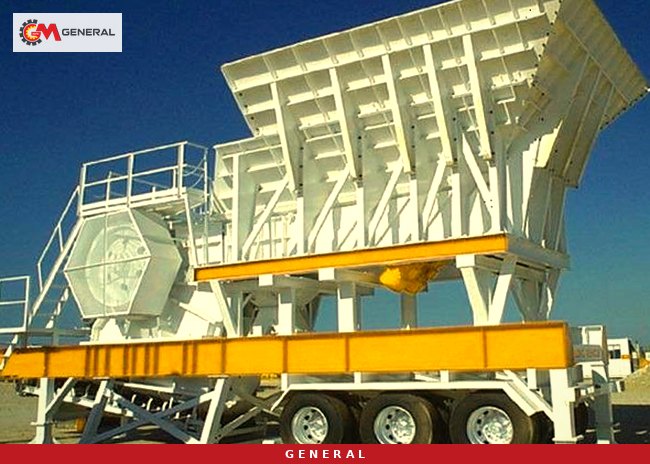
The General 640 compact wheeled crushing and screening plant carries the whole chain, from the vibrating feeder with by-pass grizzly to the triple-deck screen, on a single wheeled chassis. In the primary stage the GPJ 60 jaw reduces the coarse ore, the GNR 50 impactor sizes it in the second stage, the 1200×4000 mm triple-deck screen splits it into fractions and a return conveyor sends oversize back to the crusher. Because it stands on hydraulic legs it needs no concrete foundation; when one ore body is worked out, the plant can move to the next block or a new licence area. For a comparable hard-ore duty, see our GNR 640 project running at 100 t/h in Türkiye.
The 640's limit is feed size: 500 mm. Large blocks from blasting must be kept below that figure, or broken down at the face with a crusher bucket or hydraulic breaker. If the blast design respects this limit, the single-chassis layout leaves the crew with the fewest machines to run.
GNR 90 primary unit + M-DMK 01: a staged two-chassis layout
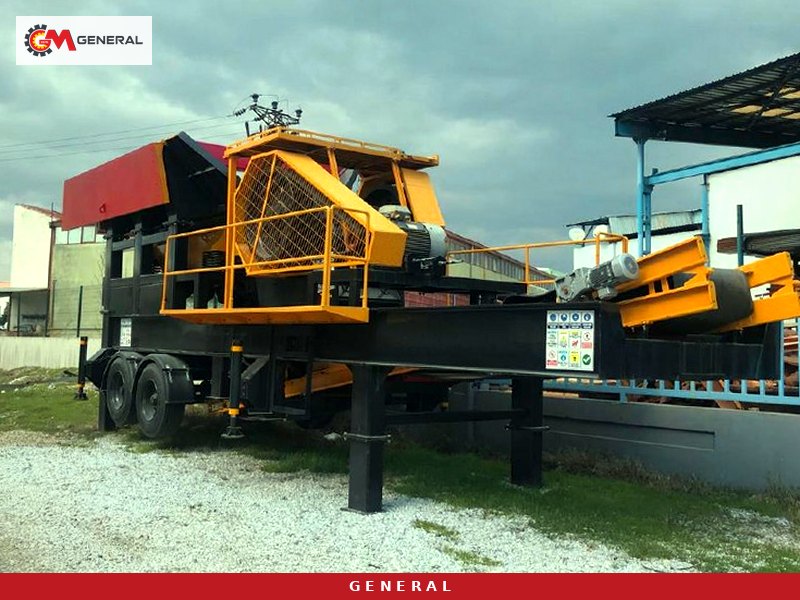
For operations receiving larger blocks or planning to grow, the wheeled primary jaw unit with feeder hopper and the M-DMK towed secondary impactor can run on two separate chassis. The GNR 90 unit works at 70-180 t/h with a 1000×3800 mm feeder and a GNRK 90 jaw; the M-DMK 01 delivers 0-50 mm product with a 1000×3000 mm feeder, a 160 kW motor and 120-180 t/h capacity. In this layout the primary unit sets line throughput; 60-100 tph is a comfortable operating point for the primary jaw and leaves margin for the fresh-rock years. The missing link is screening, which is selected separately if fractions are required. All single-chassis units of this type are listed under single-chassis mobile crusher units.
How crusher output ties into milling or leaching
In a gold operation the crushing circuit's customer is the process downstream. In a mill-fed plant the goal is to send the mill feed that is as fine and as steady as possible, because energy spent in the crusher is generally cheaper than energy spent in the mill. The General 640's 0-5, 5-12 and 12-19 mm fractions are useful here: the fine fraction can go straight to mill feed, while the coarser fractions can be recirculated as needed.
Heap-leach operations look different. The target size for leaching is set by metallurgical testwork on the ore, and too many fines can ruin heap permeability. Screen mesh apertures and the return setting are then chosen to match the size range recommended by the laboratory. It is metallurgical testing, not the crusher maker, that decides the target size; we configure the machine to hit it.
Screen fractions and output setting are defined per order to suit the material; the 640's 0-100 mm output setting range provides that flexibility.
Rainy season and quartz: the feed and wear side
Preventing blockages in laterite and saprolite
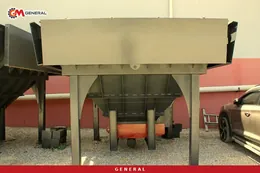
In the south and centre of the country the wet seasons raise the moisture of laterite and saprolite coming from the pit. Wet, clayey material closes the gaps in a grizzly feeder, sticks in the crusher and blinds the screen. The by-pass grizzly on the General 640's feeder takes part of this load off by removing fines and soil before they reach the crusher. On the M-DMK unit, the screen on the feeder pan and its by-pass conveyor likewise divert soil-laden fines to stock ahead of the crusher.
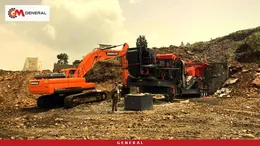
When clay content is very high, a feed solution that does not blind may be needed. The wobbler pre-screening jaw unit in this page's cover image is designed for such material, but at 250-450 t/h it sits far above this article's band. For a small operation the more realistic measures are: building a dry stockpile for rainy days, blending clayey ore with dry ore, and setting the grizzly gap to the material.
Wear parts in quartz-veined ore
Once fresh rock arrives, wear cost moves to the front. The fixed and moving jaw plates are made of austenitic manganese steel, whose surface hardens under impact; this is the main reason a jaw is the right primary choice for abrasive, quartz-bearing ore. In the secondary impact stage, blow bar alloy matters: high-chrome bars are preferred on clean abrasive feed but can crack on coarse feed or feed containing tramp metal. For the right alloy and spare quantities, the information on the manganese and high-chrome crusher wear parts page should be weighed together with sample test results. When the fresh-rock share rises and throughput needs to exceed 100 tph, moving up to a cone-secondary plant such as the General 944 becomes the logical next step.
From Abidjan or San Pedro to site: transport and preparation checklist
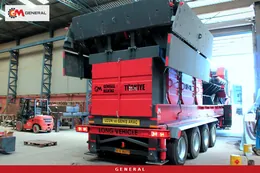
Machines can enter the country by sea through the port of Abidjan or San Pedro; San Pedro is worth considering when the site is closer to the western belts, Abidjan for the central and eastern areas. The General 640's 3500×17000×4500 mm transport dimensions mean bridges, overpasses and junctions on the route must be checked in advance. Remote sites rarely have grid power, so the optional 300 kVA generator for the 640 is usually added to the offer. We recommend confirming road, permit and abnormal-load conditions with the relevant authorities and your haulage contractor.
What to prepare before requesting a quote:
- Daily ore target and shift plan (actual crushing hours)
- Maximum block size after blasting
- Oxide versus fresh-rock share, plus abrasion and crushability results from representative samples
- Moisture and clay behaviour in the wet season, and available stockpile space
- The target size the process needs: mill feed or leach heap
- Power source: grid or generator
- Port of arrival, the route to site and ground conditions at the installation area
An offer built on this information removes the risk of surplus capacity or missing equipment from the start. All wheeled closed-circuit plants can be compared in the wheeled mobile crushing plants category.
Frequently asked questions
Can the General 640 crush hard, quartz-veined gold ore?
Yes. With a jaw and an impactor working together, the 640 is designed to cope with hard stone including abrasive minerals, and its moderate rate is kind to wear parts. As the fresh-rock share grows, blow bar alloy and spares planning should follow sample tests.
Will the plant clog while the laterite cap is being mined?
Wet, clayey material is a risk for any grizzly feeder. The by-pass grizzly separates fines and soil; blending, a dry stockpile and gap adjustment are recommended on top of that. Very high clay content calls for a separate look at the feed solution.
Can it work on a site without grid power?
It can. A 300 kVA generator option is available for the General 640; in the two-chassis layout the power demand is calculated for each unit separately.
What determines price and delivery time?
The chosen layout (single chassis or two units), generator, screen configuration, wear-part spares package and shipping terms set the price. Delivery time also depends on the scope of the order; both are given in writing at the quotation stage. Our machines carry a 1-year warranty (wear parts excluded) and hold ISO 9001 and CE certification.
Conclusion
For an operation crushing 60-100 tonnes of gold ore per hour in Côte d'Ivoire, the single-chassis General 640 delivers closed-circuit production with the fewest machines; for larger blocks and growth headroom, the GNR 90 primary unit paired with an M-DMK 01 is a flexible alternative. The right choice is decided by the ore's oxide/fresh-rock balance, clay behaviour in the rainy season and the size the process requires. To share your ore data with our team, which has built crushing and screening plants in Izmir since 1976, and get a project-specific offer, contact us.
Definitions of technical terms: Glossary