EN — English
 TR — Türkçe
 DE — Deutsch
 RU — Русский
 FR — Français
 ES — Español
 AR — العربية
 SR — Српски

Sudan Reconstruction Mobile Crushing & Screening Plant 200 Ton Per Hour
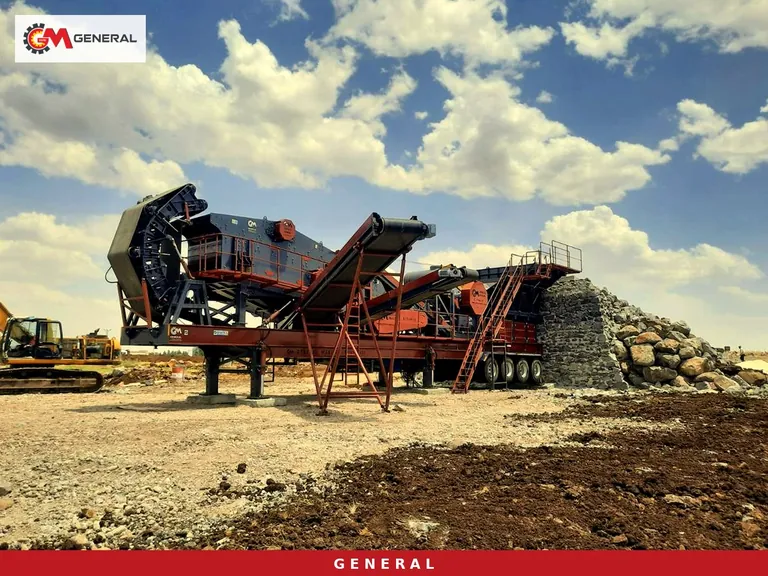
Rebuilding Sudan's damaged cities is not a single job site but a chain of jobs that follow one another: first the streets are cleared of rubble, then roads and bridge approaches are repaired, and finally concrete is poured for housing, schools and hospitals. A mobile crushing and screening plant running at around 200 tons per hour meets a different feed and a different product demand in each of these three phases. This article is written to answer, in order, the questions a contractor or a public-sector engineering team will ask: which model, which layout, which precautions. Every figure comes from the technical data on our product pages. We give no information about any specific tender or project in Sudan; those details must be confirmed from the relevant authority's specifications.
The three phases of reconstruction and what each asks of the crusher
The way to choose correctly is to write down at the outset what the machine will do in each phase. In densely built areas such as Khartoum, Omdurman and Bahri the work usually proceeds as follows, and each phase puts a different load on the crusher.
Phase 1: Rubble clearance and fill material
Blocks from collapsed reinforced-concrete buildings come mixed with rebar, brick, plaster, timber and soil. The aim here is not finely graded aggregate but volume reduction, turning debris into fill or sub-surface material on the spot. Primary crushing alone is often enough; the real work is pulling out the steel and removing wood and plastic before feeding. The equipment set for rubble recovery is described on our concrete recycling plant page.
Phase 2: Road bodies and bridge approaches
Main arteries and the approach roads linking to Nile crossings need sub-base and base material in a defined grading. Quarry rock enters the picture here, and a consistent 0-40 mm product is required. In this phase it is the secondary crusher and a multi-deck screen that bring the product within specification.
Phase 3: Structural concrete aggregate
If ready-mix concrete is to be produced for housing and public buildings, you need cubical particle shape, a controlled fines content and fractions stockpiled separately. Keeping 0-5, 5-12 and 12-19 mm in their own piles keeps the batching plant's mix design stable.
Real configurations that deliver 200 tons per hour
Treat the 200 TPH in the title as the average output you expect to sustain on site, not the highest catalogue figure. A simple formula is enough for planning daily output: daily tons = hourly capacity × actual operating hours × availability. Hypothetical example: 200 t/h with 10 hours a day and 0.8 availability gives about 1,600 tons per day. Redo this calculation with your own shift pattern. The table below compares the models that meet the target using their technical data only.
| Configuration | Capacity | Crusher layout | Max. feed | Screen | Generator |
|---|---|---|---|---|---|
| GNR-MC110 (twin chassis) | 200-300 t/h | GPJ 110 jaw + GS1215/DMK03 impact | 900 mm | 2000×6000 mm, 4 decks | 750 kVA |
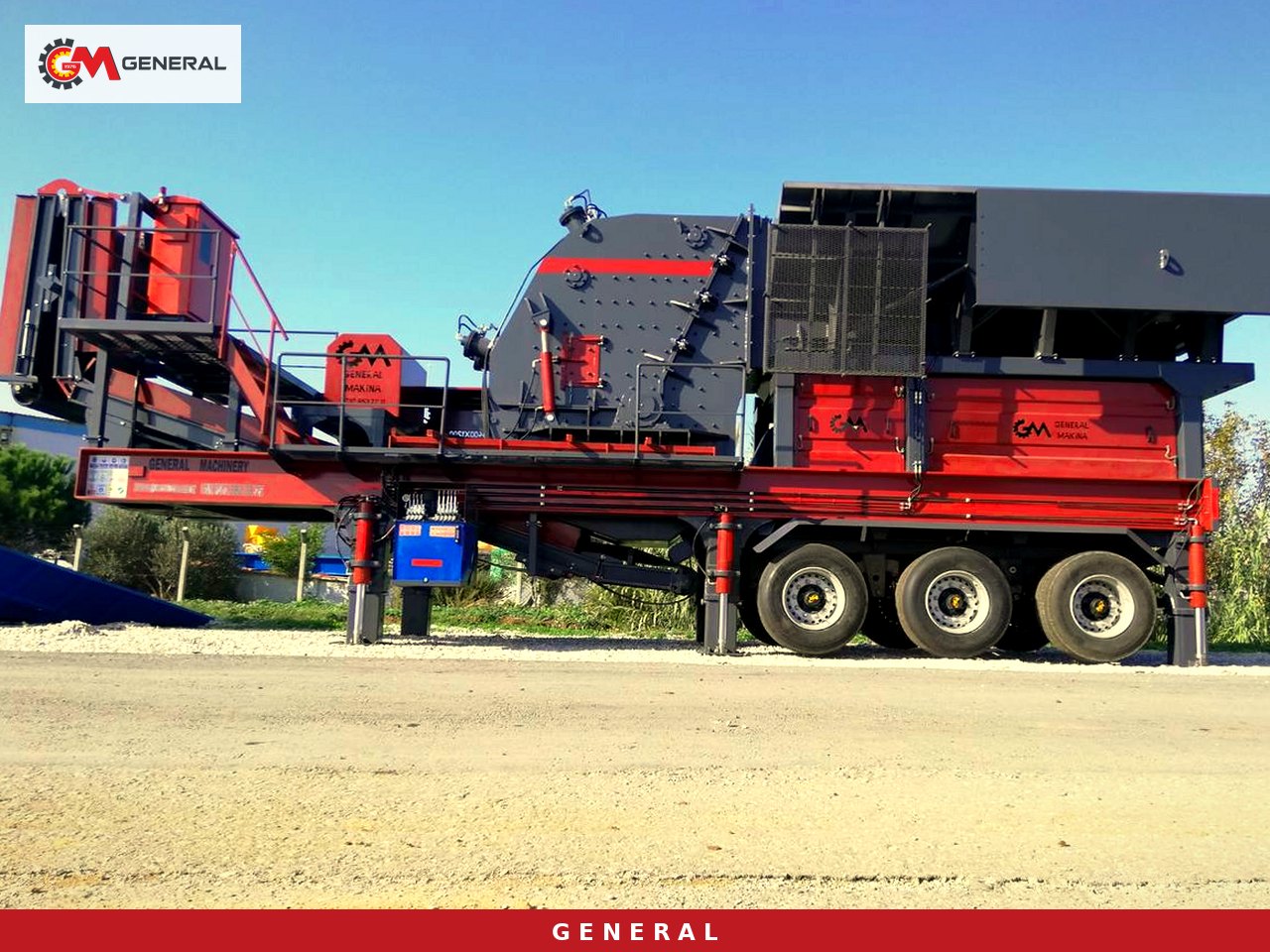
| General 02 (single chassis) | 250-300 t/h | GPS 1413 primary impact | 1000 mm | 2000×5000 mm, 4 decks | 660 kVA |
| General 03 (single chassis, 4 axles) | 250-375 t/h | GPS 1415 primary impact | 900 mm | 2400×5000 mm, 4 decks | 750 kVA |
| 2 × General 950 | 2 × 120-180 t/h | GPJ 90 jaw + DMK01 impact (each) | 800 mm | 1600×5000 mm, 3 decks (each) | 600 kVA (each) |
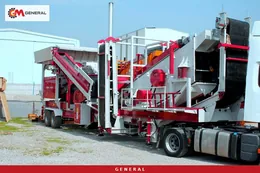
The single-chassis impact models in the table give high reduction and cubical product in low-abrasion feed such as limestone or concrete rubble. Two General 950 units together exceed the target and can work on two separate sites at the same time; on the other hand, that means two generators, two crews and two maintenance schedules. You can compare all wheeled options in our wheeled mobile crushing and screening plants category.
Why a twin chassis suits a phased work programme
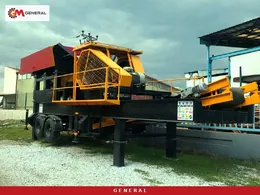
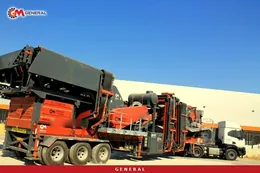
The model we put forward for a Sudanese reconstruction programme is the GNR-MC110. The reason is its structure more than its capacity: the primary and secondary groups sit on two separate wheeled chassis, and the primary group can run on its own. That matches the phases described above one to one.
Primary chassis first: rubble and coarse fill
The primary chassis carries a feeder hopper and the GPJ 110 jaw crusher; it measures 3000 × 13500 mm and weighs 55,000 kg. During rubble clearance, setting up this group alone is enough to cut debris down in volume and turn it into fill. A jaw crusher is more forgiving than an impact rotor with concrete that still holds rebar fragments. Even so, an overband magnet and a hand-picking platform are measures to be added to the project according to the rubble content, not standard equipment.
Then the secondary chassis: road and concrete products
Once the road and concrete phase begins, the secondary chassis, 4200 × 18300 mm and 55,000 kg, is added. It carries the GS1215/DMK03 impact crusher and a 2000×6000 mm four-deck screen, splitting output into 0-5, 5-12, 12-19 and 19-40 mm. The same investment thus moves to a different product range as the phase changes. We explain the role of primary, secondary and tertiary stages on a chassis in this article.
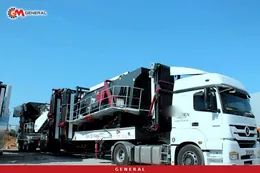
A further benefit of the twin chassis is that each unit travels on the road at a more manageable weight. Compared with the General 02, which reaches 76,000 kg in one body, the load is split across two vehicles; on a damaged road network that difference shows up in both permits and route planning.
Feed material along the Nile and across the desert belt
Sudan's geology is not uniform, and crusher choice changes with the material. Basement rocks such as granite and gneiss outcrop across much of the country; Nubian sandstone occurs in parts of the Nile valley, and volcanic basalt in the west and in some hill areas. Urban rubble, meanwhile, consists of concrete, brick and mortar.
- For hard, abrasive rock such as granite, gneiss and basalt, a jaw primary followed by a second stage is the better fit; the GNR-MC110 and General 950 are built on that logic.
- For softer material such as sandstone and concrete rubble, the primary-impact General 02 or General 03 delivers high reduction and cubical product.
- Quarry rock with soil needs the fines removed before they enter the crusher; vibrating screens and pre-screening options with a grizzly by-pass come in at this point.
- Always sample the rock of the chosen quarry and have abrasiveness and compressive strength tested in a laboratory; the plant quotation is finalised on those results.
If the same plant is expected to process rubble in the morning and quarry rock in the afternoon, feeding order and liner selection should be agreed in advance. With mixed feed, the most demanding material sets the terms.
Haboob, heat and off-grid sites
What strains a crushing and screening plant in Sudan is often not the rock but the climate and the infrastructure. The dust storms known as haboob in the north and centre, high summer heat and sites where grid power is unreliable are an inseparable part of planning.
The GNR-MC110 and General 03 run on a 750 kVA power unit, the General 02 on 660 kVA and the General 950 on 600 kVA, so the plant can produce without a grid connection. The generator air filter, radiator cores and control panel are the first points to check after a dust storm. Measures that can be selected per project include pre-filtered air intakes, covered conveyors, water-spray dust suppression at transfer points and a shaded fuel and oil store. These are not standard on every model; they are added to the quotation according to site conditions.
Where water is scarce, the volume set aside for dust suppression, the distance to the Nile and tanker logistics should be worked out at survey stage. A spare stock of wear parts is also what keeps a remote site producing; we recommend keeping at least one spare set of jaw plates and blow bars on site.
From Port Sudan to site: shipping and quotation preparation
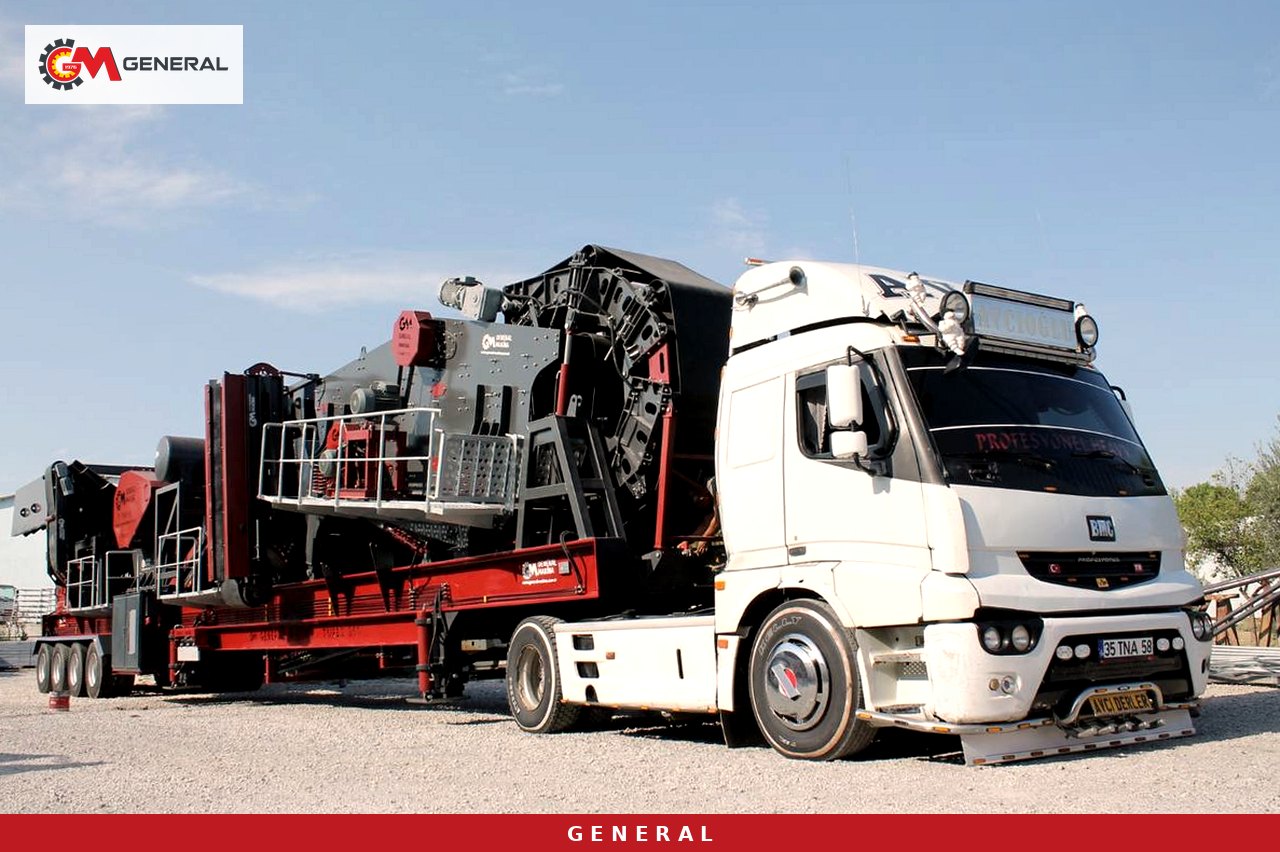
For a wheeled plant leaving Türkiye, Port Sudan on the Red Sea coast is the natural point of entry. On the road haul inland, chassis dimensions, axle count and bridge or pass restrictions matter. The General 03's 4-axle international transport chassis and the GNR-MC110's two separate vehicles both help with load distribution. Exact routing, customs and permit procedures should be discussed in advance with a local haulier and the relevant authority.
To speed up your quotation request, the following information is enough:
- Phase split: the approximate share and order of rubble, road and concrete work.
- A rock sample or test report, plus observations on rebar density in the rubble.
- Required products: which of the 0-5, 5-12, 12-19 and 19-40 mm fractions, and in what proportion.
- Whether grid power exists on site, plus the water source and its distance.
- Port of arrival, inland route and ground condition at the set-up area.
- Shift pattern and target daily tonnage.
All our plants carry ISO 9001 and CE certification and are delivered with a 1-year warranty, excluding wear parts. We have been manufacturing in İzmir since 1976, and the Middle East and North Africa are among our export regions.
Frequently asked questions
Can we work with the primary chassis alone during rubble clearance?
Yes. The GNR-MC110's primary group, with its GPJ 110 jaw crusher and feeder hopper, can operate independently. The coarse material produced in this phase can be used as fill; when finer grading is needed, the secondary chassis is added.
If the quarry rock turns out to be basalt, which model is the better choice?
Layouts that start with a jaw primary take priority in hard, abrasive rock, which is why the GNR-MC110 or two General 950 units are recommended. The primary-impact General 02 and General 03 are preferred mainly for limestone, sandstone and concrete rubble.
Will the plant run on a site with no grid electricity?
Yes. Each model in the table comes with its own generator: 750 kVA for the GNR-MC110 and General 03, 660 kVA for the General 02 and 600 kVA for the General 950. Fuel supply and dust-filter maintenance should be written into the site plan.
How are price and delivery time determined?
Price depends on the model chosen, additional measures (magnet, dust suppression, extra conveyors), the spare wear-part package and shipping terms. Delivery time depends on the production schedule at the time of order. We send both in writing in response to a request that includes the list above.
Decision summary
For reconstruction work in Sudan, the value of a 200-ton-per-hour plant lies in its ability to adapt to phases running from rubble to concrete aggregate. For a phased programme the twin-chassis GNR-MC110 stands out; for work dominated by softer material that stays on one site, the General 03 or General 02; and for feeding two different sites at once, two General 950 units. Send your sample results, phase plan and site information through our contact page and we will prepare a technical quotation specific to the model and the site.
Definitions of technical terms: Glossary