EN — English
 TR — Türkçe
 DE — Deutsch
 RU — Русский
 FR — Français
 ES — Español
 AR — العربية
 SR — Српски

South Sudan Juba Roads Mobile Crushing & Screening Plant 120-180 TPH
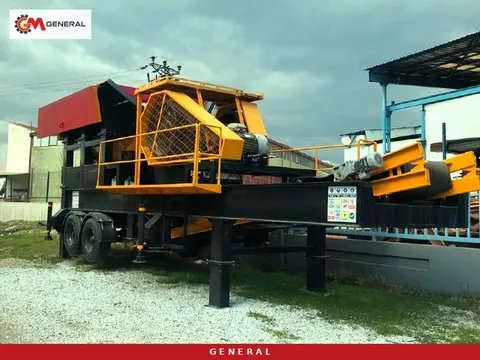
A contractor who signs a road contract in Juba usually asks about the asphalt plant first; yet what really sets the pace of the job is where the crushed stone and base material will come from, in what sequence and in what tonnage. South Sudan is landlocked: machines, spare parts and fuel arrive by road through neighbouring countries, and in the wet season dirt roads can close to heavy vehicles. In this article we compare real General Makina models for a 120-180 TPH target through transport weights and site-specific risks. For the volume, alignment and material requirements of any particular Juba road project, the only valid source is the tender specification of the relevant authority; read the recommendations below together with that document.
Where the stone comes from around Juba: rocky hills and laterite
Juba, on the banks of the White Nile, sits on a flat plain broken by rocky hills here and there. Hills such as Jebel Kujur are made of crystalline basement rock, mostly granite and gneiss. These rocks are hard and usually abrasive, which directly shapes crusher choice, the wear-parts budget and the particle shape you will get. Red laterite gravel is also widely used in the same area for earth roads and fill. Laterite needs a screen more than a crusher; once its coarse, sound particles are separated, they can serve as sub-base.
Before any firm decision on a quarry, a sample is essential. Weathering varies across the faces of the same hill, and weathered gneiss brings far more fines and clay than fresh granite. At the quotation stage, ask for at least these tests: Los Angeles abrasion value, compressive strength, water absorption and clay content. These values show which of the models below will give the lower cost per tonne over the long run.
How the 120-180 TPH target falls out of the site schedule
Capacity is calculated from how many tonnes the site will consume and on what schedule, not from a brochure. The simple formula is: required hourly capacity = total aggregate demand / (working days in the dry season × effective hours per day). A hypothetical example: a line running 10 effective hours a day at an average of 150 TPH produces roughly 1,500 tonnes a day. What matters in Juba is to allow for loading and haulage stalling in the wet season and to build stock during the dry months. That is why choosing a machine near the top of the target band, rather than the bottom, leaves room for stockpiling.
A road is not built from a single fraction. Sub-base, base, asphalt binder and wearing course each need a different grading, so the number of screen decks and the crusher arrangement matter as much as capacity. A four-deck screen separates more products at once and reduces the risk of mixing in the stockyard.
A plant that arrives by road: chassis weight and number of modules
Every part bound for Juba makes a long overland journey. Because bridge and road conditions on these routes vary, the weight and dimensions of the heaviest single piece determine the shipping plan. The table below lists the real options covering the 120-180 TPH band, plus one step up, using the values on the product pages.
| Option | Crusher arrangement | Capacity | Max. feed | Generator | Weight |
|---|---|---|---|---|---|
| General 01 (single chassis) | GPS 1210 impactor, primary + secondary | 120-180 t/h | 700 mm | 550 kVA | 55,000 kg |
| General 944 (single chassis) | GPJ 90 jaw + GM430 cone | 120-180 t/h | 800 mm | 550 kVA | 70,000 kg |
| General 950 (single chassis) | GPJ 90 jaw + DMK01 impactor | 120-180 t/h | 800 mm | 600 kVA | 70,000 kg |
| GNR 90 jaw unit + M-DMK 01 (two chassis) | GNRK 90 jaw + secondary impactor | 70-180 / 120-180 t/h | — | — | 25,000 + 32,000 kg |
| GNR-MC110 (step up, two chassis) | GPJ 110 jaw + DMK03 impactor | 200-300 t/h | 900 mm | 750 kVA | 55,000 + 55,000 kg |
Single-chassis lines: General 01, 944 and 950
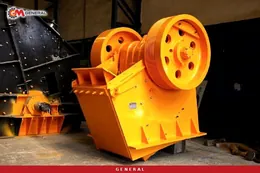
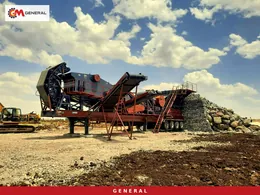
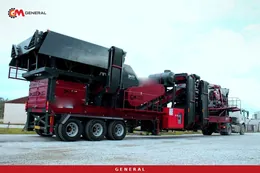
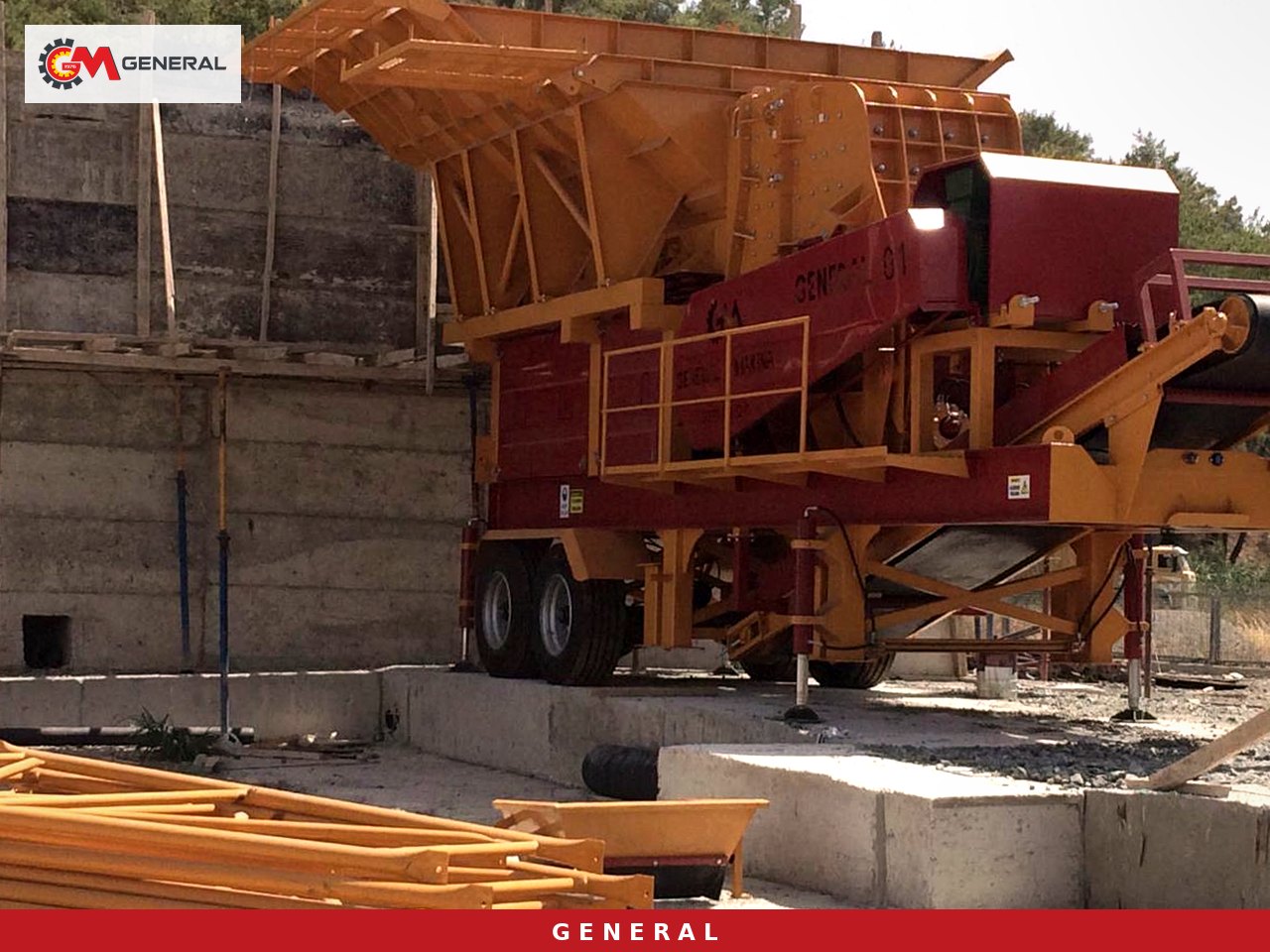
All three models gather crushing, screening and conveyors on one platform, so set-up on arrival is the shortest. On abrasive granite and gneiss, the General 944 stands out for metal life because its second stage is a cone crusher. The General 950 pairs the same GPJ 90 jaw with a DMK01 impactor; it gives a more cubical particle, but on hard stone blow bars and plates are changed more often. The General 01 does both stages with a single impactor and is the lightest single-chassis option; it makes sense on low-abrasion stone such as limestone, but it is not the first choice for Juba's fresh granite. The whole family is listed on the wheeled mobile crushing plants page.
The split route: jaw unit and secondary on separate chassis
If a heavy single piece is a problem on the haul route, it makes sense to split the line into lighter modules. The GNR 90 wheeled primary jaw unit weighs 25,000 kg and the M-DMK 01 secondary impact unit 32,000 kg; each travels behind a single truck. This combination needs a separate screen for final sizing; the GNR ME1650, which dry-screens 120-180 TPH on an 18,000 kg single chassis, is a suitable partner for that role. The modular layout also lets one unit keep working on its own while the other is under maintenance. Single-chassis alternatives are grouped under single-chassis mobile crusher units.
Wet season, black cotton soil and stockpile planning
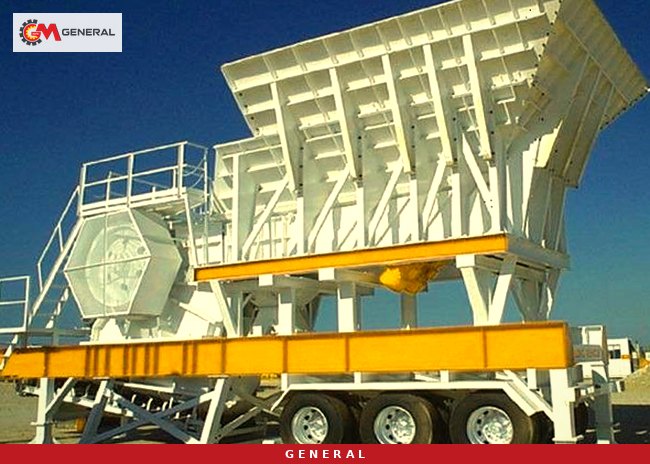
Many parts of South Sudan have so-called black cotton soil, a dark clay that swells and softens when wet. A plant standing on hydraulic legs on this ground can tilt after rain. The set-up area should be prepared as a platform compacted with laterite or crushed stone, steel plates should go under the legs, and drainage must be solved before the plant is erected.
Even if crushing is possible in the wet season, hauling material to the works stalls. So production should run at full capacity in the dry months, with each fraction stockpiled in its own drained area. The fine fraction (0-5 mm) loses the most in rain; it should be covered or heaped on raised, compacted ground. In the wet period, clayey quarry material must be removed at the grizzly feeder before it reaches the crusher; otherwise screen meshes clog.
Generator, dust and heat on an off-grid site
Most quarries around Juba have no reliable grid; the plant runs on its own generator. The kVA values in the table belong to each model, and the generator should be sized to them. Since fuel also comes by road, linking the tanker schedule to the production schedule keeps the line from standing idle.
In the dry season, dust threatens both operator health and machine life. Measures that can be chosen per project include water sprays at belt transfer points, closed belt covers, pre-filters for the generator and engines, and a cooled enclosure for control panels. In hot weather, hydraulic oil and engine coolant belong on the daily checklist. Our closest real reference to the region is the 150 t/h basalt crushing and screening project in Jijiga, Ethiopia worth reviewing for East African hard rock and hot operating conditions.
Checklist for Juba before you request a quotation
- Required grading and daily tonnage for every layer in the specification (confirmed with the authority).
- Los Angeles abrasion, compressive strength, water absorption and clay content results from the quarry sample.
- The most restrictive bridge or road section on the haul route; this decides single chassis versus a split line.
- Generator power, refuelling frequency and fuel storage area.
- Set-up platform: black clay, drainage and plates under the legs.
- A separate, drained area for every fraction to be stockpiled in the dry season.
- First-year wear-parts list: jaw plates, impactor blow bars or cone mantles.
The main factors that set the price are the chosen crusher arrangement, number of screen decks, generator, additional conveyors, dust measures and the shipping method. Until these items are clear, no figure can be compared fairly.
Frequently asked questions
Cone or impact second stage for Juba granite?
On fresh, abrasive granite and gneiss, the cone-equipped General 944 keeps wear-part costs low. If the specification specifically calls for cubical particles and the stone is less abrasive, the General 950 can be considered. The decision should follow the abrasion test of the sample.
Does laterite need a crushing plant?
In most cases screening laterite first is enough. If there are many coarse, sound particles, a jaw unit is added. Asphalt layers, however, need aggregate crushed from hard rock; laterite does not meet that need.
Can capacity be increased later?
Yes. Because the primary and secondary groups of the twin-chassis GNR-MC110 work independently, it suits starting with one group and adding the second later, reaching 200-300 TPH. Details are on the GNR-MC110 product page.
What do the warranty and certificates cover?
The machines carry ISO 9001 and CE certificates; the warranty is 1 year on everything except wear parts. Manufacturing in Izmir since 1976, we bring more than 50 years of experience, including exports to North Africa and the Middle East.
Conclusion: stone and route first, then the model
When choosing a 120-180 TPH line for Juba, answer three questions in order: how abrasive the quarry stone is, in what weight of pieces the machine can reach the site, and how much stock you need before the wet season. On abrasive granite the General 944 leads, on routes with tight load limits a split line, and on jobs with a growth plan the GNR-MC110. Share your sample results and the specification grading with us, and we will prepare the right configuration and quotation through our contact page.
Definitions of technical terms: Glossary