EN — English
 TR — Türkçe
 DE — Deutsch
 RU — Русский
 FR — Français
 ES — Español
 AR — العربية
 SR — Српски

Somalia Mogadishu Rebuild Mobile Crushing & Screening Plant 100-200 TPH
Rebuilding Mogadishu moves on many fronts at once: storage yards and quay works around the port, repairs to the main city roads, new housing, schools and public buildings. Every one of these fronts needs the same raw material: clean, correctly sized aggregate that meets the specification. In Somalia, a mobile crushing and screening plant working in the 100-200 TPH range is the most flexible way to supply that demand from a point close to the job site. This article covers crusher selection for the rock of the coastal belt, the catalogue data of the four wheeled models that fit this range, the precautions needed in a salty, hot coastal climate and the logistics from Mogadishu port to site. We give no information on the scope, schedule or volume of any specific tender or public project; those details must be confirmed in the specification issued by the relevant authority.
Which products Mogadishu job sites expect from aggregate
A city being rebuilt never asks the crusher for a single product. Road repairs need well-graded crushed material for sub-base and base layers, asphalt and surface dressing need narrowly graded chippings, reinforced concrete structures need clean manufactured sand and coarse aggregate, and fill and drainage works need coarse material. The screen arrangement of a mobile plant therefore matters as much as the crusher; a wrong screen setup can turn even well-crushed rock into an unsaleable pile in the stockyard.
The catalogue fractions answer this need directly. General 01 and General 800 deliver four products: 0-5, 5-12, 12-19 and 19-40 mm. General 944 and General 950 produce three: 0-5, 5-12 and 12-19 mm. A programme dominated by coarse road material points to the four-fraction models; one dominated by concrete aggregate points to three-fraction layouts focused on cubical product. The discharge setting of all four models is 0-100 mm, and the final screen apertures are fixed at the order stage according to the rock to be processed.
Urban sites also have a neighbourhood dimension. For a plant set up near housing, dust and noise become as decisive as capacity. When choosing the plant location, the prevailing wind direction, truck access and the position of stockpiles should be drawn up from the start.
Coastal limestone or inland hard rock?
Along Somalia's Indian Ocean coast, including the strip around Mogadishu, young coral limestones and cemented dune sandstones are widespread. Moving inland, older limestone formations and, in places, outcrops of crystalline rock such as granite appear. This general picture splits crusher selection into two paths.
Porous coastal stone: impact crushing
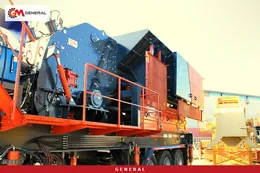
Coral-derived limestone is usually of low abrasiveness, but its porous structure can raise the share of fines during crushing. An impact crusher gives a high reduction ratio and cubical grains in this stone, and part of the fines can be used as manufactured sand. General 800 and General 01 stand out here. For details of impact crushing in limestone, see our guide to mobile crushers for limestone.
Hard, siliceous rock: jaw primary
If the quarry opens into inland granite or a rock with high silica content, the jaw primary decides the wear cost. General 944 (jaw + cone) and General 950 (jaw + impact) are configured for this work. Decide which path is right not by guesswork but by the compressive strength and abrasiveness test of a quarry sample; even within one region, two quarries can yield noticeably different stone. Another common situation on the coast is alternating limestone and sand bands; in such a quarry, removing the fines before feeding saves the crusher from needless load.
Four models and a two-unit solution for 100-200 TPH
No single machine covers the range in the title from end to end, so the table shows single units and a two-unit solution together. All values are the technical data from our product pages.
| Model | Crusher layout | Capacity (t/h) | Max. feed (mm) | Screen | Generator (kVA) | Weight (kg) |
|---|---|---|---|---|---|---|
| General 800 | PDK 1280 primary impact | 80-150 | 600 | 1300×4000 mm, 3 decks | 450 | 35,000 |
| General 01 | GPS 1210 impact (primary + secondary) | 120-180 | 700 | 1600×5000 mm, 4 decks | 550 | 55,000 |
| General 944 | GPJ 90 jaw + GM430 cone | 120-180 | 800 | 1600×5000 mm, 3 decks | 550 | 70,000 |
| General 950 | GPJ 90 jaw + DMK01 impact | 120-180 | 800 | 1600×5000 mm, 3 decks | 600 | 70,000 |
| General 800 + General 01 | Two separate impact lines | 200-330 (combined) | 600 / 700 | — | 450 + 550 | — |
When is one unit enough?
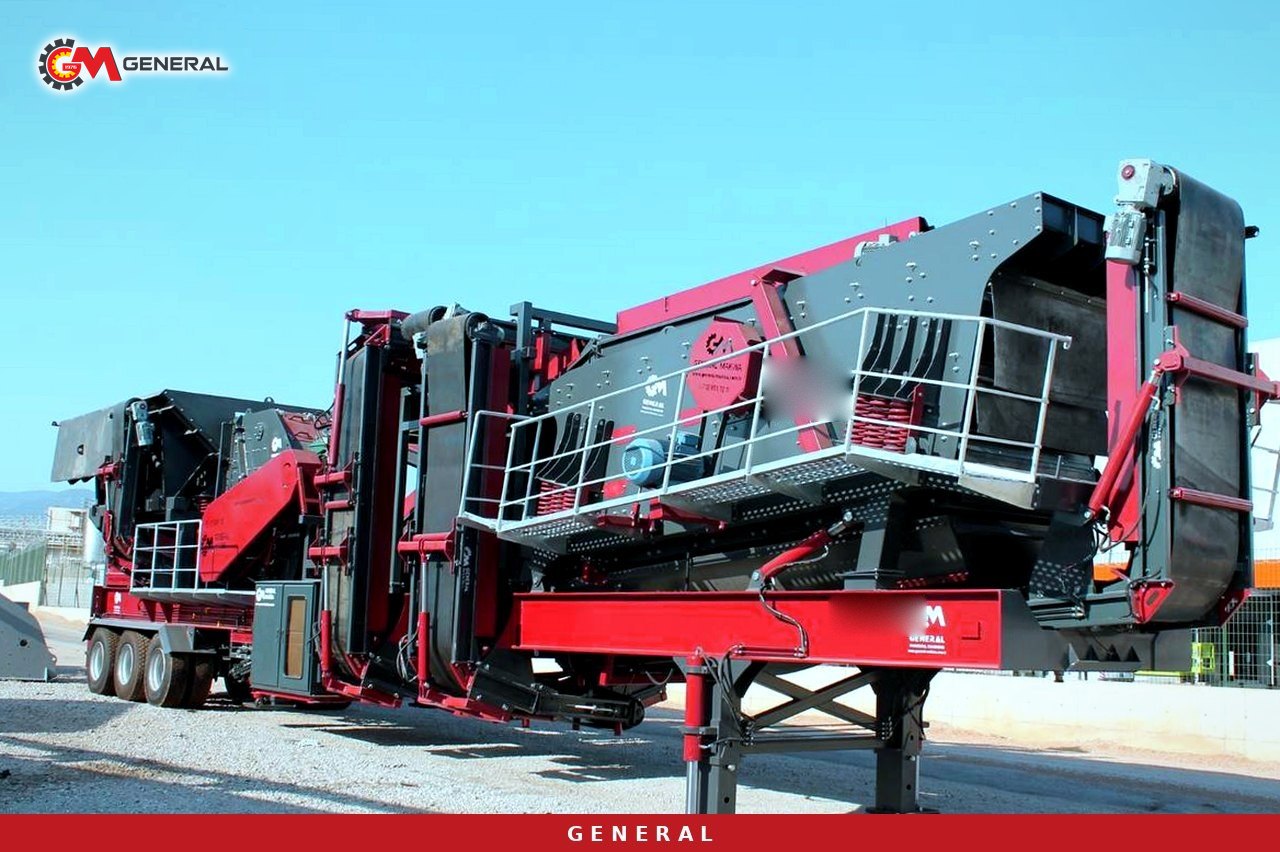
If the target stays around 100-150 tonnes per hour and the stone is coastal limestone, the General 800 is sufficient on its own; its 35,000 kg weight and 3600×15500×4500 mm transport dimensions make entering and leaving tight urban sites easier. If the target rises to 150-180 tonnes, the General 01 comes in: its two-chamber GPS 1210 rotor handles primary and secondary work in one body, and its 4-deck screen separates four products in the same pass. In hard rock, the 944 or 950 is chosen for the same tonnage. The cone-secondary General 944 extends the life of wear parts in siliceous stone, while the impact-secondary 950 gives higher reduction and cubical grains.
How do you reach 200 TPH?
With models topping out at 180 t/h, holding 200 tonnes per hour continuously requires two units. In coastal limestone, a General 800 working alongside a General 01 gives a combined 200-330 t/h, and the two lines can be split between two separate sites when needed. In hard rock, two General 944 or 950 units are set up on the same logic. You will find the whole family on our wheeled mobile crushing plants page, and the differences between crusher types on the stone crushers page.
Salt air, humidity and heat: running a coastal site
Mogadishu is a city on the ocean shore, which means the plant will work with salty, humid air all year and with heat and dust in the dry periods. The items below are not offered as standard equipment on General Makina models; they are measures that can be selected per project or applied on site:
- Corrosion: regular fresh-water rinsing of salt deposits on the chassis and conveyor structure, and prompt repair of damaged paint spots.
- Electrical panels: checking door seals and keeping panels closed on humid mornings against condensation.
- Generator cooling: cleaning radiator fins of salt and dust and shortening the air filter change interval according to the dust load.
- Dust suppression: water sprays at the crusher discharge and conveyor transfer points, and conveyor covers on sites close to housing.
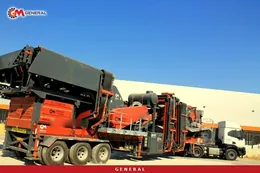
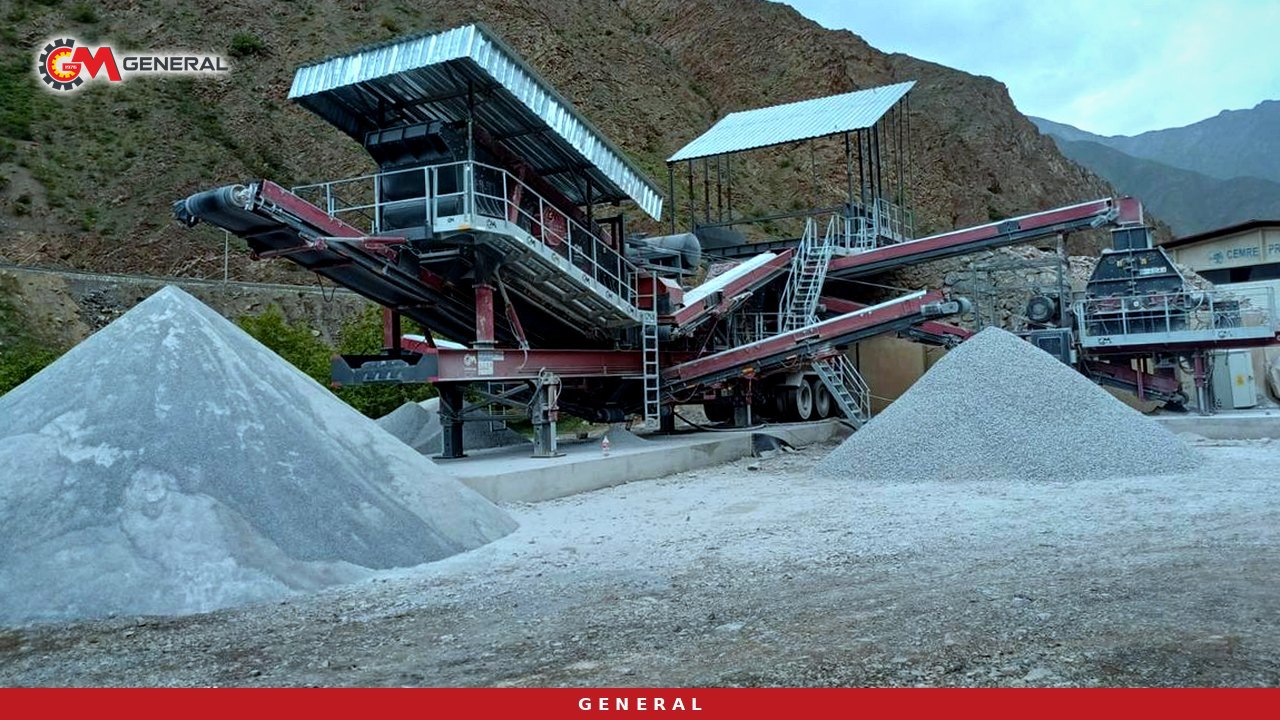
- Shade: a light roof over the screen and conveyor transfer points; the General 02 installation in the photo below is a field example of this.
- Wear-part stock: keeping at least one spare set of blow bars or jaw plates on site.
For sites where grid power cannot be relied on, each model has its own generator: 450 kVA on the General 800, 550 kVA on the General 01 and 944, and 600 kVA on the General 950. Fuel supply, generator service hours and wear-part changes should be planned in the same maintenance calendar. You can check which part suits which material on our crusher wear and replacement parts page; manganese castings work-harden under impact and therefore perform well in coastal limestone and concrete rubble.
From Mogadishu port to the job site
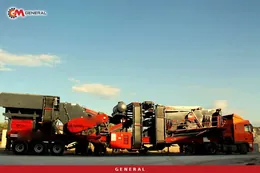
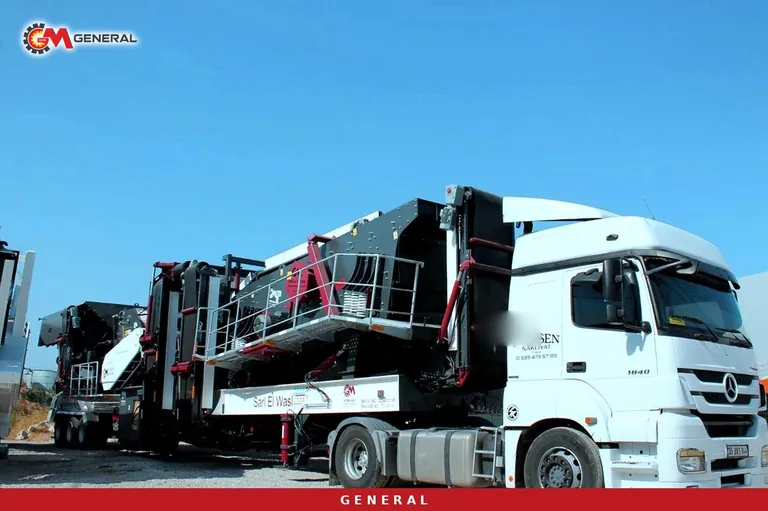
A mobile plant leaving Türkiye reaches Somalia by sea and is unloaded at Mogadishu port. The wheeled chassis allows the plant to be taken from the quay to the site on its own axles behind a tractor unit; no separate erection crane or concrete foundation is needed. The cover photo shows the General 01 hitched to a tractor, conveyors folded, ready for shipment.
The dimensions to use in route planning are in the catalogue: 3600×15500×4500 mm and 35,000 kg for the General 800, 4300×18500×4500 mm and 55,000 kg for the General 01, and 4130×20350×4500 mm and 70,000 kg for the 944 and 950. If the route passes through narrow streets, bridges or checkpoints in the city, length and weight become decisive. Customs, escort and road permits should be clarified in advance with the local haulier and the relevant authorities. As stated on its product page, the General 950 is transported by a single truck and starts production in 30 minutes; this matters for a programme with frequent site-to-site moves.
What to include in your quotation request
For us to recommend the right model, including the following information in your request shortens the process:
- Location of the quarry or material source: coastal belt or inland; if possible a rock sample and laboratory report.
- Target hourly tonnage and daily shift pattern.
- Product list: which of the 0-5, 5-12, 12-19 and 19-40 mm fractions, and in what proportion.
- Governing specification: the grading required for roads, concrete or port fill.
- Whether grid power and a water source are available on site.
- Route from port to site and ground conditions at the installation area.
- Whether the plant will stay on one site or move between several sites in the city.
Plants built at our İzmir factory since 1976 ship with ISO 9001 and CE certification; the warranty is 1 year, excluding wear parts.
Frequently asked questions
Which model suits the limestone around Mogadishu best?
In low-abrasion coastal limestone, the primary impact General 800 or the two-chamber-rotor General 01 is the economical solution. If the hourly target exceeds 150 tonnes, the General 01 is preferred.
Can the same plant produce both road material and concrete aggregate?
Yes. The four-deck General 01 separates 0-5, 5-12, 12-19 and 19-40 mm products in a single pass. If the fines limit in the concrete specification is exceeded, washing may also be needed; we assess this together based on the sample results.
Can the plant run on a generator at an off-grid site?
Yes. Each model in the table comes with its own generator; the power ranges from 450 to 600 kVA depending on the model. In a coastal climate, radiator and air filter maintenance must be kept frequent.
What determines the price?
The selected model, additional equipment (dust suppression, an extra stockpile conveyor), the spare wear-part package and the shipping method determine the price. We prepare a written quotation based on the request you send with your quarry details.
Conclusion
For Mogadishu's reconstruction, choosing the right 100-200 TPH mobile crushing and screening plant starts with the difference between coastal limestone and inland hard rock. General 800 and General 01 lead in limestone, General 944 and 950 in hard rock, and a two-unit setup when 200 t/h must be held continuously. Send your rock sample, target products and site details through our contact page and we will prepare a technical quotation tailored to the model and to your job site in Somalia.
Definitions of technical terms: Glossary