EN — English
 TR — Türkçe
 DE — Deutsch
 RU — Русский
 FR — Français
 ES — Español
 AR — العربية
 SR — Српски

South Africa Mine Waste Recovery Mobile Crushing & Screening Plant 150-250 TPH
Mining in South Africa goes back more than a century, and that history is visible in the waste rock dumps that sit beside old shafts and pits. For some investors these dumps are a source of road fill and concrete aggregate; for others they are feed preparation material for re-processing. If you are planning a 150-250 TPH recovery line, the decision is made by the dump before any brochure: its fines content, the largest block, the scrap metal hidden inside and the abrasiveness of the rock. This article explains how to read dump material and sets out three flow sheets built on real General Makina models that fit this tonnage.
All capacity, feed opening, motor and generator figures quoted here come from our product pages. We give no information on the permit status, volume or ore grade of any specific dump; these must be confirmed with the relevant mining authority and the site's own survey reports.
Waste rock, overburden and tailings: what can be crushed and what cannot?
"Mine waste" is not one material, and most misunderstandings in quotation meetings start here. A crushing and screening plant is built for coarse waste rock and stripped overburden. Tailings, the fine residue left after milling and flotation or leaching, are already sand and silt sized; feeding them to a crusher makes no sense, and if they need handling it is done with washing and classifying equipment.
Three typical materials found on South African sites can be separated as follows:
- Waste rock from underground mines: hard, angular blocks removed while developing shafts and drives. When it contains quartzite and conglomerate it is highly abrasive.
- Open-pit overburden: a mix of soil, weathered rock and sound blocks. Fines content is high and the clay can turn sticky in the wet season.
- Discard shale and sandstone from coal operations: relatively easy to crush, but heterogeneous and occasionally mixed with tramp metal.
Knowing which group you are in tells you directly which of the three flow sheets below suits you.
From the Witwatersrand to the Bushveld: dump character changes by region
South Africa's mining belts produce clearly different rock types. In the Witwatersrand gold fields around Gauteng, waste rock is mostly quartzite and conglomerate; its high silica content wears jaw plates and impact blow bars quickly. In the Mpumalanga coalfields sandstone and shale dominate. On the platinum and chrome operations of the Bushveld Complex, dense and hard igneous rocks such as norite and pyroxenite are typical.
This general picture is only a starting point. Different layers of the same dump were tipped from different workings at different times, so the material is not uniform. Before choosing a machine, take samples from several points and have compressive strength, abrasion index and grading measured in a laboratory. These tests decide both the crusher type and your wear-part budget.
Data to collect from the dump before asking for a quotation
The most expensive mistake in a recovery project is ordering a machine without knowing the material. If you complete the list below and send it to us, the configuration can be based on data rather than guesswork:
- Roughly what share of the dump is below 100 mm? (The portion that screening alone can remove.)
- The largest block size that will reach the crusher, and how often such blocks appear.
- Rock type and laboratory results: compressive strength, abrasion index, moisture and clay content.
- Tramp metal risk: drill steel, rock bolts, rail pieces, cable.
- Target product: road sub-base, concrete aggregate, railway ballast or re-processing feed.
- Daily operating hours and shift pattern; the real hourly tonnage is calculated from these.
- Power source: is a grid connection possible, or will the line run on generators?
- Environmental permit and dust management conditions; confirm these from the local authority's documents.
Use a simple formula for tonnage: required hourly capacity = target daily product ÷ net crushing hours. Hypothetical example: 1800 tonnes of product per day with 9 net operating hours requires an average of 200 TPH. The soil fraction removed by screening must be added to the gross feed.
Three flow sheets for 150-250 TPH
The options below use real models that cover this tonnage range. Every value in the table is taken from the relevant product page.
| Model | Capacity | Max. feed | Crusher / screen | Power | Weight |
|---|---|---|---|---|---|
| GNR ME2060 (mobile screen) | 200-350 t/h | 0-100 mm | 2000×6000 mm 3-deck screen, 100 mm hopper grid | Generator or grid | — |
| GM 90JP (tracked jaw) | 70-180 t/h | 700 mm | GNR 90 jaw, 95 kW | 250 kVA | 35,000 kg |
| GM 125 (tracked impact) | 150-250 t/h | 700 mm | GNR PDK02 impact, 200 kW | 550 kVA | 48,000 kg |
| GNR-MC110 (twin-chassis wheeled) | 200-300 t/h | 900 mm | GPJ 110 jaw + DMK03 impact, 2000×6000 mm 4-deck screen | 750 kVA | 2 × 55,000 kg |
Flow sheet 1: screen first, then crush the oversize
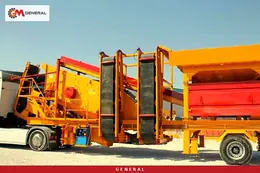
In most old dumps a large share of the material is already broken. Passing it through a crusher wastes energy and wear parts. The GNR ME2060 mobile screening plant handles 200-350 t/h; the 100 mm grid over the hopper removes large blocks and the 2000×6000 mm 3-deck screen splits the rest into fractions. Oversize retained on the grid goes to the GM 90JP tracked jaw crusher, rated at 70-180 t/h; it accepts blocks up to 700 mm and the crushed material returns to the screen. For overburden dumps with high fines content this is the most sensible arrangement.
Flow sheet 2: one tracked unit for soft to medium waste
On low-silica material such as coal-field shale and sandstone, the GM 125 tracked impact crusher covers the 150-250 TPH range on its own. The 6 m³ hopper, the 1360×2160 mm grizzly pre-screen and the 600×5000 mm by-pass conveyor remove soil before it enters the crusher. Being tracked, it can move around the dump together with the loader; when a wide dump is worked from several faces, this mobility reduces truck traffic. On quartzite-rich gold-field waste, however, blow bar wear accelerates and a jaw primary should be preferred.
Flow sheet 3: twin-chassis line for hard, abrasive rock
The GNR-MC110 carries a GPJ 110 jaw primary and a DMK03 impact secondary on two separate wheeled chassis and produces 200-300 t/h; it accepts 900 mm feed and delivers 0-5 / 5-12 / 12-19 / 19-40 mm fractions. Because the primary chassis can run alone, a project can start with coarse crushing only and send product to a re-processing plant, then add the secondary chassis once aggregate sales begin. It is the option that leaves capacity headroom for projects working at the top of the range on norite, pyroxenite or quartzite.
You can compare other wheeled options on the mobile crushing and screening plants page and the track-mounted models on the tracked mobile crushers page.
Tramp metal, clay and dust: risks specific to dump sites
Tramp metal
Waste rock from old underground mines often contains drill steel, rock bolts and pieces of wire rope. These cause blockages in a jaw crusher, rotor damage in an impact crusher and torn belts on conveyors. Measures that can be selected per project: visual picking at the loading point, a magnetic separator over the belt and a metal detector. This equipment is not standard; the need is added to the configuration after sample inspection.
Clay and moisture
In inland regions that receive summer rainfall, overburden becomes sticky with clay and blinds screen decks. The grizzly pre-screen and by-pass conveyor remove this soil before it reaches the crusher. If the clay content is very high, a washing line should be considered instead of dry screening.
Dust
During the dry winter months, dust lifting from dumps is checked both under environmental permits and for worker health. Water-spray dust suppression at the crusher discharge and conveyor transfer points, enclosed transfer chutes and frequent engine air-filter checks can be planned per project. Permit conditions must be confirmed with the local environmental authority.
Power, wear parts and transport on a remote site
Many waste dumps lie far from grid infrastructure, and load shedding is a known operating risk in the country. Generator size should therefore be planned from the start: 250 kVA for the GM 90JP, 550 kVA for the GM 125 and 750 kVA for the GNR-MC110. The ME2060 can run on a generator or the grid. In flow sheet 1 two units run together, so total power demand has to be calculated separately.
On abrasive waste, consumption of jaw plates, impact blow bars and screen mesh can be faster than on normal quarry stone. Ordering a spare set of wear parts with the first shipment shortens downtime on a remote site. Our machines carry a 1-year warranty; wear parts are excluded from the warranty.
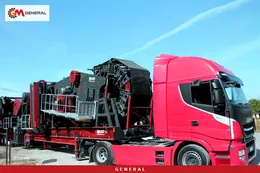
Equipment is shipped by sea from Izmir to ports such as Durban or Richards Bay, then moved to site by road. The GNR-MC110 chassis measure 3000 × 13500 mm and 4200 × 18300 mm; the abnormal-load permits required for the route should be confirmed in advance with the haulage contractor. The tracked GM series walks off the trailer on its own tracks and needs no concrete foundation on site.
Frequently asked questions
Can I process gold tailings with these machines?
No. Tailings are already fine-grained and do not need crushing. The lines in this article are for coarse waste rock and overburden.
Is a 150 TPH unit enough, or should I go to 250 TPH?
Divide your daily target product by net operating hours and add the soil fraction removed by screening. If the result sits near the top of the range, the GNR-MC110 or the ME2060 + GM 90JP combination leaves capacity headroom.
Which certificates do you hold?
General Makina has been manufacturing in Izmir since 1976 and holds ISO 9001 and CE certification.
How is the price determined?
Price depends on the model, the number of units in the combination, the generator, add-ons such as a magnetic separator, and freight. When you request it with your sample results, a project-specific quotation is prepared.
Conclusion
For mine waste recovery in South Africa, the right line is chosen by the dump's fines content and the rock's abrasiveness: screen first on fines-rich dumps, a single tracked impact unit on soft waste, and a twin-chassis jaw line on hard quartzite and norite. Send your sample results, target product and power situation through our contact page and we will size your 150-250 TPH line together.
Definitions of technical terms: Glossary