EN — English
 TR — Türkçe
 DE — Deutsch
 RU — Русский
 FR — Français
 ES — Español
 AR — العربية
 SR — Српски

Lebanon Rebuild Compact Mobile Crushing & Screening Plant 60-100 TPH
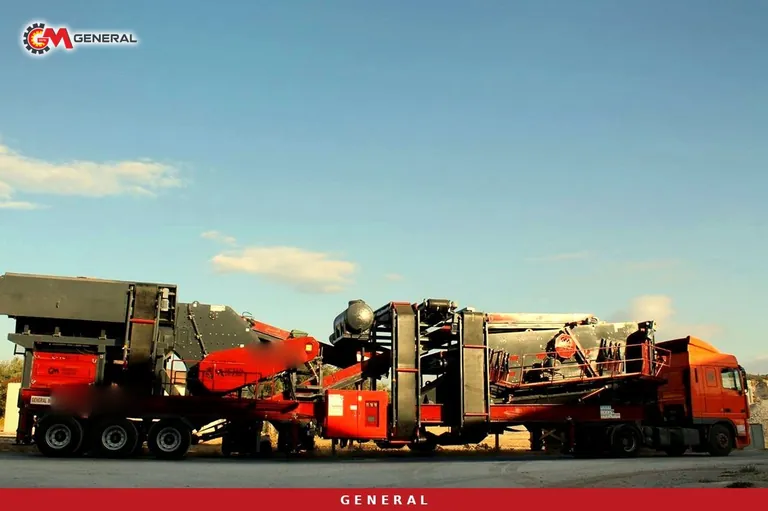
A contractor looking for a crusher for Lebanon's rebuild usually faces two very different feed materials: limestone from quarries on the slopes of Mount Lebanon, and concrete rubble from collapsed or badly damaged buildings. Both can become aggregate, but they ask different things of the machine. Then there is the question of space: the coastal strip is narrow, roads climbing into the mountains are winding, and urban plots are tight. That is why, in Lebanon, a plant chosen for 60-100 TPH has to be compact more often out of necessity than preference. Below we go through the real models that cover this band, with their catalogue figures, which job suits which unit, and the questions to settle before ordering. We give no information about any specific reconstruction programme, tender or quarry in Lebanon; please confirm the project specification with the relevant authority and the rock's crushing behaviour through sample testing.
Rubble or quarry stone? Knowing the feed in Lebanon
Plant selection starts with what goes into the crusher mouth. In Lebanon the same contractor may work a limestone quarry one month and a demolition site the next; choosing the machine for only one of them lowers efficiency in the other.
Mount Lebanon limestone and dolomite
Most of the Mount Lebanon and Anti-Lebanon ranges consist of limestone and dolomite, with basalt outcrops in the north around Akkar. Limestone is mostly low-abrasive and gives cubical grains in an impact crusher. Because of the karst structure, however, clay-filled fissures and soil pockets are common at the quarry face. If this fine, dirty fraction enters the crusher, energy is wasted and aggregate cleanliness suffers. Dolomitic or siliceous bands can also raise wear faster than expected. Planning wear parts without knowing which band dominates is guesswork; testing samples from several points for abrasiveness and compressive strength costs far less than expensive corrections later.
Demolition concrete, brick and rebar
Rubble from damaged buildings is not uniform: reinforced concrete pieces, hollow blocks, plaster, tiles, timber, plastic and, above all, reinforcing steel arrive together. An impact crusher breaks concrete well and usually frees the steel from the matrix, but long, thick bars can wrap around the rotor or tear a belt. So rubble should first be reduced with excavator-mounted breakers and shears, the rebar collected by hand or magnet, and light material such as wood and plastic picked out. Which layer of a structure recycled aggregate may go into (fill, sub-base, concrete) depends on the applicable regulations and the project specification; that decision belongs to the project engineer, not the machine maker.
Why 60-100 TPH is a sensible starting band
Reconstruction rarely runs as one big site; it proceeds as many medium-sized areas close to one another: clearing debris in a neighbourhood, then the sub-base of a side road, then fill under a school or hospital foundation. At this rhythm a plant producing 60-100 TPH works without taking over the site and moves quickly from one place to the next. A larger line sits idle when the rubble flow pauses; a smaller unit falls behind as debris piles up.
To read capacity correctly, follow this order: set the daily target tonnage, divide it by realistic operating hours, then leave a margin for feed interruptions and maintenance stops. A hypothetical example: daily target tonnage ÷ net operating hours = required hourly capacity. If the result sits near the top of the band, running the next model up at a moderate load is usually healthier than pushing a smaller model to its limit.
Four real configurations in this band
The figures below are catalogue values from our product pages. Every number sits in the row of the model it belongs to; unknown cells are marked "—". For all wheeled plants see the mobile crushing plants page, and for self-propelled models see track-mounted mobile crushers.
| Model | Capacity (t/h) | Max. feed (mm) | Undercarriage | Crusher | Weight (kg) | Screen | Power |
|---|---|---|---|---|---|---|---|
| General 640 | 60-100 | 500 | wheeled | GPJ 60 jaw + GNR 50 impact | 38,000 | 1200×4000 mm, 3-deck | 300 kVA (optional) |
| GM 90JP | 70-180 | 700 | tracked | GNR 90 jaw, 95 kW | 35,000 | 1000×2000 mm, 2-deck | 250 kVA |
| General 800 | 80-150 | 600 | wheeled | PDK 1280 primary impact | 35,000 | 1300×4000 mm, 3-deck | 450 kVA |
| GM 100 | 100-180 | 600 | tracked | GNR-01 impact, 160 kW | 42,000 | 1500×5500 mm, 3-deck | 450 kVA |
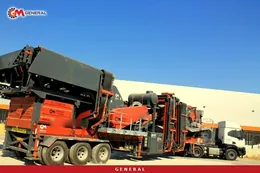
The General 800 is the first option for limestone-dominated quarries: its primary impact rotor achieves high reduction in a single pass and delivers cubical product. Its transport dimensions are 3600×15500×4500 mm. If the feed includes a high-silica band or basalt from the Akkar side, wear cost on a primary impactor rises; a configuration with a jaw crusher up front is then the safer choice.
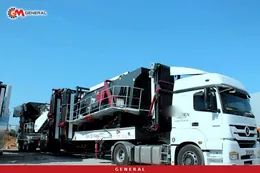
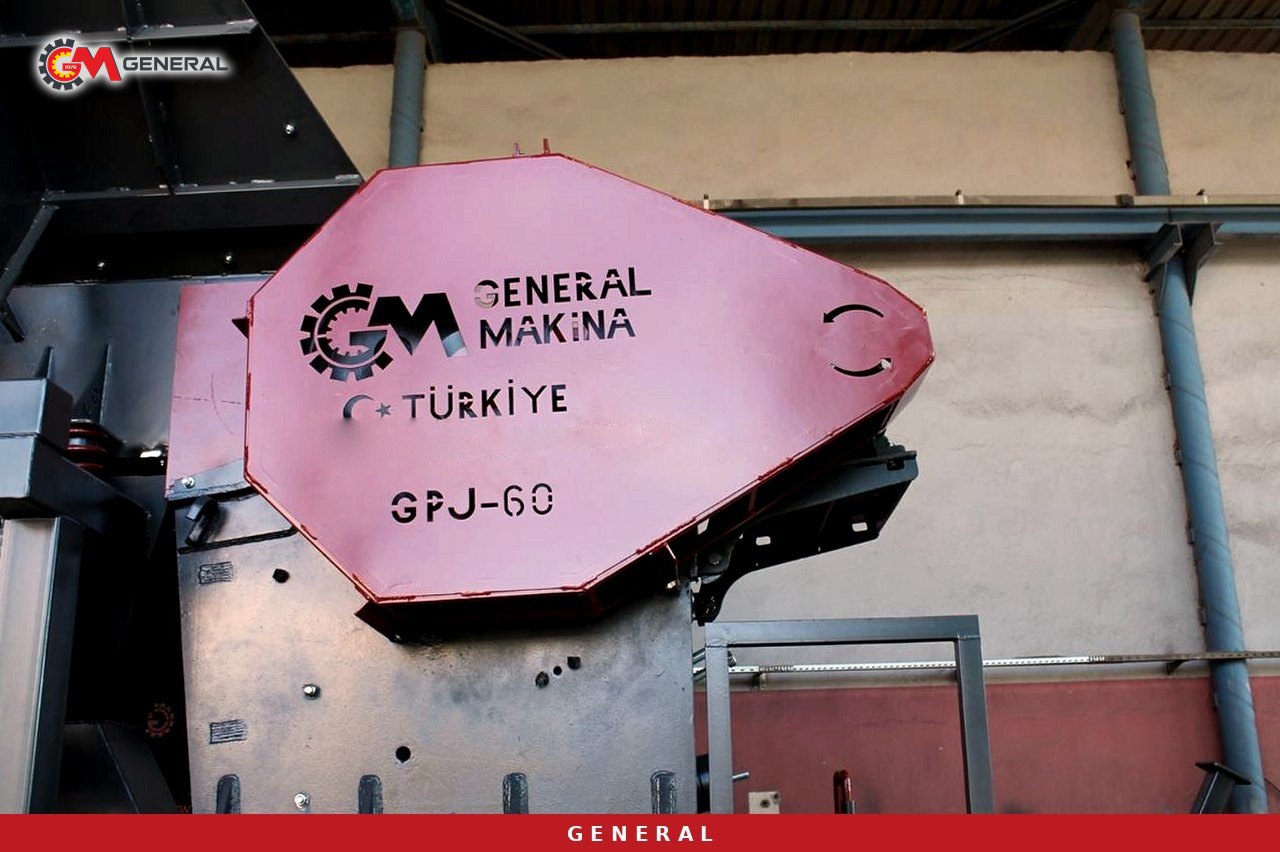
The General 640 is the single-chassis model that matches the target band exactly. The GPJ 60 jaw takes the large blocks, the GNR 50 impactor shapes the final product, and oversize returns to the start in closed circuit. It is designed to fit on one truck; transport dimensions are 3500×17000×4500 mm. Because it also handles hard, abrasive stone, it is a balanced choice for a contractor switching between basalt and limestone.
The GM 90JP is a tracked primary jaw unit with a 10 m³ hopper and a grizzly vibrating feeder; it needs no ground preparation or concrete foundation. It pays off where the machine must move frequently inside a debris zone. For a full grading curve a secondary crusher and screen must follow it. The GM 100 sits above the band, but since it offers closed circuit with an integrated screen for concrete recycling, contractors with growth plans may consider it.
Feed discipline when turning concrete rubble into aggregate
What really strains the machine in recycling is not tonnage but irregular feed. A bucket of clean concrete, then a bucket of plaster and soil, then a column piece full of steel: the crusher meets constantly changing loads. We describe a full machine set separately on our concrete recycling plant page.
Steel and foreign matter
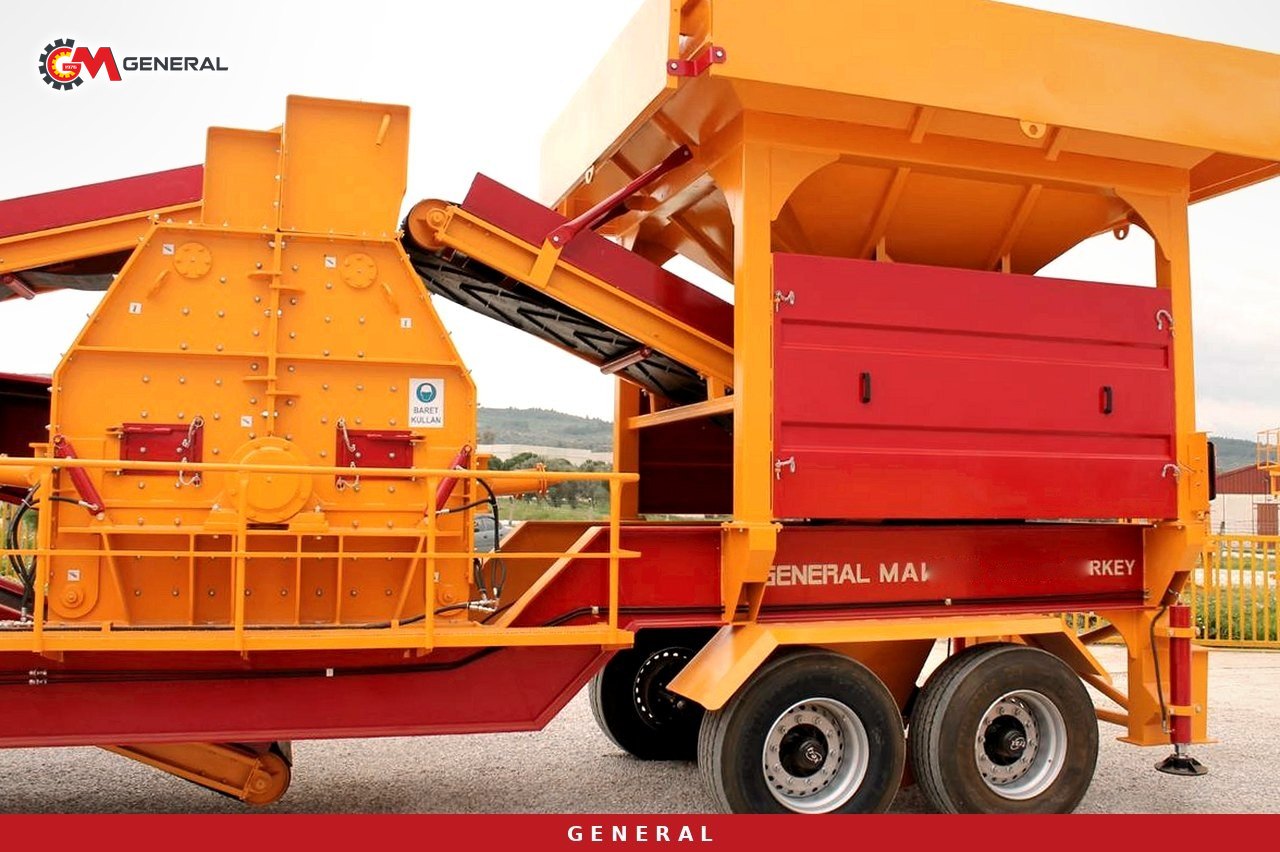
Do not skip pre-sorting: large pieces should be reduced on site and the rebar removed before feeding. A magnetic separator over the belt picks up short steel pieces that pass the crusher; note that this is optional equipment selected per project and must be specified in the order. Planning a hand-picking point for wood and plastic directly affects product cleanliness.
Keeping fines and soil away from the crusher
Soil and plaster in rubble only add wear once they enter the crusher. A feeder with a by-pass grizzly separates this fraction at the start and sends it to its own stockpile. On our portable secondary units, for example the M-DMK series, the screen on the feeder table and the by-pass conveyor do this job. The separated fines can often be used as fill; suitability is again decided by the specification.
From the ports of Beirut and Sidon to a hillside site
A mobile plant shipped from Türkiye usually reaches Lebanon by sea; ports such as Beirut and Sidon are possible discharge points. Settle the port, quay conditions and customs steps with your freight forwarder. The part that needs real attention starts after the port: roads from the coast inland are steep and winding, and on some village roads turning radius and bridge load limits challenge a long trailer.
So transport dimensions are not just a number on paper. Have the route checked on foot or by vehicle before ordering, and note limits at bends, underpasses and bridges. The tracked GM 90JP drives onto site under its own power after unloading and needs no hydraulic legs; the wheeled 640 and 800 are levelled on hydraulic legs and need flat, compacted ground.
Be realistic about power too. Planning a plant around grid electricity in Lebanon is risky; at remote quarries and debris zones a generator should be treated as the main source. The catalogue lists 300 kVA (optional) for the General 640, 450 kVA for the General 800 and 250 kVA for the GM 90JP. Sizing the generator together with the crusher avoids current problems at first start-up. For dusty summers and wet, cold winters on the slopes, shorter air-filter check intervals and spray nozzles for dust suppression are measures that can be selected per project.
The file to prepare before requesting a quote
A correct quote starts with the right questions. The clearer the following information, the more accurate the model recommendation and configuration:
- Share of feed material: quarry limestone, basalt, concrete rubble or mixed; lab results if available.
- Largest lump size and how rebar will be removed on site.
- Target products: fill, sub-base, concrete aggregate; required fractions and the specified grading.
- Daily target tonnage and net daily operating hours.
- Power source: grid, generator or both; kVA rating of any existing generator.
- Discharge port and narrow points on the route from port to site.
- Site ground, layout area and space reserved for stockpiles.
- Wear-part stock: how many jaw plates, blow bars and screen meshes to hold for the first year.
Planning wear parts with the first order shortens unexpected downtime at a remote site; for jaw plate and blow bar options see the spare parts page. Our machines carry ISO 9001 and CE certification and are delivered with a 1-year warranty excluding wear parts.
Frequently asked questions
Can the same plant crush both limestone and concrete rubble?
Yes, but settings and wear parts change. An impact crusher works on both; with rubble, steel removal and pre-screening are decisive, with limestone the blow bar material chosen according to silica content. Plan to readjust screen meshes and crusher gap between jobs.
Should I choose wheeled or tracked?
If the plant moves between distant sites and stays for weeks at each, the wheeled 640 or 800 is usually enough. For daily relocation inside a debris zone and rough ground, the tracked GM 90JP is easier; for a full grading curve, however, a secondary and a screen must be added behind it.
Will it run on a hillside without grid power?
Yes. The models are designed to be generator-fed, and the catalogue gives a kVA rating for each. Include fuel logistics and the generator service interval in the site plan from day one.
How are price and delivery time determined?
Model, crusher configuration, number of screens and conveyors, generator, extra equipment (magnetic separator, dust suppression) and the spare-parts package determine the price. Delivery time also depends on the chosen configuration and order date; both are given in writing in the quotation.
Short assessment
A contractor targeting 60-100 TPH for Lebanon's rebuild can look at the General 800 for limestone-dominated work, the General 640 for jobs alternating between basalt and limestone, and a modular line starting with the GM 90JP for frequent relocation in debris zones. Whichever you choose, testing the feed, checking the route and sizing the generator with the crusher make up half the decision. Share your material data and target products with us and let our engineers prepare the right configuration: contact page.
Definitions of technical terms: Glossary