EN — English
 TR — Türkçe
 DE — Deutsch
 RU — Русский
 FR — Français
 ES — Español
 AR — العربية
 SR — Српски

Seychelles Island Projects Compact Crusher and Screener Plant 60-100 TPH
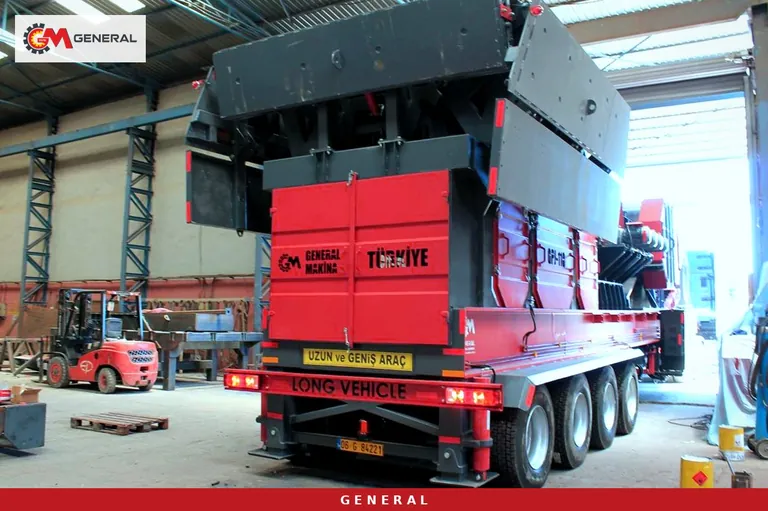
Crushing rock in Seychelles is a very different problem from running a quarry on the African mainland. The inner islands, Mahé, Praslin and La Digue, are made of hard, coarse-grained granite that is rare in the middle of an ocean, while the outer islands are coral-based and offer almost no crushable rock. Aggregate for concrete, roads and coastal protection therefore has to come largely from limited, steep sites on the inner islands that sit close to tourism. This article explains how to choose a compact mobile crusher for 60-100 TPH under these conditions: which real models fit the range, how the machine travels from Port Victoria to the quarry, and how dust, water and wear are handled in a small island economy. We give no information about any specific project, tender or quarry in Seychelles; confirm the specification with the relevant authority and the rock behaviour with a sample test.
From Mahé granite to aggregate: what Seychelles rock demands of a crusher
The granites of the inner islands are Precambrian and rich in quartz. Both facts shape the machine choice directly: the rock is tough, so the first stage needs a jaw crusher that breaks by compression, and the high quartz content means every metal part in the second stage wears fast. Near the surface the granite carries a weathered, sandy crust and a reddish clayey soil cover. If stripping is poor, this material enters the crusher, blinds the screen and raises the clay content of the product.
The product range on the islands is wide. Housing and hotel construction need concrete aggregate; road maintenance and new link roads need sub-base and surfacing chippings; coastal works call for armour stone and filter material. A compact plant should not be expected to deliver all of these at once. Once the priority product is defined, crusher setting and screen meshes are chosen for it. Taking beach and coral sand is environmentally sensitive on the islands, so the option of turning the fine fraction into manufactured sand belongs in the plant design from day one.
Why 60-100 TPH? Sizing capacity for an island market
In a small island market a high-capacity line often runs half-loaded. Stockpile space is tight, product leaves by truck on narrow roads and demand rises and falls project by project. The 60-100 TPH band gives a reasonable daily output in a single shift while keeping stockpile area and truck traffic manageable. You can find the required capacity from your own data:
Required hourly capacity = daily target tonnes ÷ (shift hours × availability)
Hypothetical example: an operation targeting 500 tonnes per day, with an 8-hour shift and 0.75 availability, needs 500 ÷ (8 × 0.75) ≈ 83 t/h, inside the band. In granite the real throughput falls as the product gets finer, so the calculation must always be checked against the target grading and a sample test.
Models that meet the range, and the footprint they need
The three layouts below are based on catalogue values from our product pages. In Seychelles, check tonnage, then check how many pieces must reach the island and how many separate units occupy the site.
| Criterion | General 640 | GM 90JP | GNR 90 mobile primary + GNR MK100 |
|---|---|---|---|
| Capacity | 60-100 t/h | 70-180 t/h | 70-180 t/h primary; 90-130 t/h cubitzer |
| Max. feed size | 500 mm | 700 mm | (jaw: GNRK 90); cubitzer 250 mm |
| Crushing stages | GPJ 60 jaw + GNR 50 impact | GNR 90 jaw, 95 kW (primary only) | GNRK 90 jaw + rotor cubitzer, 132 kW |
| Screen | 1200×4000 mm, 3 decks | 1000×2000 mm, 2 decks | (separate screen needed) |
| Power | 300 kVA generator (optional) | 250 kVA | — |
| Weight | 38,000 kg | 35,000 kg | 25,000 kg (primary unit) |
| Running gear | Wheeled chassis | Strickland tracks | Mobile chassis, hydraulic legs |
General 640: one unit, two stages, finished sizes
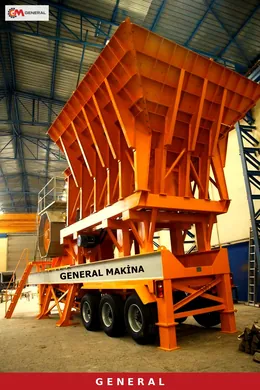
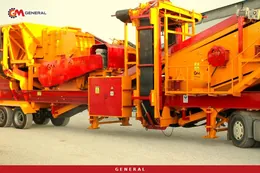
The General 640 combines a GPJ 60 jaw and a GNR 50 impact crusher with a 3-deck screen on one chassis and delivers 0-5 / 5-12 / 12-19 mm in closed circuit. Its transport dimensions are 3500×17000×4500 mm. A single unit means one heavy-lift operation at the port and one on site. Its limit is the 500 mm feed opening, so blasted or excavated granite has to be prepared to that size. The impact secondary gives cubical grains, but blow bar consumption will be high in quartz-rich granite, so a spare stock should be kept on the island.
GM 90JP: a primary that relocates itself on steep ground
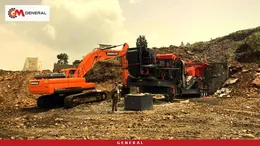
On Mahé's steep topography, moving the crusher closer to the face as it advances shortens truck haul. The GM 90JP is tracked, so it needs no ground preparation or foundation, and a 10 m³ hopper with a grizzly vibrating feeder is standard. Because it is a primary crusher only, a secondary crusher or plant has to follow it for surfacing chippings and concrete aggregate. For bulk fill, coastal filter stone and sub-base it can work on its own.
Separate mobile units: a line that travels in pieces
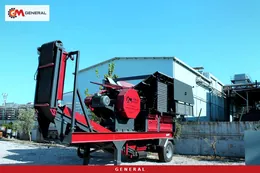
The GNR 90 from the mobile primary jaw crusher with feeder hopper series is the lightest heavy package at 25,000 kg. Adding a GNR MK100 cubitzer behind it produces cubical aggregate. This layout needs more conveyors and a separate screen and takes more room; in return every piece travels alone, which helps on roads and ramps with low load limits. The rotor crusher's wear cost in granite must be included here as well. For other combinations see mobile crushers and wheeled mobile crushing and screening plants; the crusher-type question in granite is covered in detail in our article on the best mobile crushing plant for basalt and granite.
From Port Victoria to the quarry: ship, ramp and tight bends
Port Victoria on Mahé is the main gateway for heavy equipment arriving in Seychelles. A wheeled plant can roll onto a suitable vessel on its own tyres as ro-ro cargo; a tracked machine usually travels on a low-bed or is lifted by crane. Which method is possible must be agreed with the shipowner and port operator in advance. If the machine is going to Praslin, inter-island transfer is a separate stage, and the capacity of the boat or barge used then becomes the deciding factor.
After the port, the road is the real challenge. Routes across Mahé's mountainous interior are narrow, winding and steep; a 17-metre transport length can create turning-radius problems on sharp bends. Survey the route before signing: bridge load limits, low passages, cable heights and night transport permits must be confirmed with the relevant authority.
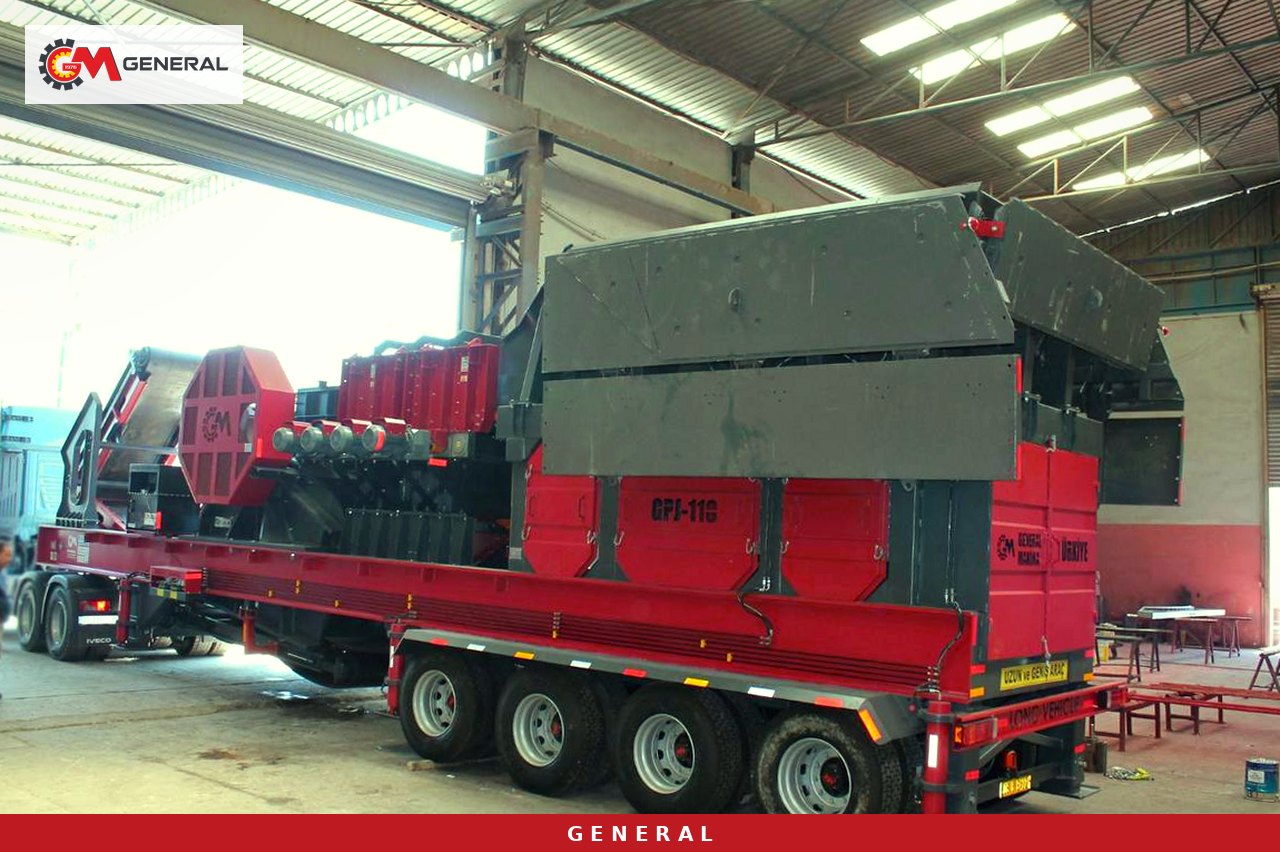
Space is tight on site too. The quarry floor must hold the crusher, stockpiles, loader manoeuvring and truck turning separately. A single-chassis plant keeps this layout simplest. A line made of separate units needs a longer, level platform for its conveyors, and on sloping ground the cost of preparing that platform is often overlooked.
Working on a tourism island: dust, noise, water and salt air
Seychelles depends heavily on nature tourism, and quarries cannot always be far from hotels, villages or protected areas. Environmental measures must therefore be part of the technical specification. The following measures can be selected per project and should appear as separate items in the quotation:
- Water-spray dust suppression at the crusher discharge and conveyor transfer points; low-flow nozzles where water is scarce.
- Enclosed covers at screen and conveyor transfers; wind screens around stockpiles.
- A sound-insulated generator canopy and working hours planned around residential areas.
- A marine-grade paint system for salty, humid air, sealed electrical panels and regular corrosion checks.
- Grizzly pre-screening and drained stockpile areas so that clayey cover stays out of the crusher in wet periods.
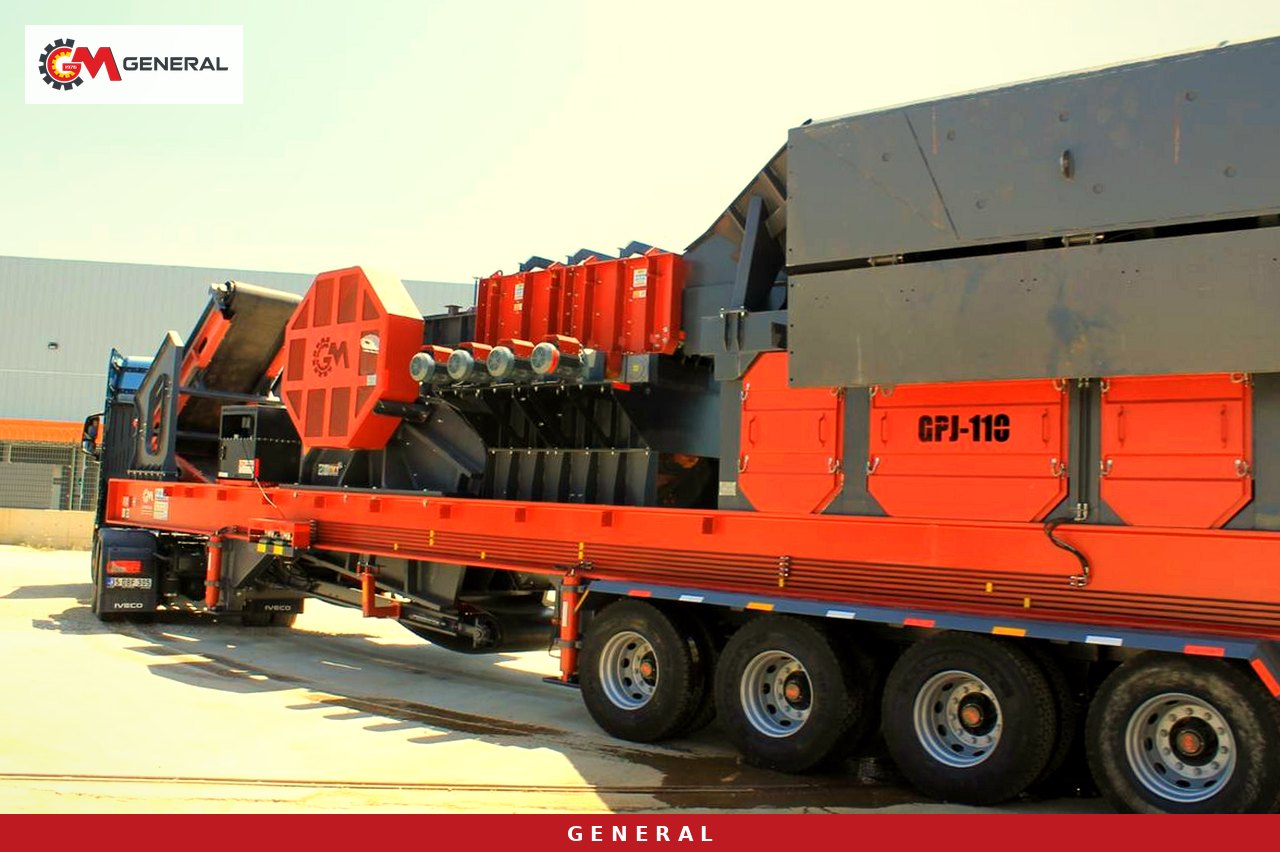
Water and power are not available at every quarry. Without a grid connection, the optional 300 kVA generator of the General 640 or the 250 kVA power unit of the GM 90JP runs the line independently. Since fuel also reaches the island by ship, fuel storage and safe refuelling should be planned on site.
What to settle before requesting a quotation
- Compressive strength and abrasiveness test results from a sample of the quarry granite.
- Largest block size after blasting or excavation (compare with the 500 mm and 700 mm limits).
- Priority products and target sizes: concrete aggregate, surfacing chippings, sub-base, manufactured sand.
- Daily tonnage target, shift pattern and availability assumption.
- Vessel type, loading and unloading method at Port Victoria and any inter-island transfer.
- Route survey from port to quarry: bends, gradients, bridges and height limits.
- Grid or generator, water source and dust suppression needs.
- List of spare and wear parts to be held on the island.
Our machines carry ISO 9001 and CE certification, and the warranty is 1 year excluding wear parts. Since jaw plate and blow bar life in granite depends on the rock, planning the wear-part list together with the first shipment is the most practical way to avoid waiting for a second vessel.
Frequently asked questions
Can the General 640 crush Seychelles granite?
Yes, the GPJ 60 jaw in the primary stage suits hard granite. The limiting factor is the high wear of the impact secondary in quartz-rich granite. A sample test shows whether this wear is acceptable, and the blow bar stock is set accordingly.
Wheeled or tracked for Mahé's steep quarries?
If the face advances often and bulk fill is enough as product, the tracked GM 90JP is practical. If finished, screened sizes are wanted from one machine on a stable quarry floor, the wheeled General 640 is the more complete solution.
Can the plant be moved to a second island such as Praslin?
Technically yes; what decides it is the capacity of the boat used for inter-island transfer and the jetty conditions. If this information is shared at the quotation stage, the machine is chosen to suit it.
What determines price and delivery time?
Model, optional equipment (generator, dust suppression, extra screen), spare parts package and shipping method set the price. Delivery depends on the production schedule at the time of order; both are confirmed in a written quotation.
Conclusion
Choosing a 60-100 TPH compact crusher in Seychelles turns on three axes: the abrasiveness of quartz-rich granite, the geometry of reaching the island and the quarry, and environmental fit on sites close to tourism. The single-chassis General 640 offers the simplest logistics, the GM 90JP freedom of movement on steep slopes, and separate mobile units the flexibility of travelling in pieces. Send your sample results, product targets and route details through our contact page and we will prepare the right configuration and a written quotation for your project.
Definitions of technical terms: Glossary