EN — English
 TR — Türkçe
 DE — Deutsch
 RU — Русский
 FR — Français
 ES — Español
 AR — العربية
 SR — Српски

Compact Mobile Crushers for Confined Job Sites and Urban Projects
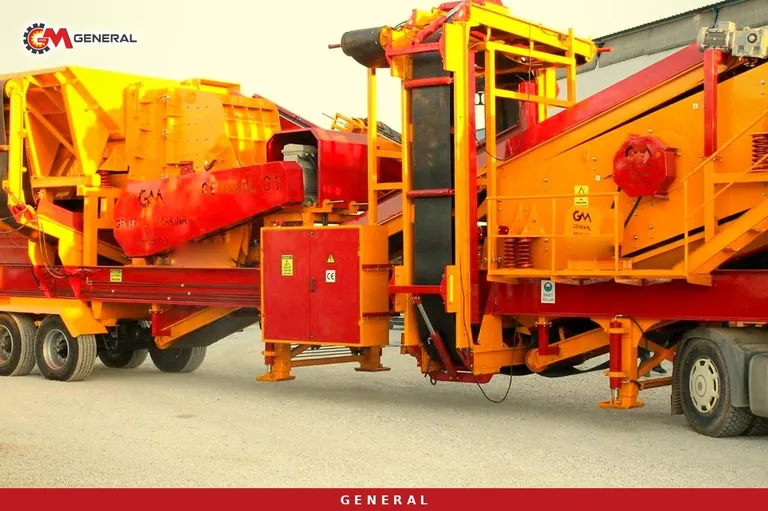
On a tight plot, an urban regeneration site or an excavation squeezed between two buildings, machine selection does not start with the capacity line in the brochure. The first questions are whether the machine fits through the gate, where it will sit once unfolded and what will power it. "Compact" appears in almost every brochure, yet on its own it is not a measurement. This article breaks compactness down into measurable items and uses the actual product-table values of General Makina's mobile range to show which model suits which confined-site scenario. Site layout, working hours and ground preparation are separate topics; the focus here is the machine itself and the model decision.
Define compactness with four measurements
Writing "we want a compact plant" into a purchase request makes the incoming quotations impossible to compare. Ask for the following four measurements as numbers instead and compare every offer on the same line.
1. Transport dimensions
Width, length and height must be read separately. Width decides the site gate and the street cross-section, length decides how the tractor unit turns, and height decides clearance under bridges, power lines and tree branches. If one of the three does not fit, the other two being small does not help.
2. Weight
Weight directly affects the class of transport vehicle and any tonnage restrictions on the access road. In cities, route permits may vary with machine weight; confirm the local rules with the relevant authority.
3. Working footprint
The transport dimensions in the catalogue describe only the travel position. Once conveyors are unfolded, stockpiles build up and the loader turns on the feed side, the required area grows. Ask the supplier for a layout drawing in working position as well as the transport dimensions.
4. Power source
A generator-powered plant brings the generator's own space and a refuelling route onto the site. A grid connection needs a switchboard and a cable route. On a confined site this item often causes more debate than the machine itself.
Model data: lower capacity does not always mean a smaller body
The table below brings together the technical values from the product pages of mobile units that can be considered for a tight site. Values not given in the product table are shown as "—"; nothing has been estimated.
| Model | Undercarriage | Capacity | Max. feed | Weight | Transport dimensions | Power |
|---|---|---|---|---|---|---|
| General 640 (jaw + impact) | Wheeled | 60-100 t/h | 500 mm | 38,000 kg | 3500×17000×4500 mm | 300 kVA generator (optional) |
| General 800 (primary impact) | Wheeled | 80-150 t/h | 600 mm | 35,000 kg | 3600×15500×4500 mm | 450 kVA generator |
| Mobil 90 (crushing + washing + screening) | Wheeled, 3 axles | 90-150 t/h | 800 mm | 45,000 kg | 3600 × 15700 × 4500 mm | 350 kVA generator |
| GM 90JP (tracked jaw) | Tracks | 70-180 t/h | 700 mm | 35,000 kg | — | 250 kVA |
| GM 100 (tracked impactor) | Tracks | 100-180 t/h | 600 mm | 42,000 kg | — | 450 kVA |
| GNR 60 portable primary jaw unit | Wheeled chassis | 20-80 t/h | — | 15,000 kg | — | — |
| GNR YM1240 (washing and screening) | Wheeled | 60-100 t/h | 0-100 mm | 18,000 kg | 4200 × 10800 × 4500 mm | Grid or generator |
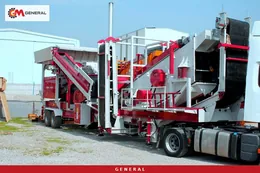
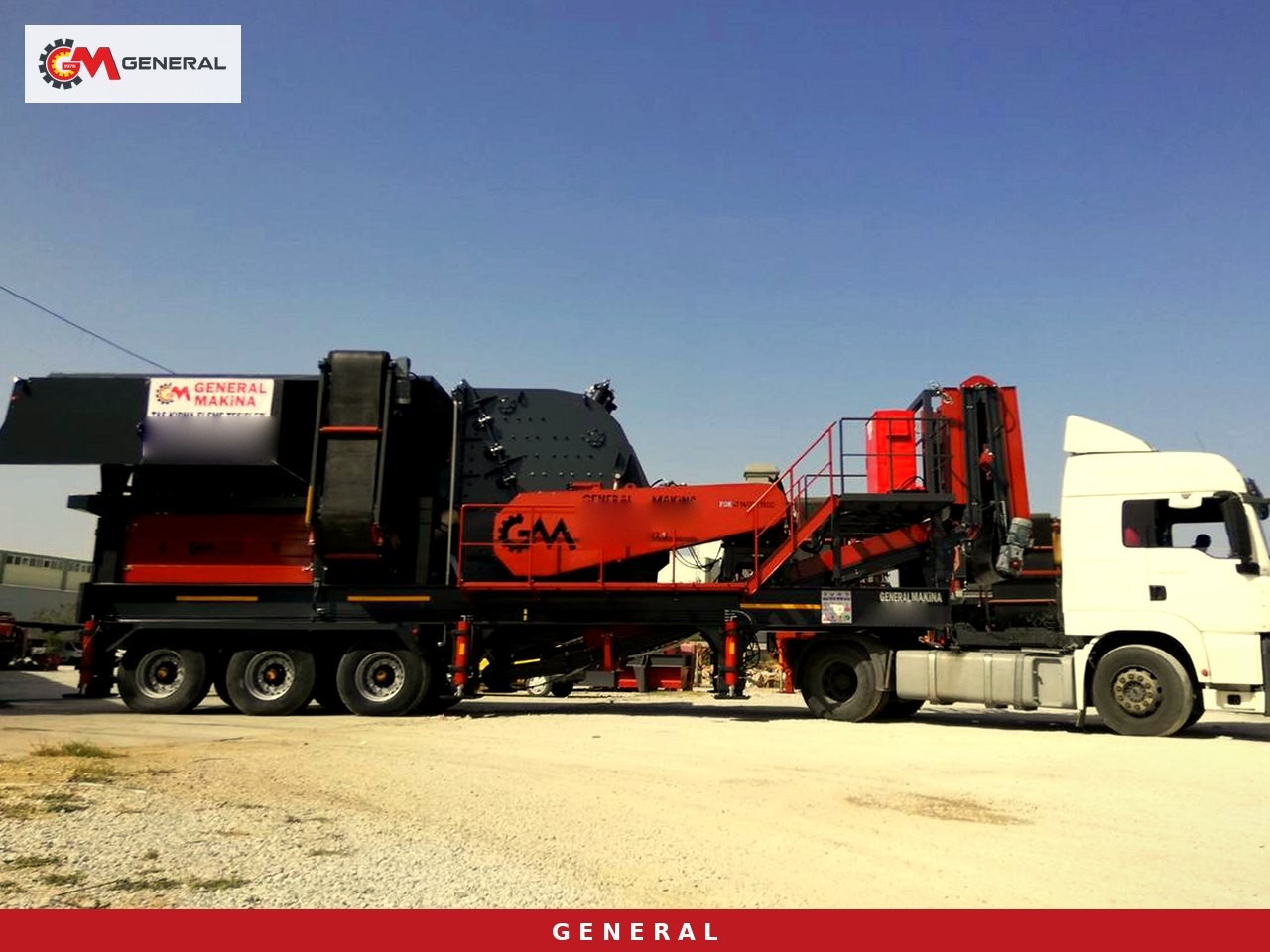
The most instructive comparison in the table is General 640 versus General 800. The 640 is the lower-capacity entry model, yet its transport length (3500×17000×4500 mm) and weight (38,000 kg) exceed those of the 800, which delivers 80-150 t/h (3600×15500×4500 mm, 35,000 kg). The reason is the layout: the 640 carries two crushers on one chassis, a GPJ 60 jaw and a GNR 50 impactor, plus a 1200×4000 mm triple-deck screen and a return conveyor; the 800 runs a single PDK 1280 primary impactor with a 1300×4000 mm triple-deck screen. If length is the limiting factor on a tight site and the material is low-abrasive, the 800 delivers more tonnage on a shorter body. If the material is hard and abrasive, the extra length of the two-stage 640 is the price paid for liner life.
The second point is width. The GNR YM1240 has the shortest (10800 mm) and lightest (18,000 kg) body in the table, but at 4200 mm it is also the widest unit. On a site with a narrow gate a short body alone gives no advantage; always check dimensions on all three axes together.
Closed circuit on one chassis or separate staged units?
The second big decision on a tight site is whether the job is done on a single chassis or by separate units linked with conveyors. The two approaches use space differently.
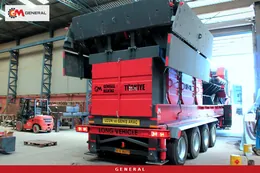
Single chassis, closed circuit: on the General 640, material flows from a hopper with a by-pass grizzly to the jaw crusher, then to the impactor and the triple-deck screen; oversize that has not reached the target size returns to the start on a conveyor. The 0-5 / 5-12 / 12-19 mm fractions leave from one footprint. With few transfer points there are also fewer intermediate conveyors, intermediate stockpiles and spillage points. If the excavated material is clayey, the Mobil 90 in the mobile stone crushers range takes the same logic into washing: GPJ 90 jaw crusher, 1600×5000 mm washing screen and 600×6000 mm twin sand screw on one wheeled chassis. No second washing plant has to be set up on the tight site.
Separate units: the units in the portable rock crushers category are individually lighter. The GNR 60 portable primary jaw unit, for instance, weighs 15,000 kg, has a 700×3000 mm feeder and is commissioned on hydraulic cylinders without a foundation. A GNR MK50 cubicizer (1000×750 mm rotor, 150 mm max. feed, 45-80 t/h, 75 kW) can be added behind it for cubical product. This arrangement helps when machines have to enter the site on different days or pass one after another through a narrow gate. The cost is conveyors and transfers between units and a separate screening need; the primary unit alone does not produce a full grading.
When separate units are chosen, stage compatibility has to be checked with numbers: the primary crusher's discharge setting is adjusted to the feed size accepted by the next unit. For the MK50 that limit is 150 mm; if the primary setting goes above it, the second stage chokes, and on a tight site a blockage means lost time as much as lost space.
Tracks or wheels: on a tight site the criterion is how the pile moves
For the general comparison of tracked and wheeled units see our article on tracked versus wheeled mobile crushers. On a confined site the decision boils down to a simpler question: does the pile to be crushed move across the site, or is it collected at one point?
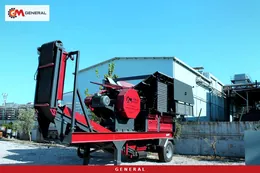
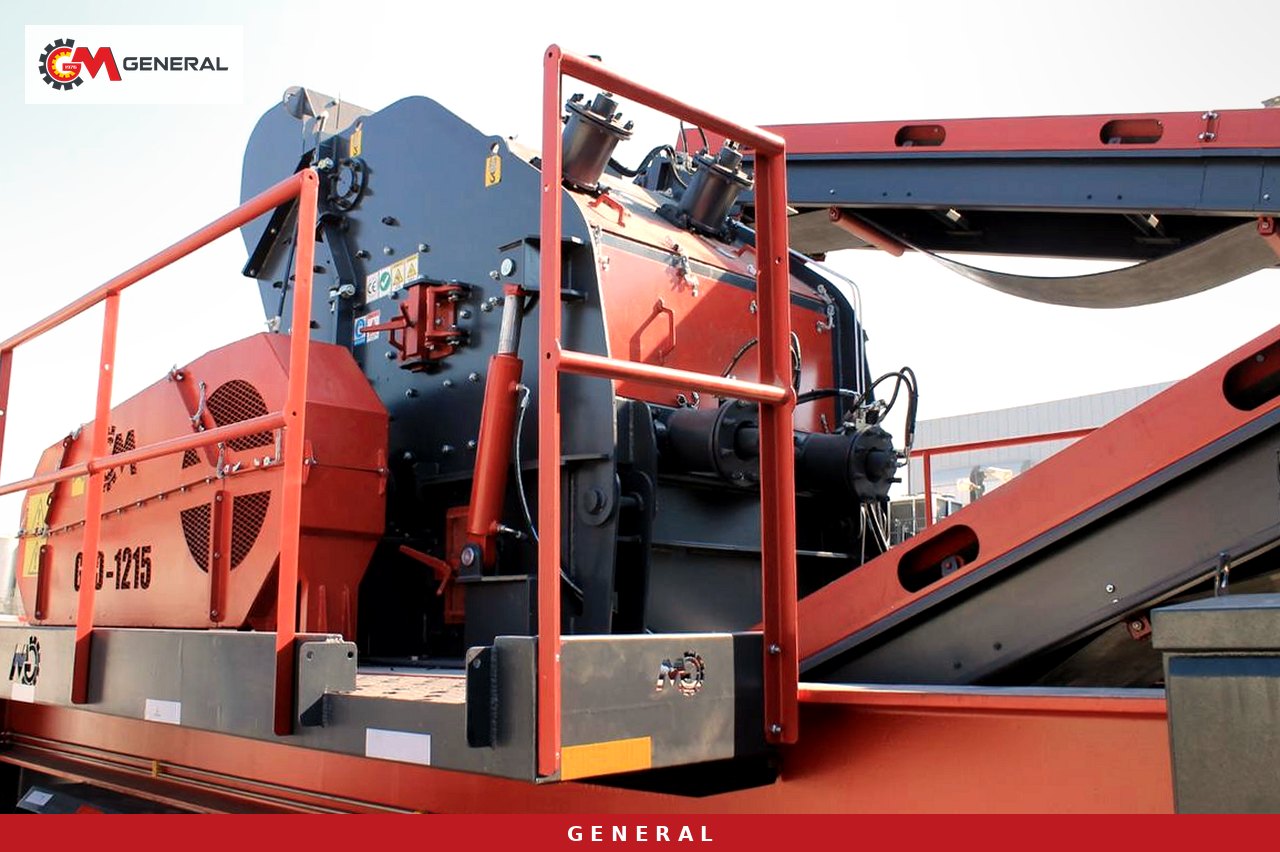
If the pile advances, for example when demolition proceeds along the plot, track-mounted mobile crushers come to the fore. The GM 90JP drives itself on Strickland tracks and needs no hydraulic legs or concrete foundation. It carries a 10 m³ hopper, an 820×3000 mm grizzly feeder (2×4.5 kW), a 95 kW GNR 90 jaw crusher, a 1000×2000 mm double-deck screen and a 600×6000 mm by-pass conveyor, and accepts feed up to 700 mm. It is, however, a primary crusher: if the specification calls for a narrow fraction, additional screening is needed. The GM 100 runs a 160 kW GNR-01 impactor in closed circuit with a 1500×5500 mm triple-deck screen; it gives the target fraction in a single pass and reduces the need to bring a second machine onto the site.
If the pile is collected at one point, a wheeled plant is enough. It arrives behind a tractor unit, is set on hydraulic legs and stays put for the whole project. In that case nothing extra is paid for the mobility that tracks provide.
Hopper volume and loader rhythm
On a tight site the loader handles both feeding and stockpiling, so hopper volume works as a buffer. The GM 90JP has a 10 m³ hopper, the GM 100 a 3.6 m³ hopper. Work out the buffer time with your own material using this formula: Buffer time (minutes) = hopper volume (m³) × bulk density of the material (t/m³) ÷ feed rate (t/h) × 60. Take the bulk density from a material test. The shorter the buffer, the less time the loader can spend on the stockpile side; if a single loader will be used, this calculation belongs in the model decision.
The power source changes the layout
Power values in the product tables vary by model: 250 kVA for the GM 90JP, an optional 300 kVA generator for the General 640, 350 kVA for the Mobil 90, and 450 kVA for the General 800 and GM 100. The GNR YM1240 can run on grid power or a generator. On a tight site these figures lead to three consequences:
- If a generator is used, its position must be planned apart from the crusher's feed side and the truck route.
- Refuelling must not share the same lane as the loader and trucks during production.
- If a grid connection is planned, capacity and connection conditions should be confirmed in writing with the local distribution company; the distance from the connection point to the plant determines the cable route and the constraints on site.
Decision matrix by site scenario
| Scenario | Model to consider | Reason (product data) | What to check |
|---|---|---|---|
| Demolition concrete, pile advancing along the plot | GM 100 or GM 90JP | Self-propelled on tracks, no foundation; GM 100 has an integrated triple-deck screen | Rebar removal and extra screening need |
| Demolition concrete collected at one point, cubical product required | General 800 | Primary impactor, 80-150 t/h, 3600×15500×4500 mm | Abrasiveness of the material |
| Hard rock from foundation excavation | General 640 | Two stages, jaw + impact, 500 mm feed | 17000 mm transport length |
| Clayey excavation or river material | Mobil 90 | Crushes, washes and screens on one chassis | Water supply and settling area |
| Sand washing on a very short plot | GNR YM1240 | 10800 mm length, 18,000 kg | 4200 mm width |
| Narrow gate, machines enter one by one | GNR 60 + GNR MK50 | Light separate units | Stage compatibility (150 mm for MK50) |
If you will be processing demolition concrete, the complete machine set is shown on the concrete recycling plant page.
Checklist before requesting a quotation
- Have the clear width and height of the site gate and the narrowest street section been measured?
- Is there a tonnage or height restriction on the access route, and has it been confirmed with the local authority?
- Is the largest lump in the material below the maximum feed size of the candidate model?
- Is the material hard and abrasive, or low-abrasive? (The choice between a jaw and an impact stage depends on this.)
- How many fractions will be produced, and how many stockpiles does the site have room for?
- Is the pile to be crushed static or moving?
- Will power come from a generator or the grid, and is the generator position known?
- Is the material clayey; if washing is needed, is there water and a settling area?
- Has a working-position layout drawing been requested from the supplier?
Filling in this list and comparing it with the product page of a candidate model such as the General 640 shortens the first round of discussions.
Frequently asked questions
What is the smallest crushing plant for a tight site?
The question cannot be reduced to one measurement. Among the separate units in the table, the lightest crusher is the GNR 60 portable primary unit at 15,000 kg, but on its own it does not produce a full grading. Among the closed-circuit wheeled crushing and screening plants in this table, the shortest body is the General 800 at 3600×15500×4500 mm.
Does a tracked crusher need a foundation on site?
The GM 90JP and GM 100 are self-propelled and need neither hydraulic legs nor a concrete foundation. The surface the machine stands on must still be level and load-bearing.
Does choosing a compact model mean giving up capacity?
Not always. The General 800 is shorter and lighter than the General 640 yet delivers 80-150 t/h. The decisive factors are crusher type and the abrasiveness of the material.
How do I get price and delivery information?
Price is shaped by options such as the crusher combination, number of screen decks, power option and washing unit. Send your material data, tonnage target and site dimensions, and a project-specific quotation will be prepared.
Conclusion
The right compact mobile crusher for a tight site is not the lowest-capacity model; it is the one that passes through the gate, fits the site in working position, carries the right stage for the material and has a power supply you can plan. Check dimensions on three axes, weight against the route and stage compatibility with numbers. Send your site dimensions and material data through our contact page and our team will prepare a suitable configuration and quotation.
Definitions of technical terms: Glossary