EN — English
 TR — Türkçe
 DE — Deutsch
 RU — Русский
 FR — Français
 ES — Español
 AR — العربية
 SR — Српски

Mali Bamako-Dakar Corridor Granite Aggregate Crusher Plant 150-250 TPH
For anyone running a granite quarry in Mali, or planning to open one, the hardest part is rarely the machine itself. It is the road the machine travels. Mali is landlocked, and most heavy equipment shipped from Europe or Türkiye is unloaded at the port of Dakar and hauled overland towards Bamako. This article is written for an investor who wants 150-250 TPH of granite aggregate at a site on, or supplied through, the Bamako-Dakar corridor. It covers which crushing and screening plant can be built from real model data, how to plan the shipment and what to watch once production starts.
A note on corridor projects: tender status, volumes and aggregate specifications for road, rail or bridge works change. Confirm the required fractions and particle shape limits in the technical specification of the relevant authority or contractor before sizing a plant.
How corridor granite drives crusher selection
In western Mali and towards the Senegalese border, granite and granitic gneiss outcrops are common, with dolerite dykes in places and sandstone along the plateau around Bamako. One quarry may yield sandstone, the next quartz-rich granite. That difference changes the crusher choice directly: impact crushers run economically on sandstone and softer rock, while in quartz-bearing granite their metal consumption climbs quickly.
The first job is therefore a representative sample from the face, tested for abrasiveness (Bond Ai), free silica and compressive strength. The threshold on our product pages is clear: above 10% silica or a Bond Ai over 0.15, a jaw crusher is the safe primary. Few granite quarries fall below that line, but no decision should be made without the test.
Laterite overburden is a separate issue. Along the corridor, quarry faces are often capped by a red, iron-rich laterite layer. If it reaches the crusher in the rainy months it plasters the cavity and blinds screen decks. It has to be stripped, or removed ahead of the crusher by grizzly pre-screening.
Real configurations for a 150-250 TPH target
Rather than covering the whole range with one machine, there are three routes depending on where each stage is handled. Every figure below is the catalogue value of the named model.
Route 1: a train of portable units
For the primary stage, the GNR 110 from the mobile primary jaw crusher with feeder hopper range combines a 1100×4750 mm feeder with a GNRK 110 jaw, delivering 180-300 t/h, accepting 0-1100 mm feed and discharging 0-250 mm. Add the GNR MK110 mobile cubitzer (0-350 mm feed, 160-250 t/h, 200 kW motor) and you get 0-25 mm cubical chips. Each unit travels on its own chassis; as the face advances the primary moves forward while the second stage stays put. Other members of this family are listed under portable rock crushers.
Route 2: a twin-chassis wheeled plant
The GNR-MC110 carries a GPJ 110 jaw primary and a DMK03 impact secondary on two separate chassis. It offers 200-300 t/h, 900 mm feed, a 2000×6000 mm four-deck screen and 0-5 / 5-12 / 12-19 / 19-40 mm fractions. The primary chassis measures 3000×13500 mm and weighs 55,000 kg, the secondary 4200×18300 mm and 55,000 kg, and it runs on a 750 kVA generator. The primary group can start producing on its own. All wheeled plants are in the mobile crushing plants category.
Route 3: a stationary plant on foundations
Where the quarry life is long, a stationary crushing and screening plant can be built from a GNR 110 vibrating feeder (200-300 t/h, 2x7.5 kW), a GNRK 110 jaw crusher (1100×850 mm opening, 110/132 kW, 200-350 t/h), a cone crusher as secondary and a GNR 2060 screen (2000×6000 mm, 18.5 kW). Cone crusher capacity by model is quoted per project; in granite the secondary reduction ratio is typically 6:1 to 8:1.
| Option | Primary | Secondary | Capacity (t/h) | Max. feed (mm) | Power |
|---|---|---|---|---|---|
| Portable train | GNR 110 (GNRK 110 jaw) | GNR MK110 cubitzer, 200 kW | 180-300 / 160-250 | 1100 | — |
| GNR-MC110 | GPJ 110 jaw | DMK03 impact | 200-300 | 900 | 750 kVA generator |
| Stationary plant | GNRK 110, 110/132 kW | Cone crusher | 200-350 (primary) | — | Grid or generator |
Plant output is capped by the narrowest link in the chain. In the portable train that link is the MK110 at 160-250 t/h; even if the primary crushes more, finished tonnage cannot exceed the second stage.
The primary impact crusher on the cover: its place in granite
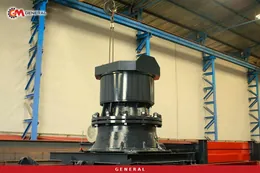
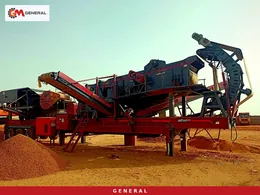
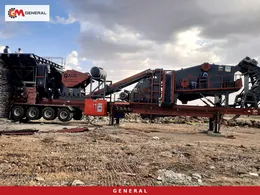
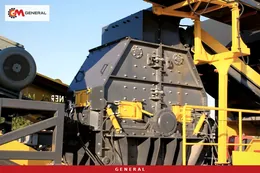
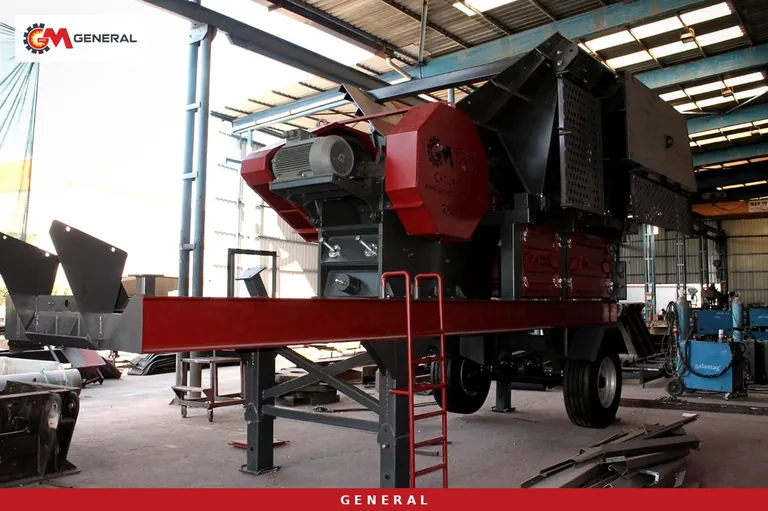
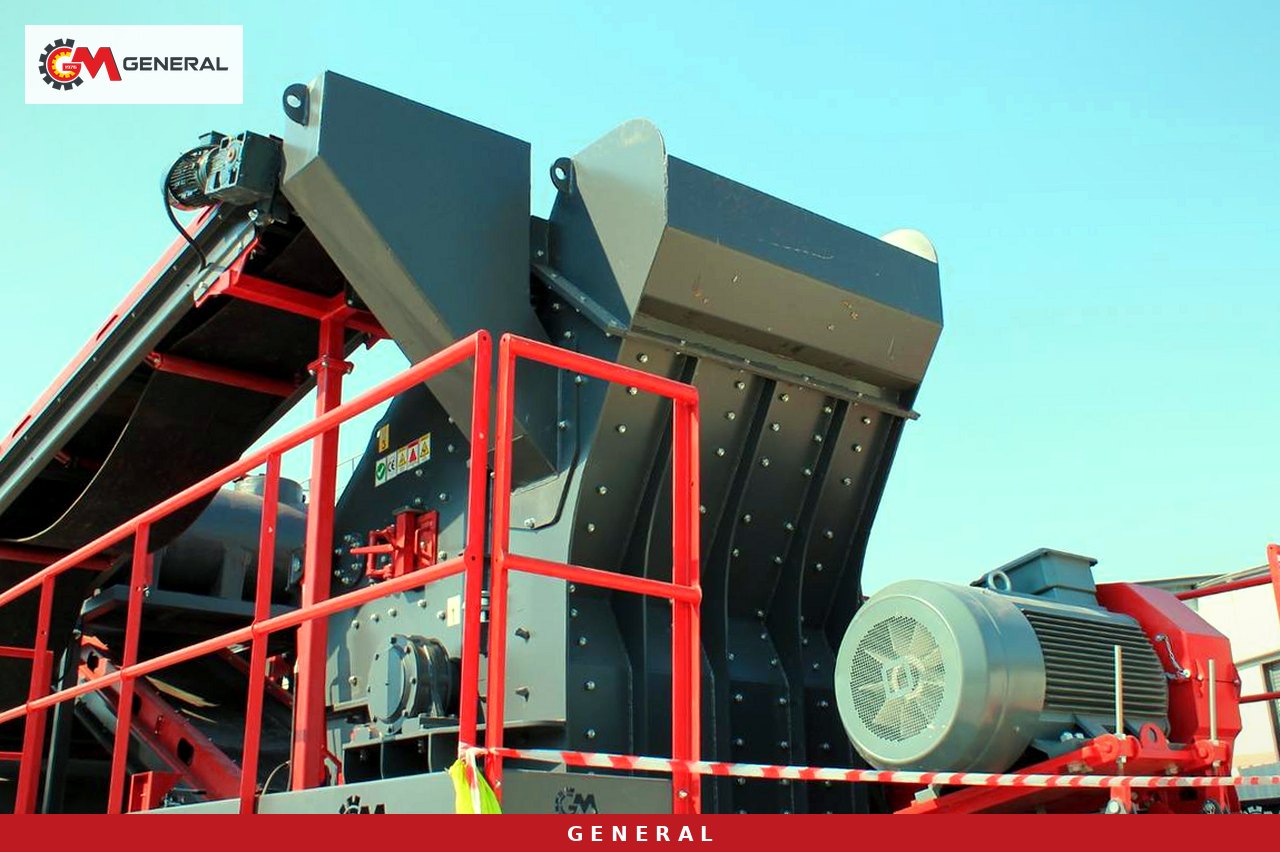
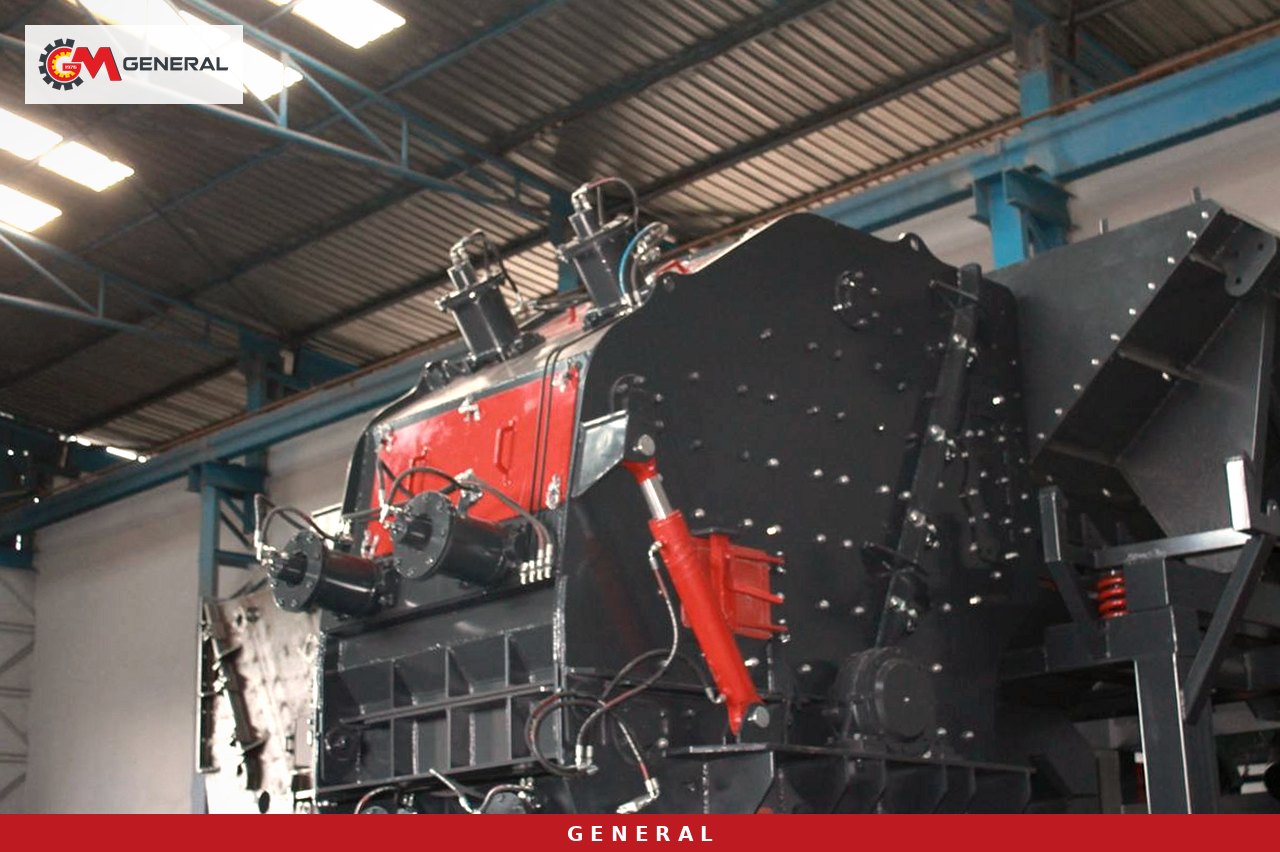
The machine in this article's photos is the M-PDK series mobile primary impact crusher. The M-PDK01 has a 1500×5000 mm feeder, 250-500 t/h, 315 kW and 50,000 kg; the M-PDK02 a 1200×4750 mm feeder, 200-300 t/h, 250 kW and 45,000 kg. Both accept 0-1200 mm feed and produce 0-70 mm cubical product.
To be plain: we do not recommend this machine as the primary for quartz-rich granite. An impact crusher will run in granite, but blow bar and impact plate wear accelerate so much that the parts cost per tonne overtakes a jaw. The M-PDK belongs at corridor quarries that process limestone or sandstone alongside granite, or in softer rock where the specification demands high reduction and cubical shape in one pass. If one investor runs two different quarries, this distinction sets the plant budget.
From Dakar port to the quarry: shipping and installation schedule
The logistics of the corridor are simple in outline and difficult in detail. After discharge in Dakar the road leg is long, with bridges, weighbridges and a border crossing along the way. When ordering, ask the supplier in writing for each chassis' axle loads, overall height and width, the parts that must be removed for transport (conveyors, ladders, handrails) and a separate packing list for them.
Each of the two GNR-MC110 chassis weighs 55,000 kg; the single-chassis GNR 110 mobile primary also weighs 55,000 kg. These weights call for a heavy-haul tractor and a suitable low-bed trailer. Plan route permits with the haulier and confirm them with the relevant agencies in both countries.
On site, the work consists of levelling the chassis on hydraulic legs, connecting conveyors and cabling the generator. Portable units need no concrete foundation. For a stationary plant, foundation design, pouring and curing is the longest item in the schedule; running it in parallel with machine manufacturing shortens the timeline.
Operating settings for Harmattan dust and the rainy season
In the dry season the Harmattan wind carries fine dust from the Sahara. It goes after engine air filters, the generator radiator and electrical panels. Track filter change intervals by the actual differential pressure gauge on site, not by the manufacturer's table. Placing panels in pressurised or filtered cabinets, adding water sprays at conveyor transfer points and reducing the drop height of stockpile conveyors are measures that can be selected per project.
In the rainy season the problem reverses. Wet laterite and clayey fines stick to the feeder grizzly and blind screen meshes. The by-pass section of the grizzly feeder diverts these fines ahead of the crusher, and the material can be stockpiled separately as road fill. Ship a spare mesh set from the start so the top-deck aperture and wire type can be changed with the season.
Wear parts planning also depends on distance. In granite, jaw plates are austenitic manganese steel (Mn13/Mn18; Mn18/Mn22 for high silica). If the quarry is days away from Dakar, carrying at least one set of jaw plates, a blow bar set where an impact stage is used, and screen mesh in the first shipment prevents lost production.
Information to collect before requesting a quotation
- Bond Ai, free silica and compressive strength results for the quarry sample.
- Laterite overburden thickness and stripping method.
- Largest block size after blasting (mm).
- Target fractions and particle shape limit in the specification.
- Daily operating hours and target daily tonnage.
- Whether grid power is available; if not, generator preference.
- Distance from the quarry to the Bamako-Dakar route and the condition of the last kilometres.
- Water source for dust suppression and, if needed, washing.
Required hourly capacity follows from one formula: required capacity = daily target tonnage ÷ (daily operating hours × availability). Hypothetical example: 2,000 tonnes per day, 10 operating hours and 0.8 availability give 250 t/h. In that case the portable train runs at the MK110's upper limit, while the GNR-MC110 or a stationary plant leaves more margin. For the differences between mobile and fixed options in granite, see our article on choosing a mobile crushing plant for basalt and granite.
Frequently asked questions
Should the secondary stage in granite be impact or cone?
With high quartz content, a cone crusher keeps metal consumption low. If the specification asks for cubical shape and the rock is moderately abrasive, an impact secondary (DMK03 or MK110) is acceptable; the decision follows the sample test.
Can the plant run without grid power?
Yes. The GNR-MC110 is specified to run on a 750 kVA generator. For portable units and a stationary plant, generator size is calculated separately from the total installed motor power.
Which certificates and warranty are offered?
The machines carry ISO 9001 and CE certification. The warranty is 1 year; wear parts are excluded.
What determines the price?
Configuration (portable, twin-chassis or stationary), secondary crusher type, number of screen decks, generator, spare parts package and delivery terms all change the price. With this information we prepare a project-specific quotation.
Final word and quotation
On the Bamako-Dakar corridor, the starting point for 150-250 TPH of granite aggregate at most quarries is a line that begins with a jaw primary: the GNR-MC110 for fast commissioning, the GNR 110 plus MK110 train for stepwise growth, and a stationary plant for a long-life quarry. Send your sample results, target fractions and site location via our contact pageand our engineers will work out the configuration and shipping list with you.
Definitions of technical terms: Glossary