EN — English
 TR — Türkçe
 DE — Deutsch
 RU — Русский
 FR — Français
 ES — Español
 AR — العربية
 SR — Српски

Burkina Faso Concrete Aggregate Mobile Stone Crusher Plant 80-150 TPH
For a ready-mix plant or a precast yard in Burkina Faso, the daily headache is rarely the mixer. It is the stone going into the bins. On sites around Ouagadougou and Bobo-Dioulasso, concrete aggregate usually comes from granite quarries, often mixed with laterite overburden, and it fills the bin compartments unevenly: the sand bin empties early while the coarse bin overflows. This article explains how to set up a mobile stone crusher plant producing 80-150 TPH of concrete aggregate around the bin layout of the batching plant it feeds. Every machine figure is taken from the technical tables on our product pages. Concrete class, maximum aggregate size and grading limits must be confirmed against the client's specification and laboratory results.
Planning backwards from the batching plant bins
Designing the crushing line from the batching plant's aggregate bins, rather than from the jaw, produces fewer mistakes. A four-compartment bin is typically split into 0-5 mm sand, 5-12 mm fine chips, 12-19 mm and, if needed, 19-25 mm coarse chips. Each compartment draws down at a rate set by the mix design, and if the crusher cannot keep those ratios, the loader operator starts topping up the missing size from another pile. A day that starts like that is a day when slump drifts from hour to hour.
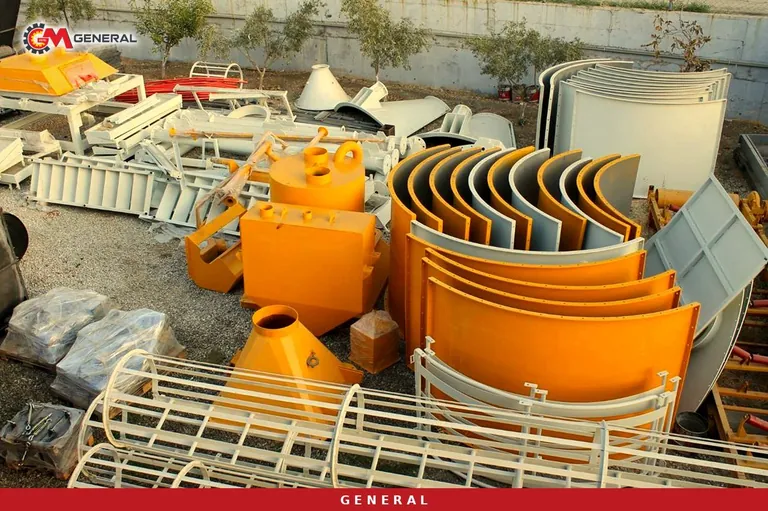
In our aggregate hopper table, the 4-compartment layout with 25 m³ per compartment comes with a 1000×13000 mm weighing belt, and the 30 m³ per compartment layout with a 1000×14000 mm or 1000×14600 mm belt. Bin volume is a buffer between the crusher and the batching plant. It covers short crusher stops; it never makes up for a size fraction that was under-produced.
A simple formula for the tonnage
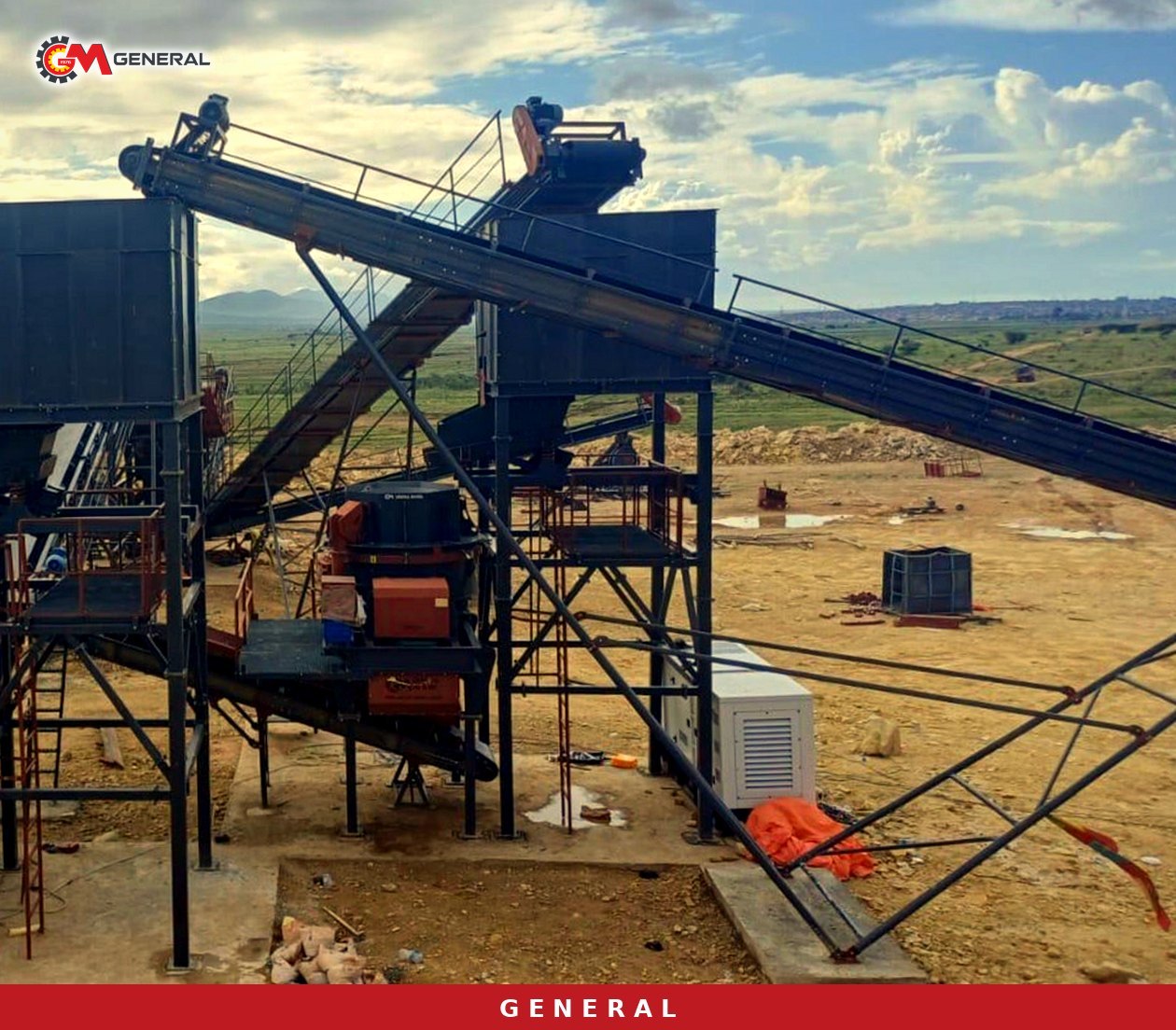
Derive the net crusher output from the batching plant's capacity: hourly concrete output (m³/h) × tonnes of aggregate per m³ in your mix design = aggregate consumed per hour. Add screening losses, extra output for stockpiling and the hours when the crusher runs shorter than the batching plant. If the batching plant works two shifts and the crusher one, required crusher tonnage roughly doubles the plant's consumption. This is a hypothetical example; recalculate it with your own mix figures.
The sand bin is always the first to run empty
Concrete mixes carry a large share of sand, yet crushed hard granite yields a low proportion of manufactured sand. So when selecting a plant in the 80-150 TPH band, ask how many tonnes of stone it makes, and also how much of that tonnage comes out as 0-5 mm. Ways to close the sand gap are covered further down.
How Burkina Faso's rock types decide the crusher
Most of the country sits on crystalline basement; granite, granodiorite and metavolcanic rock from the greenstone belts make up the majority of quarries. These rocks are high in silica and wear the blow bars of an impact crusher quickly. Jaw and cone crushers, which work by compression, use their wear metal much longer on the same stone. In more limited areas there are sedimentary rocks, limestone and dolomite; on this softer, less abrasive stone an impact crusher runs economically and gives cubical particles.
Laterite overburden is a separate matter. The top metres of the quarry face carry a red, iron-rich, clayey layer. When this material gets into concrete aggregate, the fines content rises and so does water demand. Stripping the overburden separately during excavation and removing it through the by-pass of the grizzly feeder is the first job, whichever crusher you put on the line. Rather than guessing your quarry's rock, we recommend sending a sample for abrasion and crushability testing.
Models and configurations for 80-150 TPH
Within our wheeled mobile crushing and screening plant range, the models in this band split according to rock scenario. All figures in the table below come from the technical data on the relevant product page.
| Model | Crusher | Capacity | Max. feed | Screen | Generator | Weight |
|---|---|---|---|---|---|---|
| General 640 | GPJ 60 jaw + GNR 50 impact | 60-100 t/h | 500 mm | 1200×4000 mm, 3-deck | 300 kVA (optional) | 38,000 kg |
| General 800 | PDK 1280 primary impact | 80-150 t/h | 600 mm | 1300×4000 mm, 3-deck | 450 kVA | 35,000 kg |
| General 944 | GPJ 90 jaw + GM430 cone | 120-180 t/h | 800 mm | 1600×5000 mm, 3-deck | 550 kVA | 70,000 kg |
| General 950 | GPJ 90 jaw + DMK01 impact | 120-180 t/h | 800 mm | 1600×5000 mm, 3-deck | 600 kVA | 70,000 kg |
| GNR-MVSI 900 (add-on stage) | VSI 900 vertical shaft | 90-180 t/h | 50 mm | 1600×5000 mm, 3-deck | 850 kVA | 42,000 kg |
Limestone or dolomite quarry: General 800
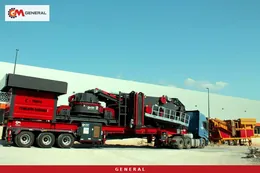
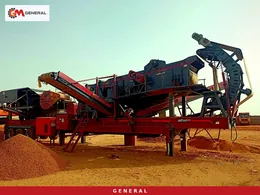
The General 800 is the model that matches the 80-150 TPH range in the title on a single chassis. Its PDK 1280 primary impact crusher accepts stone up to 600 mm and, in the 4-fraction layout, produces 0-5, 5-12, 12-19 and 19-40 mm. On low-abrasion stone, impact crushing gives a high reduction ratio and cubical particles, which helps concrete workability. In a granite quarry the same machine will run, but blow bar change intervals shorten, and that cost belongs in the quotation stage.
Granite quarry, 120-150 TPH target: General 944
If demand sits in the upper half of the band and the rock is granite, the General 944 is a more sensible starting point. Its GPJ 90 jaw takes 800 mm blocks, and the GM430 cone second stage crushes by compression, so wear parts last long in siliceous stone. The model produces 120-180 t/h; at a 150 t/h requirement it is not pushed to its limit. Buyers who want more cubical product and higher reduction look at the General 950 on the same chassis size (DMK01 impact secondary), but in granite its metal consumption will not stay as low as the cone's.
Smaller demand: General 640
If 100 t/h is enough for a precast yard or an operation feeding a single batching plant, the General 640 (60-100 t/h) is a lighter investment. Because of its 500 mm feed limit, blasting and oversize control ahead of the crusher need more care. This model does not cover the whole 80-150 t/h band; if tonnage will grow, choosing the 800 or 944 from the start is less work than adding a second line later.
Sand shortfall and fines: what reaches the mixer
When a granite line falls short on 0-5 mm sand, there are two routes. The first is to shift the main screen settings in favour of sand, which means giving up some coarse fractions. The second is to send surplus 5-12 or 12-19 mm material to a separate vertical shaft unit such as the GNR-MVSI 900. The MVSI 900 accepts feed up to 50 mm, runs at 90-180 t/h and delivers 0-3, 3-5 and 5-12 mm fractions. With its own 850 kVA generator it carries its own power and puts no load on the main line's genset.
Manufactured sand also brings a fines issue. Dust below 0.063 mm goes to the stockpile together with the sand on a dry crushing line. If the specification limits this content, or a methylene blue test indicates clay, a washing unit is added to the project; that decision is made on lab results, never on a guess. Dusty sand raises water and cement demand at the batching plant and lengthens mixing time.
When the crusher and batching plant come from one supplier
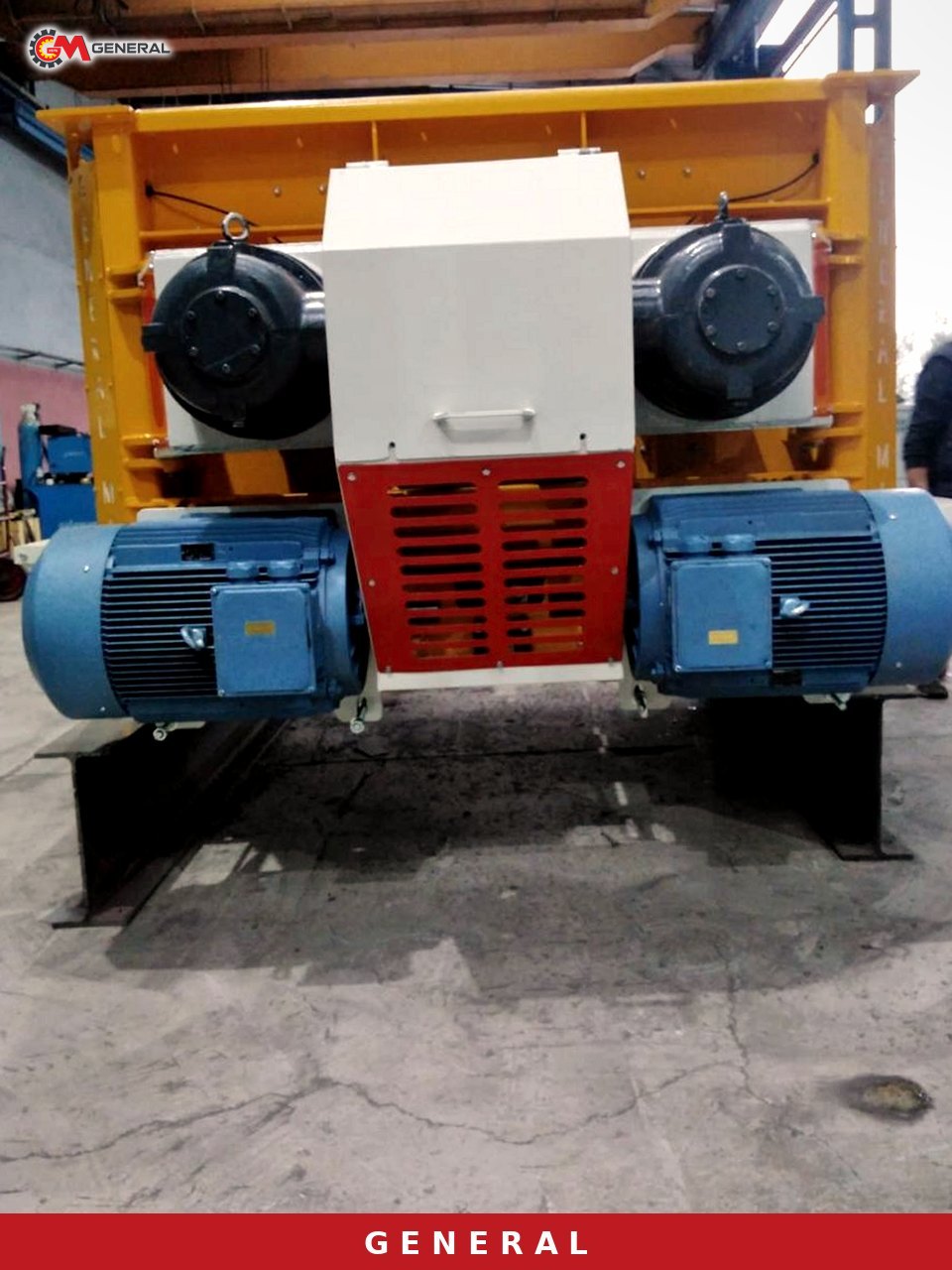
Alongside crushing and screening lines, General Makina builds concrete batching plants, cement silos and aggregate bins. For an investor in Burkina Faso setting up both, this means screen apertures are matched to bin compartments and the mix design by one team. Conveyor heights, stockyard layout and the electrical panel are solved on the same project drawing.
Port, road haulage and dry-season dust
Burkina Faso is landlocked. Machinery normally lands by ship at a port in a neighbouring coastal country (Abidjan, Tema or Lomé) and is then hauled inland by road. That puts the wheeled chassis's transport dimensions at the centre of the shipping plan. The General 800 measures 3600×15500×4500 mm in transport and weighs 35,000 kg; the General 944 measures 4130×20350×4500 mm and weighs 70,000 kg. Bridge and axle limits on the route should be checked with the haulier in advance; a machine waiting for a permit on the road means a batching plant waiting on site.
In the dry season, fine dust carried by the Harmattan wind joins the dust coming off the crusher. More frequent checks of generator and engine air filters during this period, water-spray dust suppression at the screen and transfer points, and belt covers are measures that can be selected per project. In the rainy season, laterite gets wet, turns sticky and blinds the grizzly gaps; keeping overburden out of the quarry floor during these months protects output. Remote sites have no grid, so fuel logistics for the 450 kVA (General 800) or 550 kVA (General 944) generator belong in the operating plan.
Information to prepare before the quotation
For a correct model proposal, we suggest collecting the following in one file:
- Rock type in the quarry and, if available, abrasion and crushability test results
- Largest block size after blasting and thickness of the laterite overburden
- Hourly capacity and shift pattern of the batching plant to be fed
- Fractions in the mix design, maximum aggregate size and fines limit
- Daily operating hours of the crushing line and target stockpile
- Whether grid power is available on site
- Port of discharge and road route to the site
Frequently asked questions
Is manufactured sand from a granite quarry enough for concrete?
In quantity it usually falls short; in quality it depends on fines content. The sand gap is closed with a vertical shaft crusher stage, and dust or clay problems with washing based on lab results.
Can the same line produce concrete aggregate and road base material?
Yes. The General 800's 4-fraction layout also delivers 19-40 mm. Screen apertures are set at order stage for both products, and the stockyard has to be divided accordingly to supply two specifications on the same day.
What certificates and warranty come with the machines?
Our machines carry ISO 9001 and CE certification. Warranty is 1 year, wear parts excluded. We have been manufacturing in Izmir since 1976.
What determines the cost of the plant?
The selected model, any added vertical shaft crusher or washing unit, generator size, number of screen decks, stockpile conveyors and the port of discharge set the cost. Once your quarry data arrives, a quotation is prepared for your case.
Final word
When setting up an 80-150 TPH mobile line for concrete aggregate in Burkina Faso, talk about the batching plant bins and the mix design first, then the rock, and the model last. General 800 on limestone, General 944 on granite and an MVSI 900 add-on for the sand gap cover most scenarios. Send your quarry and batching plant details through our contact page and our engineers will prepare the configuration and quotation accordingly.
Definitions of technical terms: Glossary