EN — English
 TR — Türkçe
 DE — Deutsch
 RU — Русский
 FR — Français
 ES — Español
 AR — العربية
 SR — Српски

Saudi Arabia Road Projects Mobile Crushing & Screening Plant 250-375 TPH
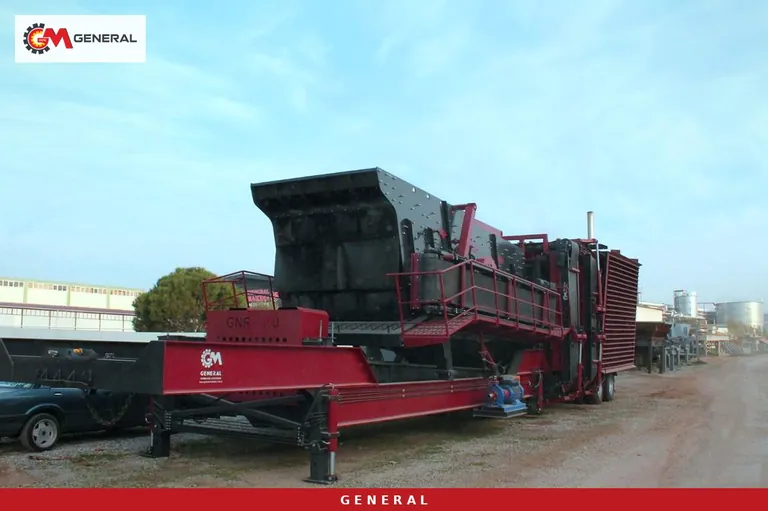
When a highway contract is signed in Saudi Arabia, the aggregate problem usually shows up in the first month: thousands of tonnes of crushed rock for the subbase, tightly graded material for the base course and clean, cubical chippings for asphalt all compete for the same schedule. On top of that the alignment keeps growing, and the distance between quarry and laying point changes every week. A mobile plant working in the 250-375 TPH band does two jobs in this situation: it holds the target tonnage, and it follows the quarry and the job site as the road advances. Below we set out the real models that cover this band, how to choose between them for the rock types met along Saudi routes, and the settings that shape operation on a desert site, with the figures that belong to each machine.
Thinking layer by layer: what 250-375 TPH means in road building
Each layer of a road section asks something different of the crushing plant, and it is this demand, not nominal capacity, that defines the product split. The subbase tolerates a wide grading envelope; tonnage is high and shape limits are relatively loose. In the base course, fines content and plasticity limits come into play, which depends on how well pre-screening is done. Asphalt wearing and binder courses need chippings with a low flakiness index, free of dust and in narrow fractions.
So the question "how many tonnes per hour" really has to be asked as "how many tonnes per hour of which fraction". If 0-5 mm crusher sand piles up while 12-19 mm runs short, the paving crew waits even when the plant runs at nameplate capacity. Fraction limits, grading envelopes and quality tests are defined in the project's technical specification; screen media and crusher settings should not be chosen before these values are confirmed with the road authority and the contract documents.
On jobs where most of the crushed rock goes into the road base, adding a plant-mix unit behind the crushing line is worth considering. The mobile soil stabilization plant works at 200-600 t/h with 3-5 cold bins and a 2×22 kW twin-shaft mixer; it produces granular base stabilised with cement or binder, not ready-mix concrete. When the crushing plant and the stabilization plant relocate together along the same alignment, intermediate stockpiles and truck traffic shrink.
Rock that changes along the route: from the western shield to the central plateau
Saudi geology does not allow a single crusher type to be the right answer across the whole country. Broadly, in the west the Arabian Shield running parallel to the Red Sea is dominated by igneous and metamorphic rock, with basalt prominent in the wide volcanic fields; in the central and eastern regions the sedimentary sequence of limestone, dolomite and sandstone takes over. Wadi floors hold rounded gravel and sand deposits. A single road project can cut through two of these zones.
Hard, abrasive rock: granite, basalt, gneiss
In high-silica igneous rock the blow bars of an impact crusher wear quickly; here a jaw and cone combination working on compression extends metal life. If asphalt chippings need a cubical shape, an impact unit can still be used at the secondary stage, but wear-part consumption must be written into the operating budget from day one. The choice of manganese jaw plates and suitable blow bar alloy should be discussed together with sample testing.
Limestone, dolomite and wadi gravel
In the limestone quarries of the central plateau a primary impact crusher gives a high reduction ratio and cubical product in a single stage; it is a simpler line than jaw plus secondary. In wadi gravel part of the material is already at target size: screening first and feeding the crusher only with oversize lifts tonnage noticeably. In every case, the final model decision should wait for abrasion, hardness and clay-content tests on a quarry sample.
Models that cover the target band, and a two-unit option
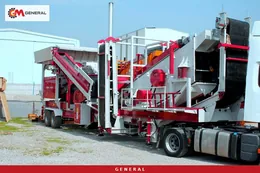
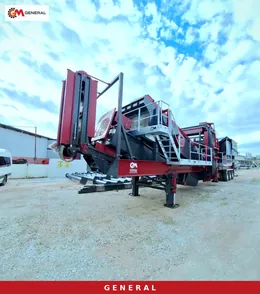
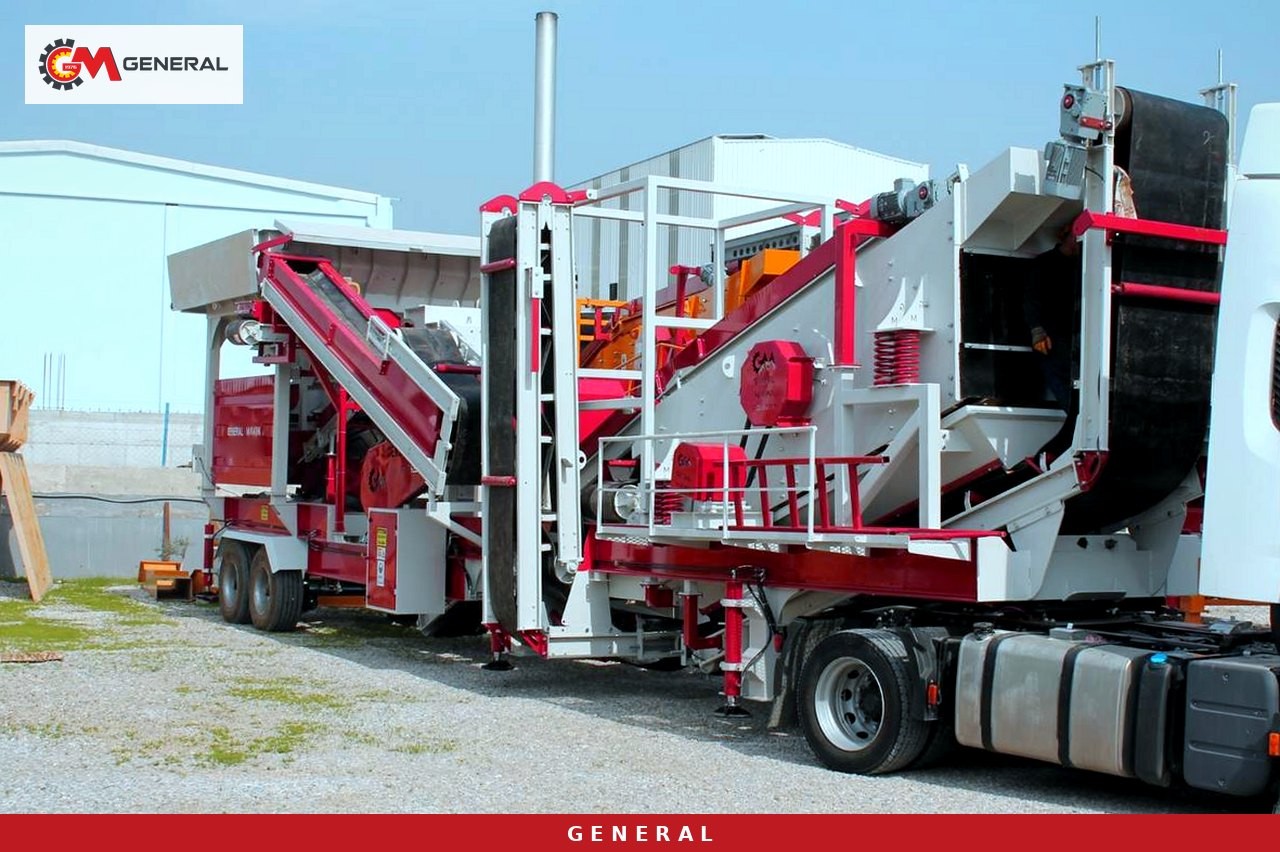
Within the wheeled mobile family, the model that covers 250-375 TPH on a single chassis is the General 03. For a quarry staying in the lower half of the band and feeding large blocks, the General 02 should also be evaluated. If the rock is hard and abrasive, running two jaw plants in parallel is a sounder route than pushing a single impact unit. All options are listed on the wheeled mobile crushing and screening plants page.
| Criterion | General 03 | General 02 | General 944 + General 950 |
|---|---|---|---|
| Crusher layout | GPS 1415 primary impact | GPS 1413 primary impact | GPJ 90 jaw primary on both; secondary GM430 cone (944) and DMK01 impact (950) |
| Capacity | 250-375 t/h | 250-300 t/h | 2 × 120-180 t/h = 240-360 t/h |
| Maximum feed | 900 mm | 1000 mm | 800 mm |
| Screen | 2400×5000 mm, 4-deck | 2000×5000 mm, 4-deck | 1600×5000 mm, 3-deck horizontal (each unit) |
| Generator | 750 kVA | 660 kVA | 550 kVA + 600 kVA |
| Weight | — | 76,000 kg | 70,000 kg + 70,000 kg |
| Suitable rock | Limestone, low-abrasion rock | Limestone, quarries with large blocks | Granite, basalt and other hard, abrasive rock |
The General 03 with its 4-axle chassis and 2400×5000 mm screen deck, has the largest screening area in the series; the four-deck screen separates subbase, base and chipping fractions in one pass. The General 02 with its 1000 mm feed opening, reduces the need for pre-breaking in quarries where blasting leaves many oversize blocks. In the two-unit setup we suggest for hard rock, the General 944 limits wear with its cone secondary, while the General 950 gives asphalt chippings a cubical form through its impact secondary. Two units also provide redundancy: while one is under maintenance, the other keeps producing.
If the alignment will rely on one quarry for a long period and tonnage climbs above 375 t/h, stationary crushing and screening lines belong on the table. There is a concrete Saudi reference here: the GNR PDK 02 stationary crusher in Saudi Arabia, 250 t/h in desert conditions.
The plant moves as the road moves: transport and re-erection
On a highway project the real value of a mobile plant is the short time between set-up and dismantling. Wheeled chassis travel by road behind a tractor unit; folding hydraulic conveyors and support legs remove the need for concrete foundations. When the quarry moves closer to the next section of the alignment, haul distance per truck shortens again.
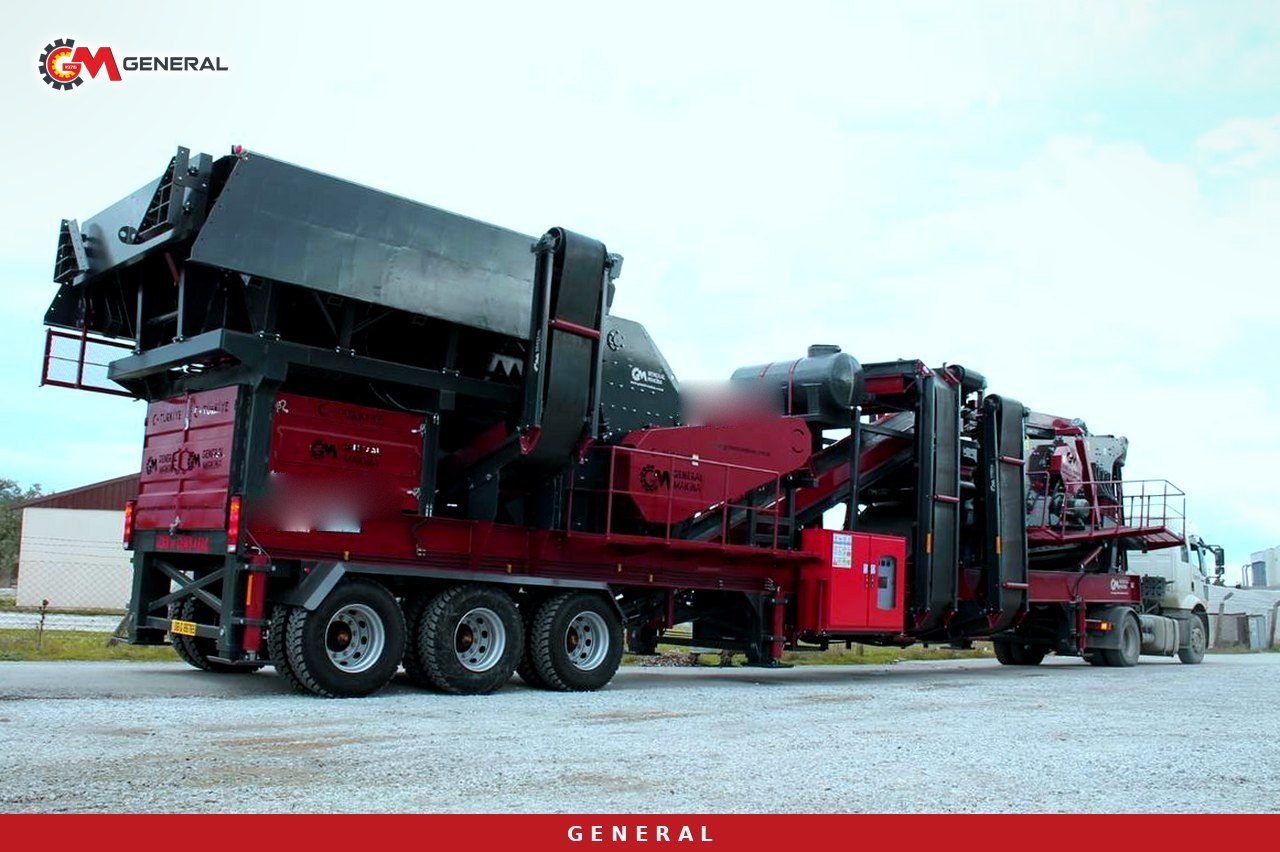
Shipments from Türkiye to Saudi Arabia usually go by sea through one of the ports on the Red Sea or Gulf coast, then by road to site. Points to watch at this stage:
- Compare chassis loading dimensions and axle count with abnormal-load permits along the route from port to site.
- Send screen meshes, spare blow bars and jaw plates with the first shipment; waiting for parts on a remote site is lost tonnage.
- Compact the ground at the set-up point and level the area where support legs will rest.
- Lay out stockpiles so fractions do not mix and prevailing wind does not carry dust towards the camp.
Operating settings for a hot, dusty, off-grid site
Most Saudi road sites are far from the grid, so the plant runs on its own generator. The 750 kVA figure for the General 03 and 660 kVA for the General 02 are sized to carry crusher, screen and conveyor motors together. Because high summer ambient temperatures strain engine and generator cooling, air filter change intervals should be shortened and radiator surfaces cleaned regularly.
Fine dust is a risk for people, bearings and electrical panels alike. Measures that can be selected per project include water-spray dust suppression at feed and transfer points, belt covers at transfers and filtered ventilation for panels. Where water supply is limited, the spray system should use low-flow nozzles focused only on dust-generating points. On sandy, windy days, check at the start of each shift whether screen mesh openings are blinding.
The site file to prepare before asking for a quotation
The right model and configuration depend on the quality of the data the contractor provides. Adding the following to your enquiry speeds up evaluation and reduces later revisions:
- Rock type, abrasion and hardness test results of a quarry sample, and clay content if any.
- Feed size: the largest block after blasting, or the top size of wadi material.
- The fractions required by the specification and the daily target tonnage for each.
- Daily operating hours and number of shifts.
- Energy source: generator, or a possible later grid connection.
- Distance from site to port and transport restrictions on the route.
The main factors behind the quoted price are the chosen model or two-unit combination, screen media and wear-part selection, extra equipment such as dust suppression, and the scope of shipping. A firm figure can therefore only be given once the file above is complete.
Frequently asked questions
Is a single General 03 enough for a Saudi road project?
If the rock is limestone or a similar low-abrasion stone and the daily target sits in the 250-375 t/h band, the General 03 is enough on its own. If the quarry turns out granite or basalt, the paired General 944 and General 950 setup keeps wear costs under control.
Can subbase and asphalt chippings come from the same plant?
Yes, four-deck screens separate 0-5, 5-12, 12-19 and 19-40 mm fractions at the same time. Shape and cleanliness criteria for asphalt chippings must still be tested against the specification; if needed, screen media and crusher setting are optimised for that fraction.
What do the warranty and certificates cover?
General Makina plants carry ISO 9001 and CE certification, with a 1-year warranty excluding wear parts. The company has manufactured in Izmir since 1976, and the Middle East is among its export regions.
How do I find out price and delivery time?
Both depend on the chosen configuration and shipping scope. Once you send your site file, a project-specific quotation and schedule are prepared in writing.
Conclusion
For a Saudi road project targeting 250-375 TPH, the decision starts with the rock. In limestone and low-abrasion stone the General 03 covers the full range on one chassis; in quarries with large blocks the General 02, and in hard, abrasive rock the General 944 and General 950 pair, are the better choice. Where a permanent quarry and higher tonnage are involved, a stationary line should be evaluated. Send your sample test results, fraction targets and site details through our contact page and our engineers will prepare the configuration and quotation that fit your alignment.
Definitions of technical terms: Glossary