EN — English
 TR — Türkçe
 DE — Deutsch
 RU — Русский
 FR — Français
 ES — Español
 AR — العربية
 SR — Српски

Saudi Arabia Giga-Projects Crushing and Screening Plant 300-500 TPH
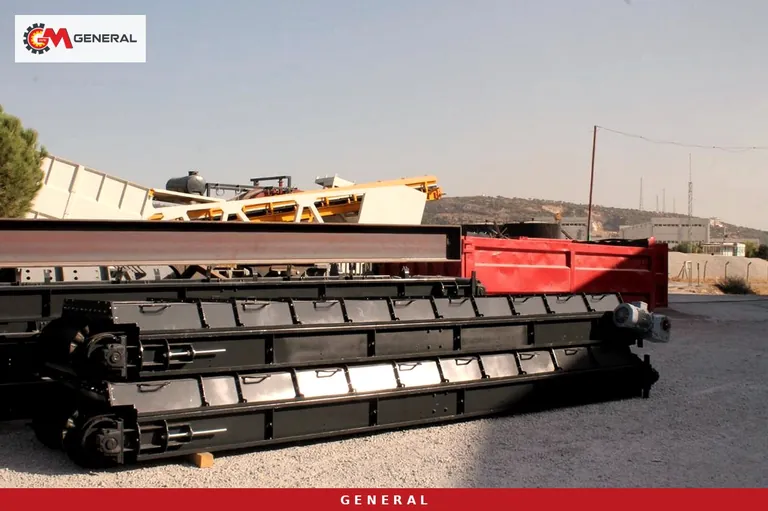
Large construction sites under Saudi Arabia's Vision 2030 push an aggregate buyer towards a different question than routine quarry operation: not how many tonnes a single crusher delivers per hour, but how to build a line that turns out road fill, concrete aggregate and asphalt chippings at the same quality and the same tonnage for months on end. 300-500 TPH is a typical range for this kind of job, and at that throughput the feeder, the screening area and above all the belt conveyor line sit at the centre of the calculation just as much as the crushers do. This article walks through the crusher chain for the two different rock belts of the Arabian Peninsula, the configurations that can be built from real model data, and the details that keep a line running on a desert site.
Every capacity, feed opening and power figure in the text is taken from the model data on our product pages. Project volumes, schedules and quality classes must be confirmed against the specification issued by the relevant authority or the main contractor; the machine selection is finalised against the grading table in that document.
What does a giga-project site demand from an aggregate line?
On a major infrastructure or urban development project, a crushing and screening plant does not work like a stand-alone quarry; it works as one link in the site logistics chain. Concrete batching plants, asphalt plants and earthworks crews all draw from the same stockyard, so one lost shift at the plant means several crews standing idle. In the 300-500 TPH range the design therefore has three priorities:
- Sustained tonnage: what counts is not the top catalogue figure but the net output that remains after maintenance stops are deducted.
- Several products at once: cubical chippings for concrete, sub-base for roads and a fine fraction for asphalt must flow from the same line to separate stockpiles.
- Repeatable quality: specifications usually set limits on particle shape, fines content and grading envelope; crusher type and screen layout are chosen to meet those limits.
The quick way to size the required capacity is: required TPH = daily target tonnes ÷ (operating hours × availability). A hypothetical example: on a line running two shifts for a total of 18 hours with an assumed availability of 0.85, the net time is 15.3 hours; if 6,000 tonnes of saleable product are needed per day, 6,000 ÷ 15.3 ≈ 392 t/h is required. The soil fraction removed at scalping is added on top of that result; this calculation tells you whether the line should be planned at 300 or at 500 TPH.
Arabian Shield versus Arabian Platform: two rock belts, two crusher chains
Geologically, Saudi Arabia divides roughly into two parts, and that split feeds straight into crusher selection. Knowing which belt your quarry sits in answers the first question of the quotation stage.
The west and the Red Sea coast: granite, gneiss and basalt
The Hejaz and Asir highlands are made up of the old igneous and metamorphic rocks of the Arabian Shield; granite, gneiss and the basaltic lava fields known as harrats are widespread here. These rocks are hard and high in silica. For such material a compression-based chain of jaw primary and cone secondary is preferred: manganese steel jaw plates and cone liners keep wear per tonne at a reasonable level. An impact crusher's blow bars are consumed quickly in high-silica rock, which is why an impact-based line is not recommended for western sites.
Central and eastern regions: limestone and dolomite
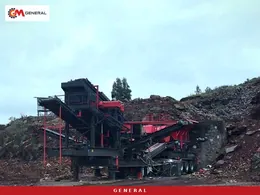
Around Riyadh and in the Eastern Province, the sedimentary layers of the Arabian Platform, namely limestone and dolomite, dominate. In this low-abrasion rock a primary impact crusher delivers a high reduction ratio and cubical particles in a single stage. Our GNR PDK 02 stationary crusher project in Saudi Arabia running at 250 t/h in desert conditions, is a field example of this approach. In every case the decision should rest on abrasiveness and compressive strength tests on a sample from the quarry; even within the same region, rock character changes as the seam changes.
Building a 300-500 TPH line from real models
In this range a single mobile unit can cover the lower limit, while the upper end is only reached with a stationary line or with more than one unit. The table below brings together the product-page values of the models that make up the configurations.
| Stage / role | Model | Capacity | Feed / opening | Power |
|---|---|---|---|---|
| Primary feeding | GNR 140 grizzly feeder | 350-600 t/h | max. 1500 mm | 2×9.2 kW |
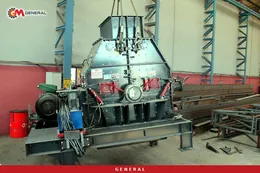
| Hard-rock primary | GNRK 130 jaw crusher | 400-500 t/h | 1300×1000 mm | 160 kW |
| Hard-rock secondary | General cone crusher | — | 50-250 mm feed | — |
| Limestone primary | GNR PDK01 impact crusher | 250-500 t/h | 1000 mm | 315 kW |
| Screening | Twin screen, GNR 2460 body | 100-500 t/h | 2400×6000 mm screen | 22 kW |
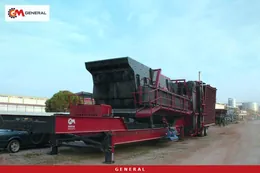
| Mobile option | General 03 | 250-375 t/h | 900 mm | 750 kVA |
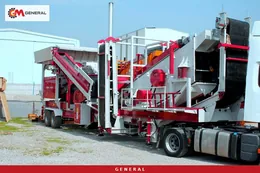
| Mobile option | General 02 | 250-300 t/h | 1000 mm | 660 kVA |
The cone crusher cells are left blank because model-specific capacity and power tables are issued per project. Three configurations follow from the table:
- Stationary hard-rock line for the western belt: GNR 140 feeder + GNRK 130 jaw + cone secondary + twin screen. The jaw crusher's 400-500 t/h range covers the upper part of the target; the number and size of cone crushers are set by the required product curve.
- Limestone line for the eastern belt: with its 250-500 t/h range, the GNR PDK01 primary impact crusher covers most of the target on its own. A twin screen follows it, plus a cubical finishing stage if needed. For details, see the GNR PDK series primary impact crusher page.
- Phased start-up: if the site moves during the first months, start with the General 03 (250-375 t/h) or the General 02 (250-300 t/h); once tonnage grows, add a second unit or a stationary line. Both models have an impact primary, so they suit limestone sites. If a wheeled plant is being considered for hard rock, the General 944 with jaw and cone crushers delivers 120-180 t/h; for a granite requirement approaching 500 t/h, a stationary line is the better route.
To see which configuration fits, compare our stationary crushing and screening lines with our wheeled mobile crushing and screening plants.
The belt conveyor line: the system that actually carries 500 TPH
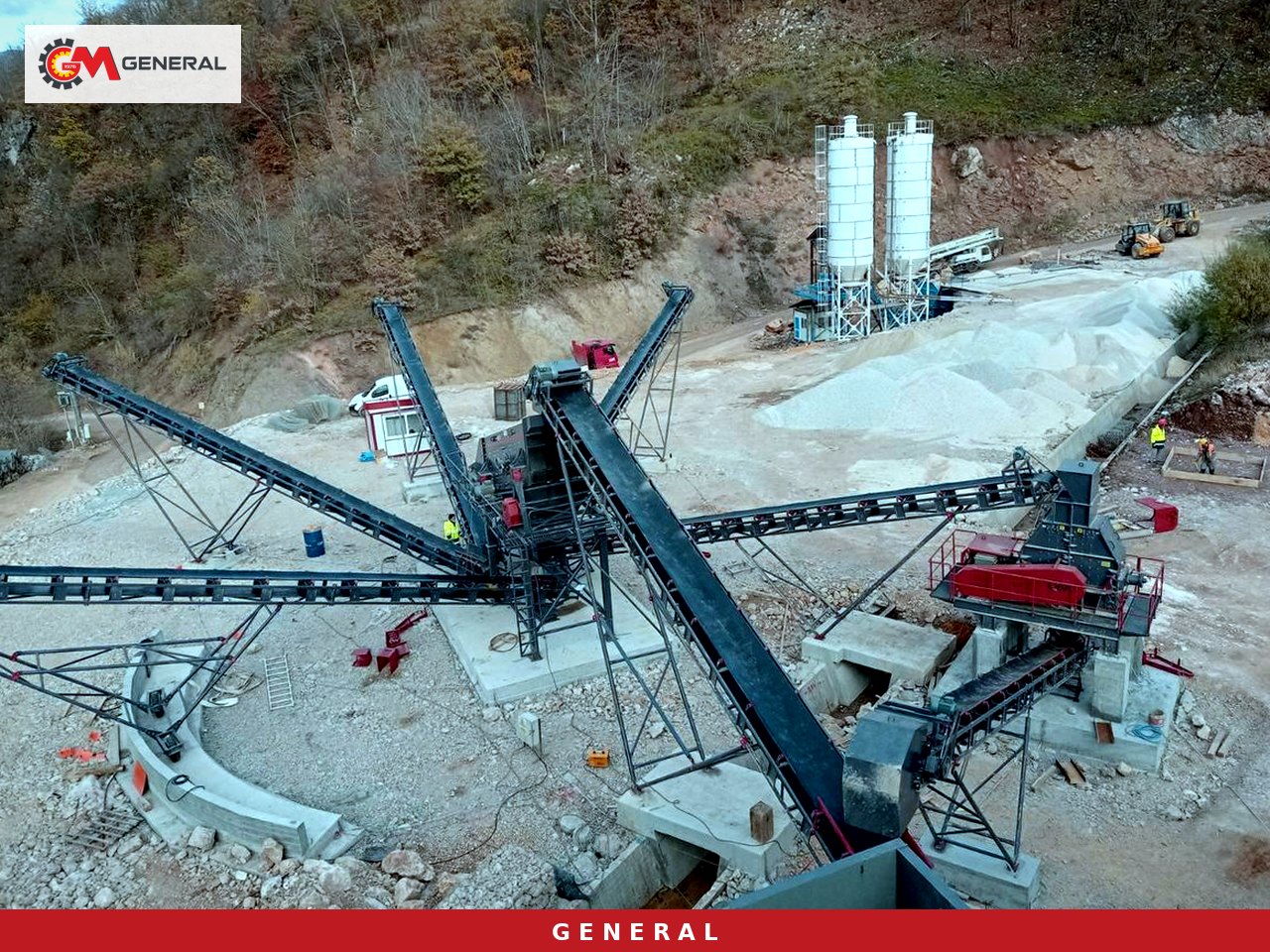
On a high-tonnage line the crushers stand at a few points, while the belts connect everything. If any one of the belts running from the primary crusher to the screen tower, from the screen back to the secondary in the recirculation circuit, and from there to the stockpiles is undersized, the whole line drops to that belt's capacity. The belts we build come in 7 widths between 500 and 1200 mm, at any required length and across a 50-1000 t/h capacity range; that means the 500 TPH main line and the lower-tonnage product belts can be chosen from the same family.
Selecting width, inclination and belt rubber
Belt capacity is set by width, inclination and speed together. As the incline rises the conveyable quantity falls; steep transfers call for chevron belting. Under an impact crusher, EP 125 – 4 ply rubber is used instead of the standard EP 100 – 4 ply, because the falling material carries more energy. On 1000-1200 mm belts the frame plate is 5 mm; carrying idlers are ø76 mm at no more than 1 m spacing, and return idlers are spaced at 3 m. Since the largest particle size the belts carry is 0-250 mm, oversize lumps from the primary crusher discharge must not exceed that limit.
Radial stockpile conveyors and stockyard layout
A giga-project site needs many products, and each fraction must go to its own pile. Radial stockpile conveyors spread the pile along an arc, allowing more stock to be held on the same footprint and moving loader traffic away from the crusher area. For detailed options on the belt line, see our conveyor belt page and the aggregate conveyor systems category.
Sandstorms, heat and power: keeping the line running on a desert site
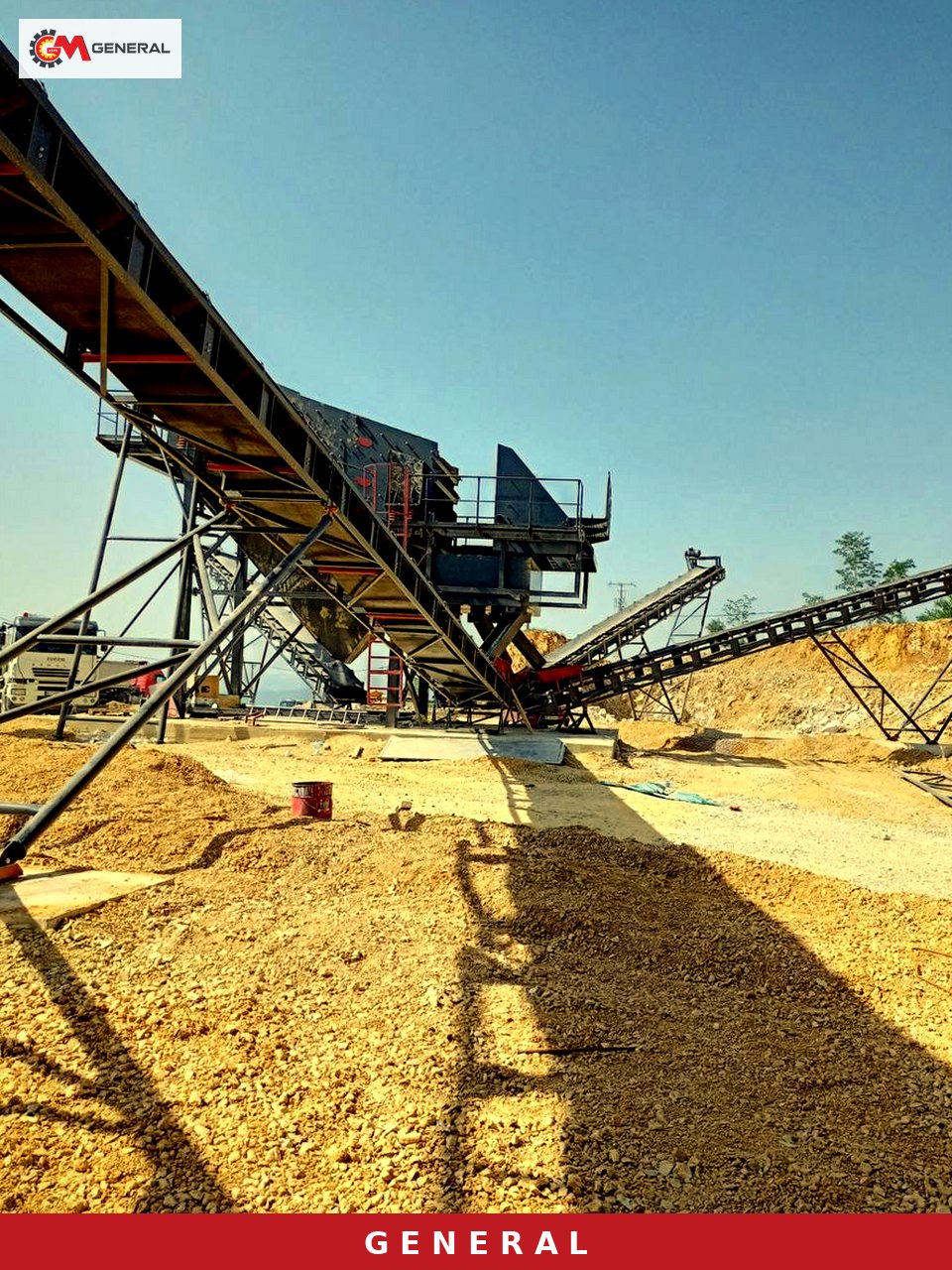
In Saudi Arabia's interior and on its coastal plains, summer heat and wind-borne fine dust are the two factors that strain equipment most. The measures here are selected per project; the points below are those the buyer should pin down in the specification:
- Filtration and cooling: air filters on the generator, crusher motors and hydraulic units head the list of parts to check after a sandstorm. Dust building up on radiator surfaces reduces cooling capacity, so regular cleaning belongs in the maintenance plan.
- Dust suppression: water-spray dust suppression and enclosed transfer chutes at crusher discharge points and belt transfers are required on sites for both worker health and environmental conditions. Water availability determines how this system is sized.
- Power: on sites the grid has not yet reached, wheeled plants run on their own generator: the General 03 carries a 750 kVA power unit and the General 02 a 660 kVA unit. On a stationary line, total installed power is calculated in advance for either a grid connection or a separate generator set.
- Wear parts on hand: keeping spare jaw plates, blow bars, cone liners and screen mesh on site prevents weeks of downtime in a remote area. Our warranty is 1 year and wear parts are excluded, so consumption should be planned from day one.
On the shipping side, Jeddah is the logical port of entry for projects on the Red Sea coast and Dammam for projects on the Gulf side; for road haulage from port to site, the 4-axle chassis of the General 03 complies with international transport standards. A stationary line, by contrast, is shipped in modules and erected on site on concrete foundations.
From specification to quotation: the file to prepare
A sound quotation starts with sound data. Collecting the following before approaching us or any other manufacturer shortens the process considerably:
- Quarry location and which rock belt it lies in; abrasiveness and compressive strength test results on a sample.
- Largest block size after blasting (this sets the feeder and primary opening).
- Required products and the daily tonnage of each; grading and particle shape limits from the specification.
- How many years the plant will stay in one place (the key distinction between a stationary line and a mobile one).
- Power source, water situation and stockyard dimensions.
- Port of delivery and road access to the site.
Frequently asked questions
Which crusher should I choose if the specification calls for cubical concrete aggregate?
In limestone, a primary impact crusher gives cubical particles directly. In granite and basalt, particle shape is improved by running a cone crusher choke-fed after the jaw primary; if needed, a vertical shaft impactor is added as the final stage.
Is 300 TPH production possible on a site without grid power?
Yes. The General 03 and General 02 run on their own power units and produce in the 250-375 t/h and 250-300 t/h ranges respectively. For a stationary line, a separate generator set sized for the total power is planned.
Does it make sense to start with a mobile unit and move to a stationary line later?
Yes, if the site location changes during the first months. The mobile unit gets early production going; once quarry data is clear, the stationary line is built with the same feeder and belt family, and the mobile unit can later be moved to a secondary site.
What determines the quotation amount?
Rock type, number of stages, number of screen decks, total length of the belt line, the power solution and options such as dust suppression. We prepare the figure specifically for your project from the file described above.
Conclusion
For giga-projects in Saudi Arabia, a 300-500 TPH line can be built as a stationary jaw-and-cone chain in the western belt, as a primary impact line in the eastern belt, or with the General 03 / General 02 for a phased start-up. Whichever is chosen, what carries the tonnage all the way through is the feeder, the twin screen and a correctly sized belt line. To work out the right configuration for your site with ISO 9001 and CE certified equipment built in Izmir since 1976, send us your quarry data via our contact page.
Definitions of technical terms: Glossary