EN — English
 TR — Türkçe
 DE — Deutsch
 RU — Русский
 FR — Français
 ES — Español
 AR — العربية
 SR — Српски

Azerbaijan Road & Building Mobile Crushing & Screening Plant 120-180 TPH
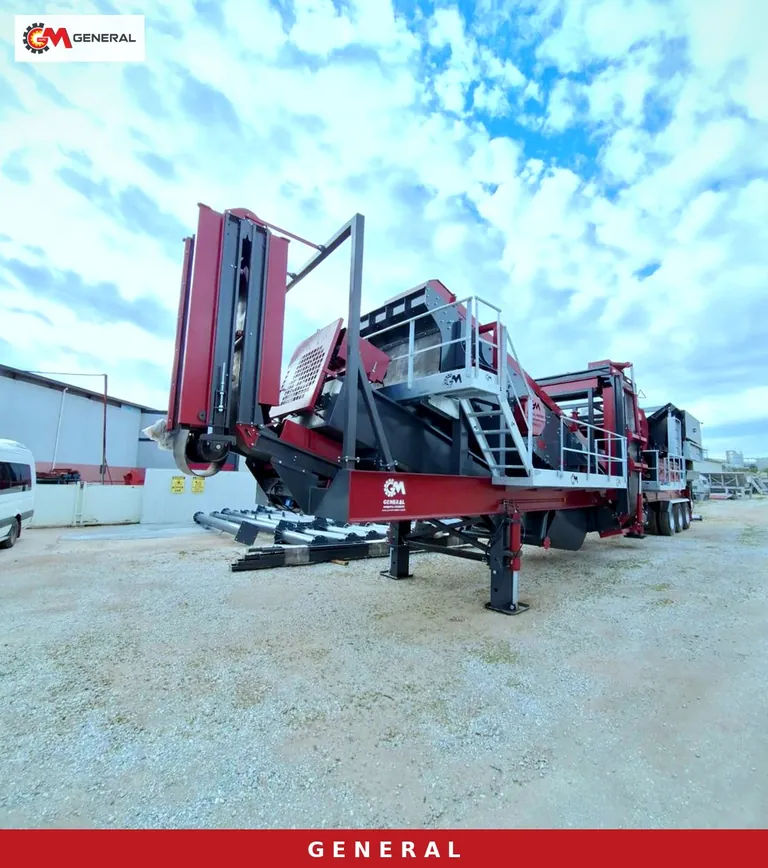
In Azerbaijan a single contractor may have to supply base material to a highway section and concrete aggregate to a housing or public building site within the same year. Even when both jobs draw on the same quarry, they do not want the same product: road layers need well-graded crushed stone and stabilised material, while building concrete expects clean, cubical coarse aggregate and properly graded sand. This article looks at a wheeled mobile crushing and screening plant working in the 120-180 TPH band against Azerbaijan's stone sources, haul route and climate, and weighs real General Makina models against each other. For the volume, layer thicknesses and aggregate requirements of any specific tender, the only valid source is the technical specification issued by the relevant authority; read the recommendations below alongside that document.
From Absheron to the Kura plain: which stone will you crush?
Azerbaijan is a small country, yet its stone varies a lot, and that variety changes the crusher choice directly. On the Absheron peninsula, home to Baku and Sumgait, shelly limestone and weakly cemented sedimentary rocks are common. They break easily and are low in abrasion; on the other hand, their fines content can be high and weak particles cause trouble in concrete.
Alluvium carried by the Kura and Araz rivers is an important gravel source in the lowland part of the country. River gravel is usually rounded, rich in quartz and made of hard particles. The goal here is often less about size reduction and more about turning rounded stones into fractured faces and converting oversize into sand.
On the Lesser Caucasus side, around Ganja and Gazakh and in Nakhchivan, hard rocks of volcanic origin such as andesite and basalt occur. Along the foothills of the Greater Caucasus, gravel beds of mountain streams are worked. Talking about models before the region is fixed leaves the picture incomplete. Hardness and clay content can vary even within one deposit, so we recommend running abrasion and strength tests on a quarry sample before requesting a quotation.
Road work and building work differ: write the product list first
Before any capacity figure, decide which fractions are needed, in what proportions and at what quality. A road section typically needs continuously graded material of around 0-40 mm for sub-base and base, plus separately screened chippings for asphalt layers. On the building side, a ready-mix batching plant draws 0-5 mm sand and 5-12 and 12-19 mm coarse aggregate from separate stockpiles.
For a company handling road and building work together, two features of the line are decisive. The first is the number of screen decks: a four-deck screen also delivers a separate 19-40 mm fraction, whereas on a three-deck screen that size goes to recirculation or into a mixed product. The second is sand quality: the 0-5 mm that naturally falls from the crusher is often fine for road work, but concrete may need more cubical, better-graded sand. That need decides whether the VSI unit described below joins the line.
Three wheeled lines in the 120-180 TPH band
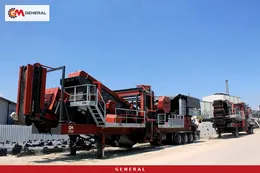
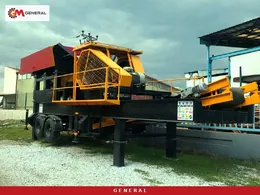
Among General Makina's wheeled mobile crushing plants three models cover this band on a single chassis. All three deliver the same tonnage range; they differ in crushing principle and therefore in the stone they suit.
General 01: a single-crusher answer for limestone and low-abrasion stone
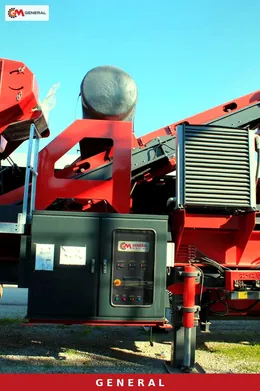
General 01 uses the GPS 1210 impact crusher, which performs primary and secondary work in one body, and accepts feed up to 700 mm. Its 1600×5000 mm four-deck screen separates 0-5 / 5-12 / 12-19 / 19-40 mm at once, a practical advantage for an Absheron quarry that wants both road base and concrete aggregate. Impact crushing gives cubical particles; however, blow bar wear accelerates in quartz-rich gravel and hard volcanic rock.
General 950 and General 944: a jaw primary for hard rock and quartz gravel
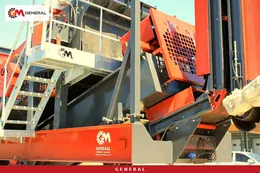
Both models carry a GPJ 90 jaw crusher up front and accept 800 mm feed. General 950 uses a DMK01 impact crusher in the second stage for high reduction and a cubical product. General 944 works on the compression principle with a GM430 cone crusher, which pays off in metal part life in Lesser Caucasus andesite and basalt or in quartz-rich Kura gravel. Both screens are 1600×5000 mm with three decks.
| Item | General 944 | General 950 | General 01 | Mobile VSI tertiary unit |
|---|---|---|---|---|
| Crushing layout | GPJ 90 jaw + GM430 cone | GPJ 90 jaw + DMK01 impact | GPS 1210 impact (primary+secondary) | Vertical shaft impact, rock-on-rock |
| Capacity | 120-180 t/h | 120-180 t/h | 120-180 t/h | 60-250 t/h |
| Max. feed | 800 mm | 800 mm | 700 mm | 0-200 mm |
| Screen | 1600×5000 mm, 3 decks | 1600×5000 mm, 3 decks | 1600×5000 mm, 4 decks | — |
| Product fractions | 0-5 / 5-12 / 12-19 mm | 0-5 / 5-12 / 12-19 mm | 0-5 / 5-12 / 12-19 / 19-40 mm | 0-10 mm manufactured sand |
| Generator | 550 kVA | 600 kVA | 550 kVA | — |
| Weight | 70,000 kg | 70,000 kg | 55,000 kg | — |
| Transport dimensions | 4130×20350×4500 mm | 4130×20350×4500 mm | 4300×18500×4500 mm | — |
A short rule of thumb: General 01 for Absheron limestone, 944 for Kura-Araz gravel and volcanic rock, and 950 for sites with moderately abrasive stone that want both cubical shape and strong reduction. The working principles of each crusher type are explained on the crushers page.
Sand for building concrete: when does adding a VSI make sense?
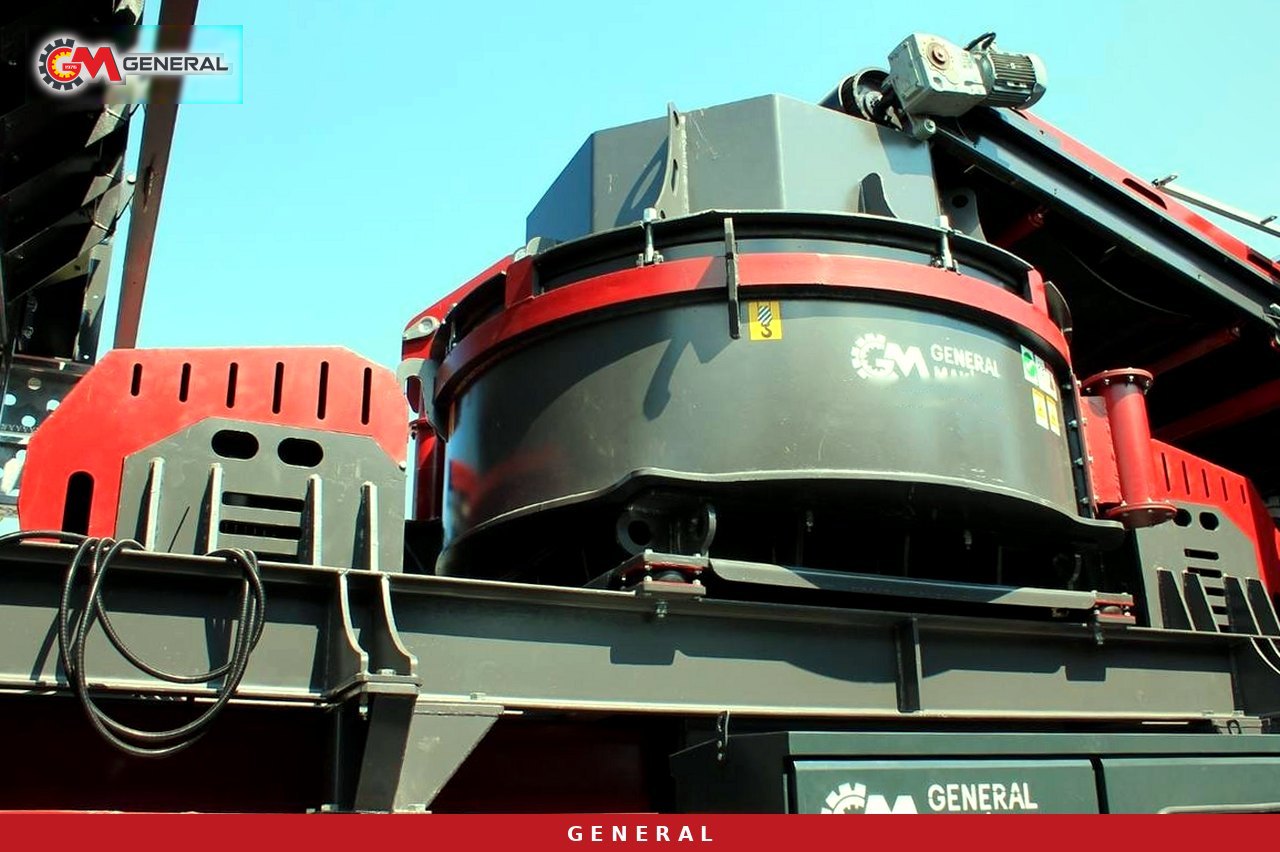
In road work, oversize left on the screen is rarely a problem; it is recirculated or used as fill. Once building work starts, the ready-mix producer asks for particle shape and grading in the sand, and the oversize takes up stockyard space. This is where the mobile VSI tertiary unit comes in: it throws feed of up to 0-200 mm rock-on-rock, converts it into 0-10 mm manufactured sand and runs at 60-250 t/h.
Because river gravel is quartz-rich and abrasive, a rock-on-rock VSI is a sensible choice here; the material strikes the stone bed it builds inside the rotor, so metal surfaces wear less. A VSI has a low reduction ratio; its real job is particle shape and sand production. It therefore does not replace the main line but is connected behind it. If the deposit has high clay content, the crushed sand may also need washing, which should be assessed separately based on sample results.
The Georgian corridor and the Caspian coast: getting the plant to site
A wheeled line travelling from Izmir to Azerbaijan usually moves by road, either through Georgia or via the Nakhchivan link. Mountain passes, bridge limits and gauge rules that require special permits are part of the planning on this route. The weights in the table matter here: General 01 weighs about 55,000 kg, the 944 and 950 about 70,000 kg, all loaded at a height of 4500 mm. Confirm route and permit conditions with your haulier and the competent authorities of the transit countries.
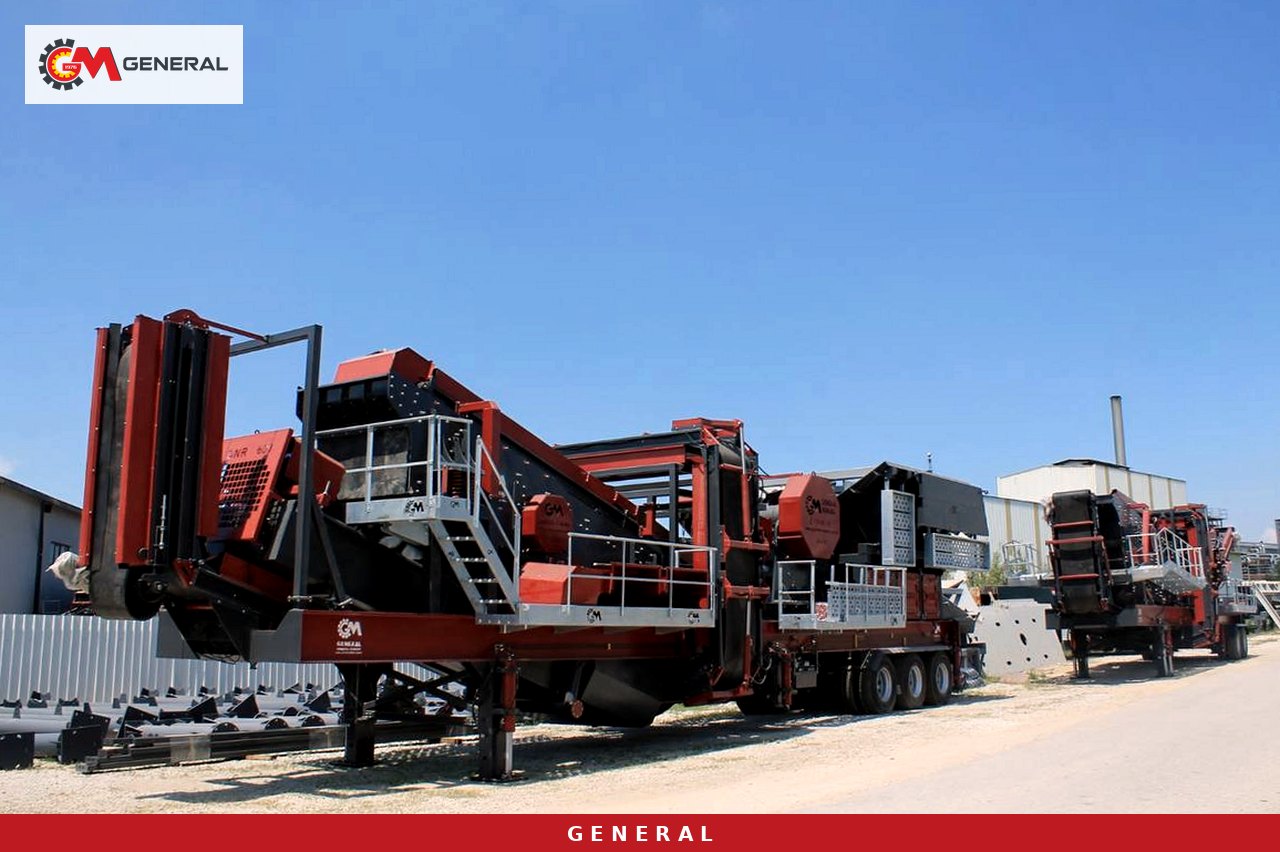
For a contractor doing road and building work together, the real gain of a wheeled chassis is relocation. As the road section advances, the line can be towed to a new quarry point; when the building project starts, it can be shifted to a sand and gravel site closer to the city. The single-chassis layout set up on legs needs no concrete foundation; the ground must simply be compacted and levelled.
Grid power or a generator?
Quarries near cities may be able to connect to the grid; at foothill and riverside sites a generator is often the only option. The generator ratings in the table (550 kVA for the 944 and 01, 600 kVA for the 950) are the starting point for planning fuel logistics and transformer needs at quotation stage.
Caspian wind, scorching plains, snowy mountains: operating measures
Absheron is known for strong winds; fines lift off open stockpiles and product blows off the belts. Summers on the Kura-Araz plain are hot and dusty, while winters in the northern mountain areas are severe. These differences are not solved by one standard package; measures that can be selected per project include:
- Water-spray dust suppression at belt transfer points and the crusher discharge
- Covered or side-screened conveyors on wind-exposed sites
- Dust-rated air filters for the generator and hydraulic unit, with frequent filter service
- Cold-weather protection for oil, fuel and water lines at sites working through winter
- Removing fines ahead of the feeder grizzly in clay-bearing deposits
Information to prepare before requesting a quotation
- Quarry location and stone type: limestone, river gravel or volcanic rock
- Sample test results: abrasion, strength and clay content
- Separate fraction lists for road and building work, plus the daily target tonnage
- Whether concrete sand requires a VSI
- Power source: grid connection or generator
- Site access, ground conditions and planned relocation frequency
- The specification and environmental conditions you must comply with
Frequently asked questions
Can one line produce both road base and concrete aggregate?
Yes, both product groups can be obtained by changing screen and crusher settings. Because General 01 has a four-deck screen that delivers 19-40 mm separately, it is more flexible for this; if higher quality concrete sand is required, a VSI unit is added to the line.
Cone or impact for Kura gravel?
In quartz-rich river gravel, the General 944 with its cone secondary usually stands out for wear part life. The final decision should be based on an abrasion test of the sample.
What do the warranty and certificates cover?
General Makina has been manufacturing in Izmir since 1976; the machines carry ISO 9001 and CE certification and a 1-year warranty excluding wear parts. The Turkic republics are among our export regions; spare parts support is provided to the extent stated on the product pages.
What does the quoted price depend on?
The selected model, screen and crusher configuration, add-on units such as a VSI, the generator, options like dust suppression, and transport terms determine the quotation. Any figure given before these are clear would be misleading.
For a company running road and building work together in Azerbaijan, the right line is chosen first by stone type and then by product list: General 01 for limestone, 944 or 950 for hard and abrasive stone, with a VSI behind them if the concrete sand spec is strict. Send your quarry details and target products through our contact page and we will prepare a suitable configuration and quotation.
Definitions of technical terms: Glossary