EN — English
 TR — Türkçe
 DE — Deutsch
 RU — Русский
 FR — Français
 ES — Español
 AR — العربية
 SR — Српски

Saudi Harrat Volcanic Fields Stone Crushing Plant 200-300 TPH
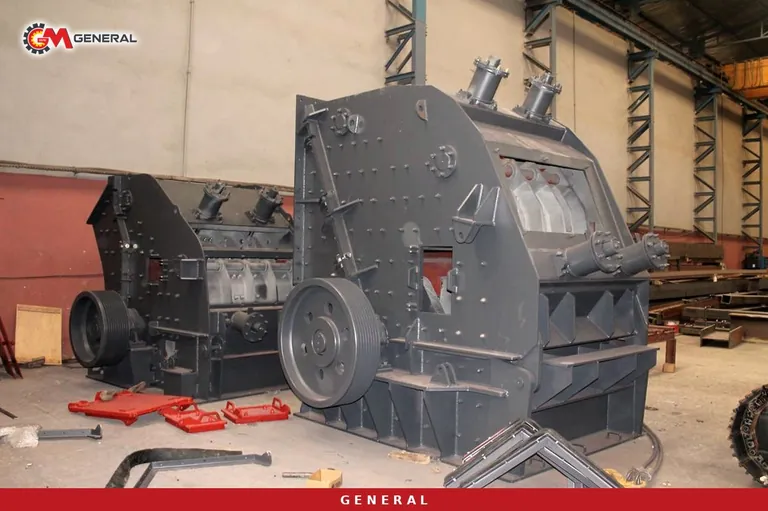
In western Saudi Arabia, running roughly parallel to the Red Sea coast, the harrat fields, vast basaltic lava plains, offer aggregate producers an abundant and strong raw material. Yet an investor preparing to crush this rock at 200-300 tonnes per hour meets a few traps: angular black blocks from the surface of the lava flow, a gas-pocketed crust layer and fine wind-blown sand all end up in the same feed hopper. If the crusher is not chosen for that mix, either the wear-parts bill balloons or the clean, cubical chippings the concrete plant expects never appear. This article walks through the questions to ask when turning harrat basalt into a crushing chain, the real General configurations that fit the 200-300 TPH band, and the site-specific logistics decisions, seen through the eyes of a crushing and screening engineer.
One boundary first: the licence, product specification and work schedule of a quarry opened on Harrat Rahat, Harrat Khaybar or any other lava field belong to the relevant Saudi authority and the project contractor. The assessment below is for machine selection; always confirm grading and quality limits against the project specification.
From lava field to hopper: three faces of harrat rock
At a harrat quarry the material reaching the crusher is not a single type of block; it comes from different layers of the same lava flow. Thinking about these layers separately while drawing up the quarry plan settles half of the machine selection.
Surface blocks and the massive flow core
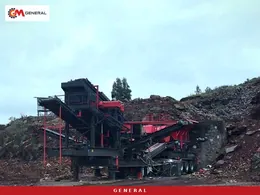
The top of the flow is often covered with angular blocks of all sizes. They can be picked up by loader and fed directly, but their sizes are irregular and pieces approaching one metre bridge in the feed opening. The massive core needs blasting and yields dense, fine-grained, high-strength basalt. This is the material that really defines the crushing chain: core basalt eats metal liners quickly, yet it responds well to compression crushing. Determine the largest block size at the quarry through a sampling study and choose the crusher opening accordingly. The gap between 900 mm and 1000 mm feed size is felt directly in blast design and in how much sorting the loader operator has to do.
Vesicular crust and cinder cones
The upper crust, where the lava released gas as it cooled, has a porous (vesicular) texture. This material breaks easily, but its low bulk density and high water absorption can make it fail a concrete aggregate specification. Cinder (scoria) cones, common on harrat fields, are similarly light and brittle; they can serve as fill or sub-base, but they should be stockpiled separately for jobs that require an abrasion test. Practical advice: do not mix vesicular crust and massive core at random on the same line. Decide in the production plan which layer goes to which product, and have water absorption, Los Angeles abrasion and compressive strength tests run separately for each layer.
Working back from the product list to the 200-300 TPH target
Hourly tonnage alone does not select a machine; the split of that tonnage into fractions does. General mobile plants in this class deliver four products (0-5, 5-12, 12-19 and 19-40 mm), while the General 944 works with three fractions (0-5, 5-12, 12-19 mm). In a contract weighted towards road sub-base, the coarse fraction dominates and primary crusher capacity becomes the limit. If concrete and asphalt aggregate is to be sold, the share of 0-5 and 5-12 mm grows, and then the reduction power of the secondary crusher and the screen area become the bottleneck.
Follow this order in the calculation: first establish the annual fraction demand of the site or buyer, then divide it by daily operating hours to obtain hourly product tonnage, and finally add the pre-screening loss coming from vesicular crust and soil-laden surface material. A hypothetical example: if 220 tonnes of product per hour are required and roughly one tenth is removed at pre-screening, the feeder must receive about 245 tonnes per hour. That lands in the middle of the 200-300 TPH band and shows that a configuration running without hitting its ceiling is needed. A plant permanently working at the top of its band wears liners and screen meshes needlessly fast in basalt.
Five real configurations that cover the band
The table below is built from the values on General product pages. Cells marked with a dash are values not published on the product page; they are fixed at the order stage according to the rock to be processed.
| Configuration | Capacity (t/h) | Max. feed | Crushing chain | Screen | Generator | Weight |
|---|---|---|---|---|---|---|
| GNR-MC110, twin wheeled chassis | 200-300 | 900 mm | GPJ 110 jaw + GS1215/DMK03 impact | 2000×6000 mm, 4 decks | 750 kVA | 2 × 55,000 kg |
| General 02, single chassis | 250-300 | 1000 mm | GPS 1413 impact (primary + secondary) | 2000×5000 mm, 4 decks | 660 kVA | 76,000 kg |
| General 03, 4-axle chassis | 250-375 | 900 mm | GPS 1415 impact (primary + secondary) | 2400×5000 mm, 4 decks | 750 kVA | — |
| 2 × General 944 in parallel | 2 × 120-180 | 800 mm | GPJ 90 jaw + GM430 cone in each unit | 1600×5000 mm, 3-deck horizontal per unit | 2 × 550 kVA | 2 × 70,000 kg |
| Stationary line: GNR 110 feeder + GNRK 110 jaw + GNR DMK03 impact + GNRTK-2060 screen | 200-300 | Jaw opening 1100×850 mm | Jaw primary + impact secondary | 2000×6000 mm, 3 decks | — | — |
Single-chassis impact plants: General 02 and General 03
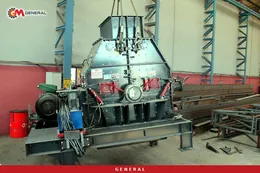
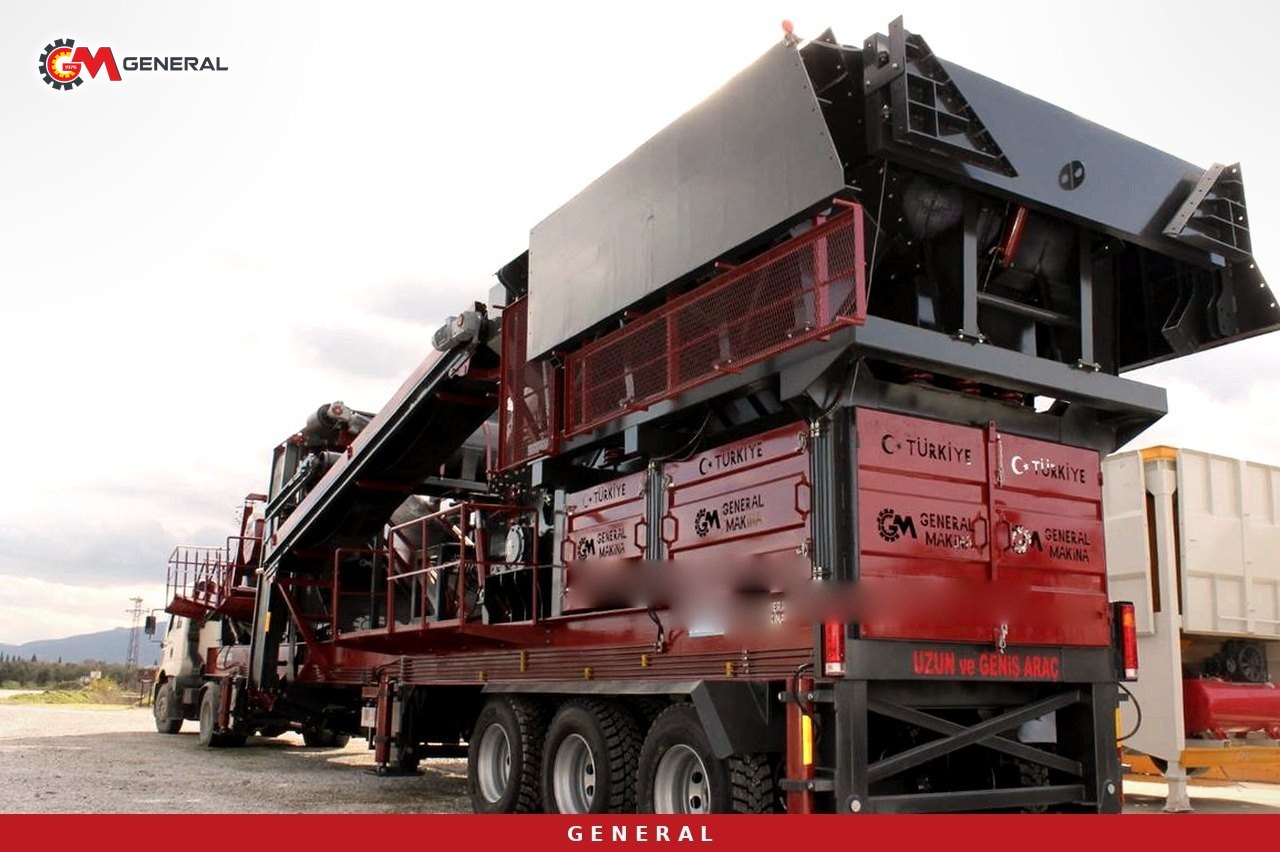
The GPS series impact crusher handles primary and secondary duty in one body, so the General 02 and 03 arrive on site on a single chassis and installation and relocation are shorter. The 1000 mm feed opening of the General 02 reduces the sorting effort on large surface blocks. The General 03 offers more screening area for the fine fractions with its 2400 mm wide screen, and with an upper limit reaching 375 t/h it meets the 300 t/h target without strain. The price to pay: an impact crusher consumes blow bars and impact plates faster than compression crushers in massive basalt. If the feed is mainly vesicular crust and mixed surface material, this disadvantage shrinks noticeably.
Jaw primary up front: GNR-MC110 and parallel General 944 units
The GNR-MC110 first reduces large, hard blocks by compression in the GPJ 110 jaw crusher, then shapes them cubically in the DMK03 impact crusher. Because the rock reaching the impactor has already been reduced, the load on the impact parts is lighter. As the two chassis can run independently, it is possible to produce sub-base with the primary group alone in the first period and bring the secondary chassis in later. For an investor who wants to minimise metal consumption in massive core basalt, the other option is to run two General 944 units in parallel: each carries a GPJ 90 jaw and a GM430 cone crusher, and the cone extends liner life in abrasive rock through its compression principle. The parallel layout also keeps the line from stopping completely while one unit is in maintenance; in return it needs two generators, two control panels and a wider site layout.
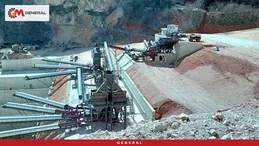
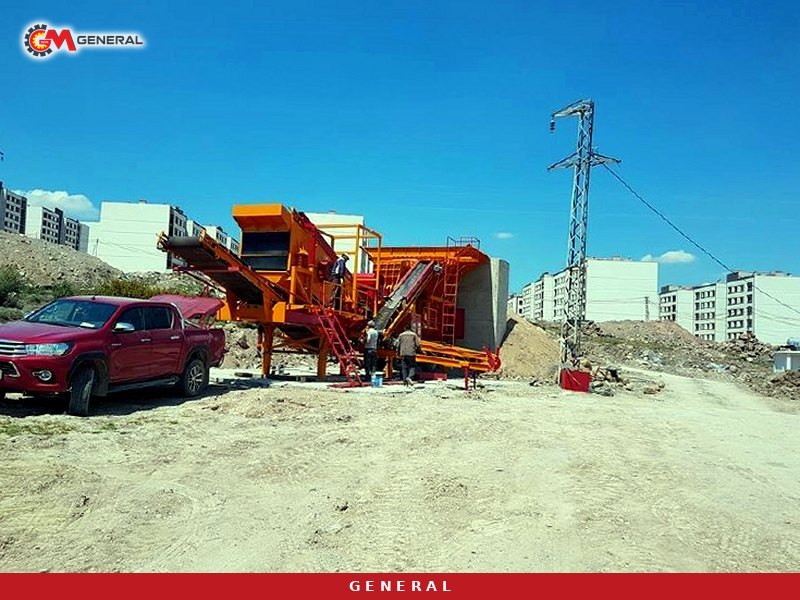
If quarry life is long and production will stay at the same spot for years, a line on concrete foundations should be considered instead of a mobile plant. In the stationary combination in the table, the GNR 110 feeder pre-screens the 200-300 t/h flow through its grizzly by-pass, the GNRK 110 jaw takes large blocks through its 1100×850 mm opening, and the GNR DMK03 delivers the cubical shape. See the stationary crushing plants page for details of this set-up, and the mobile stone crushers page for sites that need to relocate.
Wear in basalt: which part runs out in which crusher?
In harrat basalt, wear parts drive operating cost as much as energy does. Each crusher type has its own wear zone, and the stock plan should follow it.
Jaw plates and cone liners
In a jaw crusher, wear concentrates in the lower third of the plates. Cast manganese jaw plates can be turned over to gain a second life; this should be done before the plate profile flattens completely. In a cone crusher, mantle and concave liners wear more evenly when the chamber is kept choke-fed. A line that feeds the cone intermittently wears its liners earlier at the same tonnage.
Blow bars and impact plates
In an impact crusher, blow bar wear shows up directly in product shape: a worn bar produces fewer cubical and more flaky particles. In massive basalt, settle rotor tip speed, feed size and bar material together with a sample test. Removing wind-blown fine sand at the grizzly pre-screen extends the life of both crusher liners and conveyor belts. At a remote harrat quarry, keeping the fastest-wearing parts in stock on site prevents the line from waiting during the time between order and delivery; use the spare parts page for the parts list.
Desert climate, remote sites and the shipping plan
Most harrat fields lie far from settlements and a grid connection is not always possible. In that case the generator is chosen together with the plant: product pages list 750 kVA for the GNR-MC110 and General 03, 660 kVA for the General 02, and 550 kVA per unit for the General 944. In hot, dusty air the cleaning interval for radiator cores and air filters shortens; write a daily filter check into the shift plan. Water spray nozzles for dust suppression and enclosed conveyor covers are measures that can be selected per project; investigate early whether the quarry has enough water for them.
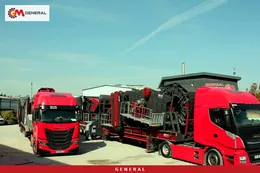
On the shipping side, a route is drawn by sea from Turkey to Red Sea ports and then by road to site. The 4-axle chassis of the General 03 is designed to the international transport standard, while the two separate chassis of the GNR-MC110 split the total weight into two loads. The last kilometres to the lava fields are often rough tracks; have the lowbed route and the bearing capacity of the installation ground checked beforehand. For a sense of working conditions in the region, see our project page on the 250 t/h GNR PDK 02 stationary crusher in Saudi desert conditions.
The site file to prepare before requesting a quote
How quickly the right configuration emerges depends on how complete the buyer's data is. For a harrat quarry, prepare this list:
- Rock samples taken separately from the massive core and the vesicular crust, with laboratory results.
- The largest block size expected after blasting or loader collection.
- Product shares by fraction (0-5, 5-12, 12-19, 19-40 mm) and target hourly product tonnage.
- Daily operating hours and shift pattern.
- Energy source: distance to the grid or generator preference.
- Water source available for dust suppression and equipment cleaning.
- Port-to-site transport route and the condition of the last kilometres.
- Grading, shape and abrasion limits in the project specification.
- Quarry life and preference for a mobile or stationary line.
Our article on choosing a mobile crushing plant for basalt and granite complements this list with a detailed crusher-type comparison.
Frequently asked questions
Should harrat basalt go through an impact plant or a jaw-cone line?
If the feed comes mainly from massive core basalt, a jaw primary with a cone secondary lowers metal consumption. If vesicular crust and mixed surface material dominate and cubical shape is the priority, single-chassis GPS impact plants offer a simpler solution. The decision should rest on laboratory results.
Can a single mobile plant reach 300 t/h?
Yes. According to the product pages, the General 02 is rated at 250-300 t/h, the General 03 at 250-375 t/h and the GNR-MC110 at 200-300 t/h. The real figure varies with rock hardness, feed size and the required fraction split.
Can vesicular lava rock be used as concrete aggregate?
It can if its water absorption and abrasion values meet the specification; if not, stockpiling it separately for fill and sub-base is the better choice. The project specification and laboratory tests decide which use is appropriate.
How are price and delivery time determined?
The configuration, any additional crusher or screen, the generator, dust measures and the shipping route are the main items that set the price. Delivery time is fixed in the quotation according to the production schedule at the time of order.
Conclusion
The right order for setting up a 200-300 TPH stone crushing plant on the harrat fields is to understand the lava layers first, then work back from the product list to the tonnage, and only then choose between a single-chassis impact plant and a jaw-cone twin-unit layout. General Makina, manufacturing in Izmir since 1976, supplies its ISO 9001 and CE certified plants with a 1-year warranty (wear parts excluded). Send us your sample results and product list via our contact page and we will work out the right configuration for your harrat quarry together.
Definitions of technical terms: Glossary