EN — English
 TR — Türkçe
 DE — Deutsch
 RU — Русский
 FR — Français
 ES — Español
 AR — العربية
 SR — Српски

Angola Diamond Fields Heavy-Duty Stone Crushing Plant 250-450 TPH
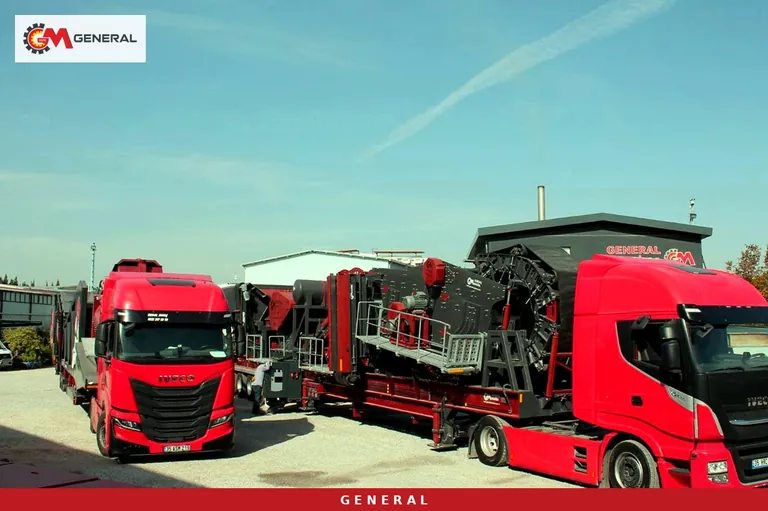
An operator buying a crusher for Angola's north-eastern diamond belt, across the provinces of Lunda Norte and Lunda Sul, faces a question that never comes up in a road-stone quarry: will the machine reduce the rock enough, or will it also break the valuable grain inside and destroy its value? In an aggregate quarry, the finer and more cubical the product, the better. In kimberlite ore, every bit of unnecessary crushing is lost money. A heavy-duty stone crushing plant rated at 250-450 TPH therefore has to be chosen not on tonnage alone but on crushing principle, closed side setting and behaviour with clay. This article explains which crushers suit kimberlite and country-rock feed, which models fit this range according to the real figures on our product pages, and how to keep the line running at a remote mine site.
We give no information on any specific licence area, operator or ore evaluation report. The target grain size, the closed side setting limit and site safety rules must be confirmed in the technical specification of the mine operator and the relevant authority; the recommendations below concern the selection of crushing and screening equipment. Dense media separation and final recovery units are outside the scope of this article.
The crusher's job in kimberlite: open the rock, protect the grain
Diamond is extremely hard but brittle; a sudden impact can split it along its cleavage planes. In a diamondiferous ore line the goal is therefore to crush just enough to liberate the grain from the surrounding rock, and no further. In practice that becomes two rules. First, the crusher's closed side setting (CSS) is kept above the largest grain size the operation wants to recover; that limit is a number set by the ore evaluation, not by the machine manufacturer. Second, machines that break material by compression are preferred over those that break it by throwing it at high speed. Jaw and cone crushers are the natural core of the ore line for this reason; rotor impact crushers are kept away from it.
The reduction ratio also needs to be spread across stages. Demanding a very high reduction from a single crusher holds the grain in the compression zone for longer. A two-stage layout with moderate reduction at each stage protects the grain and balances the life of jaw and cone liners.
Why does the feed change every shift in the Lunda belt?
Kimberlite pipes are heavily weathered near the surface. With depth the rock becomes fresher and harder, and its crushing behaviour changes. The country rock around the pipe is a different material altogether. Because an excavator cannot always separate these zones, the pile arriving at the crusher changes character several times a day.
Weathered upper zone: clayey, wet and sticky
Weathered kimberlite, known to miners as "yellow ground", has largely turned to clay. The rainy season in the region is long; during it the material balls up, sticks between the bars of a fixed grizzly and builds layers in the jaw cavity. For this zone the key decision is made at the feeder, before the crusher: rotating shafts with elliptical discs remove clay and fines from below while cleaning themselves, and keep material flowing where a grizzly feeder blinds.
Fresh kimberlite and country rock: hard blocks, large slabs
"Blue ground" at deeper levels is harder; the large blocks produced by blasting decide the size of the jaw opening. Dolerite dykes cutting the pipe and the surrounding gneiss-granite basement are harder and more abrasive still. Part of this material is processed not as ore but as overburden or road material. This is where "heavy duty" becomes concrete: manganese jaw plates, a feed opening large enough to grip the biggest block, and protection against tramp metal such as drill bits and bucket teeth.
The alluvial deposits of the Cuango and Chicapa valleys are a different case. There the gravel is already free; the need is less to crush and more to break up clay and classify. The main equipment for such deposits is a washer and a screen, not a crusher; oversize gravel passes through a jaw only when needed.
Matching crusher and feeder to 250-450 TPH
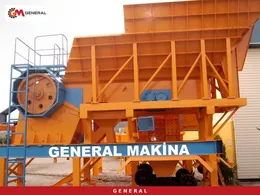
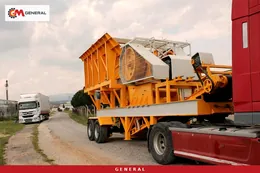
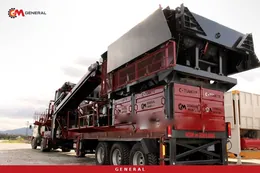
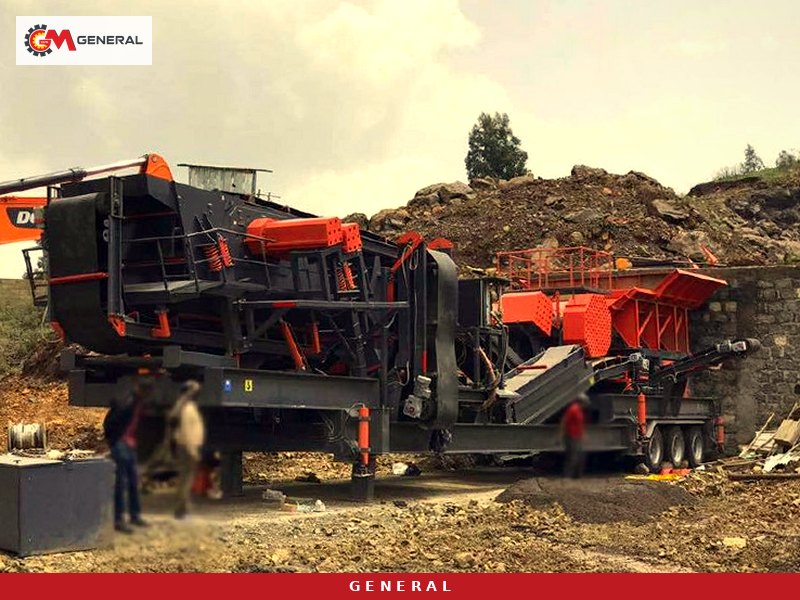
The range in the title can be met in two different ways depending on the clay content on site. If clayey feed dominates, a single-chassis mobile jaw unit with a wobbler feeder comes first: our product page lists 250-450 t/h for the mobile jaw crushing unit with wobbler feeder and it is the jaw-primary option that covers the whole range on one machine. If hard blocks dominate and the same pit will be worked for many years, a stationary primary station built around a GNRK series jaw crusher makes more sense.
| Model / configuration | Capacity (t/h) | Opening / max. feed | Output (mm) | Power | Role in the line |
|---|---|---|---|---|---|
| Mobile jaw unit with wobbler feeder | 250-450 | — | — | — | Clayey upper zone, primary + pre-screening on one chassis |
| GNRK 110 jaw crusher | 200-350 | 1100×850 mm | 150-225 | 110/132 kW | Lower half of the range, stationary primary |
| GNRK 130 jaw crusher | 400-500 | 1300×1000 mm | 125-250 | 160 kW | Above 400 t/h, large fresh kimberlite blocks |
| GNR 140 grizzly feeder | 350-600 | 1500 mm | — | 2×9.2 kW | Ahead of GNRK 130 in the dry season |
| GWB1136 wobbler feeder | 75-600 | 1500 mm | — | 18.5 kW | Ahead of the stationary line with clayey feed |
| General 950 (country-rock aggregate) | 120-180 | 800 mm | 0-100 | 600 kVA generator | Non-ore line: haul roads and concrete aggregate |
The gap between GNRK 110 and GNRK 130 calls for a decision at a 350-400 t/h target. The larger model can be chosen and run at a lower tonnage through feed rate and setting; this is the preferred route in an ore line, because the wide opening takes large blocks without bridging and the crusher runs without strain. The other route is to split the tonnage between two parallel primaries; one line keeps producing while the other is under maintenance, which is a real advantage at a remote site.
Two site types, two line layouts
Clayey open pit: wobbler-fed mobile primary plus washing
In a pit where the weathered zone dominates, the layout can be: a truck-fed mobile jaw unit with wobbler feeder, followed by a log washer that breaks clay mechanically, and a classifying screen. The log washer accepts 0-200 mm feed and works at 50-250 t/h, so two units in parallel should be planned for a 450 t/h target. The benefit of a mobile primary is that the line can follow the advancing face, shortening truck haul and easing the load on site roads that deteriorate in the rainy season.
Fresh kimberlite above 400 TPH: stationary primary station
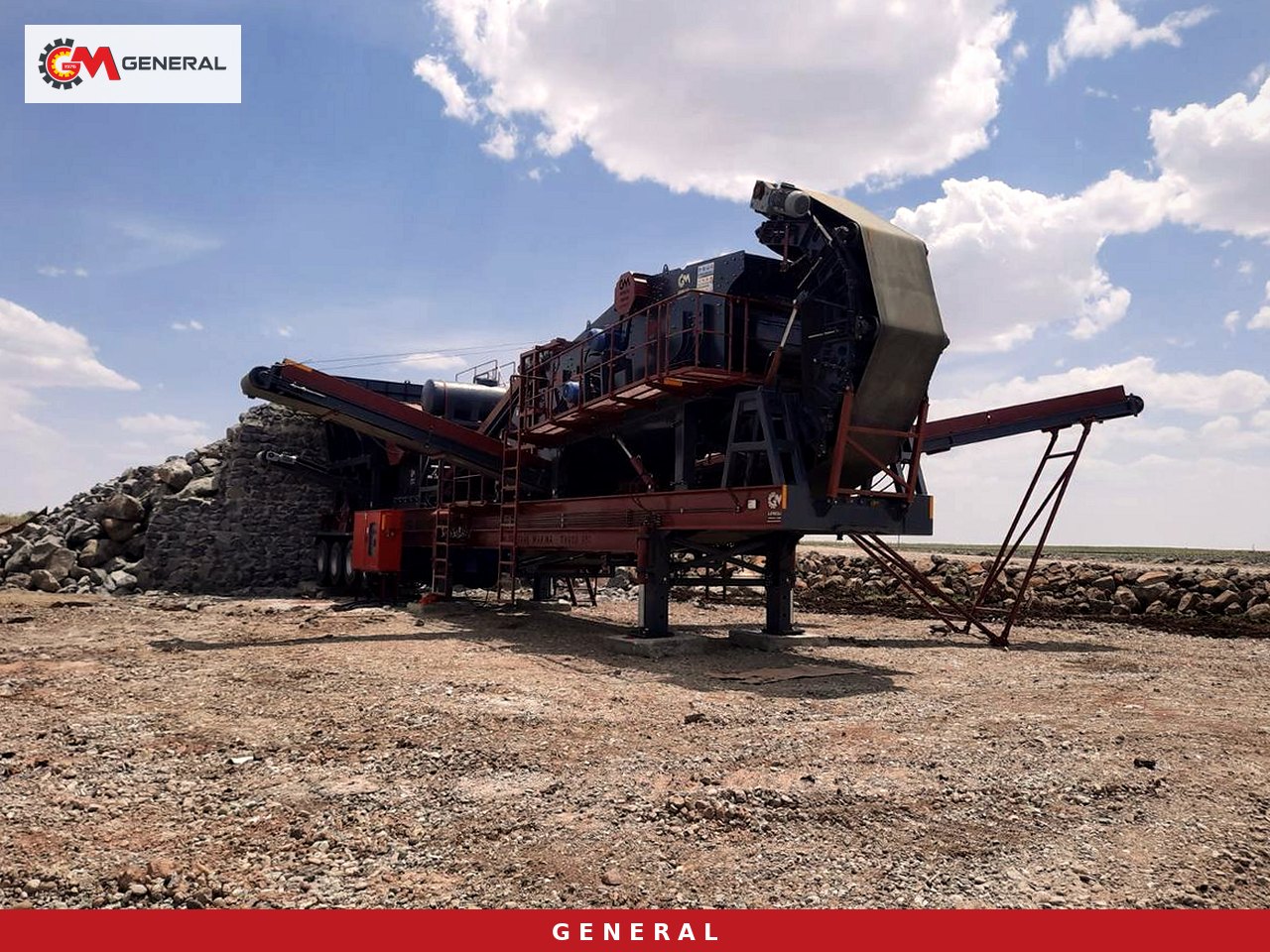
In a long-life pit that has reached deeper levels, a station with a GNRK 130 jaw crusher on a concrete foundation should be considered. In the dry season a GNR 140 grizzly feeder sits in front of it; when clay content rises, a GWB1136 wobbler feeder takes its place. In the second stage a cone crusher runs at a wide setting; its compression principle reduces the material without subjecting the grain to needless impact. As model-specific capacity and CSS figures for the cone crusher are given per project, this stage is sized at quotation stage from an ore sample. All fixed-line options are on the stationary crushing plants page.
Where does an impact crusher fit, and where not?
An impact crusher's high reduction and cubical product are valuable for aggregate; in a kimberlite ore line they raise the risk of breaking the grain. Our advice is therefore to use rotor crushers only on material that carries no ore. On diamond fields this is not a minor job: hard country rock from stripping can be turned into aggregate for haul roads, camps and plant foundations.
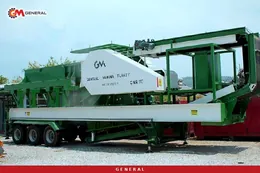
For this side line the General 950 is a suitable candidate: it carries a GPJ 90 jaw primary and a DMK01 impact secondary on one chassis, accepts 800 mm feed and produces 120-180 t/h. If country-rock tonnage is high, two units can be planned together. Because it works on the same site as the ore line, the stockpiles, conveyors and truck routes of the two lines must be kept strictly apart.
Keeping the line running at a remote mine site
Sites in the Lunda provinces are reached by long road haulage from the ports of Luanda and Lobito. Equipment arrives at the port by sea and continues on heavy-haul trucks, so machine dimensions and weights must be checked against the route before ordering. Off-grid sites draw power from generators; dry-season dust calls for frequent checks of air filters and cooling. Access rules on diamond sites are strict, so site entry for the installation and commissioning team must be agreed with the operator in advance.
Information to collect from site before ordering:
- The largest grain size to be recovered, from the ore evaluation, and the smallest closed side setting allowed as a result
- The share of weathered and fresh kimberlite in the pit, and clay and moisture conditions in the rainy season
- Largest block size after blasting (a few weeks of measurement records)
- Laboratory abrasion and compressive strength results for country rock and dolerite
- Hourly and annual target tonnage, shift pattern and need for redundancy
- Power source, water availability and wash-water recovery requirements
- Bridge, bend and height limits along the route from port to site
Wear parts must be stocked to a plan at a remote site: we recommend a spare set of jaw plates, cone liners, grizzly bars and washer paddles with the first shipment. Our machines carry ISO 9001 and CE certification; the warranty period is 1 year, excluding wear parts. You can compare primary options and portable units in the portable rock crushers category.
Frequently asked questions
Why a jaw primary rather than an impact crusher for kimberlite?
A jaw crusher breaks material by compressing it between two jaws and holds the closed side setting limit. An impact crusher throws material at high speed, which raises both the risk of grain breakage and the share of fines. Using jaw and cone crushers in the ore line, and impact crushers for non-ore aggregate, is the sounder split.
Will weathered kimberlite stop the line in the rainy season?
A line running on a grizzly feeder can expect capacity loss and blockages. A wobbler feeder keeps material flowing in this period because its rotating shafts separate clay and fines; the log washer that follows breaks up the lumps. In pits with high clay content both should be planned from the start.
Is a single unit enough for 450 TPH?
The mobile jaw unit with wobbler feeder covers 250-450 t/h on one chassis; the GNRK 130 delivers 400-500 t/h. If a breakdown at a remote site must not stop all production, splitting the tonnage between two parallel primaries should be considered.
What determines the price and scope of supply?
The choice of primary and secondary crusher, feeder type, washing needs, generator, conveyor lengths, spare wear set and the transport route set the price. The quotation is prepared from a site sample and the data in the list above.
Conclusion
On Angola's diamond fields the right crusher is not the one that crushes most, but the one that opens the rock enough while protecting the grain. A wobbler-fed mobile jaw unit and log washer in the clayey upper zone, a GNRK 130 with a wide-set cone crusher in fresh kimberlite, and a separate General 950 line for country rock form a sound framework. Share your site data and we will refine the right layout together: contact us for a quotation and technical discussion.
Definitions of technical terms: Glossary