EN — English
 TR — Türkçe
 DE — Deutsch
 RU — Русский
 FR — Français
 ES — Español
 AR — العربية
 SR — Српски

Saudi Desert Dust-Controlled Stone Crusher Plant Setup 200-300 TPH
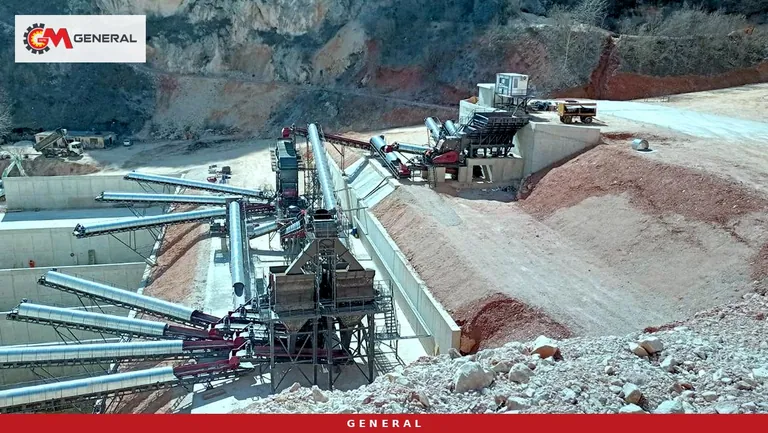
When a 200-300 TPH aggregate plant is planned for Saudi Arabia, the first question is usually capacity. On site, a second question decides the job: where is the fine dust generated, and how will you keep it inside the line? Whether the plant sits in a limestone quarry on the Najd plateau, on a granite slope in the Hejaz mountains or at the edge of a basalt lava field (harrat), dust affects the environmental permit, bearing and control-panel life, and the cleanliness of the aggregate that goes to the batching plant. This article compares real configurations that meet the 200-300 TPH target, using published figures, and walks through dust control from machine selection to the site layout.
Note: the aggregate specification, grading limits and environmental conditions of any particular infrastructure job in Riyadh, Jeddah or the Eastern Province belong to the relevant authority and contractor. The recommendations below cover the machinery side; always confirm the project specification against the authority's tender documents.
Before the setup: rock, wind and water
Saudi Arabia is not a single-rock country. Sedimentary limestone and dolomite are common in the central and eastern regions, while granite, gneiss and basalt linked to the Arabian Shield dominate in the west. This split changes the backbone of the plant. In limestone an impact crusher delivers a high reduction ratio in one stage; in high-silica granite and basalt its blow bars wear quickly and a jaw + cone arrangement makes more sense. No model should be fixed before abrasiveness and compressive strength tests have been run on a sample from your quarry.
The second corner is wind. On a desert site the prevailing wind direction decides where the crusher, the screen and the stockpiles go relative to one another. The third corner is water: in a quarry with limited water, dust suppression has to rely on enclosing the points where dust is born and on targeted spraying rather than continuous wetting. The clearer these three inputs are at quotation stage, the fewer revisions the layout will need.
Where does dust form in the line?
The dust sources in a crushing and screening plant are well known, and each needs a different answer:
- Truck tipping and the feed hopper: a cloud rises the moment run-of-mine rock drops. A wind screen on the hopper edge and a spray bar that runs during tipping can be added per project.
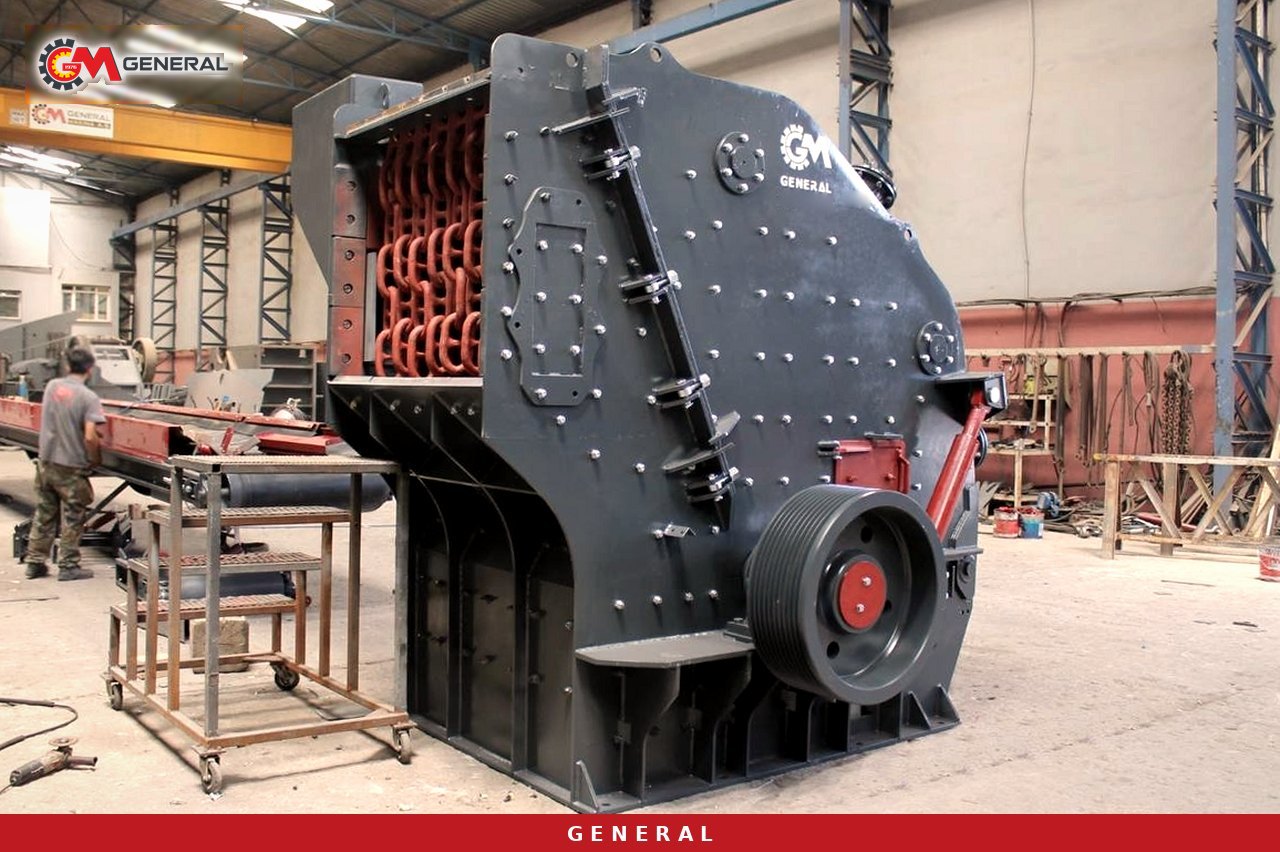
- Primary crusher inlet and outlet: in an impact crusher, fines thrown by the rotor can kick back out of the mouth; a chain curtain at the feed opening limits this.
- Belt transfer points: the higher the drop from one belt to the next, the more dust. Short drops, enclosed chutes and scrapers are low-cost yet highly effective measures.
- Screen decks and under-screen area: dry fines become airborne here; a canvas or sheet-metal cover over the screen can be chosen per project.
- Stockpiles: 0-5 mm material falling freely from the top of a conical pile is carried off by wind; bringing the stacker discharge closer to the pile shortens the drop.
The key point in this list: most of the dust comes not from the crusher itself but from the points where material falls and changes hands. Dust control is therefore part of the layout design, not an accessory.
Machine choices that cut dust at source
Preventing dust, or separating it before it reaches the crusher, is more sensible for operations than suppressing it afterwards. Three design decisions stand out.
Removing fines up front with a grizzly feeder
A vibrating grizzly feeder uses its by-pass section to remove fines and soil before they enter the crusher. The primary crusher then does not grind material that is already small, which cuts both wasted crushing energy and the extra dust generated inside the rotor. For the target range, the GNR 110 feeder (1100×4750 mm pan, 200-300 TPH, 2×7.5 kW) is the right size. The by-pass fraction can be sent on a separate belt to stock or to a fill-material pile, so the dust-laden material leaves the main flow at the very start.
Matching the crushing principle to the rock
A cone crusher working by compression produces fewer fines and less dust than an impact crusher in hard, abrasive rock. If granite or basalt is to be processed, placing a cone secondary behind a jaw primary lowers both wear cost and dust share. In limestone the cubical-product advantage of the impact crusher wins; there the dust load is managed with enclosed transfers and targeted spraying.
Letting automation control the feed rate
An overfed crusher chokes, an irregularly fed crusher runs empty, and dust rises in both cases. Whether you choose a GNR PDK series primary impact crusher or a jaw crusher, PLC-based automation slows the feeder when crusher current approaches its threshold and speeds it up again once current returns to normal. Sequential start-up prevents starting on a loaded belt and the spillage that follows.
Real configurations for 200-300 TPH
The table below sets out four options that meet the target range, based on data from our product pages. Cells that are unknown or depend on the project are marked "—".
| Option | Capacity | Max. feed | Main crusher | Screen | Power | Suitable rock |
|---|---|---|---|---|---|---|
| Fixed line: GNR 110 feeder + GNR PDK02 | 200-300 t/h | 900 mm | PDK02 impact, rotor 1400×1200 mm | per project | 200 kW (crusher motor) | Limestone, dolomite |
| Fixed line: GNRK 110 jaw + cone secondary | 200-350 t/h (jaw primary) | — | GNRK 110, opening 1100×850 mm | per project | 110/132 kW (jaw) | Granite, basalt |
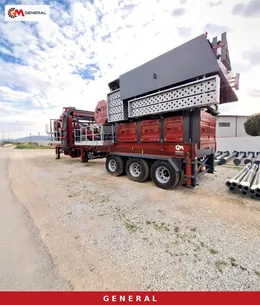
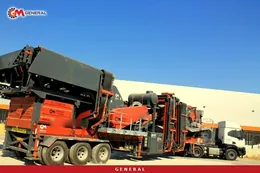
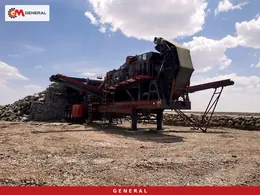
| Wheeled mobile: General 02 | 250-300 t/h | 1000 mm | GPS 1413 primary impact | 2000×5000 mm, 4-deck | 660 kVA generator | Limestone, low-abrasive stone |
| Wheeled mobile: General 03 | 250-375 t/h | 900 mm | GPS 1415 primary impact | 2400×5000 mm, 4-deck | 750 kVA generator | Limestone, low-abrasive stone |
The practical reading of the table: in a limestone quarry with a chance of relocating within a few years, the General 02 sits right in the middle of the target with 250-300 TPH on a single chassis, and its 1000 mm feed opening accepts large blasted blocks without pre-crushing. If tonnage occasionally needs to exceed 300 TPH, the General 03 leaves headroom with its wider screen. If you will stay in the same quarry for many years, a fixed line allows more screen decks and permanent enclosed transfers. For granite or basalt, a fixed layout with a GNRK jaw crusher and a cone secondary should be considered instead of the primary-impact mobile models. All fixed options are listed under fixed crushing plants and the wheeled models under wheeled mobile crushing plants.
Setup plan: from shipment to first production
Equipment bound for Saudi Arabia usually enters through Jeddah on the Red Sea side or Dammam on the Gulf side; the road route to the quarry, axle loads and clearance limits must be settled before shipment planning. Wheeled plants are towed on their own chassis, while a fixed line is loaded as modules and erected on concrete foundations on site.
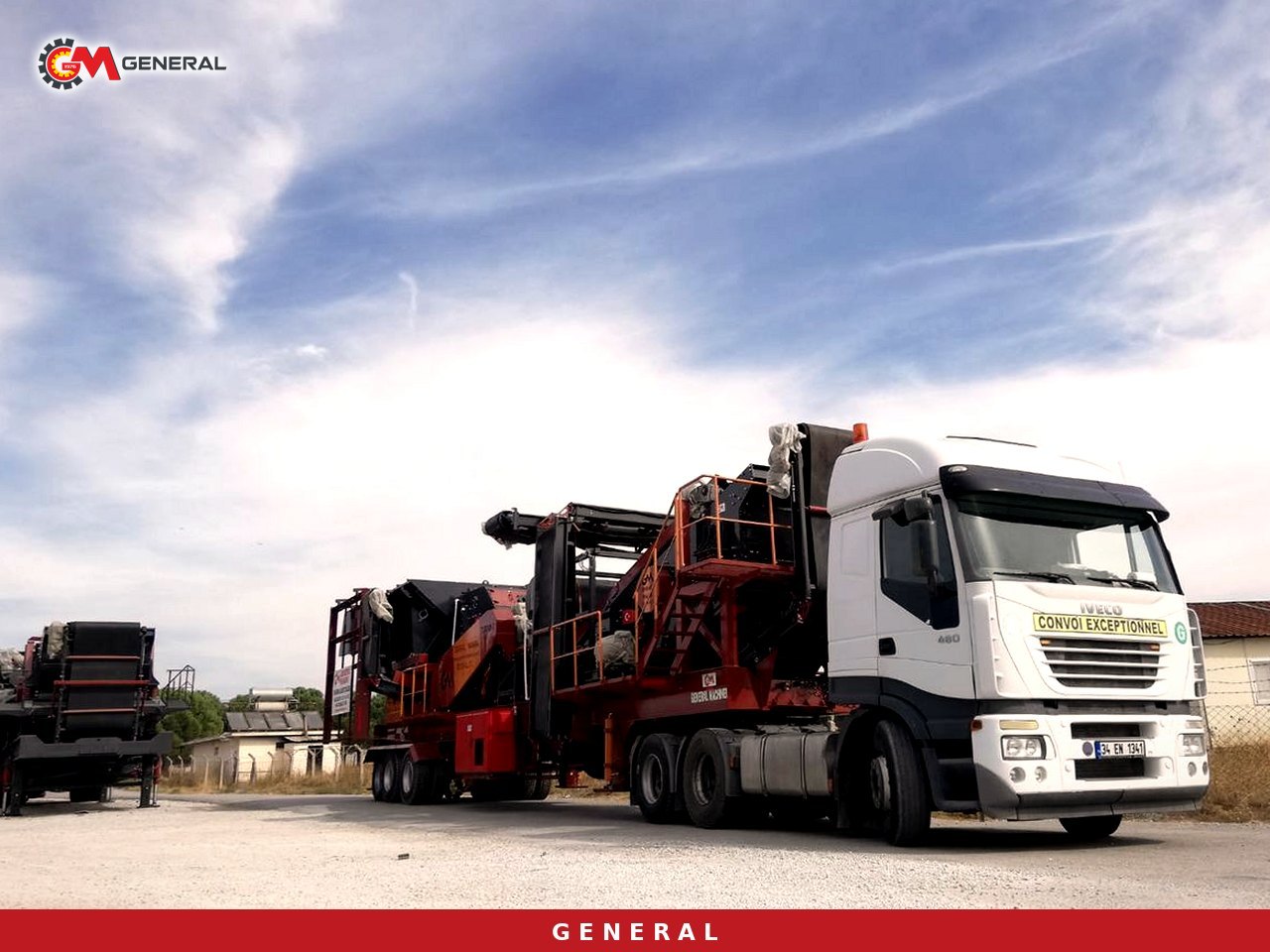
The site-preparation steps that make the biggest difference to dust are:
- Establish the prevailing wind direction; position the crusher and screen so that the control cabin and stockpile area are not downwind of them.
- Plan the haul road and tipping ramp on compacted ground, watered if needed; a large share of dust outside the plant comes from vehicle traffic.
- Minimise drop heights at belt transfer points at drawing stage and list where chutes and covers are needed.
- Report your water source and flow rate before the quotation; the spray system is sized on this information.
- Keep the generator air intake away from the downwind side of the crusher and screen; filter change intervals depend directly on it.
- Assess dust-tight door seals and cabin cooling for the electrical panel and control cabin separately.
Enclosed transfers and targeted spraying
The visible part of a dust-controlled plant is its enclosures. The chain curtain at the impact crusher inlet keeps particles and dust thrown back by the rotor inside the mouth. At belt transfer points, enclosed chutes, impact idlers and front and rear scrapers reduce spillage; because spilled material no longer dries out and lifts again in the wind, the site stays clean.
On the spraying side, the goal is not to soak the material but to catch dust the moment it forms. Nozzles therefore go on the hopper tipping edge, at the head of the crusher discharge belt and in the under-screen collection chute. In limestone, excess moisture can blind screen meshes, so flow should be adjusted in steps. Equipment such as full enclosures, spray systems or filtered extraction is not a standard package; it is engineered for the quarry's rock and water situation, and the need is decided together with sample and site data.
Operating on site: dust and heat discipline
In desert conditions dust control does not end with the setup. At the start of each shift, fines built up on screen meshes and scrapers should be cleaned off and transfer-chute covers checked. Generator and compressor air filters need changing noticeably more often than in a temperate climate; the interval is set by the manufacturer's manual and the differential-pressure gauge on site. Greasing bearings and shaft seals also keeps dust out, so it must not be skipped.
When a plant is connected for remote monitoring, shift tonnage, stoppages and alarm history are recorded, and in a fault the logs can be reviewed over the connection for a first diagnosis. Our page on the GNR PDK 02 stationary crusher running at 250 t/h in Saudi desert conditions is a concrete example of how a fixed impact line is laid out in this country.
The warranty is 1 year, excluding wear parts; since the life of manganese jaw plates, blow bars and screen meshes depends on the rock, the spare-parts stock list should be prepared together before commissioning.
Frequently asked questions
Should I install a mobile or a fixed plant for 250 TPH in Saudi Arabia?
If the quarry life is short or several sites are planned, wheeled plants such as the General 02 or General 03 give flexibility. If production will continue in the same quarry for a long time, a fixed line offers more screen decks, permanent enclosed transfers and a steadier set-up on concrete foundations.
How much water does dust suppression need?
The figure varies with rock moisture, fraction distribution and the number of nozzles, so quoting a fixed number would be misleading. Once you share your water source flow and target products, the spray system is sized accordingly.
Can the General 02 be used in a granite quarry?
The General 02 uses a primary impact crusher and is designed for low-abrasive stone such as limestone. In high-silica granite the impact parts wear fast; in that case a jaw primary with a cone secondary runs more economically and with less dust.
How are price and delivery time determined?
Capacity, rock type, required fractions, the scope of dust measures and the haulage route together set the price and the schedule. A project-specific quotation prepared with this information is the only sound document for comparison.
Conclusion
A 200-300 TPH dust-controlled plant in the Saudi desert starts with the right crushing principle, continues with grizzly pre-scalping and short transfers, and is completed by targeted spraying and operating discipline. As a manufacturer producing in Izmir since 1976 with ISO 9001 and CE certification, we can work out the right configuration with your quarry's rock data, wind direction and water situation: contact us for a quotation.
Definitions of technical terms: Glossary