EN — English
 TR — Türkçe
 DE — Deutsch
 RU — Русский
 FR — Français
 ES — Español
 AR — العربية
 SR — Српски

Rwanda Hilly-Terrain Compact Mobile Crusher and Screener Plant 60-100 TPH
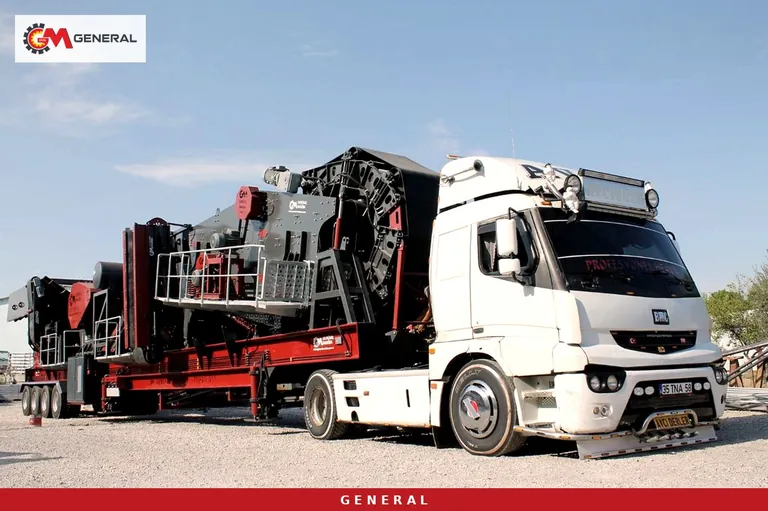
A contractor planning to crush aggregate in Rwanda usually hits one question before choosing any machine: where will the plant actually stand? In the "land of a thousand hills", a flat, wide pad is often harder to find than the crusher itself. A plant that has to work between ridge roads, terraced slopes and narrow valleys must be short, move in one piece and set up quickly. This article looks at compact mobile crushing and screening plants that meet a 60-100 TPH target through the lens of Rwanda's sloping ground, its rock types, its rainfall pattern and its landlocked logistics. The aim is to help you settle which model, which layout and which precautions you need before you ask for a quotation.
Choosing the scale for hilly ground: why 60-100 TPH?
A large share of aggregate demand in Rwanda comes from scattered, medium-sized jobs: upgrading district and feeder roads to gravel or paved standard, bridge approaches, hillside drainage channels, foundations for schools and clinics, and crushed stone for terrace retaining walls. Each of these jobs lasts a few months, and when it ends the plant has to move to the next hill. A large line running above 250 t/h does not fit that rhythm; both the pad it needs and the excavator and truck fleet that must feed it grow out of proportion.
The 60-100 TPH band is a scale that one excavator and a few trucks can feed, and that covers a road section or the concrete aggregate of a building site within a day shift. More importantly, machines in this band stay small enough to travel on a single chassis. On hilly sites that means no second pad for a second unit, no extra crane and no belt alignment between two separate machines.
Know your feed: which rock gets crushed in Rwanda?
Crusher choice starts with the hardness and abrasiveness of the stone. Rwanda's geology is not uniform; different rocks can turn up within the same province. The outline below is general knowledge only; for your own quarry, take samples and have abrasion and strength tests done in a laboratory.
Quartzite, granite and gneiss
Across most of the country, old basement rocks sit close to the surface: quartzite ridges, granite and gneiss outcrops, with bands of schist between them. Quartzite and granite carry a lot of silica, and such stone eats metal. With this kind of feed, the right arrangement is a jaw crusher in the first stage and an impact crusher in the second, shaping stone that has already been reduced.
Volcanic basalt in the north-west
Around the Virunga volcanoes, towards Musanze and Rubavu, basalt and other volcanic rocks are common. Basalt is hard and dense and gives cubical aggregate, but it can also contain porous, scoriaceous layers. The ratio of massive to vesicular basalt in the face changes both product quality and crusher setting.
Red soil cover and clayey fines
On top of the slopes there is often a thick, red, clayey weathering soil. If this overburden enters the crusher with the blasted rock, it contaminates the product, blinds screen meshes on rainy days and sticks to belts. That is why the feed line must have a grizzly that removes fines before the crusher, and stripping must be written into the quarry plan from day one.
Real models that meet the target, with their figures
The table below sets manufacturer data side by side for units that can be considered around a 60-100 TPH target. Values that are unknown or do not apply to a unit are shown as "—".
| Item | General 640 | General 800 | GM 90JP | GNR 60 primary unit |
|---|---|---|---|---|
| Capacity | 60-100 t/h | 80-150 t/h | 70-180 t/h | 20-80 t/h |
| Max. feed size | 500 mm | 600 mm | 700 mm | — |
| Crusher arrangement | GPJ 60 jaw + GNR 50 impactor | PDK 1280 primary impactor | GNR 90 jaw, 95 kW | GNRK 60 jaw |
| Screen | 1200×4000 mm, triple-deck | 1300×4000 mm, triple-deck | 1000×2000 mm, double-deck | — |
| Power | 300 kVA generator (optional) | 450 kVA generator | 250 kVA power unit | — |
| Weight | 38,000 kg | 35,000 kg | 35,000 kg | 15,000 kg |
| Transport size (W×L×H) | 3500×17000×4500 mm | 3600×15500×4500 mm | — | — |
| Running gear | Wheeled, towed | Wheeled, towed | Tracked, self-driving | Wheeled, towed |
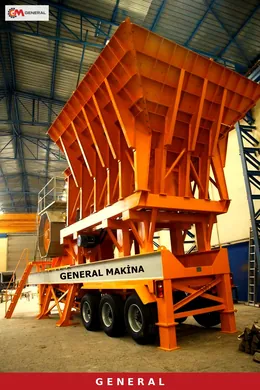
For Rwandan quartzite and granite the lead candidate is the General 640. It carries a jaw and an impactor on the same chassis, accepts rock up to 500 mm, splits 0-5, 5-12 and 12-19 mm fractions on its triple-deck screen and sends oversize back to the crusher in closed circuit. Because its capacity matches this article's target range one to one, the machine can run without being pushed; working hard rock at a moderate pace extends wear part life.
The General 800 runs a single primary impactor and is designed for low-abrasion stone such as limestone. Limestone occurs only in limited areas of Rwanda, so the 800 is worth considering only if quarry tests show low abrasiveness. The GM 90JP is a tracked primary jaw crusher; it can move by itself between benches inside a quarry, but on its own it does not deliver a full aggregate recipe and needs a secondary stage behind it. The GNR 60 primary unit, at 20-80 t/h, sits at the lower end of the target; it makes sense when it is added in front of an existing screening and secondary crushing line. You can review all wheeled options on the wheeled mobile crushing plants page and the separate primary units on the GNR wheeled primary jaw unit page.
Layout on sloping ground: pad, benches and flow direction
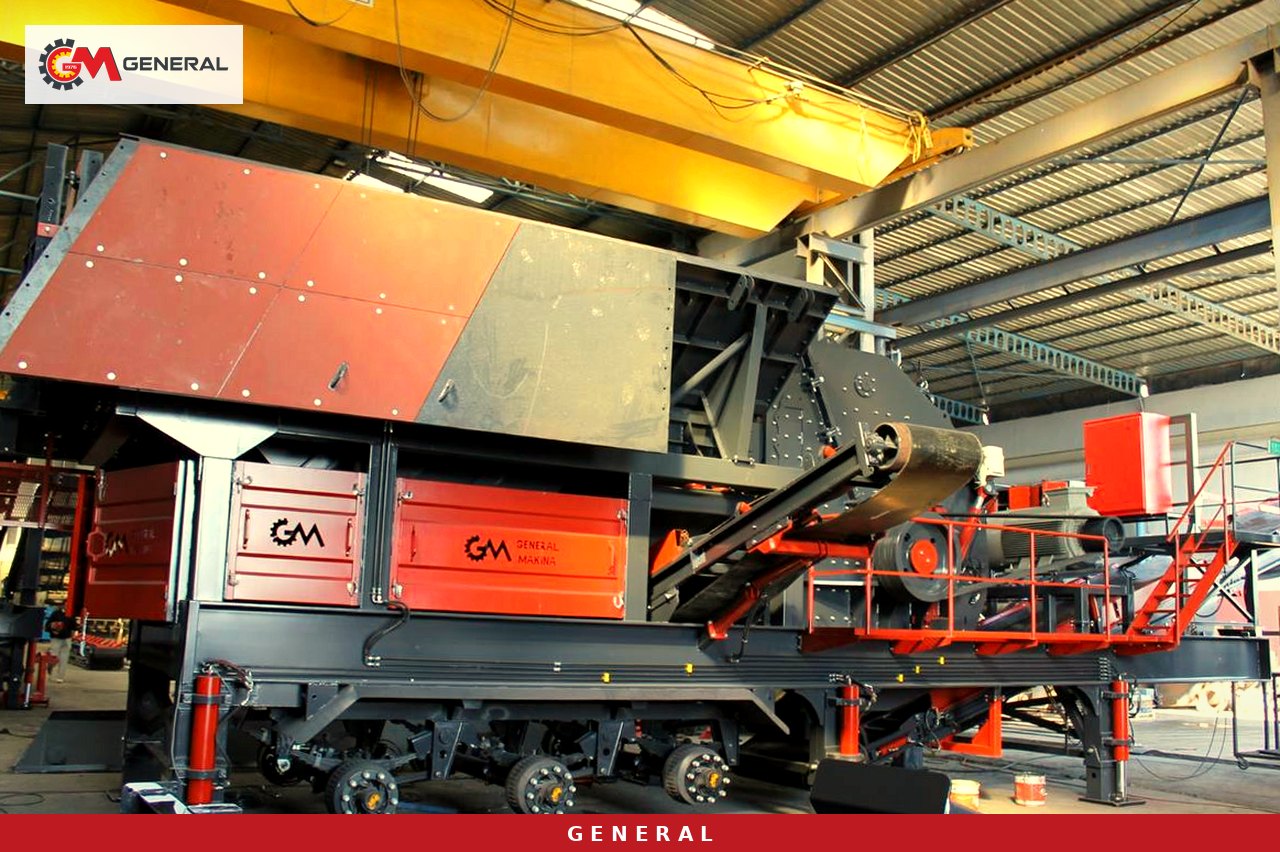
On hilly terrain, the right layout directly decides what you get out of the machine. Hydraulic legs are there to stabilise the chassis and get it ready to work quickly, not to make up for a steep gradient. The ground under the machine should therefore be levelled with compacted fill and prepared so it will not soften in the rain. The General 640 travels at 17 metres long and 3.5 metres wide; extra space around that is needed for the unfolded belts, stockpiles, loader movement and truck turning.
The slope can actually be turned into an advantage. If you cut the pad as two benches, trucks or the excavator can tip straight into the hopper from the upper bench, so no long loading ramp is needed. Product belts open towards the lower bench, stockpiles build up below and trucks load on level ground. A cut-off ditch on the uphill side keeps rainwater from running under the pad and the stockpiles. This arrangement saves the weeks that are often lost searching for flat ground in Rwanda's tight valleys.
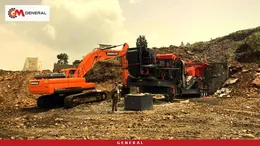
If the quarry has several benches and the primary crusher must stay next to the point where rock is won, a tracked crusher starts to make sense. Once off the trailer, the GM 90JP walks under its own power and needs no ground works or concrete foundation. For this difference and a comparison of the two kinds of running gear, see the tracked crawler crushers page and our article tracked or wheeled?
Shipping to a landlocked country: port, corridor and hill roads
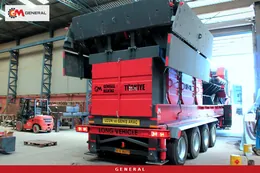
Rwanda has no coastline. A machine leaving Turkey normally reaches an East African port such as Dar es Salaam or Mombasa by sea, then enters Rwanda by road through border crossings. The last part of that journey is a road winding between hills. Being able to haul a compact plant with a single truck helps a great deal here: no second heavy-load convoy, no separate permit and no separate escort.
The route must still be surveyed in advance. The 4500 mm transport height should be checked against bridge clearances and power lines, and the 17-metre length assessed for turning radius on sharp bends and through villages. If length is critical, the General 800's 15,500 mm transport length may come up as an alternative, but that choice must be weighed together with the abrasiveness of the stone. Confirm heavy-load rules, escort requirements and customs procedures with the relevant authority and your haulier.
Rain, clay and power: what to watch in operation
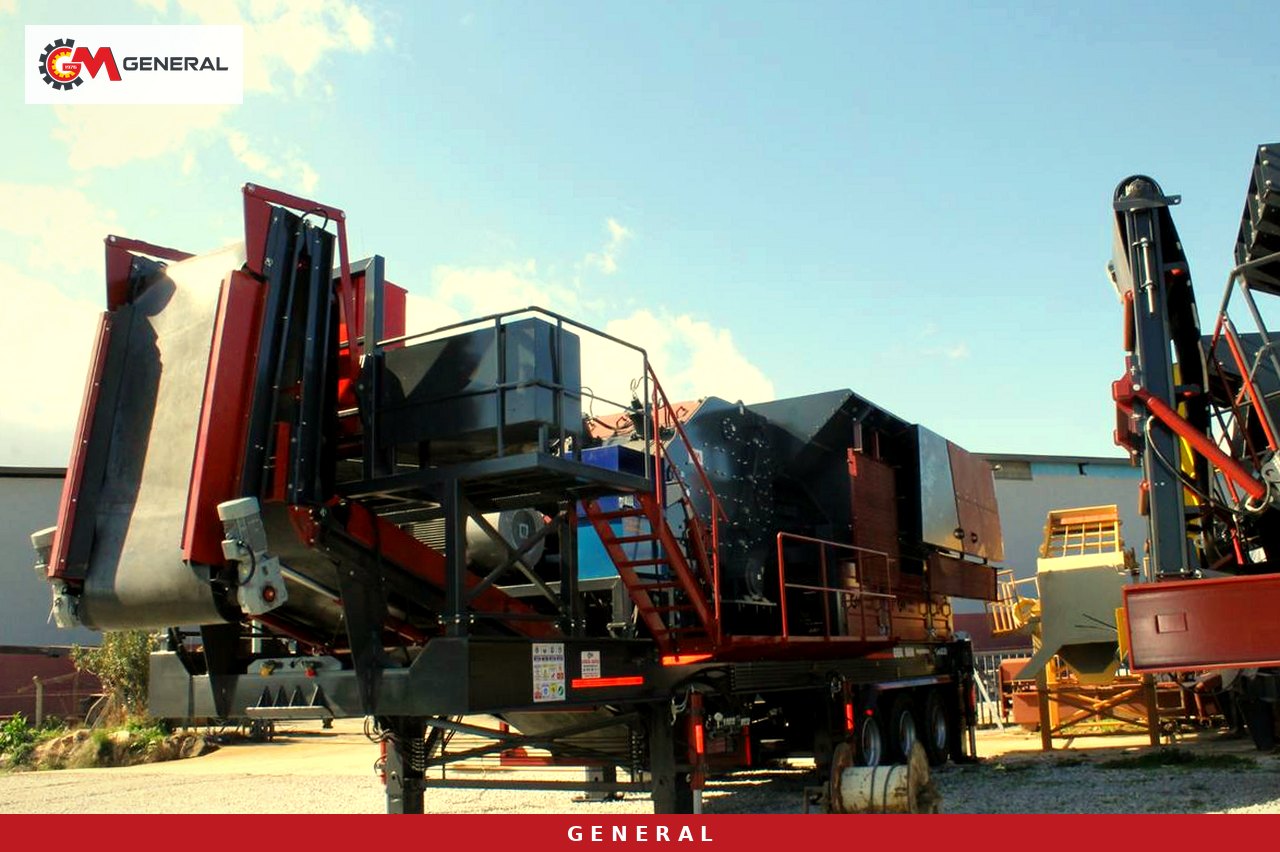
Rwanda has two rainy seasons a year. During them, the moisture and clay content of quarry feed rise. The by-pass grizzly on the General 640's vibrating feeder separates soil and fines before they reach the jaw crusher, but for that to work the grizzly spacing must be set to the quarry's real material. Screen meshes are chosen the same way: mesh openings and final gradation are fixed per project to suit the stone being fed. Covering product stockpiles in wet weeks and keeping pad drainage open prevents a large part of the stoppages.
Most sites on remote slopes have no grid connection. With the optional 300 kVA generator, the General 640 can run entirely off-grid; the General 800 has a 450 kVA generator and the GM 90JP a 250 kVA power unit. On a sloping site, place the generator where a fuel tanker can reach it and where rainwater will not collect.
Wear is unavoidable in quartzite. Plan the stock of wear parts such as jaw plates and impactor blow bars together with the first shipment, because in a landlocked country an urgent parts order can take weeks. General Makina has been manufacturing in Izmir since 1976 and holds ISO 9001 and CE certification; machines carry a 1-year warranty, with wear parts excluded.
Frequently asked questions
Can the General 640 crush hard Rwandan quartzite?
Yes. With a GPJ 60 jaw crusher in the first stage, it can handle high-silica, abrasive stone, while the GNR 50 impactor shapes the pre-crushed rock. To keep wear costs down, avoid pushing the machine to the top of its range and set it according to quarry tests.
Should I choose wheeled or tracked on a hilly site?
If the plant will move by road between different sites several times a year, the wheeled General 640, which delivers a complete recipe, is the better fit. If the crusher must move often from bench to bench inside one quarry, a tracked primary such as the GM 90JP is preferred, with a secondary stage planned behind it.
Can it work on a slope with no grid power?
It can. A 300 kVA generator is offered as an option for the General 640, so the plant can produce in quarries the power line does not reach.
How are price and delivery time set?
Price depends on the model, options such as the generator, the screen configuration, the spare wear parts package and the shipping route. Delivery time depends on the production schedule at the time of order. Both are settled in a written quotation once your project details are received.
Conclusion and your quotation file
On Rwanda's hilly ground, the most balanced choice for a 60-100 TPH target is the General 640, carrying a jaw and an impactor on one chassis; the tracked GM 90JP can be considered as the primary stage in quarries that move often. Preparing the following information speeds up an accurate quotation:
- A rock sample from the quarry and any abrasion and strength test results
- Target product fractions and daily or monthly output needs
- Dimensions and gradient of the area available for the pad
- The planned road route from port to site, with bridge and power line heights
- Whether grid power is available on site
- How many times a year the plant will move to another site
- Clay and moisture condition of the feed in the rainy seasons
To compare models with your own data, use the Design Your Plant and send your project details through our contact page to request a written quotation.
Definitions of technical terms: Glossary