EN — English
 TR — Türkçe
 DE — Deutsch
 RU — Русский
 FR — Français
 ES — Español
 AR — العربية
 SR — Српски

Rwanda Concrete Aggregate Compact Crusher and Screener Plant 60-100 TPH
If you run a batching plant in Rwanda, or pour building, bridge or road concrete around Kigali, the aggregate question comes down to two things: will your rock give the sand and chippings the mix design asks for, and can the crushing line keep pace with the batching plant? This article looks at compact crushing and screening plants in the 60-100 TPH range from exactly that angle, as a source of concrete aggregate. We size the machine backwards from the batching plant's weigh hopper, because for concrete the deciding factor is the cleanliness of the sand and the shape of the coarse particles, more than tonnage.
What concrete on Kigali job sites asks of aggregate
Ready-mix and site batching plants usually work with three or four fractions: 0-5 mm sand, 5-12 mm fine chippings and 12-19 or 12-20 mm coarse chippings. Some structural mixes also call for a separate 19-25 mm size. The lab that prepares the mix design checks each fraction's grading curve, fines content and particle shape against the specification. The crushing line's job is to stay within those limits and deliver the same quality every day.
The sand side: 0-5 mm and fines
Sand causes the most trouble in a concrete mix. If manufactured sand carries too much dust below 75 microns, water demand rises, cement content goes up and more superplasticiser is consumed. In Rwanda a large share of sand is taken from riverbeds and wetland margins, and its quality and availability change with the season. Sand made from crushed quarry rock gives the batching plant the same grading all year, provided dust and clay are kept under control with the screen and, where needed, washing.
Coarse aggregate: 5-12 and 12-19 mm, particle shape
Flaky and elongated particles reduce workability, make pumping harder and need more cement for the same strength. Shape is set by the crusher's working principle. A jaw crusher breaks rock by compression and on its own can produce flakier particles; an impact crusher throws rock between the rotor and the aprons and raises the share of cubical particles. That is why placing an impact secondary behind a jaw primary is a common and sound layout for a concrete aggregate line.
Rwandan rock and the rains: clay, weathering and the washing decision
Much of the country sits on old basement rocks such as granite, gneiss and quartzite; basalt is widespread in the volcanic northwest, while limestone occurs only in limited areas. For concrete, granite and quartzite are strong but abrasive because of their silica content. In basalt, the massive sections make good aggregate while porous, scoriaceous layers can push water absorption up. Have Los Angeles abrasion, water absorption and alkali-silica reactivity tests run on your own quarry rock in a laboratory before you commit to a mix design or a machine.
The second issue is the weathered cover. The red clayey soil on hilltops, and clay packed into rock joints, gets wet during the country's two rainy seasons and enters the crusher with the rock. In dry months it passes the screen as dust; in the rains it balls up and ends up as clay inside the 0-5 mm sand. Concrete cannot accept that. Three measures belong together: write stripping into the quarry plan, use the grizzly in the feed hopper to remove fines and soil before the crusher, and add a sand screw washer at the end of the line if the clay content of the sand fraction exceeds the specification. Screw washers clean 0-50 mm feed at 50-250 t/h; the single and twin GNR models are on the mining washers page. Washing also depends on water, so the site water source should go into the quotation file together with the sample analysis.
Matching 60-100 TPH to the batching plant
A simple calculation links crusher capacity to concrete output: daily concrete volume (m³) × aggregate per cubic metre in the mix (t/m³) ÷ crusher operating hours per day = required hourly capacity. Take the aggregate quantity from your own lab mix design.
Hypothetical example: a plant produces 400 m³ of concrete a day, the mix uses about 1.9 t of aggregate per cubic metre, and the crushing line runs 10 hours a day. Daily aggregate demand is 760 t and the hourly crushing requirement is about 76 t, which falls inside the 60-100 TPH band. The batching plant may exceed that pace during short peaks; the stockpile and the aggregate bins cover that difference, not the crusher. Planning the stockpile for at least several days of consumption is wiser than buying an oversized crusher.
Configurations and catalogue data
The table below compares layouts worth considering for concrete aggregate, using manufacturer data. Values that are unknown or do not apply to that layout are marked "—".
| Item | General 640 | General 640 + mobile VSI | General 800 |
|---|---|---|---|
| Capacity | 60-100 t/h | 640: 60-100 t/h; VSI: 60-250 t/h | 80-150 t/h |
| Max. feed size | 500 mm | 640: 500 mm; VSI: 0-200 mm | 600 mm |
| Crushers | GPJ 60 jaw + GNR 50 impactor | GPJ 60 + GNR 50, followed by vertical shaft impactor | PDK 1280 primary impactor |
| Screen | 1200×4000 mm, 3 decks | 1200×4000 mm, 3 decks | 1300×4000 mm, 3 decks |
| Products | 0-5 / 5-12 / 12-19 mm | Plus 0-10 mm manufactured sand | 0-5 / 5-12 / 12-19 / 19-40 mm |
| Generator | 300 kVA (optional) | — | 450 kVA |
| Weight | 38,000 kg | — | 35,000 kg |
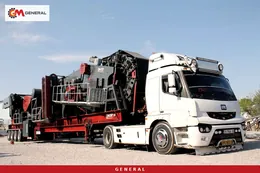
| Transport size (W×L×H) | 3500×17000×4500 mm | — | 3600×15500×4500 mm |
The single-chassis General 640
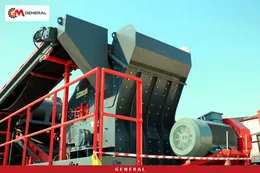
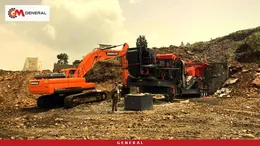
The General 640 is the main candidate for concrete aggregate. Its vibrating feeder with by-pass grizzly separates soil and fines, the GPJ 60 jaw reduces rock up to 500 mm, and the GNR 50 impactor corrects particle shape. The 1200×4000 mm three-deck screen splits the product into 0-5, 5-12 and 12-19 mm, and oversize returns to the crusher in closed circuit. Those three fractions correspond directly to the sand, fine chippings and coarse chippings of a typical concrete mix. On abrasive granite and quartzite, running the line at a moderate rate instead of pushing it to the top of the band extends the life of jaw plates and blow bars.
A mobile VSI behind the 640: when you need manufactured sand
If natural sand is short or its quality varies, the 640's screen oversize or surplus 5-12 mm can be turned into 0-10 mm manufactured sand with a mobile VSI sand maker. The unit accepts 0-200 mm feed, works at 60-250 t/h and crushes rock on rock, which keeps metal wear in check on abrasive granite and quartzite. Sand from the VSI should pass a separate screen, and be washed if needed, before it goes into the mix.
The General 800 runs a PDK 1280 primary impactor and is built for low-abrasion rock such as limestone. If you have a limestone quarry in Rwanda and also need a 19-40 mm fraction, the 800 is an option; on granite or quartzite its blow bars wear fast. Other wheeled models can be compared on the mobile crushing plants page.
From crusher to mixer: stockpile, bins and weighing
The link between the crushing line and the batching plant is often neglected, yet the plant's ability to hold the mix depends on it. Store the fractions so they cannot mix, with walls or enough spacing between piles. Covering the sand pile in the rainy season reduces swings in moisture, and the plant's water dosing should be corrected for sand moisture.
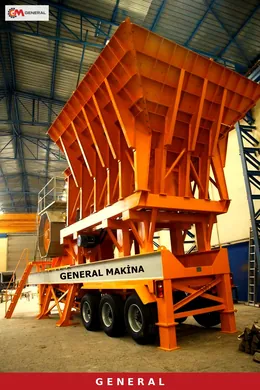
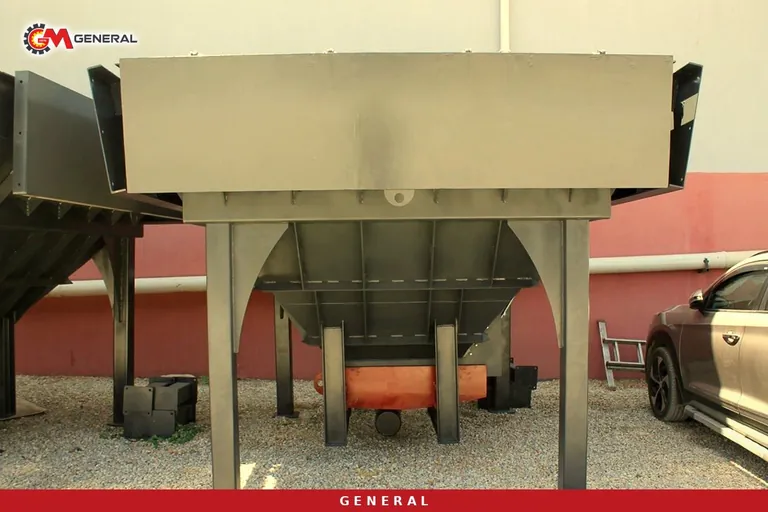
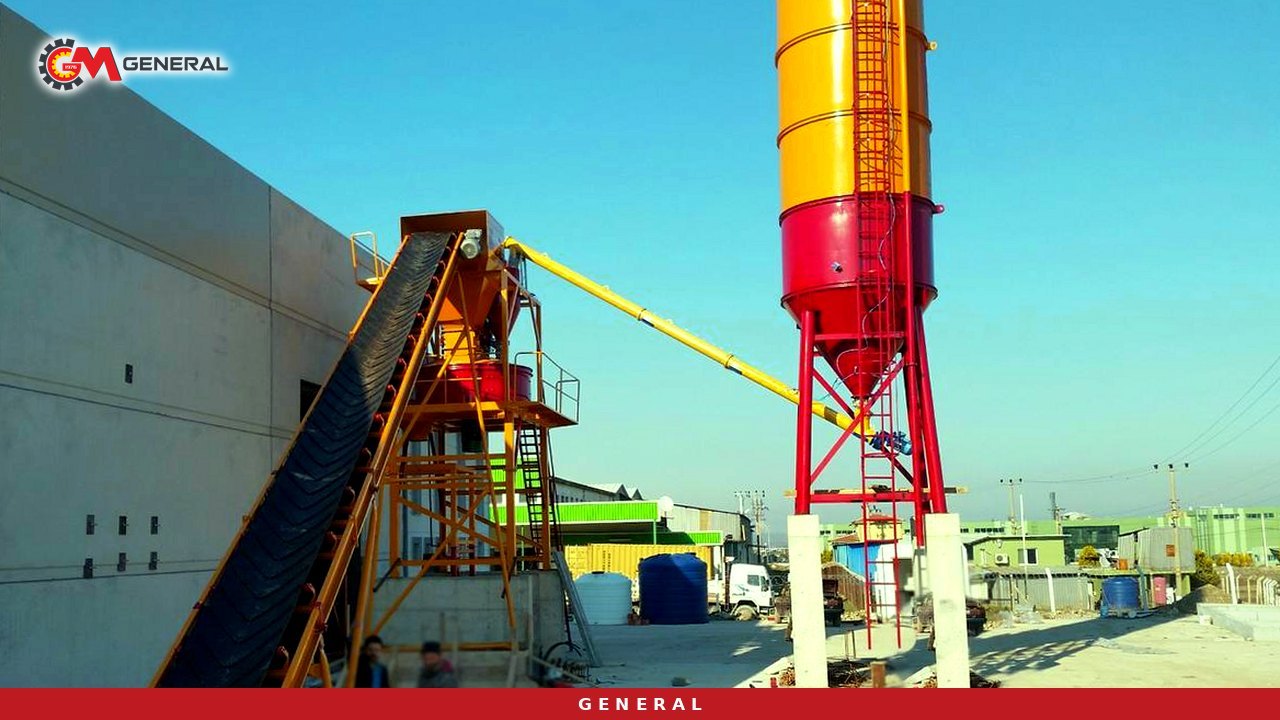
Between stockpile and mixer sits the aggregate bin. General Makina bins come with 2-8 compartments, 10-50 m³ per compartment and 20-500 m³ total storage. Pneumatic gates open under automation control and material drops onto a load-cell weigh belt. With wet, sticky sand an optional vibromotor per compartment keeps material flowing, which prevents bridging in the sand bin during Rwanda's wet months. A four-compartment bin takes the 640's three fractions and leaves the fourth for natural sand or VSI sand.
Scale matching on the batching side matters as well. The Diamond 60 stationary batching plant works at 55-60 m³/h with a pan mixer, a 4×15 m³ aggregate bin, an 800×12000 mm weigh belt and 2400 kg aggregate weighing. Buying the crushing line and the batching plant from one manufacturer makes it easier to choose the number of fractions, bin compartments and weighing capacity to fit each other from the start. Plant options are on the concrete batching plants page.
The file to prepare before asking for a quote
A sound quotation for a line going to Rwanda needs quarry and batching plant data together. Machines usually reach this landlocked country by road from the port of Dar es Salaam or Mombasa. Have your haulier check the 640's 3500×17000×4500 mm transport size against bridge, bend and height limits on the route. Obtain the aggregate requirements of the project specification in writing from the relevant authority or consultant.
- Quarry rock type and lab results (abrasion, water absorption, reactivity), with a photographed sample if possible.
- Largest block size coming from the face and a site note on soil and clay content.
- Fractions required by the mix design and the daily consumption of each.
- Batching plant capacity, number of bin compartments and current natural sand source.
- Whether grid power is available on site; if not, generator needs.
- If washing is planned, the water source and a settling area for wastewater.
- Area set aside for stockpiles and the distance from crusher to batching plant.
Frequently asked questions
Can the General 640 alone produce enough sand for concrete?
The 640's three-deck screen separates a 0-5 mm fraction. Whether that is enough for the mix depends on how the rock breaks. If there is a sand shortfall, oversize or surplus fine chippings can be turned into manufactured sand with a mobile VSI.
How do I control dust in manufactured sand?
First remove soil ahead of the crusher with the grizzly feeder, then choose screen mesh to suit the rock. If fines still exceed the specification, pass the sand fraction through a screw washer. Washed sand leaves at 15-30 percent moisture; dewatering equipment brings this to 8-20 percent.
Will it work at a quarry with no grid power?
Yes. A 300 kVA generator is offered as an option for the 640. If washing and a VSI are added, total power demand is calculated separately for the configuration.
What sets the price and delivery time?
The number of units, the generator, extras such as washing and bins, and the shipping method set the price. Delivery time is stated in writing in the quotation, based on the production schedule at the time of order.
Final word
If you plan to produce concrete aggregate in Rwanda, test your rock first, then pin down the fractions the mix needs and the daily consumption. In most cases the General 640 is enough on its own; add a VSI for a sand shortfall and washing for clay. General Makina has manufactured in Izmir since 1976; its machines carry ISO 9001 and CE, with a 1-year warranty excluding wear parts. Send your quarry and batching plant data through our contact page and we will prepare a suitable layout and quotation.
Definitions of technical terms: Glossary