EN — English
 TR — Türkçe
 DE — Deutsch
 RU — Русский
 FR — Français
 ES — Español
 AR — العربية
 SR — Српски

Blasting vs Throughput in a 250-450 TPH Stone Crusher Plant
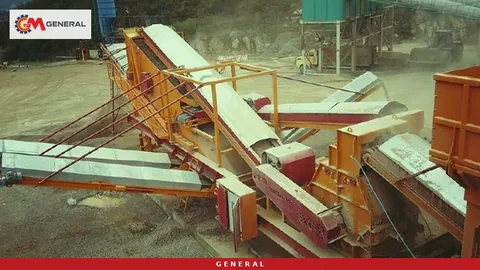
When a quarry plans a stationary line for 250-450 tonnes per hour, most of the discussion goes to the crusher model. In practice, the tonnage the primary crusher delivers at the end of a shift is set largely by the blast. The largest block in the muckpile, the share of fines and soil, how easily the loader digs the pile: all of it travels to the feeder and then into the jaw. After years of commissioning crushing lines, our view is simple. A well-chosen jaw crusher cannot make up for a poor blast, but when the blast is tuned to what the crusher needs, the same machine runs far more steadily. This article looks at the link between blasting and throughput, together with the General models that fit the 250-450 TPH band. All technical values come from the tables on our product pages.
Crushing starts at the quarry face
Blasting is the first size reduction the rock goes through, and its energy is much cheaper than the energy spent in a crusher. Hole diameter, spacing, burden, charge and delay sequence decide the size distribution of the muckpile. For the primary crusher that distribution causes trouble at both ends: oversize blocks that will not enter the jaw, and fines and soil that should never reach the crusher at all.
Blast design is the responsibility of a licensed blasting engineer and the quarry operator. What we can do as a crusher manufacturer is describe in numbers what the crushing line needs: the largest acceptable block, the amount of fines expected to pass the grizzly, and how many minutes of buffer the hopper gives. If these three figures never reach the blasting crew, the two teams work blind to each other and the loss usually shows up in front of the primary crusher.
What muckpile fragmentation does to the primary crusher
A jaw crusher breaks rock by squeezing it between a fixed jaw and a swinging jaw. The capacity in the table assumes the mouth is kept full and the feed matches the opening. When the muckpile breaks that assumption, output drops to the bottom of the range or below it.
Oversize blocks and bridging in the jaw
For the GNRK series the maximum feed size is given as roughly 0.8-0.9 times the opening width; for the GNRK 140 the product page puts this at about 1.1-1.25 m. A block above that limit bridges across the mouth. The feeder stops, the block is broken with a rock breaker or an excavator, and the line restarts. Each bridge costs a few minutes, and if it happens often during a shift the hourly average falls well below the table figure. Part of the oversize problem can be handled on the quarry floor, with the loader operator setting large blocks aside, but that slows loading. The lasting fix is on the blasting side.
Too many fines and soil in the muckpile
Overcharging, or a fractured and weathered face, raises the fines content. That material needs no crushing, yet if it goes through the crusher it takes up space in the chamber, packs inside the cavity and wears the jaw plates for nothing. When it is clayey and wet it also brings a risk of blockage. This is where the by-pass section of the grizzly feeder earns its place: fines and soil drop through the bars and go to a belt or screen without touching the crusher. Bar spacing should be set according to the fines the blast produces. If the pile carries a lot of clay, the grizzly starts to blind, and a wobbler feeder should be considered instead.
Feeder and primary crusher pairings for 250-450 TPH
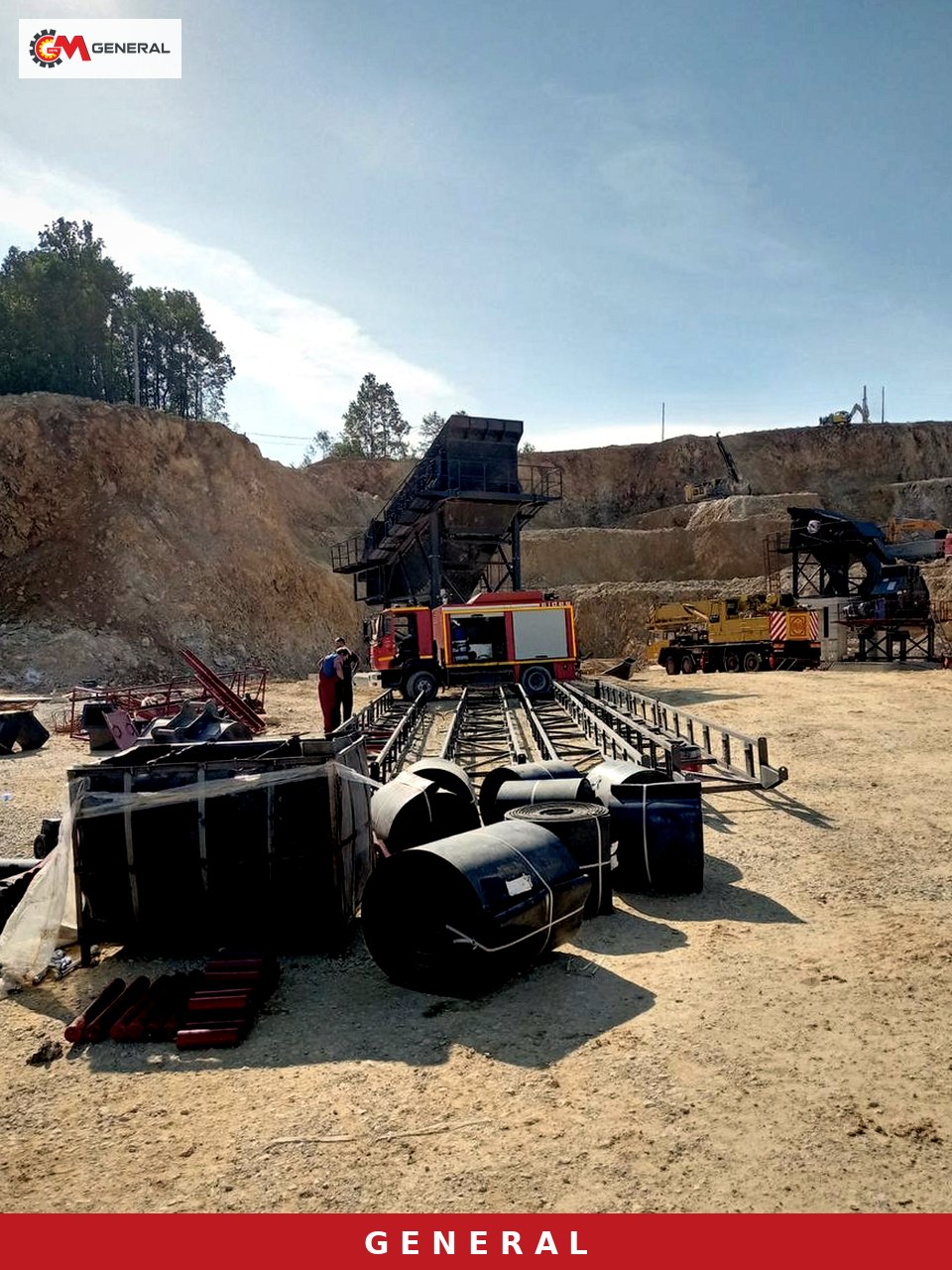
No single jaw crusher covers the whole target range, so the lower and upper ends need separate pairings. The table below shows primary stages that can be built from models in the vibrating feeders and crushers categories. Capacities are the ranges in the product tables; the real figure depends on fragmentation, rock hardness and the CSS setting.
| Configuration | Feeder (capacity, motor) | Primary crusher (opening, motor) | Crusher capacity | Fit for the muckpile |
|---|---|---|---|---|
| Lower end, hard rock | GNR 110 (200-300 t/h, 2x7.5 kW) | GNRK 110 (1100×850 mm, 110/132 kW) | 200-350 t/h | Granite, basalt; oversize must be held by the blast |
| Upper end, hard rock | GNR 140 (350-600 t/h, 2x9.2 kW) | GNRK 130 (1300×1000 mm, 160 kW) | 400-500 t/h | Wider opening, more tolerant of large blocks |
| Upper end with reserve | GNR 140 (350-600 t/h, 2x9.2 kW) | GNRK 140 (1400×1100 mm, 200 kW) | 500-600 t/h | Leaves margin where blasting is uneven |
| Limestone | GNR 140 (350-600 t/h, 2x9.2 kW) | GNR PDK01 (rotor 1400×1500 mm, 315 kW) | 250-500 t/h | Max. feed 1000 mm; not for abrasive rock |
| Secondary stage | — | General cone crusher | — | Model data supplied per project |
A target between 350 and 400 TPH goes past the top of the GNRK 110 table, so the GNRK 130 is chosen and the setting is adjusted to the product size. In a new quarry whose blasting has not settled yet, choosing one size larger opening is the most direct way to cut oversize stoppages. The GNRK jaw crusher handles abrasive rock such as granite, basalt and quartzite. The GNR PDK primary impact crusher gives a high reduction ratio in one stage on limestone, but blow bars wear quickly in high-silica rock.
The buffer between blast and crusher
A truck dumps its load into the hopper at once, while the crusher wants an even flow. Swings in fragmentation also reach the crusher through this gap. Three elements share the buffering job: hopper volume, the feeder grizzly and the controls that watch crusher load.
Hopper volume and grizzly bar spacing
On the vibrating grizzly feeder models the hopper volume ranges from 15 to 100 m³ and the feeder accepts material up to 1500 mm. That 1500 mm is the feeder's limit; the crusher opening is usually smaller and is the figure that governs. Hopper volume is chosen together with truck size and loading cycle, so that the jaw is never left empty between two trucks. Bar spacing is set according to the fines the blast produces. If fines rise, the gap is opened, net load on the crusher falls, and the same crusher has more time for the coarse rock.
Feeding by crusher current
The automation and control system watches the current drawn by the crusher. As the current nears the threshold the feeder slows; when it returns to normal the feeder speeds up. This smooths the sudden load from a blocky, hard pile. When shift reports log tonnage and downtime, the blasting crew also gets hard data showing which muckpile pushed the crusher.
Crusher data to share with the blasting crew
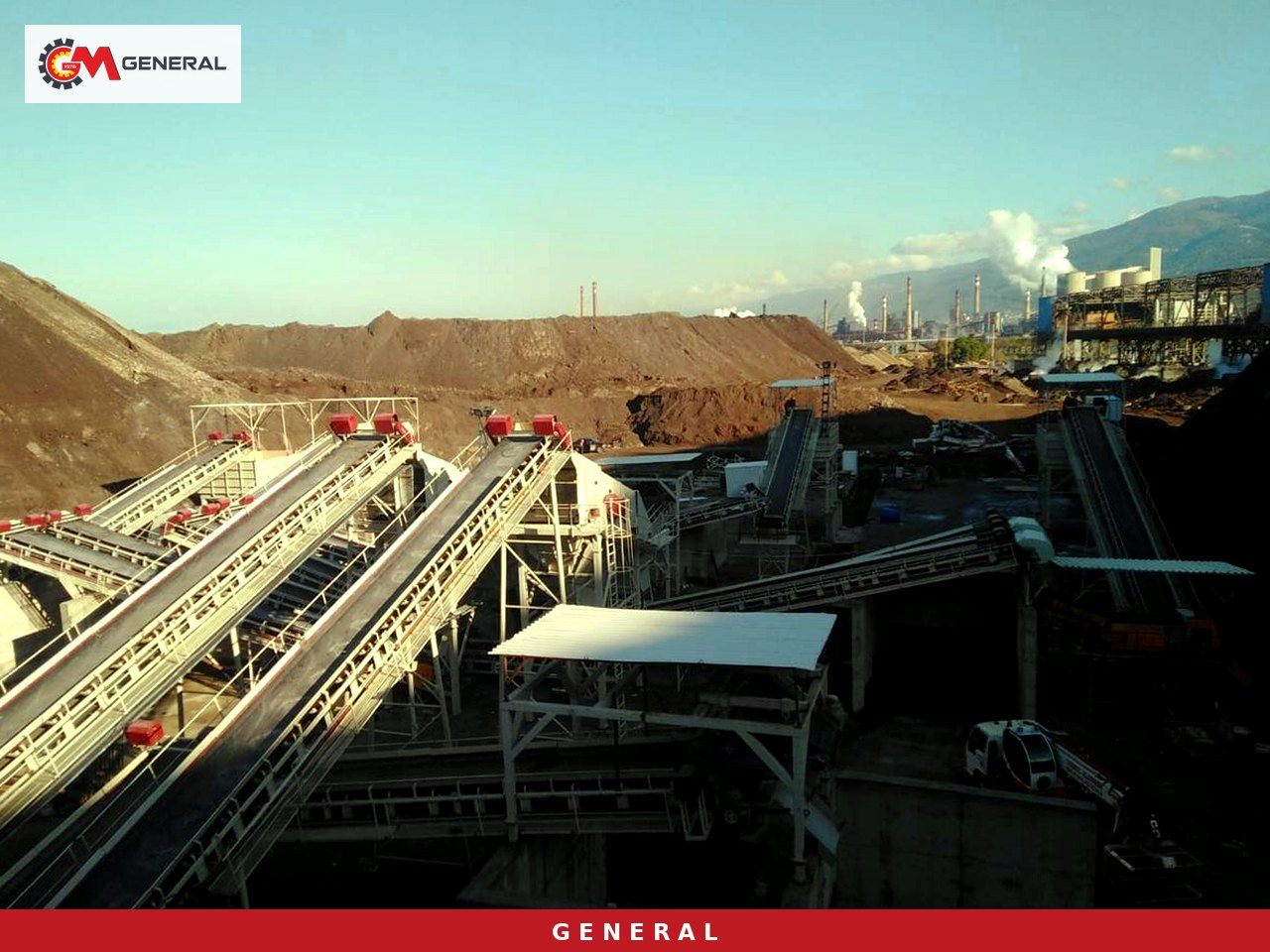
Without a common language, the crushing team and the blasting team each believe they are doing their job right. The list below covers what we suggest agreeing with the quarry operator while commissioning the line:
- The largest block the primary crusher accepts and how it is derived from the opening width
- Grizzly bar spacing and the expected share of by-passed fines
- Hopper volume, truck capacity and the time between two trucks
- Rock type per face, jointing and the location of clay bands
- Whether oversize is broken on the quarry floor or above the hopper
- Crusher current, stoppage causes and hourly tonnage recorded per shift
- The date of every change to the blast pattern, so it can be matched to crusher data
Kept for a few weeks, these records show which face and which pattern strain the crusher. Photo-based fragmentation software and screen samples taken from the pile give more reliable results than a visual guess. Laboratory abrasion and crushability tests on the rock supply the same data to both blast design and crusher selection.
How blasting affects the secondary stage and screens
The effect of the blast does not end at the primary. Coarse fragmentation makes the primary crusher deliver a coarser product, the load on the secondary cone crusher rises and the recirculating load grows. Fine fragmentation sends more material through the grizzly straight to the screens; if the deck area is not sized for that surge, the screen chokes. On high-tonnage lines a twin screen with 100-500 t/h capacity is used to absorb this fluctuation. On the cone side, choke feeding keeps the product cubical, and that requires steady flow from the primary. The stationary crushing plants page shows where these stages sit in the line.
Limestone behaves somewhat differently. The impact crusher's high reduction ratio tolerates coarse fragmentation better, but clay and soil in the feed stick to blow bars and impact plates. In these quarries, grizzly pre-screening after the blast can make a bigger throughput difference than the choice of crusher.
Frequently asked questions
Can I raise crusher capacity without changing the blast?
To a degree, yes: setting bar spacing to the fines, matching hopper volume to the truck cycle and feeding by crusher current all improve throughput. If oversize stoppages continue, however, the lasting fix lies in the blast pattern or a primary crusher with a wider opening.
Does a bigger crusher solve the oversize problem completely?
It reduces bridging but does nothing about the wear and blockage caused by fine, soily muck. A large-mouth crusher also runs inefficiently when its mouth cannot be kept full. The choice should be made with fragmentation data.
What information do I need to request a quotation?
Target capacity, rock type, any laboratory results, the largest block in the muckpile, fines and clay content, the required fractions and the power source. Price and delivery schedule are prepared per project from this information.
What does the warranty cover?
Our machines carry a 1-year warranty; wear parts such as jaw plates, blow bars and liners are excluded. Our production is ISO 9001 and CE certified.
Bring your quarry data and we will size the primary stage together
We have built crushing and screening machinery in Izmir since 1976 and ship lines to quarries in the Middle East, North Africa, Russia, the Turkic republics and the Balkans. For a 250-450 TPH stationary line, the right pairing appears once it is read alongside your blasting results. Send muckpile photos, rock data and target fractions through our contact page, and we will prepare a quotation covering feeder, primary crusher and grizzly setting.
Definitions of technical terms: Glossary