EN — English
 TR — Türkçe
 DE — Deutsch
 RU — Русский
 FR — Français
 ES — Español
 AR — العربية
 SR — Српски

Nigeria Quarry Start-Up: Mobile Stone Crusher Plant 120-180 TPH
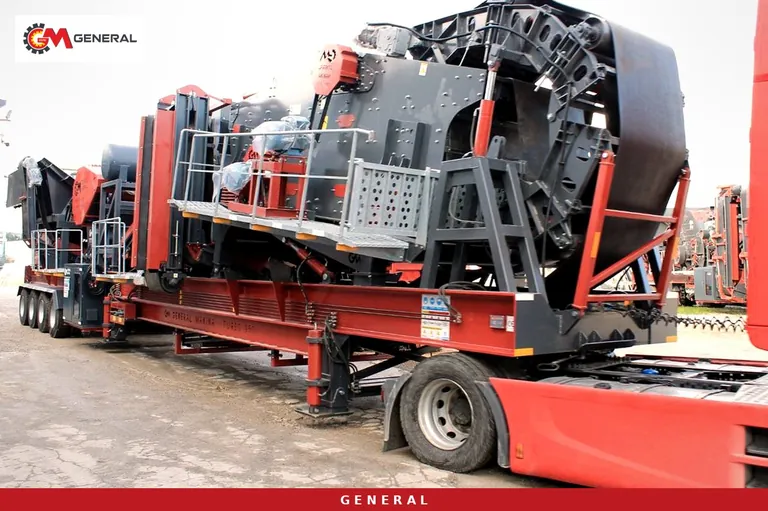
An investor opening a new quarry in Nigeria usually spends the first year caught in the same squeeze: licensing and site preparation burn cash, yet there is no aggregate to sell. Waiting for foundation concrete, buildings and a long erection schedule for a stationary plant stretches that gap by months. Starting with a mobile crushing and screening plant puts the quarry into production first and gets cash flowing, while the fixed investment can be weighed once real sales figures exist. This article walks through which model suits a 120-180 TPH start, why, what must be ready before the low-loader arrives, and which costs to track during the first year.
The reasoning applies across very different Nigerian settings, from the granite hills around Ogun and Oyo to quarries near Abuja, and from the northern basement-rock belt to limestone areas further south. The final decision, however, always comes from a sample taken in your own pit.
Before the machine: sample, market and product list
The most expensive mistake in a fast start is ordering a machine before you know the rock. Much of Nigeria is underlain by hard, silica-rich basement rocks such as granite, gneiss and migmatite, while some basins are worked for limestone and softer sedimentary stone. These two groups point to opposite answers when the secondary crusher is chosen. So the first task is to have several samples from different parts of the deposit tested by an independent laboratory for compressive strength, abrasiveness and Los Angeles abrasion value.
The second question is the market: who will buy what leaves the gate? Around large cities such as Lagos and Abuja, ready-mix plants and block makers want 0-5 mm crusher sand plus 5-12 and 12-19 mm chippings. Road contractors look for wider-graded sub-base material and asphalt aggregate. Writing down the three or four products you will sell at the start directly fixes the number of screen decks and the plant type.
A first steer from the lab report
If the report shows hard, abrasive rock, the line to consider is a jaw primary followed by an impact or cone secondary. With limestone and low-abrasion stone, lighter and more economical primary-impact models come into play. Quotes requested without this distinction cannot be compared with one another.
Real models that meet a 120-180 TPH target
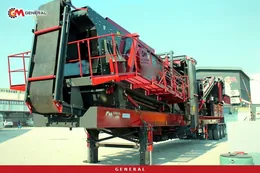
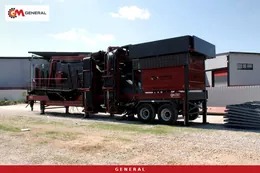
Several models in our wheeled mobile crushing plants range sit inside the title's capacity band. When speed and hard rock are wanted together, the General 950 stands out, but the right call only emerges when four options are laid side by side.
| Item | General 950 | General 944 | General 01 | General 800 |
|---|---|---|---|---|
| Capacity | 120-180 TPH | 120-180 TPH | 120-180 TPH | 80-150 TPH |
| Crusher layout | GPJ 90 jaw + DMK01 impact | GPJ 90 jaw + GM430 cone | GPS 1210 impact (primary + secondary in one body) | PDK 1280 primary impact |
| Max. feed size | 800 mm | 800 mm | 700 mm | 600 mm |
| Screen | 1600×5000 mm, 3 decks | 1600×5000 mm, 3 decks | 1600×5000 mm, 4 decks | 1300×4000 mm, 3 decks |
| Product fractions | 0-5 / 5-12 / 12-19 mm | 0-5 / 5-12 / 12-19 mm | 0-5 / 5-12 / 12-19 / 19-40 mm | 0-5 / 5-12 / 12-19 / 19-40 mm |
| Generator | 600 kVA | 550 kVA | 550 kVA | 450 kVA |
| Weight | 70,000 kg | 70,000 kg | 55,000 kg | 35,000 kg |
| Transport dimensions | 4130×20350×4500 mm | 4130×20350×4500 mm | 4300×18500×4500 mm | 3600×15500×4500 mm |
General 950: quick commissioning on hard rock
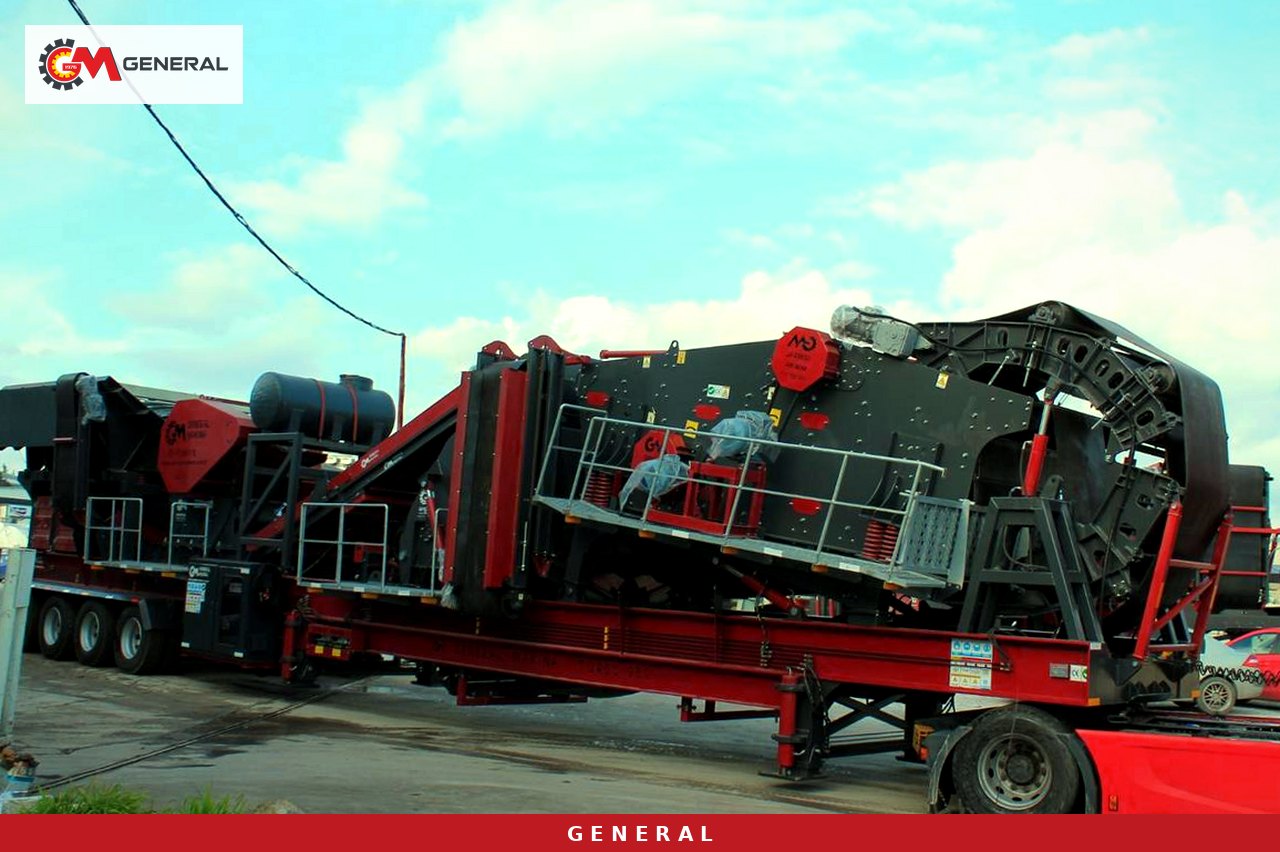
The General 950 breaks blocks up to 800 mm in its GPJ 90 jaw, takes them down to cubical product at high reduction in the DMK01 impact crusher, and splits the flow into 0-5, 5-12 and 12-19 mm on a 1600×5000 mm triple-deck screen. It travels on one chassis behind one tractor unit and is working on site within about 30 minutes. For a Nigerian quarry dominated by granite and gneiss that needs both cubical concrete aggregate and a fast set-up, it is the first model to look at.
When do the 944, 01 or 800 make more sense?
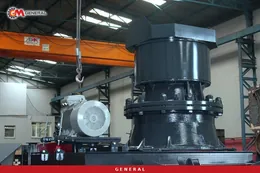
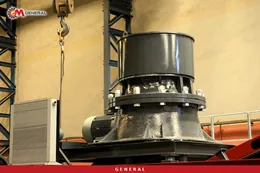
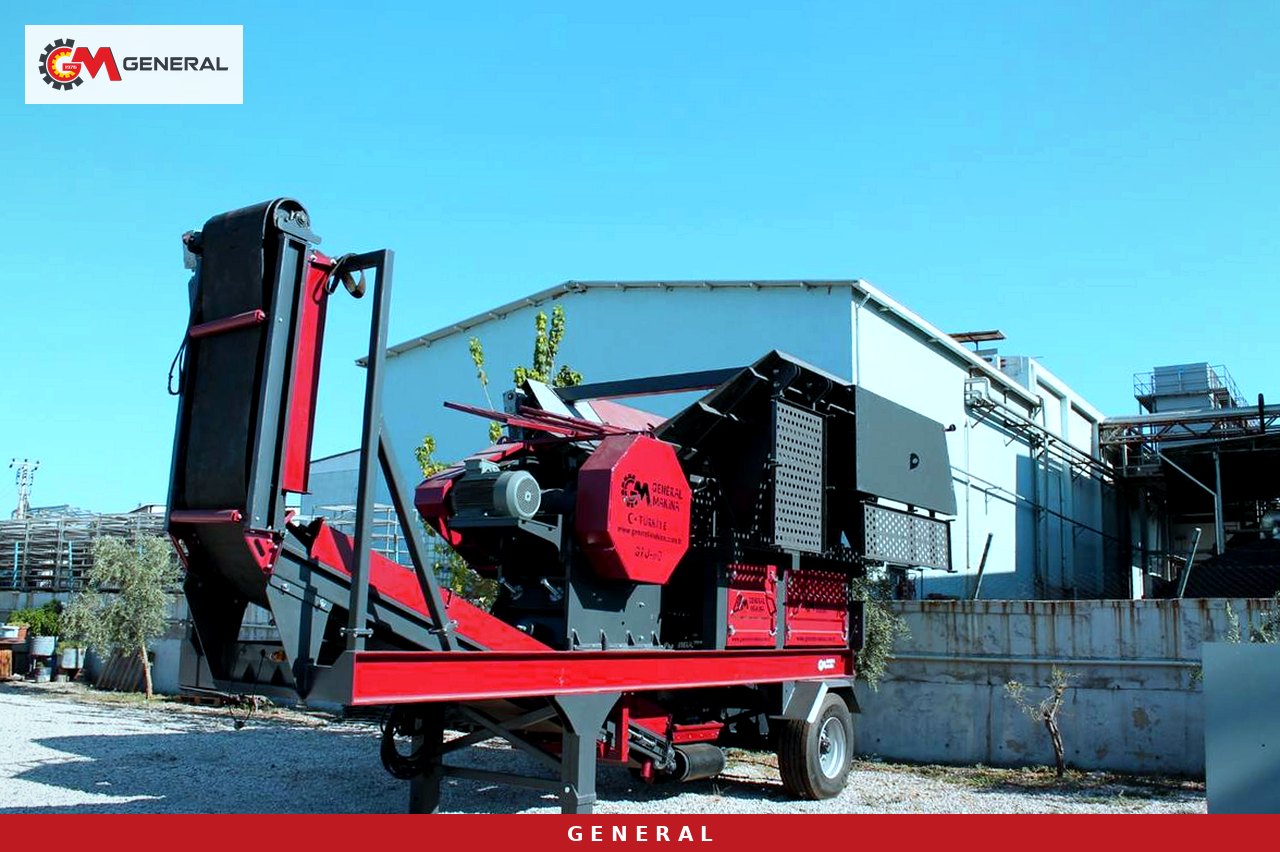
If the sample comes back with very high silica, consider the General 944 which has the same size and weight. Its GM430 cone secondary crushes by compression, so metal lasts longer in abrasive rock, though it does not reach an impactor's reduction ratio. For medium-hard, mixed rock, the General 01 combines both crushing stages in a single GPS 1210 impact body and its four-deck screen also delivers a separate 19-40 mm fraction. If the deposit is limestone and the start-up budget is tight, the 35,000 kg General 800 covers the lower half of the target at 80-150 TPH; it is not recommended for hard granite.
What must be ready on site before the truck arrives
A mobile plant needs no foundation, but that does not mean the site can be unprepared. Whether the plant produces on day one depends largely on the items below:
- A compacted, slightly sloped pad: the ground under the hydraulic legs of a 70-tonne chassis must not turn to mud in the rainy season.
- A feed ramp: an earth or rock ramp at a height where the excavator or loader can tip into the hopper comfortably.
- A generator position: 600 kVA for the 950, 550 kVA for the 944 and 01, with fuel tank, spill bund and ventilation clearance planned.
- Stockpile areas: separate, drained stockpiles for each fraction, wide enough for trucks to turn.
- Water supply: a spray line to keep dust down on conveyors and stockpiles in the dry season.
- Weighbridge and loading routine: to record sold tonnage from the very first day.
- Blasting and oversize plan: a hydraulic breaker or secondary blasting so blocks above 800 mm never reach the hopper.
From port to pit: shipping and permits
Leaving Izmir, the plant normally reaches Nigeria by sea through the ports in the Lagos area or Onne in the south-east, and is then hauled by road to the quarry. The General 950's transport dimensions of 20350 mm length and 4500 mm height mean bridges, power lines and bends on the route must be checked in advance. Rainy-season conditions on laterite roads can make the haul harder, so it pays to build the shipping schedule around the seasons.
Mining title, environmental approval and heavy-haul permits fall under different federal and state bodies. We do not quote timeframes or conditions here; confirm the current requirements with the relevant authority and your local legal adviser. Keeping copies of the plant's ISO 9001 and CE certificates on file makes customs paperwork easier.
Year one: wear, energy and real throughput
How profitable a fast start turns out to be depends on the quality of the records kept in the first months. We suggest watching three items every week.
Wear parts. With granite feed, jaw plates and the impactor's blow bars and aprons are the fastest-consumed items. The warranty runs for 1 year and excludes wear parts, so ordering at least one spare set of manganese castings with the first shipment stops the plant from standing idle while a consignment travels to Nigeria. See crusher wear and replacement parts for the options.
Energy. Remote pits rarely have grid power, and generator fuel makes up a large share of cost per tonne. We give no fixed consumption figure; use your own data in this formula: energy cost per tonne = (hourly fuel use × fuel unit price) ÷ tonnes produced per hour. Our energy and wear cost calculator lets you run the sum for different scenarios.
Real throughput. 120-180 TPH is a range; whether you run near its lower or upper end depends on rock hardness, moisture, feeding practice and how fine the product must be. Divide weighbridge records by operating hours to find your true average. During the Harmattan, fine dust calls for frequent cleaning of generator and engine air filters; put that into the maintenance schedule.
From start-up to growth: planning the second step
A quarry opened with a mobile plant can grow in three directions once the market settles. The first is adding a separate fine-material screen or sand washing unit at the end of the line if demand for crusher sand rises. The second is doubling tonnage with a second wheeled plant in the same pit, which also keeps production going while one unit is in maintenance. The third, once reserves and sales are firm for the long term, is moving to a stationary plant and redeploying the mobile unit to remote jobs or a new quarry.
As a concrete regional example, the General 950 project delivered to neighbouring Niger shows how the same model was set up in West African conditions. It should not be read as a Nigerian delivery; it is a reference for similar climate and logistics.
Frequently asked questions
How soon can a mobile plant produce its first aggregate in Nigeria?
Once on site, the General 950 is set up in about 30 minutes. What really decides the time to first sale is permits, the site pad, blasting and shipping. We cannot give a fixed period for these; they are planned together per project.
Should I choose the 950 or the 944 for a granite quarry?
Both offer the same capacity, weight and screen. Choose the 950 when cubical product and high reduction come first, and the 944 when metal life in very abrasive, siliceous rock matters most. We make the call together with the lab report.
Does the generator come with the plant?
The product pages list a 600 kVA generator for the General 950 and 550 kVA for the General 944 and General 01. If a grid connection is possible, an alternative power arrangement can be discussed at quotation stage.
What determines the price?
Model and crusher layout, number of screen decks, generator, spare wear-part package, extra conveyors and delivery terms (FOB or CIF port) set the price. We give the figure in a quotation prepared for your sample and product list.
Conclusion
For a new quarry in Nigeria, the quickest route is to test the rock, fix the product list and then pick the right wheeled model in the 120-180 TPH band: the General 950 or 944 for hard granite, the General 01 for mixed material, the General 800 for limestone. Our team in Izmir, building crushing and screening plants since 1976, will review your sample results and site details and propose a configuration for your pit. Send the lab report, target products and quarry location when you contact us and we will prepare your quotation.
Definitions of technical terms: Glossary