EN — English
 TR — Türkçe
 DE — Deutsch
 RU — Русский
 FR — Français
 ES — Español
 AR — العربية
 SR — Српски

Mali Remote Sites Generator Mobile Stone Crusher Plant 80-150 TPH
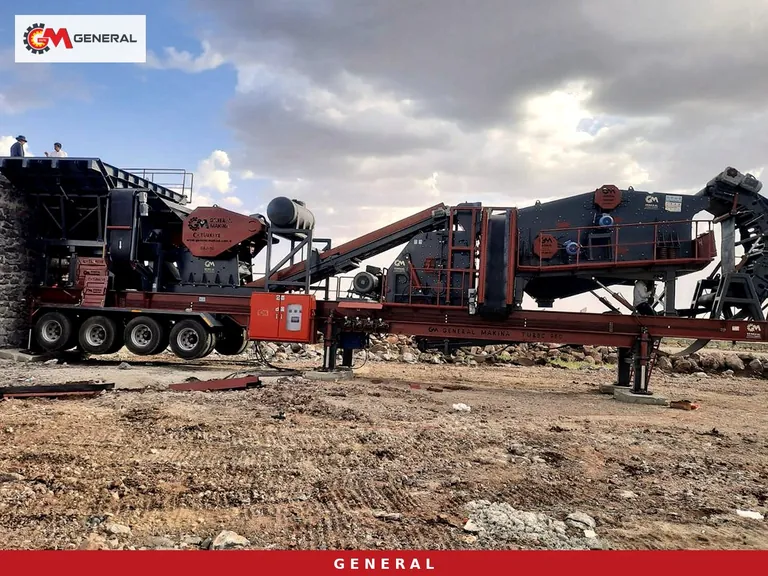
A contractor looking for a crushing plant for a road job, a dam site or mine-area infrastructure in Mali usually opens with "how many tonnes?". On a remote site the better first question is different: can the plant reach the site under its own wheels, make its own electricity and keep running until the next parts shipment arrives? This article works through the choice of a generator-powered mobile stone crusher for an operation targeting 80-150 TPH far from the grid, using those three constraints: road haulage, the power unit and on-site self-sufficiency. Every figure quoted for the recommended models comes from the technical data on our product pages.
On a remote Mali site, roads, fuel and parts decide the model
Mali is landlocked. Imported equipment is normally discharged at Dakar or Abidjan and then hauled a long way inland by road. Mining belts around Kayes and Sikasso, worksites along the Niger River and road projects heading north often mean the last stretch is driven on laterite feeder roads. So a model has to be judged on crushing capacity and also on its transport dimensions, its weight and how many loads it travels in.
The second constraint is energy. If no transformer can be brought to site, the crusher, screen and conveyor motors all draw from a single power unit, and when the generator stops the whole line stops. The third is parts: if blow bars, jaw plates, screen meshes, filters and belts are not held on site, a minor fault can turn into a stoppage lasting weeks. The model selection below is built around these three limits.
Candidate models and power ratings in the 80-150 TPH band
These are our wheeled plants that meet or sit closest to the target range. The kVA values are the generator ratings stated on each model's own product page; on the General 640 the power unit is optional.
| Model | Capacity | Crusher layout | Max. feed | Generator | Weight | Transport size (mm) |
|---|---|---|---|---|---|---|
| General 640 | 60-100 t/h | GPJ 60 jaw + GNR 50 impactor | 500 mm | 300 kVA (optional) | 38,000 kg | 3500×17000×4500 |
| General 800 | 80-150 t/h | PDK 1280 primary impactor | 600 mm | 450 kVA | 35,000 kg | 3600×15500×4500 |
| Mobil 90 | 90-150 t/h | GPJ 90 jaw + washing screen + twin screw | 800 mm | 350 kVA | 45,000 kg | 3600×15700×4500 |
| General 944 | 120-180 t/h | GPJ 90 jaw + GM430 cone | 800 mm | 550 kVA | 70,000 kg | 4130×20350×4500 |
General 800: the centre of the band in the lightest package
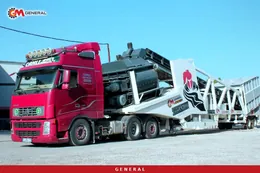
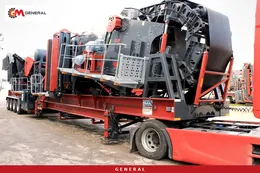
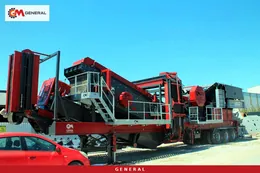
The General 800 matches the 80-150 TPH title range exactly. A PDK 1280 primary impactor, a 1300×4000 mm three-deck screen and a 450 kVA generator share one chassis. At 35,000 kg and 3600×15500×4500 mm it is the lightest option in the table, a difference you feel in axle loads and permits on a long road tow. The impactor gives cubical product from limestone and low-abrasion stone; in hard, siliceous rock blow-bar consumption climbs.
General 640 and General 944: when the rock gets harder
If the quarry face is granite, dolerite or quartz-rich sandstone, a jaw primary is the sounder start. The General 640 carries a jaw and an impactor together, covers the lower half of the band at 60-100 t/h and can run off-grid with its optional 300 kVA unit. When demand passes 100 t/h, the General 944 comes in: run at the low end of its 120-180 t/h rating it comfortably covers the upper half of the target, and its compression-type cone secondary keeps metal consumption down in abrasive stone. The price is weight; whether a 70,000 kg chassis can cross the bridges and culverts on Mali's secondary roads must be checked in advance.
Where the feed is clayey river gravel or laterite mix that needs washing, the Mobil 90 crushes, washes and screens on one chassis. Washing needs water, though; on a dry site with no steady supply that option stays on paper. All our wheeled units can be compared on the wheeled mobile crushing plants page.
Setting up the power unit away from the grid
On a generator-driven plant a power failure halts the entire line at once, so the generator should be treated as the line's main machine, not an accessory parked next to the crusher. What to check on a remote site:
- Start-up sequence: motors come on from the end of the line backwards, stockpile belts, screen, feeder and the crusher last. Starting everything together throws a sudden load onto the generator.
- Heat derating: in the hot Sahel months a generator struggles to approach its nameplate output. Ask the generator maker for its temperature and altitude derating table at quotation stage and state your site conditions.
- Air filtration: fine dust blown in from the Sahara during the dry season clogs filters fast. A pre-cleaner on the air intake and spare filter elements are measures that can be specified for the project.
- Fuel storage and quality: diesel trucked to site may carry water and sediment. A water-separating pre-filter between tank and generator cuts the risk of injector failure.
- Earthing and cable routing: redo the earthing at every relocation and protect cables from machine traffic.
Fuel burn depends on the rock, the feed regime and the load factor, so we give no litre figure here. The method for your own site is set out step by step in our article on hourly fuel consumption and operating cost. As a simple frame, energy cost per tonne = hourly fuel use × unit fuel price ÷ net hourly output. The denominator (real tonnes per hour) usually moves more than the numerator; with irregular feeding the generator burns fuel while no stone is broken.
From port to site: planning the road leg
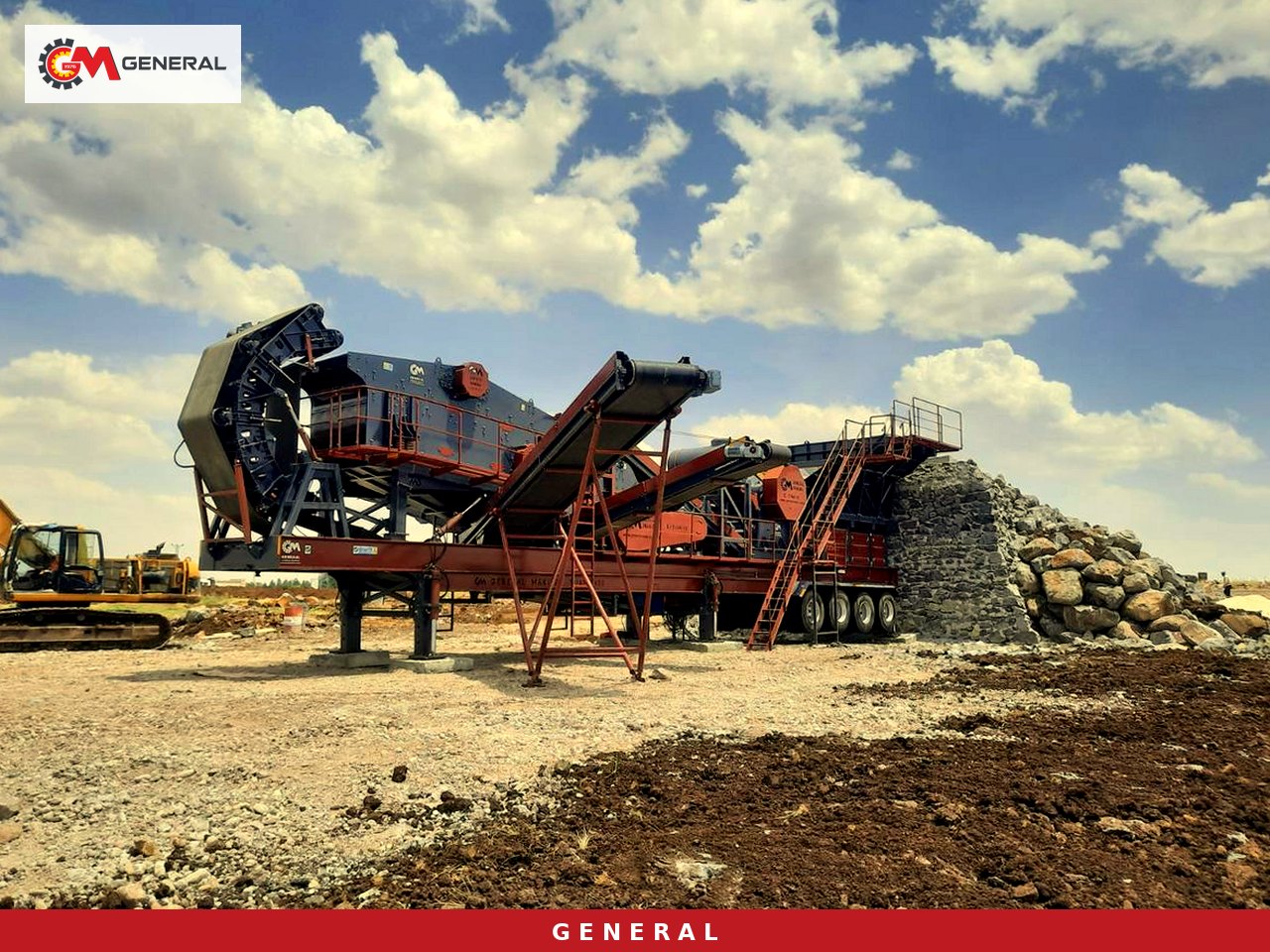
Once the plant is off the ship at Dakar or Abidjan, the real journey starts. A wheeled chassis hitches to a tractor unit and rolls on its own tyres, with no lowbed needed. A few preparations still set the arrival date:
- Confirm axle-load and clearance rules along the route, and any escort requirement, with the road authorities concerned. Nothing here replaces those rules.
- Allow for laterite roads softening in the rainy season; moving a heavy chassis in the dry period protects the installation schedule.
- Put the spare-parts crate in the same shipment as the machine. A crate sent separately and held at customs or on the road leaves the plant idle on site.
- Level the set-up area beforehand. Hydraulic legs need no concrete foundation, but they do need compacted ground that does not hold water.
- Build the feed ramp from local rock or compacted fill and leave turning room for trucks and loaders.
Self-sufficiency on site: parts, maintenance and crew
On a site days away from Bamako, uptime is set by the distance to the workshop. A site parts kit should therefore be planned with the first order. Its contents follow the crusher type: blow bars and impact plates for an impactor, fixed and moving jaw plates for a jaw, mantle and concave for a cone. Add screen meshes, conveyor belts and pulleys, hydraulic hoses, generator filters and belts. Manganese and high-chrome cast wear parts are listed on our crusher wear and replacement parts page.
Size the parts stock from a sample, not a guess
How long a set of blow bars or jaw plates lasts depends on the rock's abrasiveness. Before ordering, have a quarry sample tested for abrasivity and compressive strength and attach the results to the enquiry. Without test data, track wear closely during the first month and plan the second shipment from that.
On the crew side, at least one operator should be able to adjust the crusher setting alone and one person to service the generator alone. On a remote site, "we'll wait for the technician" can halve output. The warranty runs one year and excludes wear parts, so wear-part planning rests entirely with the operator.
Mali's rock types and the product you can expect
Granite and dolerite quarries, sandstone on the plateaus, gravel along the rivers and laterite over wide areas are all common in the country. The same plant moved between projects may therefore meet a different stone each time. No one can state a specific quarry's rock properties without a sample, but general guidance is possible.
In granite and dolerite a jaw primary followed by a cone or impact secondary leads; the General 944 and General 640 are built for that. In limestone and soft sandstone the General 800's impactor gives a high reduction ratio and cubical shape. In clayey gravel the real problem is screen blinding, which calls for washing or removing fines before the crusher. The General 800 and General 944 split product into 0-5, 5-12 and 12-19 mm fractions, and the General 800 adds a 19-40 mm cut. These are the basic sizes for concrete aggregate, asphalt chippings and road base. Confirm the grading limits in the project specification with the relevant authority and set the screen apertures accordingly at order.
Frequently asked questions
Which model suits a remote site in Mali best?
The General 800 if the rock is limestone or low-abrasion and transport weight is decisive. The General 640 for granite or dolerite where 100 t/h is enough; the General 944 when more tonnage is needed. The final call should rest on a sample test and the condition of the access road.
Is the generator part of the plant?
The product specifications list a 450 kVA unit on the General 800, 550 kVA on the General 944 and 350 kVA on the Mobil 90. On the General 640 the 300 kVA generator is optional. Where a grid connection exists, a different power arrangement can be discussed at quotation.
How is the plant moved from one site to the next?
Conveyors fold, hydraulic legs retract and the chassis is hitched to a tractor unit to travel on its own wheels. No concrete foundation is needed at the new site; level, compacted ground is enough.
What drives price and delivery time?
The model, crusher layout, whether the generator is included, the scope of the site parts kit and the sea and road freight arrangement set the price. Firm figures and a schedule come in a written quotation once we have your requirements.
Conclusion
For 80-150 TPH on a remote Mali site, the General 800 is the lightest option and the most direct fit for the target; in hard rock the General 640 or General 944 is the better route. Whichever is chosen, generator heat derating, the road route and the site parts kit deserve as much planning as crushing capacity. Send us your rock information, target tonnage and site location for our ISO 9001 and CE certified plants, built in Izmir since 1976, and request a quotation through our contact page.
Definitions of technical terms: Glossary