EN — English
 TR — Türkçe
 DE — Deutsch
 RU — Русский
 FR — Français
 ES — Español
 AR — العربية
 SR — Српски

Using Mobile Crushers with Iron Separation in Recycling Plants
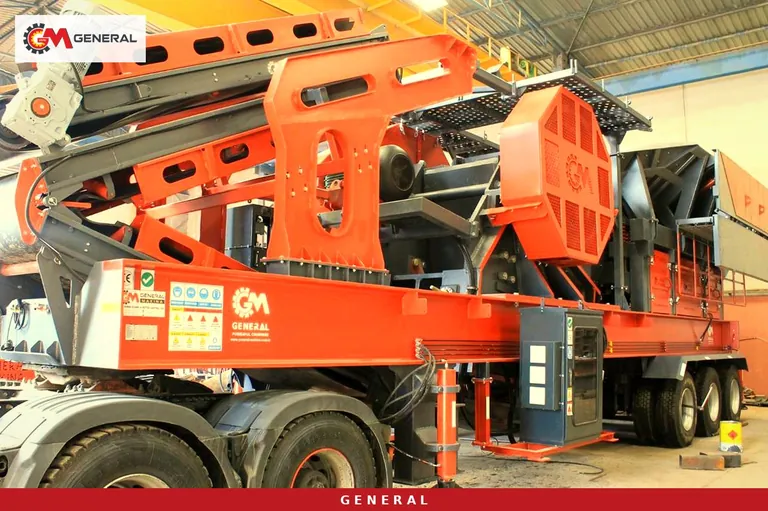
A mobile crusher working on reinforced demolition rubble produces two things at its discharge: aggregate and steel. The aggregate earns money; the steel, if it is not pulled out on the line, contaminates the product, slits belts and sits in the stockpile as a hidden hazard. This article is not about how to crush rubble. It is about how to catch the rebar once crushing has freed it: where the magnetic separator sits relative to the discharge conveyor, how belt and crusher choice affect separation, which items must be written into the quotation and how the recovered scrap is handled on site. One point up front: none of the technical tables on General Makina product pages lists a magnetic separator as standard equipment. For every model named below, the magnet, its type and its mounting are therefore an item specified in the offer.
What "with iron separation" actually means on a mobile crusher
A mobile crusher with iron separation does not have a special device inside the crusher body. Separation happens on the main discharge conveyor that carries the crushed material, using a magnet suspended across or along the belt. The crusher strips the concrete off the steel; the belt carries the material in a thin layer under the magnet; the magnet lifts the steel and throws it to the side into a scrap bin.
For a buyer this means that separation success depends as much on belt length, belt width, burden depth and how cleanly the steel leaves the crusher as on magnet strength. A line with a good magnet but a short or overloaded belt will still carry part of the steel into the stockpile. Start the assessment with the belt that will carry the magnet, not with the magnet itself.
Candidate models: discharge conveyor and readiness for a magnet
The table sets the General Makina models most relevant to recycling side by side, using the dimensions that matter for magnet mounting. Where a product page does not give the main conveyor size, the cell shows "—"; those values are settled in the quotation. The magnetic separator column deliberately carries a single answer, because no model's technical table mentions a magnet.
| Model | Crusher | Feed size | Capacity | Main conveyor | By-pass conveyor | Power | Magnetic separator |
|---|---|---|---|---|---|---|---|
| GM 100 | GNR-01 impactor, 160 kW | 600 mm | 100-180 t/h | 1000×10000 mm | — | 450 kVA | Specified in the offer |
| GM 125 | GNR PDK02 impactor, 200 kW | 700 mm | 150-250 t/h | 1200×12000 mm | 600×5000 mm | 550 kVA | Specified in the offer |
| GM 90JP | GNR 90 jaw, 95 kW | 700 mm | 70-180 t/h | 1000×12000 mm | 600×6000 mm | 250 kVA | Specified in the offer |
| M-DMK 02 | Secondary impactor, 200 kW | 0-350 mm | 150-250 t/h | — | — | — | Specified in the offer |
| M-PDK01 | Primary impactor, 315 kW | 0-1200 mm | 250-500 t/h | — | — | — | Specified in the offer |
The first takeaway: the main conveyors of the three tracked models are 10 to 12 metres long, which leaves room to hang a magnet between the crusher outlet and the stockpile end. The 1200 mm belt on the GM 125 can carry the same tonnage in a thinner layer, which lowers the chance of steel staying buried under the material. This explains how the layer depth helps; the actual capture rate depends on the feed and the magnet chosen and is measured on site. All tracked options are compared on the track-mounted mobile crushers page.
Crusher type makes the magnet's job easier or harder
A magnet can only lift steel that has been freed from concrete. A piece of rebar with a lump of concrete still attached is heavy and may ride past the magnet with the belt. How cleanly the crusher strips concrete from the steel therefore drives separator performance directly.
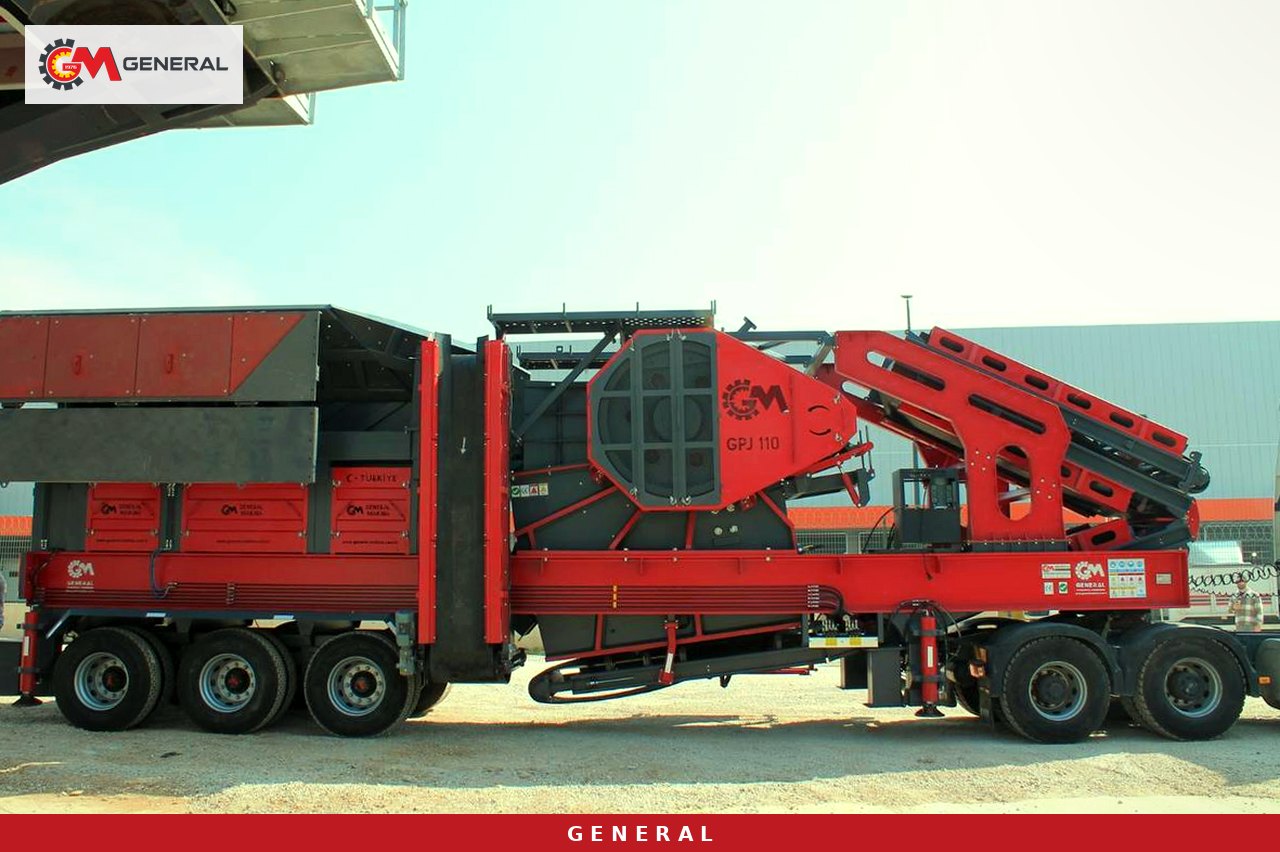
In an impact crusher the blow bars strike the material and throw it against the aprons; the concrete shatters away from the reinforcement. The GM 100 and GM 125 work on this principle. A jaw crusher breaks by compression; it is more tolerant of large, heavily reinforced blocks, but some steel may leave still bonded to concrete pieces. The GNR 90 jaw of the GM 90JP belongs to this class. After a jaw primary the steel arrives on the belt as longer, more irregular pieces, so the gap between magnet and belt and the scrap discharge direction need closer adjustment.
Crusher choice also sets the wear picture. Product pages recommend manganese or martensitic blow bars where tramp iron is a risk in recycling, and high-chrome bars for clean, abrasive feed; high chrome is brittle and can crack when it meets steel. The magnet works after the crusher, so it does not protect the blow bars; the right alloy does. Alloy options are described on the crusher wear parts page.
The belt side: protecting the conveyor that carries the steel
On reinforced rubble the part that suffers most is often not the crusher but the discharge belt. If the end of a freed bar spears the belt at the loading point, the belt can be ripped lengthwise. Three points should be written clearly into the quotation.
- Belt grade: the General Makina conveyor page gives EP 100 – 4 ply as standard and EP 125 – 4 ply under an impact crusher. Confirm the belt under the crusher on a recycling line is of this grade.
- Loading point: rubber-lined impact idlers take the load where material lands; scrapers clean sticky fines off the return run.
- Emergency stop: a pull-cord emergency switch is listed as an option on the conveyor page. If hand-picking will happen beside the belt, treat this option as mandatory, not negotiable.
If a separate stockpile or transfer belt is needed, General Makina builds belt conveyors in seven widths from 500 to 1200 mm at any required length. When the magnet does not fit on the crusher's own belt, mounting it over a separate transfer conveyor is another solution.
By-pass flow: is the steel only on the main belt?
This is the question most often skipped in quotation meetings. The GM 125 has a 600×5000 mm and the GM 90JP a 600×6000 mm by-pass conveyor; fines that pass the grizzly go to a separate stockpile without entering the crusher. If the magnet is hung only over the main discharge belt, the by-pass flow never passes under it.
Fines from demolition rubble can carry steel too: short rebar offcuts, wire, nails and tie wire. If the by-pass product goes to fill, that may be acceptable; if you plan to sell it or use it in more demanding work, you need either a second magnet over the by-pass belt or an arrangement that routes fines onto the main belt. Decide according to where the by-pass product will go, and put the decision in writing in the quotation.
Iron separation items to write into the specification
Because the magnet is not standard equipment, a vague scope means missing parts on site. Attach the list below to your request for quotation and ask for a written answer on each item.
- Separator type: permanent magnet or electromagnet? As a general principle an electromagnet needs power, so the plant's generator capacity (for example 450 kVA on the GM 100, 550 kVA on the GM 125, 250 kVA on the GM 90JP) must be confirmed to cover the separator load too.
- Mounting point: on which section of the main belt will the magnet hang, and how far from the crusher outlet?
- Width match: does the separator's working width cover the belt width (1000 mm or 1200 mm)?
- Suspension height: can the gap between magnet and belt be adjusted on site?
- Scrap discharge side and bin: which side does the steel drop to, where does the bin stand, and can a truck or loader reach it?
- By-pass flow: is a second magnet needed, or will fines be routed onto the main belt?
- Guarding and access: is there a guard around the magnet, a maintenance platform and a lockout point?
- Hand-picking: is there a safe picking station beside the belt for copper cable, plastic and timber that the magnet will not catch?
If you prefer to work from a ready machine set, the concrete (C&D) recycling plant page shows the crusher, screen and conveyor combination in one place.
Handling scrap steel on site
Separated steel is not waste but a saleable by-product, provided it is collected and recorded properly. A few habits make the difference: empty the scrap bin before it is full, because an overflowing bin drops steel back onto the belt or the stockpile; empty it only after the belt has been stopped and locked out; weigh and log the collected scrap at the end of each shift.
Track the scrap contribution with variables: Scrap income = scrap tonnage collected × scrap unit price. Set the magnet's energy use, bin haulage and maintenance hours against it. Hypothetical example, not a real value: if 2 tonnes of scrap are collected in a shift and the scrap unit price is 10 units, scrap income is 2 × 10 = 20 units. Real tonnage depends on the reinforcement density of the rubble; take it from the weighbridge records of the first weeks.
If a stockpile sample shows steel, the cause is most likely one of three: the magnet hangs too high, the belt is overloaded, or the steel leaves still attached to concrete. The first two are fixed by adjustment, the third by crusher setting or by cutting long bars before feeding. For the general crushing approach by rubble type, see our article on recycling and asphalt/concrete crushing; single-chassis units for pre-broken rubble are on the portable rock crushers page.
Frequently asked questions
Is a magnetic separator standard on General Makina mobile crushers?
The technical tables on the product pages do not list a magnetic separator as standard equipment. Magnet type, width and mounting point are specified in the offer according to your feed and belt dimensions.
Does the magnet protect blow bars and jaw plates from steel?
No. The magnet works after the crusher and cleans the product. What protects the crusher against steel is the right wear-part alloy: manganese or martensitic blow bars are recommended for recycling.
Is a jaw or an impact crusher better for iron separation?
An impact crusher strips concrete from rebar more cleanly, which makes the magnet's job easier. For very large, heavily reinforced blocks a jaw primary such as the GM 90JP is more tolerant; steel then comes out longer and more irregular, and the magnet is adjusted for that.
What determines the price of a line with iron separation?
The crusher model, separator type, any second magnet or transfer belt, belt grade and picking platform all set the price. A figure is given in the quotation once the scope is clear.
Conclusion
A mobile crushing and screening plant with iron separation works when crusher, discharge belt and magnet are designed together. Choose the crusher type for the reinforcement density first, then check belt width and length against magnet mounting, do not forget the by-pass flow, and get the separator written into the offer as a separate item. Share your rubble type, expected tonnage and where the product will be used, and we will work out the right combination with you: request a quote through our contact page.
Definitions of technical terms: Glossary