EN — English
 TR — Türkçe
 DE — Deutsch
 RU — Русский
 FR — Français
 ES — Español
 AR — العربية
 SR — Српски
Planned Shutdown Maintenance Schedule for a Crushing Plant
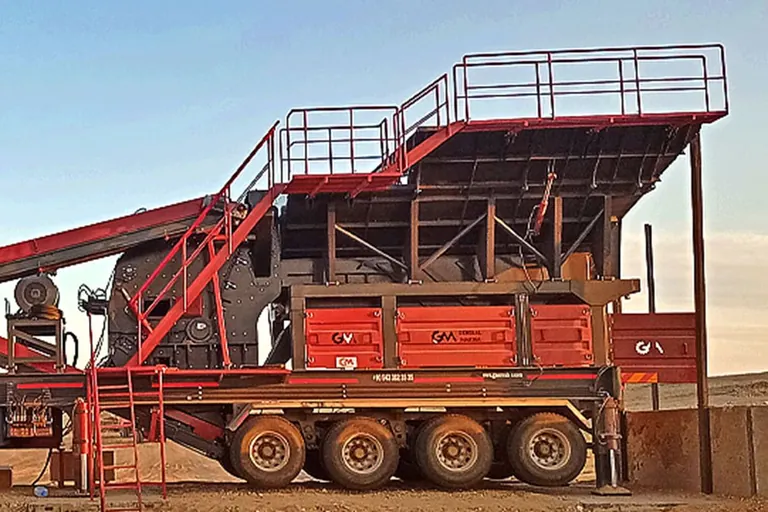
Most crushing plants have a maintenance list. Far fewer have a schedule. The distinction sounds small and is not: the list states what has to be done, while the schedule states when it happens, inside which shutdown window, with which crew and with which parts already unpacked on site. Building a planned shutdown maintenance schedule means grouping work into tiers by how fast the failure develops and then placing each tier inside the production calendar, before breakdowns write that calendar instead.
Tiers follow degradation speed, not habit
Whether a task belongs in a weekly or a monthly round is not a matter of preference. The governing quantity is the time between the moment a defect first becomes detectable and the moment the function is actually lost. Where that window is short, inspection has to be frequent. The established rule is to set the inspection interval at no more than half that window, so that a defect starting immediately after one round is still caught on the next, leaving time to order parts and plan the outage.
Inspection intervals in a planned shutdown maintenance schedule
| Time for the defect to develop | Maximum inspection interval | Where it lands in the schedule |
|---|---|---|
| 2 weeks | 1 weeks | weekly round |
| 4 weeks | 2 weeks | fortnightly |
| 8 weeks | 4 weeks | monthly round |
| 12 weeks | 6 weeks | six-weekly |
| 26 weeks | 13 weeks | quarterly outage |
| 52 weeks | 26 weeks | half-yearly overhaul |
The logic is applied per item of equipment. Bearing vibration can develop over weeks while a crack in a screen frame may take months; bundling both into the same round means inspecting one too often and the other too late. Schedules are therefore built equipment by equipment and only then merged into shared shutdown windows.
A four tier skeleton
Four tiers cover most plants. The shift tier holds observations that can be made safely while the plant runs: temperature, noise, leaks, feed balance. The weekly tier needs a short stop and takes belt tension, screen media tension and bolt torque checks. The monthly tier needs a longer window and access at height: wear part thickness measurement, oil sampling, setting and clearance checks. The seasonal overhaul is the heavy work done when production is down: rotor balancing, shaft and bearing inspection, frame weld examination. Duration and manpower for each tier are written down in advance, because unwritten durations reliably double.
Treating the window as a work package
The value of a planned outage is proportional to the quality of its preparation. What has to be ready before the stop is knowable: replacement parts delivered and unpacked, lifting gear with valid certification, isolation points listed, task sequence and parallel crews assigned, and a cleared laydown area for removed components. Without that, the first hours of the window are spent hunting for parts and the window closes with the job half done.
Unexpected findings during the outage go on a separate list and are not executed on the spot. Absorbing them destroys the plan. They are scheduled into the next window, and only genuinely urgent items justify a separate decision.
The one metric that shows whether the schedule works
Success is not the number of jobs completed; it is the share of planned work completed when it was planned. Around 90 per cent is the widely cited target, usually tracked as a band between 85 and 95 per cent. Once the figure falls below 40 to 50 per cent, the plant is no longer executing a plan; it is being driven by breakdowns, and the inspections that would have prevented those breakdowns are exactly what is being dropped. The measurement has to be honest: work done late is not compliant, only work completed inside a defined tolerance window counts.
Fitting the schedule to the plant
Fixed installations hold a schedule more easily because windows can be locked to the production programme. For a stationary crushing plant the annual plan usually takes the shape of one major overhaul placed outside the season plus short monthly stops. Reading wear part life and replacement decisions alongside the schedule is covered under maintenance and wear.
Questions we are asked
Who should own the schedule?
The person planning the work and the person doing it should not be the same. Where they are, the plan is the first thing sacrificed on a busy day.
Do intervals change over time?
They do. Harder feed, higher throughput or a different parts supplier all change how fast degradation develops, so intervals are retuned using the first year of records.
Is this overkill for a small plant?
The number of tiers can shrink; the logic cannot. Even a single machine operation needs its shutdown window and its parts preparation written down.
Send us your equipment list and production programme and we will draft the tiers and shutdown windows around your operation so the schedule becomes something your crew can actually follow.
Definitions of technical terms: Glossary