EN — English
 TR — Türkçe
 DE — Deutsch
 RU — Русский
 FR — Français
 ES — Español
 AR — العربية
 SR — Српски
Crusher spare parts inventory management
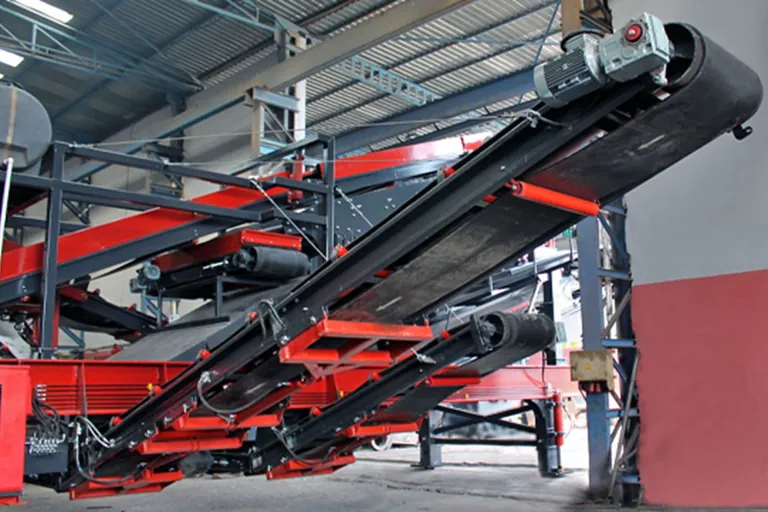
The size of a store room is never the measure of a maintenance department. The measure is whether the needed item is on the shelf at the hour it is needed. Crusher spare parts inventory management therefore decides what to hold not by unit price but by how many hours the plant stops without the item and how long a replacement takes to arrive. A cheap seal can outrank a bearing that takes six weeks to source, and the reverse happens just as often.
Crusher spare parts inventory management starts with criticality
Decisions become clear once every line in the store is classified on three independent axes. The value axis shows where capital is locked. The demand-pattern axis states how predictable consumption is. The criticality axis measures what happens to production when the part is missing, and it carries the most weight in a stocking decision. The three axes give different answers for the same item, and the final policy sits at their intersection.
| Axis | What it measures | Classes | Effect on stocking policy |
|---|---|---|---|
| Value | Share of annual consumption spend | High, medium, low | Tight control and frequent review on high-value lines |
| Demand pattern | Predictability of consumption | Steady, fluctuating, erratic | Erratic demand is governed by criticality, not by forecast |
| Criticality | Whether production stops without the part | Vital, essential, desirable | Vital lines carry a high service level regardless of value |
In a crushing plant the vital class typically holds crusher main bearings and their seals, eccentric shaft sealing elements, the hydraulic power unit pump and valve block, screen exciter bearings, main drive belts and coupling elements, and the contactors and thermal protection of the main motor. What they share is a long lead time and a total line stop in their absence. Wear parts follow a different logic because their consumption is measurable and can be planned. For the wear items on the crusher and screen side, the crusher spare parts list is the natural starting point.
Safety stock and reorder point
Stock levels come from two relationships, not from opinion. Safety stock equals the service level factor multiplied by the standard deviation of demand and by the square root of the lead time. The reorder point equals average daily consumption multiplied by average lead time, plus the safety stock. Together they turn the argument about how many to keep into an arithmetic question with an auditable answer.
| Variable | Meaning | Source | Effect when it rises |
|---|---|---|---|
| Service level factor | Statistical equivalent of the target availability | Set from the criticality class | Safety stock increases |
| Standard deviation of demand | Volatility of consumption between periods | Historical issue records | Safety stock increases |
| Lead time | Time between order and delivery | Supplier confirmation and past performance | Both safety stock and reorder point increase |
| Average daily consumption | Mean number of units issued per day | Store issue records | Reorder point rises |
The most fragile input here is lead time. Use the delivery times actually achieved over the last year rather than the time a supplier quotes. When customs clearance, freight and the production queue are left out, the reorder point comes out too low and the calculation fails in the field.
Balancing downtime risk against carrying cost
Holding an item costs tied capital plus storage and obsolescence. On the other side sits the cost of the stoppage that occurs when the part is missing: lost production, an idle crew and a late despatch. The decision compares those two figures. While the downtime cost exceeds the carrying cost, the part stays on the shelf; when it does not, the part is bought against a work order. Calculating an hourly downtime cost specific to the plant means separating out the operating cost lines, and that same breakdown underpins the maintenance budget.
A separate policy for long-lead items
For large castings and machined components measured in months, safety stock alone does not solve the problem. The working method is to place the order before consumption occurs and to tie delivery to the planned maintenance calendar. The part arrives shortly before the scheduled strip-down, spends little time in the store, and the downtime risk disappears. Overhaul kits follow the same logic.
Store discipline: counting, traceability, shelf life
However good the arithmetic, the system fails when records do not match reality. Every issue is linked to a work order number, because without knowing which part went onto which machine no consumption statistic can be built. Counting is done cyclically — critical lines often, low-criticality lines rarely — rather than as one annual sweep. Items with a shelf life are tracked separately: elastomer seals, hoses, belts and oils lose their properties over time, and an unlabelled rubber component can turn out to be unusable at the moment it is needed.
A practical order for building the list
Start by extracting the parts tree machine by machine, collecting manufacturer part number, quantity, dimensions and equivalence data in a single table. Second, assign a criticality class to every line. Third, record the lead times actually achieved. Fourth, apply the calculation and set the reorder points. Fifth, match the list against the maintenance plan and move every item with a scheduled strip-down from stock into the calendar. Follow that order and the store shrinks while availability rises. Related maintenance practices are gathered under maintenance and wear.
Frequently asked questions
Should a complete spare be held for every machine?
No. A complete spare is justified only for single-point-of-failure units with very long lead times; elsewhere a set of critical sub-components is more efficient.
How often is the reorder point updated?
Whenever consumption pattern or lead time changes noticeably, and at least once a year, otherwise the calculation describes a reality that no longer exists.
Are common parts stocked separately?
Standard bearings, seals and belts used on several machines are pooled, which delivers the same availability from fewer units.
Definitions of technical terms: Glossary