EN — English
 TR — Türkçe
 DE — Deutsch
 RU — Русский
 FR — Français
 ES — Español
 AR — العربية
 SR — Српски

Oman Coastal Armour Rock Screening & Stone Crushing Plant 250-450 TPH
On Oman's coast, most of the quarry stone that goes into a breakwater, groyne or shoreline revetment never passes through a crusher. Large pieces separated as armour rock are placed as they are. The job of the crushing and screening plant is to split everything else into the filter layer, core fill and concrete aggregate classes named in the specification. That is why an armour rock line targeting 250-450 TPH is laid out differently from a normal aggregate plant: sorting and pre-scalping come first, and the crusher plays a supporting role. Below we build that layout with model values taken from our product pages.
We give no information on any specific Omani port, coastal scheme or tender. Confirm the armour mass grades, filter gradation and rock quality tests in the project specification and with the responsible authority.
How quarry stone is shared out in coastal protection
A rubble-mound breakwater section has an outer armour layer of the heaviest blocks, an underlayer (filter) of smaller stone beneath it, and a core in which quarry fines are mixed with stone of every size. The blasted muckpile from the quarry is divided among these uses. The designer's mass grades decide which share goes where, and the plant is set up to match them.
Blocks to be picked out
Armour blocks are selected at the face or at the muckpile with an excavator and graded on a weighbridge. They never reach the feeder. What is hauled to the feed hopper is the material left after block selection. A common mistake is rushing that selection and sending pieces above 1500 mm to the hopper. The largest lump the GNR feeder series accepts is 1500 mm; anything bigger bridges across the grizzly bars and stops the line.
Filter stone, core and aggregate
Part of the material entering the hopper falls straight through the grizzly and is sorted, uncrushed, into core fill or filter grades. Oversize riding over the bars goes to the jaw crusher, and the crusher product is screened into filter material and aggregate for road and quay concrete. Line efficiency depends directly on how much material the grizzly keeps away from the crusher.
Material flow from hopper to stockpile
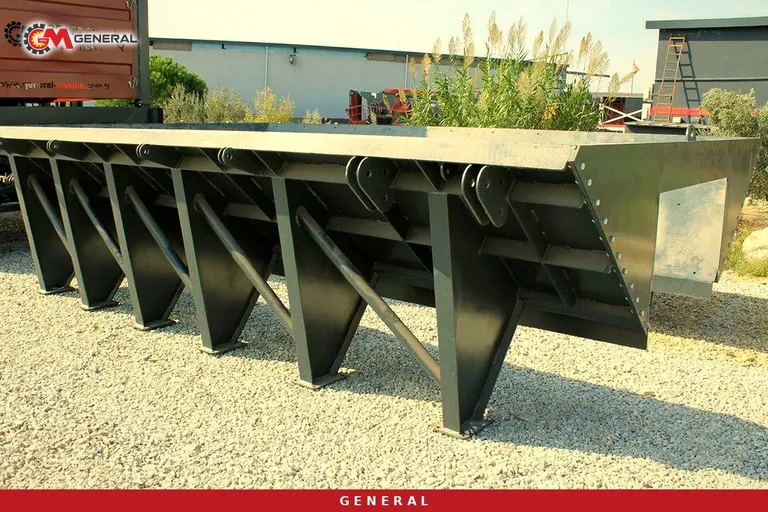
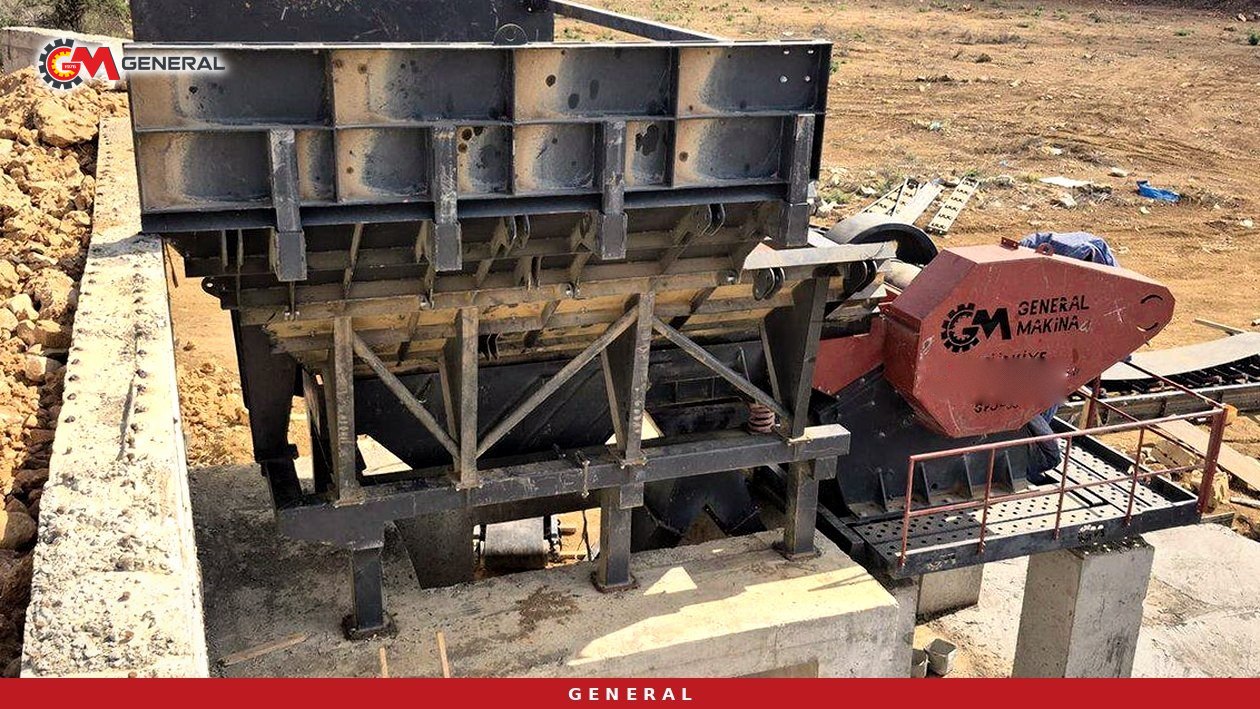
The flow is set up like this: a truck or loader tips the sorted run-of-mine rock into a hopper whose volume can be chosen between 15 and 100 m³. The vibrating grizzly feeder walks the material forward on a trough resting on helical springs. The grizzly section at the end of the trough removes fines and soil through the by-pass and delivers the coarse rock into the crusher mouth at a steady rate. The crusher mouth stays full and the jaws do not run empty.
In armour rock work the by-pass stream is not waste. Very often it is exactly the mixed material needed for core fill. If it carries too much soil and fines, running the by-pass over a second grizzly screen separates clean filter stone from the dirty fraction. The G-type grizzly screen sits between the feeder and the primary crusher for this purpose; its bars are Mn13-type austenitic manganese castings and the bar gap is adjustable. The gap is set at order stage to the lower limit of the filter grade in the specification.
One limit should be known from day one: the largest lump our belt conveyors accept is 250 mm. Filter stone above 250 mm does not go on a belt. It is discharged from the grizzly through a chute to a ground stockpile and picked up by loader. If the site layout leaves no truck turning space around that stockpile, the line will jam in its first week.
Two configurations for 250-450 TPH
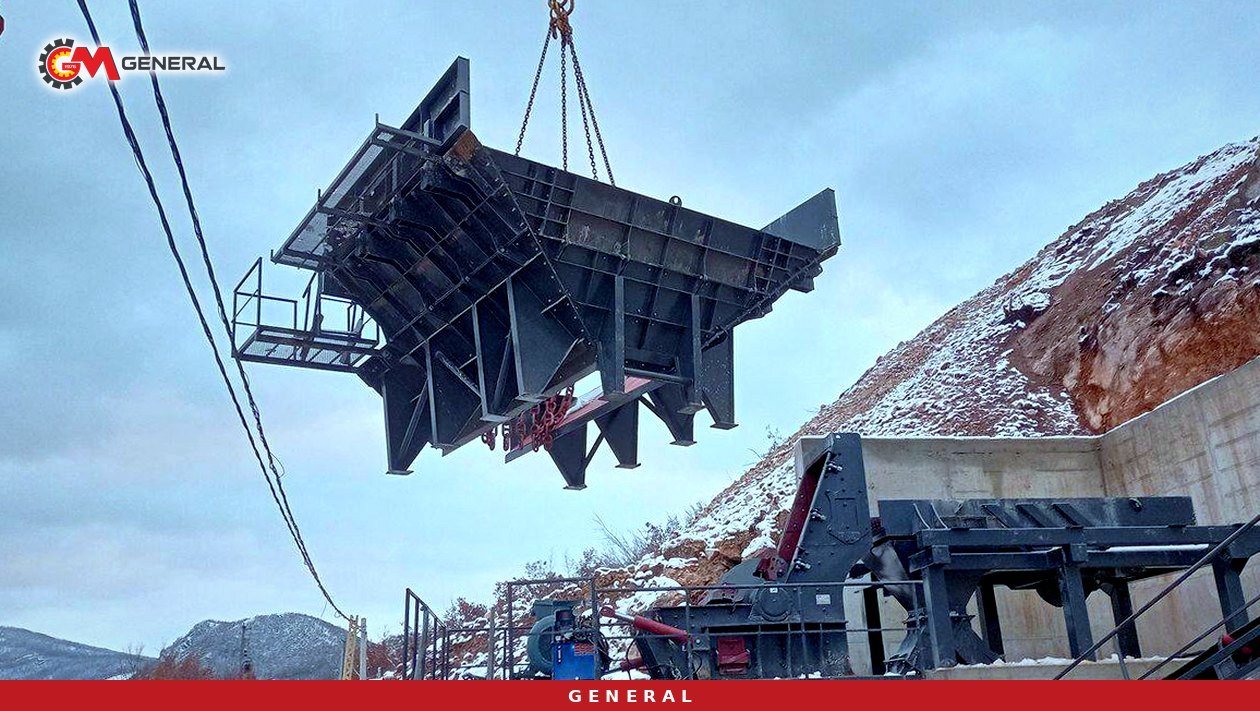
The target range is met by stacking feeder, crusher and screen capacities, not by one machine. Every value below comes from our product pages; unknown cells are marked with a dash.
| Machine | Role in the line | Size / opening (mm) | Capacity (t/h) | Motor (kW) | Weight (kg) |
|---|---|---|---|---|---|
| GNR 110 grizzly feeder | Line A feeding | 1100×4750 | 200~300 | 2x7.5 | — |
| GNR 140 grizzly feeder | Line B feeding | 1400×5000 | 350~600 | 2x9.2 | — |
| GNRK 110 jaw crusher | Line A primary | 1100×850 | 200–350 | 110/132 | 33,000 |
| GNRK 130 jaw crusher | Line B primary | 1300×1000 | 400–500 | 160 | 42,500 |
| ELKG-1930 grizzly screen | By-pass separation | 1200×3000 | 100-400 (series) | 11.5 | 6,500 |
| GNR 2060 vibrating screen | Line A sizing | 2000×6000 | 100-400 (series) | 18.5 | 12,700-13,000 |
| Twin screen, GNR 2460 body | Line B sizing | 2400×6000 | 100-500 (twin) | 22 | — |
Line A: 250-300 TPH
The GNR 110 feeder delivers 200~300 t/h, and the GNRK 110 jaw crusher behind it works in the 200–350 t/h range. The largest lump a jaw crusher should take is about 0.8-0.9 of its opening width, which on the GNRK 110 means roughly 880-990 mm. Because the feeder accepts lumps up to 1500 mm, stone over one metre that stays on the grizzly must either be pulled into a filter or block grade during sorting, or be reduced with an excavator-mounted hydraulic breaker before it reaches the crusher. Crushed material and grizzly undersize are sized on a single GNR 2060 screen.
Line B: 350-450 TPH
In the upper band the GNR 140 feeder (350~600 t/h) pairs with the GNRK 130 (400–500 t/h). On the GNRK 130 the largest lump into the crusher is about 1040-1170 mm, so less of the oversize left after sorting needs pre-breaking. On the screening side, a twin vibrating screen that runs two screen surfaces together keeps a single deck from choking; the twin configuration covers 100-500 t/h.
The crusher's real load is not the feed tonnage. It is found with this formula: Q crusher = Q feed × (1 − by-pass ratio). Hypothetical example: if a quarter of the run-of-mine passes through the grizzly on a line fed at 450 t/h, about 340 t/h is left for the crusher. The by-pass ratio varies from quarry to quarry, so no model should be fixed before a sieve analysis of a trial blast muckpile. If finer, cubical aggregate is also needed for road and quay concrete, a secondary stage is added; the reasoning behind that choice is covered in our jaw versus impact crusher comparison for hard rock.
Conditions that wear a line on the Omani coast
Limestone is common in quarries near Oman's coast, while gabbro and other igneous rocks dominate inland towards the Hajar belt. Armour work needs dense, sound stone that does not break down in seawater, and even within one quarry it can change from bed to bed. Quarry choice and machine sizing should wait until block density, water absorption and durability are documented by laboratory tests. If the stone turns out hard and abrasive, jaw plates move to Mn18 or Mn22 alloy; because the jaw crusher works by compression, metal consumption stays low on this kind of rock.
On a plant set up by the sea, salty humid air attacks the steel structure and the electrical panels. A suitable paint system, sealed panels and an air-conditioned control cabin are measures that can be chosen per project, and they should be requested in writing at quotation stage. In summer, motor and panel cooling need attention; on dusty inland sites, water sprays at transfer points and covered conveyors are worth planning. Using seawater for dust suppression looks convenient, yet it brings chloride into aggregate destined for concrete, so a fresh water source belongs in the layout from the start.
On a coastal site far from the grid, the line runs on a generator. Generator size is found by adding up the motor ratings of the jaw crusher and screens and allowing for starting currents; the kW values in the table are the starting point for that calculation.
Site data for the quotation file
A sound quotation for an armour rock line is prepared from quarry and project data. The more completely you send the items below, the fewer revisions the model proposal needs:
- Mass or size grades for the armour layer, filter layer and core in the specification
- Sieve analysis of a trial blast muckpile and the estimated by-pass ratio
- Density, water absorption, compressive strength and abrasion test results for the stone
- Daily operating hours and the stockpile volume needed to match stone demand from marine works
- Whether grid power or a generator will be used
- Distance from site to the shore, fresh water source and truck route
- Required fractions and cubicity expectations if aggregate is also produced
All feeding and pre-scalping equipment is listed on our crusher feeders page, and foundation-mounted line layouts are on the fixed crushing plants page.
Frequently asked questions
Are armour blocks produced by crushing on this line?
No. Armour layer blocks are sorted at the quarry and graded by weight. The line takes what is left after the blocks, splits it into filter, core and aggregate classes and crushes what needs crushing.
How does one line reach 450 TPH?
Layout B, built from the GNR 140 feeder, the GNRK 130 jaw crusher and a twin screen, targets that band. Material kept away from the crusher by the by-pass lets the crusher stay inside its own capacity range.
Why a fixed line rather than a mobile plant?
Coastal protection works are usually supplied from one quarry for a long period, and a feeder accepting lumps up to 1500 mm with a 1300×1000 mm crusher opening works more efficiently on a concrete foundation. If the quarry will change often, we assess wheeled options separately.
What warranty and certificates apply?
Our machines carry ISO 9001 and CE certification and a 1-year warranty excluding wear parts. Price and delivery plan are prepared per project, according to the chosen configuration and auxiliary equipment.
Conclusion
On an armour rock line built for coastal protection in Oman, results depend on sorting blocks correctly at the quarry, setting the grizzly to the filter grade and choosing the crusher for its real load after by-pass. GNR 110 with GNRK 110 for 250-300 TPH and GNR 140 with GNRK 130 for 350-450 TPH are a solid starting point. Send your specification and quarry data through our contact pageand our team, manufacturing in Izmir since 1976, will size your line from that data.
Definitions of technical terms: Glossary