EN — English
 TR — Türkçe
 DE — Deutsch
 RU — Русский
 FR — Français
 ES — Español
 AR — العربية
 SR — Српски

Oman Gabbro & Limestone Crushing and Screening Plant 250-450 TPH
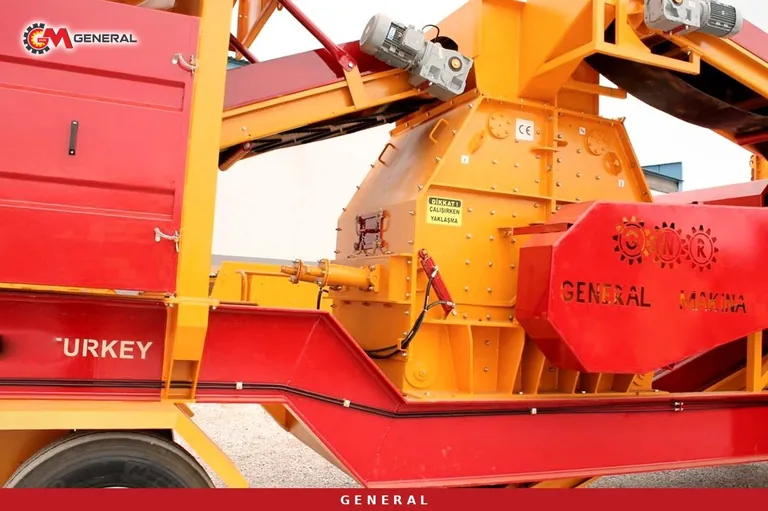
An investor opening a quarry in Oman usually meets two very different rocks: the dark, tough gabbro of the ophiolite belt running along the Hajar Mountains, and the limestone that is common along the coastal strip and the inland plains. These two rocks do not behave the same way inside a crusher. Gabbro wants to be broken by compression; limestone broken by impact gives a more cubical product at a lower wear-part cost. In a plant aiming for 250 to 450 tonnes per hour, the real decision is which stage stays common to both rocks and which one splits. This article builds that decision step by step using the actual model values from our product pages.
We give no information about any specific quarry, licence or public tender. Please confirm your project's aggregate specification with the relevant authority or the contractor's documents and have lab tests run on samples taken from the face; the model recommendations below become final once those data are in hand.
Why gabbro and limestone behave differently in a crusher
Gabbro is a coarse-grained, dense and tough plutonic rock. Its resistance to fracture is high; in an impact rotor the blow bars have to overcome that toughness with kinetic energy, and wear accelerates. Abrasiveness, on the other hand, varies from quarry to quarry: two gabbro faces in the same belt can show different free-silica content and Bond abrasion index (Ai). That is why the crusher type for gabbro should be chosen from Ai and compressive-strength tests, not from a guess.
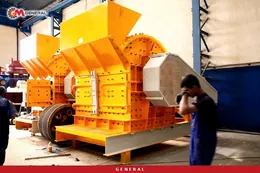
Limestone is a low-abrasion sedimentary rock. According to the data of the GNR PDK primary impact crusher limestone can be reduced up to 20:1 in a single stage, whereas the typical figure for a jaw crusher is 4:1–9:1. That difference cuts the number of crushers in a limestone line and improves particle shape. Feeding the same impact machine with gabbro, however, turns blow-bar consumption into the main item of cost per tonne.
The practical consequence: in a two-rock Omani quarry, no single crusher type gets the best out of both materials. You need either two separate lines or a common primary followed by a secondary stage that splits in two.
Shared stage, split stage: laying out a two-rock line
A jaw crusher handles both rocks safely. The compression principle keeps metal wear low in gabbro and runs without trouble in limestone, which is why the primary stage is usually shared in two-rock quarries while the secondary is chosen per rock. The GNRK series jaw crusher uses austenitic manganese steel jaw plates, moving to Mn18/Mn22 alloys for high-silica feed.
Gabbro branch: jaw + cone
In the gabbro line the GNRK jaw primary is followed by a cone crusher. The cone's secondary reduction is 6:1–8:1, its feed range 50–250 mm (300 mm with some liners) and its product range 0–60 mm (up to 75 mm). Because the mantle and concave work by compression, they wear noticeably more slowly in a tough rock like gabbro than an impact rotor does. The model-by-model capacity and power table for the cone is prepared per project, so we do not quote a firm cone capacity in the table below.
Limestone branch: impact primary or impact secondary
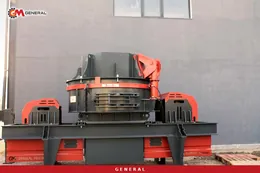
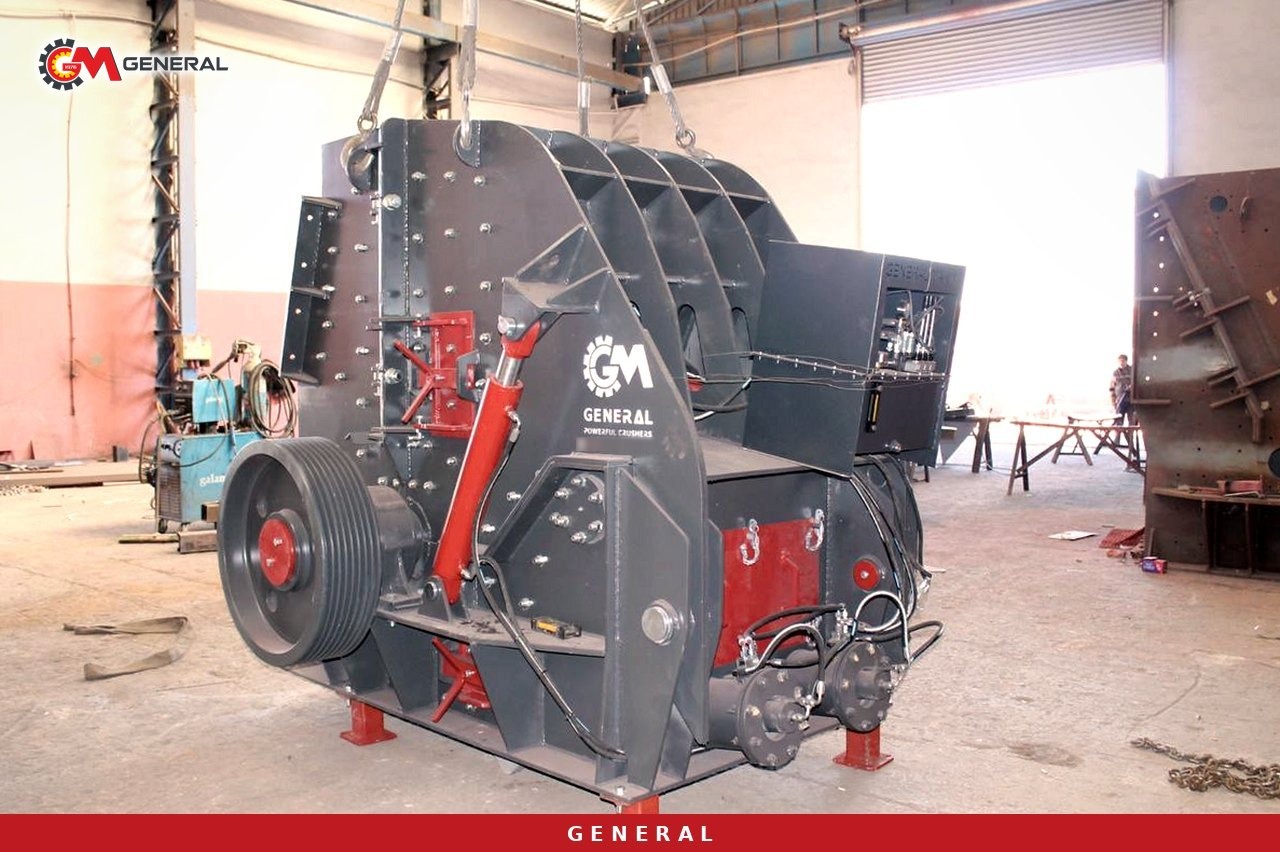
If limestone is processed on its own line, the shortest chain starts with the PDK primary impactor. If limestone passes through the shared jaw primary, the GNR DMK impact crusher is used as secondary; the DMK series gives a typical reduction of ~10:1 and accepts feed up to 800 mm. DMK suits cubical chippings from limestone, while a secondary cone is preferred for high-silica hard rock. You can follow how each crusher family covers this split, stage by stage, on our rock and stone crushers page.
Real models that fit the 250-450 TPH range
No single machine covers the 250-450 TPH range in the title; the models that do are listed stage by stage below. All values come from our product pages, and unknown cells are marked "—".
| Stage | Model | Capacity (t/h) | Opening / rotor / pan (mm) | Max. feed (mm) | Motor (kW) | Rock |
|---|---|---|---|---|---|---|
| Feeding | GNR 110 grizzly feeder | 200~300 | 1100×4750 | 1500 | 2x7.5 | gabbro, limestone |
| Feeding | GNR 140 grizzly feeder | 350~600 | 1400×5000 | 1500 | 2x9.2 | gabbro, limestone |
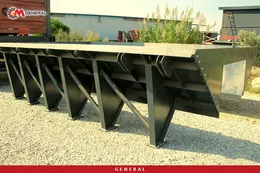
| Primary | GNRK 110 jaw | 200–350 | 1100×850 | — | 110/132 | gabbro, limestone |
| Primary | GNRK 130 jaw | 400–500 | 1300×1000 | — | 160 | gabbro, limestone |
| Primary | GNR PDK01 impact | 250–500 | 1400×1500 | 1000 | 315 | limestone |
| Primary | GNR PDK02 impact | 200–300 | 1400×1200 | 900 | 200 | limestone |
| Secondary | GNR DMK03 impact | 250–300 | 1100×1500 | 800 | 250 | limestone |
| Secondary | GNR DMK05 impact | 250–500 | 1400×2000 | 800 | 500 | limestone |
| Secondary | Cone crusher | (per project) | — | 50–250 (300) | 90–500 (order of) | gabbro |
Two thresholds emerge from the table. For a 250-350 TPH target, the gabbro line's intake can be built with the GNR 110 feeder and the GNRK 110 jaw. For 400-450 TPH you need the GNRK 130 and a GNR 140 feeder able to keep it fed; the GNR 110 feeder's 200~300 t/h is too tight at that tonnage. In limestone, the GNR PDK01's 250–500 t/h range meets a 450 TPH target with a single primary; at the secondary stage the DMK05 covers the same band alone, while the DMK03 goes up to 300 t/h.
On the screening side, the GNR 2460 (2400×6000 mm, 22 kW) and GNR 2470 (2400×7000 mm, 30 kW) circular-motion screens work in the 100-400 t/h range. On a 450 TPH line the screening load should be split over two screens and the number of decks set by the target fractions. If limestone that has picked up moisture after winter rain starts blinding the mesh, the three-shaft oval-stroke GNRTK-2060 (2000×6000 mm, 30 kW, 3 decks) is worth considering.
Fixed line or wheeled mobile plant?
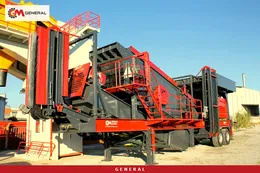
If the reserve spans many years and output is to exceed 400 TPH, a fixed crushing and screening line makes sense: with no chassis transport limit, a larger feed opening and more screen decks can be used. If gabbro and limestone are extracted at distant points, or production will later move to another area, wheeled mobile crushing and screening plants give flexibility. The wheeled range offers three options for this band:
- General 03: GPS 1415 primary impactor, 250-375 t/h, 900 mm feed, 2400×5000 mm 4-deck screen, 750 kVA power unit, 4-axle chassis. It is meant for limestone, not designed for gabbro.
- GNR-MC110: GPJ 110 jaw primary and DMK03 impact secondary on two chassis, 200-300 t/h, 900 mm feed, 2000×6000 mm 4-deck screen, 750 kVA. Since the primary chassis can run independently, during a gabbro campaign it can do primary crushing only and feed a separate cone stage.
- Two General 944 units: each with a GPJ 90 jaw and a GM430 cone, 120-180 t/h, 800 mm feed, 550 kVA. Two units in parallel give 240-360 t/h of gabbro capacity, and one keeps producing while the other is in maintenance.
The ceiling of the mobile options stays below the GNRK 130 + PDK01 arrangement of a fixed line. If 450 TPH is a firm target, go fixed; in the 250-350 TPH band with more than one production point, the wheeled plant comes to the fore.
From the Hajar foothills to the coast: design measures for Omani sites
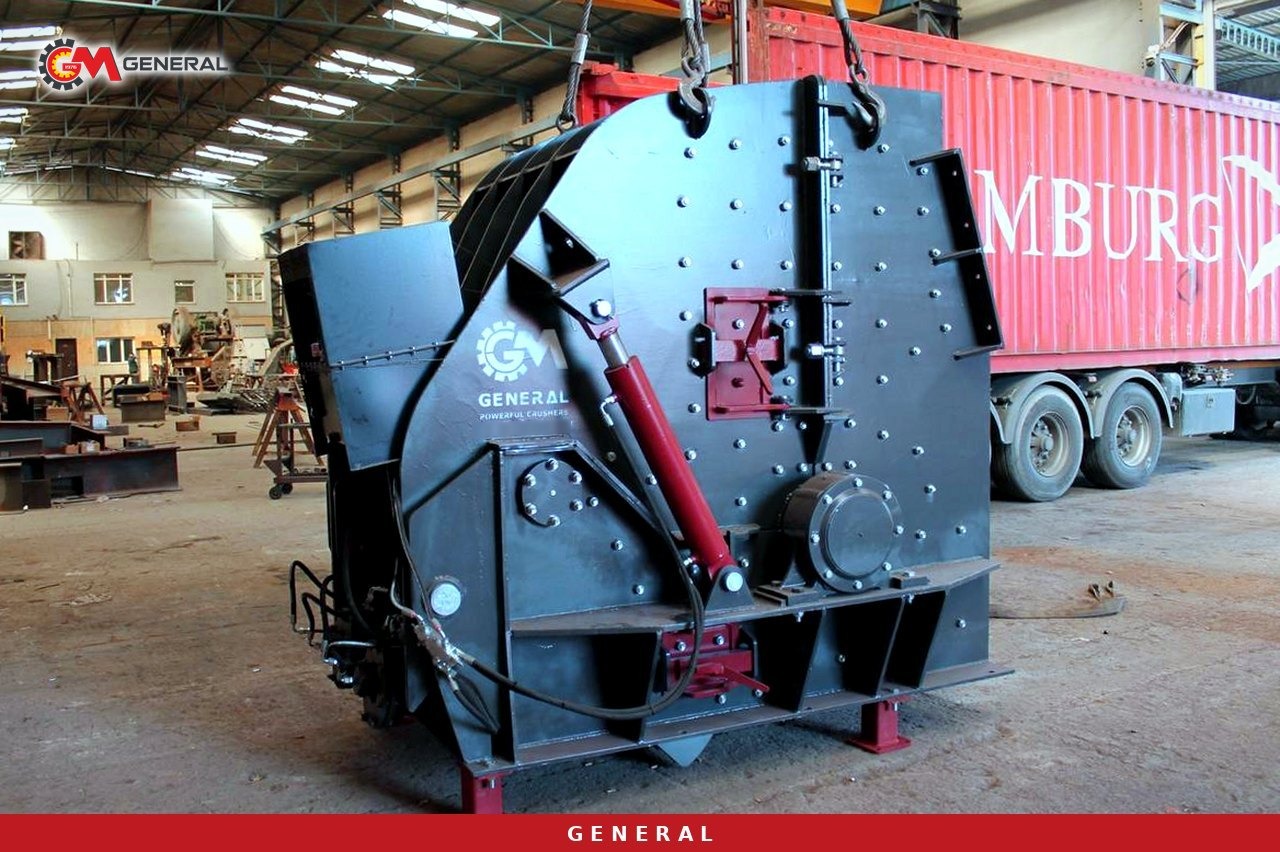
A good share of Oman's quarries lie in mountain foothills, far from settlements and with a weak grid connection. Three topics stand out in the plant design.
Heat, wind and fine dust
Summer heat and wind-borne fine dust are the heaviest load on motors, the generator and the electrical panel. Measures that can be selected per project: water-spray dust suppression at the crusher discharge and belt transfers, belt covers, panels placed in dust-protected cabins, and more frequent checks of generator air filters. In neighbouring Saudi Arabia, the GNR PDK 02 stationary crushing plant (250 t/h) working in desert conditions is a close example of this capacity class on the limestone side.
Power source
At a quarry far from the grid, the power source is a generator. Per the catalogue, the power unit is 750 kVA on the General 03 and GNR-MC110 and 550 kVA on the General 944. On a fixed line, total connected load is calculated by adding up the motor ratings of the selected crushers, feeders and screens; for example, if a GNRK 130 (160 kW) and a GNR PDK01 (315 kW) are to be in the same plant, the generator or transformer must be sized for these loads and for the motors' starting currents.
Port, road and foundation
Equipment from Türkiye to Oman usually arrives by sea and is trucked from ports such as Sohar or Salalah to the quarry. Fixed-line conveyors come on bolted modular frames; wheeled plants are towed on their own chassis. The concrete foundation design of a fixed plant should be prepared with local engineering support, based on crusher weights (33,000 kg for the GNRK 110, 42,500 kg for the GNRK 130) and dynamic loads.
Site data to collect before requesting a quote
- Samples of both rocks; Bond abrasion index (Ai), compressive strength and free-silica content.
- Largest block size after blasting; GNR grizzly feeders accept up to 1500 mm.
- Target fractions and their shares (e.g. 0-5, 5-12, 12-19, 19-40 mm) plus the project's aggregate specification.
- Share of gabbro and limestone in annual output; will the two rocks be processed at the same time or in turns?
- Whether grid power exists on site, or the plant will run entirely on generators.
- Water source available for dust suppression.
- Reserve life and the chance that the plant will be relocated later.
- Port of arrival and road conditions from port to quarry.
The layout drawing, flow sheet and model list prepared from these data form the basis of our quotation. The main factors that set the price are crusher type and count, number of screen decks, fixed versus mobile, power source, scope of dust suppression and mode of transport.
Frequently asked questions
Can an impact crusher be used on gabbro?
It can, but in tough and abrasive gabbro blow-bar life shortens and wear cost per tonne rises. For some gabbros with a low Ai result a DMK secondary can be tried; the general recommendation is jaw + cone.
Can both rocks be processed in the same plant?
Yes, if two secondary branches (cone for gabbro, DMK for limestone) follow a shared jaw primary. Separate screens and stockpile conveyors are needed so the products do not mix. Campaign operation, processing the rocks in turns, is another option.
Which primary crusher is needed for 450 TPH?
The GNRK 130 (400–500 t/h) in gabbro and the GNR PDK01 (250–500 t/h) in limestone. The GNRK 110 tops out at 350 t/h, so it is not enough on its own at 450 TPH.
What warranty and certificates apply?
Our machines carry ISO 9001 and CE certification; the warranty is 1 year, excluding wear parts. Price and delivery schedule are defined in a project-specific quotation based on your site data.
Conclusion
For a 250-450 TPH plant in Oman that will handle gabbro and limestone together, the right approach is not to force both rocks through the same crusher but to split the stages by rock: jaw + cone for gabbro, PDK or DMK for limestone. Our team, building crushing and screening plants in İzmir since 1976 and exporting to the Middle East, builds its model recommendation on sample data. Send your test results and target fractions through our contact page and we will prepare a tailored quotation with a flow sheet and model list.
Definitions of technical terms: Glossary