EN — English
 TR — Türkçe
 DE — Deutsch
 RU — Русский
 FR — Français
 ES — Español
 AR — العربية
 SR — Српски

Mozambique Maputo-Katembe Roads Crushing and Screening Plant 150-250 TPH
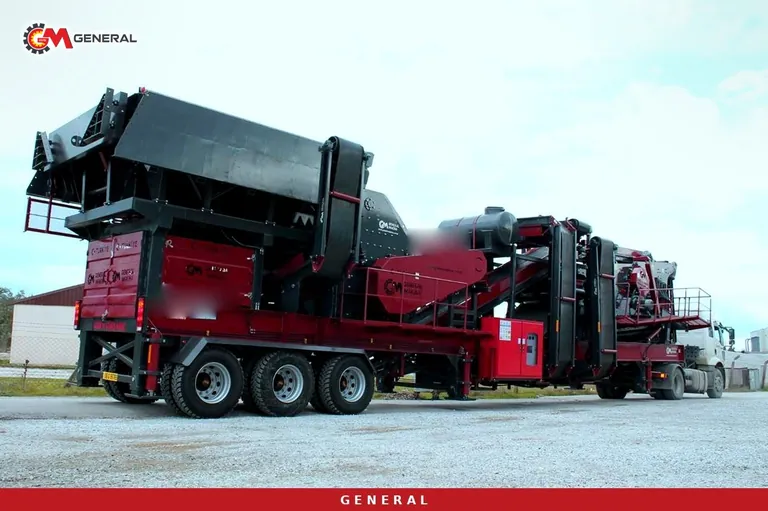
The suspension bridge that carries traffic across Maputo Bay from the city to Katembe has tied the southern shore into the road network running toward Bela Vista and Ponta do Ouro. The link, widening and rehabilitation works that follow along this corridor need an uninterrupted flow of aggregate, from subbase material and asphalt chippings to culvert concrete and slope protection. For the contractor setting up the line, the real challenge is not tonnage but geography: the coastal plain south of the bridge is largely sand, while the hard rock suitable for a road structure rises to the west, toward the Lebombo ridges. In this article we look at an aggregate line targeting 150-250 TPH through three questions: where will the rock come from, where will the machinery be set up, and which General Makina configuration suits that rock.
Two sides of the bridge: where is the rock, and where is the work?
While most of the road work takes place in Katembe and along the sandy coastal strip to its south, quarries in volcanic rock capable of yielding durable aggregate are usually sought west of Maputo, in the Lebombo foothills around Boane and Moamba. This split drives the first decision: will you install the plant at the quarry face, or haul the run-of-quarry material to the job site and crush it there?
Uncrushed run-of-quarry material is bulkier and more irregular than screened product, and part of what comes out of the quarry is separated and discarded as soil and fines. That is why, as haul distances grow, it usually makes more sense to set up the plant close to the quarry and transport only the saleable fractions. On the other hand, if there is a short but intensive concrete job at an interchange near the bridge approaches, bringing a small screening unit next to the site makes stockpile management easier. This decision is shaped by the size of your truck fleet and by the heavy-vehicle rules on the bridge; be sure to confirm the latter with the relevant road authority.
The main payoff of a wheeled mobile plant in this region is that changing quarries stops being a construction project. A line that starts at a quarry toward Boane can be towed to a new location by a tractor unit if a closer rock source turns up as the road advances south. You can review the options model by model on our wheeled mobile crushing and screening plants page.
Lebombo volcanics or coastal limestone: know the rock first
Two separate source families come up when road aggregate is discussed in southern Mozambique. The first is the volcanic rock, such as rhyolite and basalt, that forms the Lebombo ridges. These rocks are sound and dense, but the high silica content of rhyolite wears down crusher metal quickly. The second is the calcareous and sandy sedimentary units of the coastal plain; they break easily but do not always deliver the strength required for a wearing course or high-strength concrete.
These two families push crusher selection in opposite directions. In high-silica volcanic rock, a jaw primary and cone secondary working on the compression principle keep metal consumption low. In low-abrasion limestone, on the other hand, a primary impact crusher delivers a high reduction ratio and cubical particles in a single stage. According to the criterion on our jaw crusher page, compression crushing should be the basis once free silica exceeds 10% or the Bond abrasion index exceeds 0.15.
If the quarry has not yet been finalized, take a representative sample before ordering and have Los Angeles abrasion, compressive strength and Bond abrasion index tests carried out. Rhyolite, basalt and weathered bands can sit side by side on the same ridge. Choosing a crusher from a single hand sample turns out to be expensive at the first wear part change. Read the aggregate specification of the road project together with these results as well: the values required for the wearing course and for the subbase differ, and the screen layout is set up accordingly.
Configurations sorted by the 150-250 TPH range
The table below is based solely on our catalog data. Actual capacity varies with the material, the feed size and the required product gradation; use the table as a starting point for matching.
| Plant | Crusher arrangement | Capacity | Max. feed | Screen | Generator | Suitable rock |
|---|---|---|---|---|---|---|
| GNR-MC110 (twin chassis) | GPJ 110 jaw + DMK03 impact | 200-300 t/h | 900 mm | 2000×6000 mm, 4-deck | 750 kVA | Hard rock such as basalt and granite |
| General 944 | GPJ 90 jaw + GM430 cone | 120-180 t/h | 800 mm | 1600×5000 mm, 3-deck | 550 kVA | Hard and abrasive rock |
| General 950 | GPJ 90 jaw + DMK01 impact | 120-180 t/h | 800 mm | 1600×5000 mm, 3-deck | 600 kVA | Hard rock, cubical product |
| General 02 | GPS 1413 primary impact | 250-300 t/h | 1000 mm | 2000×5000 mm, 4-deck | 660 kVA | Limestone, low-abrasion rock |
| General 01 | GPS 1210 impact (primary + secondary) | 120-180 t/h | 700 mm | 1600×5000 mm, 4-deck | 550 kVA | Limestone, mixed feed |
| Stationary line | GNRK 110 jaw + cone | GNRK 110: 200-350 t/h | Opening 1100×850 mm | Project-specific | — | Long-term hard rock quarry |
For volcanic rock: jaw-primary lines
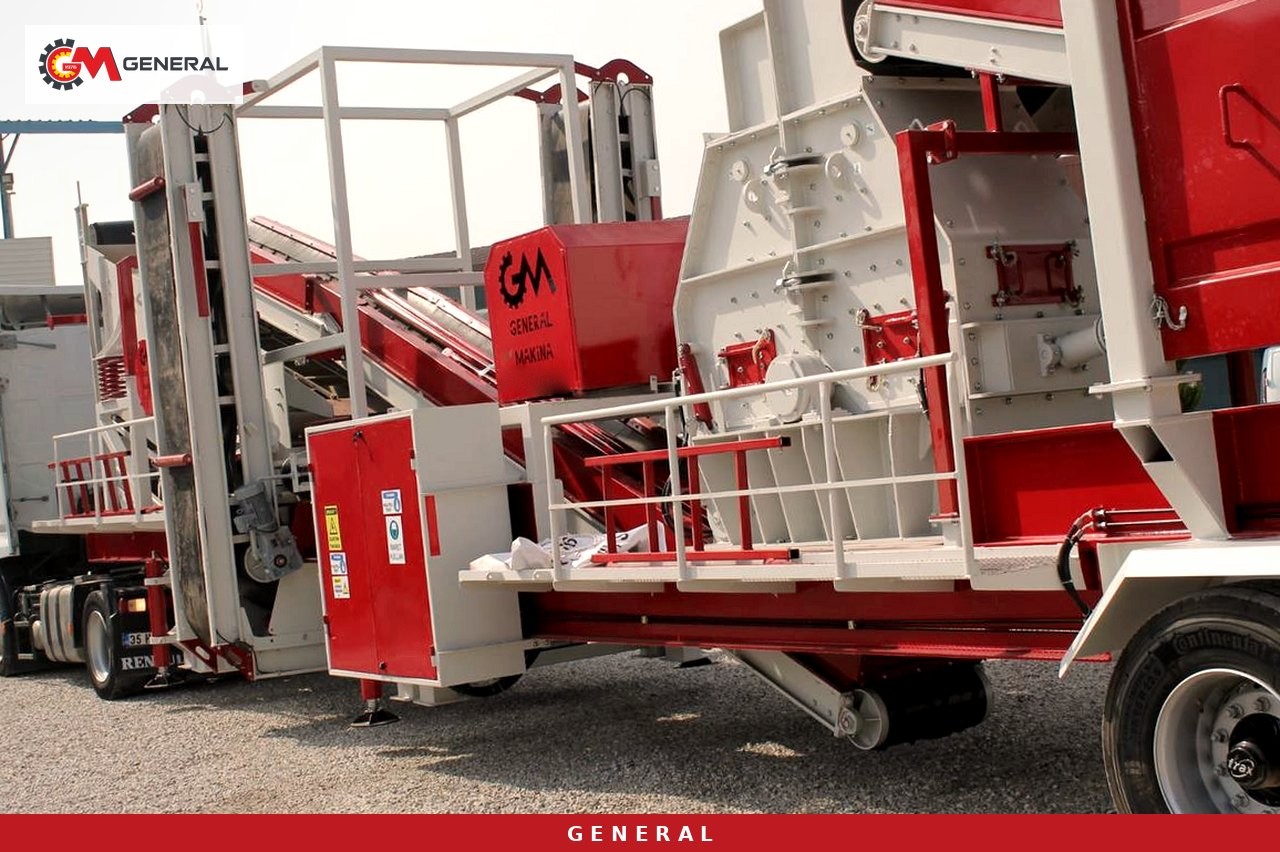
If rhyolite or basalt is to be fed, the first candidate is the GNR-MC110. At 200-300 t/h it covers the entire target range with a single line and accepts feed up to 900 mm. Its two-platform design is especially useful here: because the primary chassis can run on its own, coarse material such as fill and slope protection stone is produced first while the quarry is being opened, and the secondary chassis is brought in later. Since its secondary stage is an impact crusher (DMK03), evaluate wear part consumption alongside the sample results when the feed is very high in silica.
If metal consumption is the primary concern, a two-unit solution is the more cautious choice. The General 944 combines a GPJ 90 jaw crusher with a GM430 cone secondary and, working on the compression principle, extends metal life in abrasive rock. A single 944 delivers 120-180 t/h; to approach 250 t/h, a second 944 is added, or a General 950 for asphalt chippings that require cubical particles. Two separate units also provide redundancy: while one is under maintenance, the flow to the road site does not stop completely.
For coastal limestone and low-abrasion rock: impact plants
If the quarry is opened in a calcareous unit on the coastal plain, the primary-impact General series comes to the fore. The General 02 produces 250-300 t/h with its GPS 1413 crusher and 1000 mm feed opening, and its 4-deck screen separates four fractions in a single pass. If the target is around 150 t/h, the General 01 (GPS 1210, 120-180 t/h) combines primary and secondary crushing in one body. Do not run these models on Lebombo rhyolite: the hammers and plates of an impact rotor wear out quickly in high-silica rock.
If the quarry will stay in one place for years: a stationary line
If the link roads will be spread across several contracts and the same quarry will be used for a long time, a line built on concrete foundations is worth considering. A GNRK 110 jaw crusher (opening 1100×850 mm, 200-350 t/h) handles the primary stage, while a cone crusher takes on the secondary stage; the cone model and screen layout are selected on a project basis. For details, see our stationary stone crushing and screening lines page.
Setting up a mobile plant on Katembe's sandy ground
A wheeled mobile plant needs no foundation excavation, but it does need firm ground. The General 02 weighs approximately 76,000 kg and each chassis of the GNR-MC110 weighs 55,000 kg, and this load is transferred to the ground through the support legs. On the sandy coastal strip, the plant should not be set up without compacted crushed stone fill or steel or timber outrigger pads laid under the legs; otherwise the legs settle, which disturbs the screen angle and causes belts to run off track.
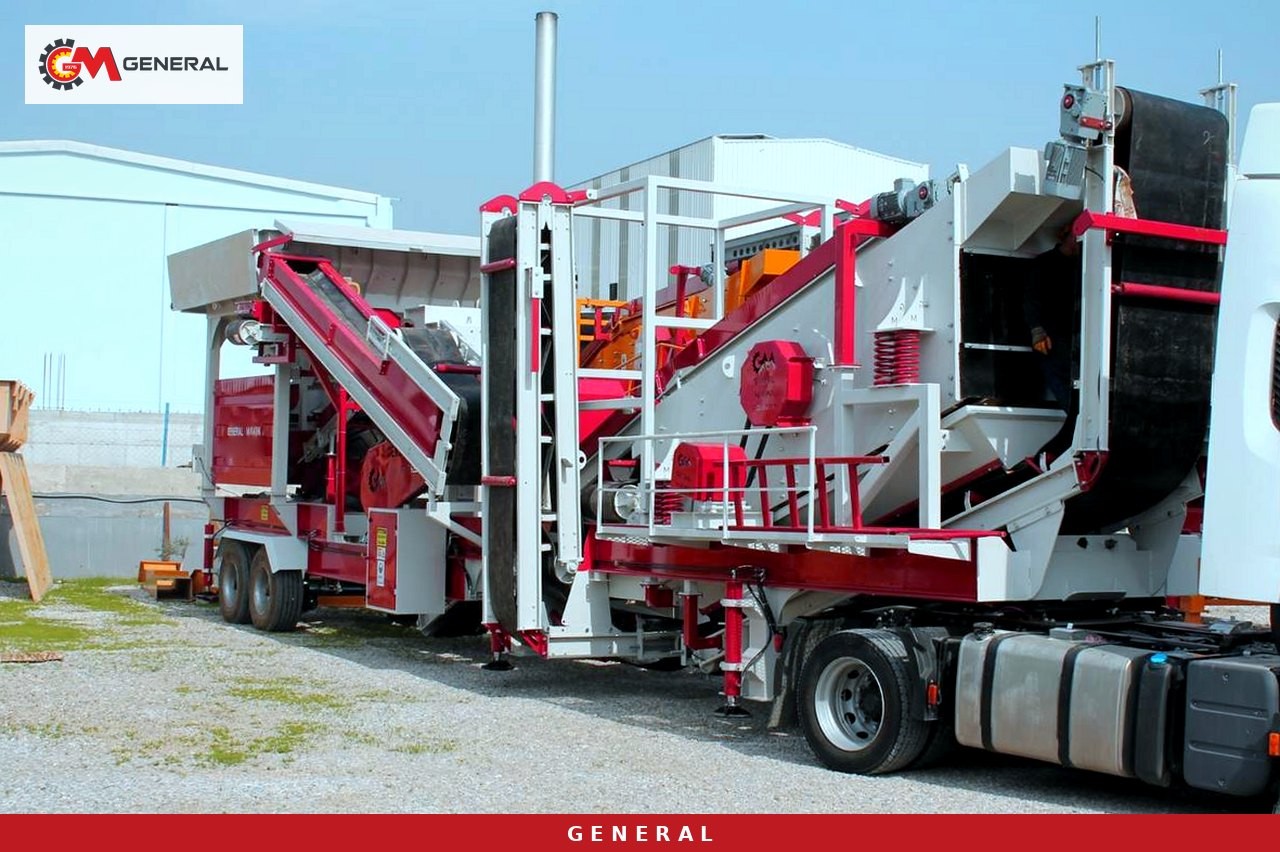
Think of three separate areas in the site plan: a firm ramp where trucks can back up to the feed hopper, stockpiles for each fraction that do not mix with one another, and a turning area where the tractor unit can hitch up the plant again and pull it out. The transport dimensions are 4300×18500×4500 mm for the General 01 and 4340×20600×4500 mm for the General 02; check in advance that the sandy roads leading to the quarry can carry a trailer of this size.
Once the machine is unloaded at the port of Maputo, it travels to the quarry by road. Clarify the permits required for oversized vehicle movements and bridge use in advance with the haulage company and the competent authority; these permits determine the route.
Salt air, the rainy season and dust: measures specific to the bay shore
Because Katembe and the strip to its south lie close to Maputo Bay and the Indian Ocean coast, the plant operates in salty, humid air. In this environment, regular touch-ups of damaged paint, keeping electrical panel doors closed and their seals intact, and periodic checks of fasteners should be part of the operating program. Additional surface protection and enclosed-type panels are measures that can be selected depending on the project; specify them at the quotation stage.
During the rainy season, overburden and weathered rock from the quarry reach the hopper along with the run-of-quarry material. The bypass section of the grizzly feeder separates these fines and soil before they enter the crusher. Since wet, clayey feed would clog the cavity of a jaw crusher, pre-screening is not optional here. At a quarry with a high clay content, a washing unit should also be considered for concrete aggregate.
In the dry season, the problem is dust. If there are settlements along the road, water-spray dust suppression at transfer points and, if necessary, enclosed conveyor covers can be added. At a remote quarry, power comes from a generator: a 550 kVA power unit is specified for the General 01, 660 kVA for the General 02 and 750 kVA for the GNR-MC110. The refuelling arrangement, more frequent checks of air filters on dusty days and keeping spare filters on site are among the first planning items.
What to collect from the quarry and the specification for the quotation file
- Quarry location and rock type; sample test results (Los Angeles abrasion, Bond abrasion index, compressive strength).
- The largest block size in the run-of-quarry material and the estimated clay or soil content.
- Target hourly tonnage and daily operating hours; which value between 150 and 250 t/h is taken as the basis.
- The product list in the specification: subbase, base course, asphalt chippings and concrete aggregate fractions.
- Power source: grid connection or generator?
- Ground conditions at the installation area and whether the quarry road is suitable for trailer access.
- Preferred delivery point: the port of Maputo or directly to the quarry site?
A quotation prepared with this information builds the configuration around the site rather than around guesswork. For fraction distribution and screen layout in road works, our article on plant configuration for road construction and base course material offers an additional checklist.
Frequently asked questions
Can the General 02 be used for Lebombo rhyolite?
We do not recommend it. The General 02 is a primary impact plant and delivers strong reduction in low-abrasion rock such as limestone; in high-silica volcanic rock, the life of impact wear parts is shortened. For this rock, a solution based on the GNR-MC110 or the General 944 is more appropriate; the final decision is made according to sample testing.
Can a single plant produce both road base and asphalt chippings?
Yes. The GNR-MC110, with its 4-deck screen, separates 0-5 / 5-12 / 12-19 / 19-40 mm fractions simultaneously. Fraction limits and screen apertures are set at the order stage according to the road specification.
What warranty and certifications apply?
Our plants are ISO 9001 and CE certified, and come with a 1-year warranty excluding wear parts. General Makina has been manufacturing in İzmir since 1976.
What determines the price and delivery time?
The configuration (single or twin unit, mobile or stationary), the number of screen decks, the generator, additional dust and corrosion measures, and the delivery point. Send us this information and we will prepare a project-specific quotation.
Summary
On the Maputo-Katembe link roads, the right aggregate line is chosen not by the sandy strip south of the bridge but by the quarry the rock comes from: for volcanic rock, the jaw-primary GNR-MC110 or a two-unit General 944/950 setup; for calcareous coastal stone, the General 02 or General 01. Send your quarry details and specification via our contact page and together we will work out the line that matches your target tonnage and the shipping plan.
Definitions of technical terms: Glossary