EN — English
 TR — Türkçe
 DE — Deutsch
 RU — Русский
 FR — Français
 ES — Español
 AR — العربية
 SR — Српски

Mozambique Nacala Corridor Riprap & Chippings Stone Crushing Plant 200-300 TPH
A contractor working along the Nacala corridor usually asks one quarry for two opposite products. Port fill, slope protection, culvert outlets and river crossings need heavy, angular, sound riprap blocks. The same face must also deliver chippings for asphalt, concrete and road surfacing in fractions such as 0-5, 5-12, 12-19 and 19-40 mm. The first product is stone that should never enter a crusher; the second has passed through two crushing stages. When planning a line in the 200-300 TPH band, the real task is splitting the muckpile into these two flows at the right point. This article sets out layouts that can be built with real models, based on northern Mozambique rock, shipment through Nacala port and site power conditions. For the volume, schedule and block classes of any specific corridor job, the specification issued by the relevant authority governs.
Blocks and chippings from one face on the Nacala line
Nacala is a port city set on a deep bay on the Indian Ocean coast. The corridor is the rail and road route linking the port to the interior. Aggregate demand along it is not uniform. Breakwaters and quay fill on the coast call for heavy blocks, while inland road sections consume mostly chippings and base material. If one quarry is to serve both, machine selection starts with a question that comes before capacity: how much of the blasted rock will be set aside as blocks, and how much will be crushed?
That ratio moves. A tighter blast pattern gives fewer large blocks and sends more tonnage to the chippings line. A wider spacing yields more riprap, but also more oversize that will not fit the crusher mouth and needs secondary breaking. The crushing plant capacity should therefore be sized on the tonnage left after the blocks are removed, not on total quarry output.
Northern Mozambique rock and the order of lab tests
Granite and gneiss inselbergs
Around Nampula and Nacala the scenery is dominated by granite and gneiss hills rising out of the plain. This rock is generally sound and able to produce large blocks, which helps riprap. On the other hand its quartz content can be high, and then crusher wear parts are consumed quickly. Foliation in gneiss can raise the share of flaky particles in chippings. Asphalt specifications set flakiness limits, so this point directly affects the choice of secondary crusher.
Weathered top zone
In a tropical climate the top of the rock weathers into a clayey, loose cover. This layer is neither riprap nor clean chippings. If stripping is poor, soil reaches the crusher, blinds the screen and contaminates the fine fraction. A grizzly feeder at the head of the line removes part of this dirt before it gets to the crusher.
The sampling order should be: first Los Angeles abrasion and water absorption (for block durability), then abrasion index and quartz content (for crusher type), and finally flakiness on a trial-crushed sample. Getting these three results before opening the face prevents a wrong secondary choice.
Riprap comes from the blast, not from the crusher
There is no separate crusher for riprap. Blocks are sorted at the muckpile or at the feed point. A common quarry layout works like this: an excavator, loader or grapple picks blocks matching the specified weight class out of the pile and moves them to their own stockpile. The remaining material is trucked to the feed hopper.
This is where the GNR vibrating grizzly feeder comes in. The GNR 110, with its 1100×4750 mm pan and 2x7.5 kW drive, feeds 200-300 TPH and accepts material up to 1500 mm. Fine and earthy material falling through the grizzly section is separated before the crusher. It often serves as fill or sub-base, so it is not pure waste.
Block quality is checked on site: crack-free faces, angular shape, the ratio between longest and shortest dimension. The limits for these criteria are defined separately in the specification of each corridor job. Ask the authority for them in writing instead of guessing.
Chippings line: real configurations for 200-300 TPH
Once blocks are removed, there are three routes for the material to be crushed. The choice depends on the abrasion value from the lab and on how many years the quarry will stay in one place.
One set: GNR-MC110
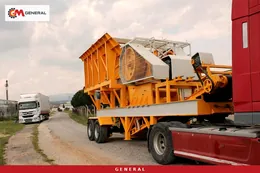
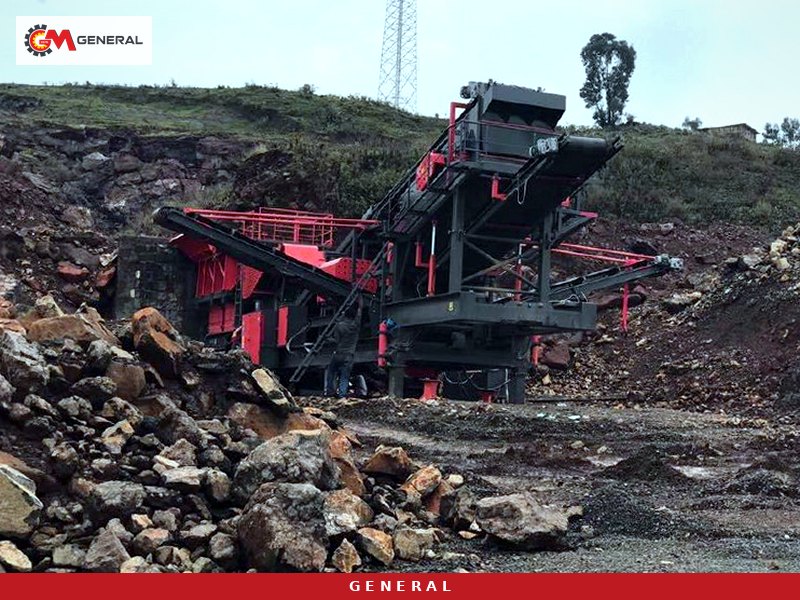
The GNR-MC110 is our model that covers the 200-300 TPH band in the title with a single plant. A GPJ 110 jaw primary and a DMK03 impact secondary travel on two separate wheeled chassis. Feed size is 900 mm, the screen is 2000×6000 mm with 4 decks and the generator is 750 kVA. Four fractions (0-5, 5-12, 12-19, 19-40 mm) are stockpiled at once. Because the primary chassis can run on its own, the quarry can open with the jaw group alone, producing coarse material and fill, and bring the secondary in later.
Two General 944 units for hard, quartz-rich granite
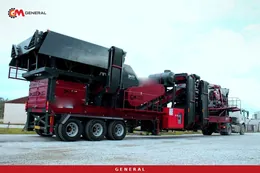
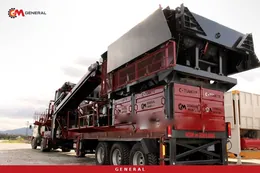
If the lab shows high abrasiveness, blow bar cost on an impact secondary makes each tonne of chippings expensive. In that case the General 944 makes more sense: GPJ 90 jaw primary with a GM430 cone secondary, 120-180 TPH. Two units side by side give a combined band of 240-360 TPH. While one is under maintenance the other keeps producing, which matters on long corridor jobs.
Stationary line
If the quarry will stay at the same point for years, a stationary crushing plant can be built from a GNR 110 feeder, a GNRK 110 jaw crusher (1100×850 mm opening, 200-350 TPH) and a DMK03 secondary. Screen decks and stockpile conveyors are not limited by chassis size in this layout.
| Configuration | Capacity (TPH) | Max. feed (mm) | Secondary | Screen | Generator |
|---|---|---|---|---|---|
| GNR-MC110 (twin chassis) | 200-300 | 900 | DMK03 impact | 2000×6000 mm, 4 decks | 750 kVA |
| 2 × General 944 | 2 × 120-180 | 800 | GM430 cone | 1600×5000 mm, 3 decks (each) | 2 × 550 kVA |
| Stationary: GNR 110 + GNRK 110 + DMK03 | 200-300 (feeder and DMK03 band) | GNRK 110 opening 1100×850 | DMK03 impact (rotor 1100×1500 mm, 250 kW) | — | — |
All wheeled options are listed on the wheeled mobile crushing plants page.
Where the impact secondary stops, and how to track wear
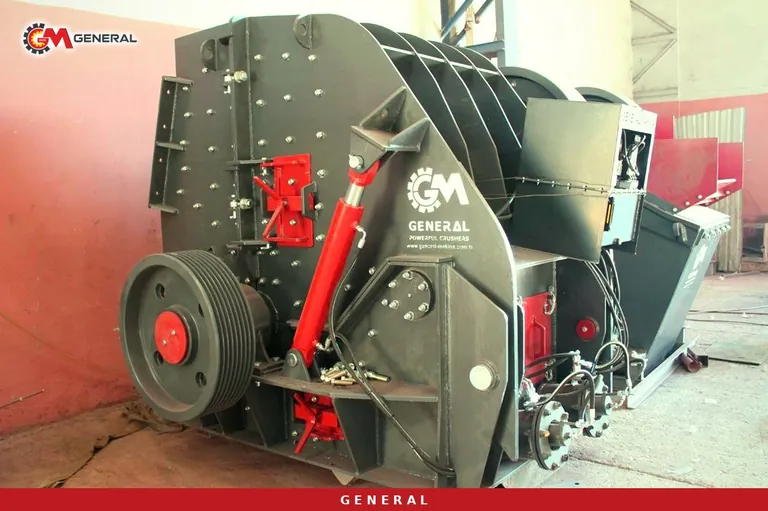
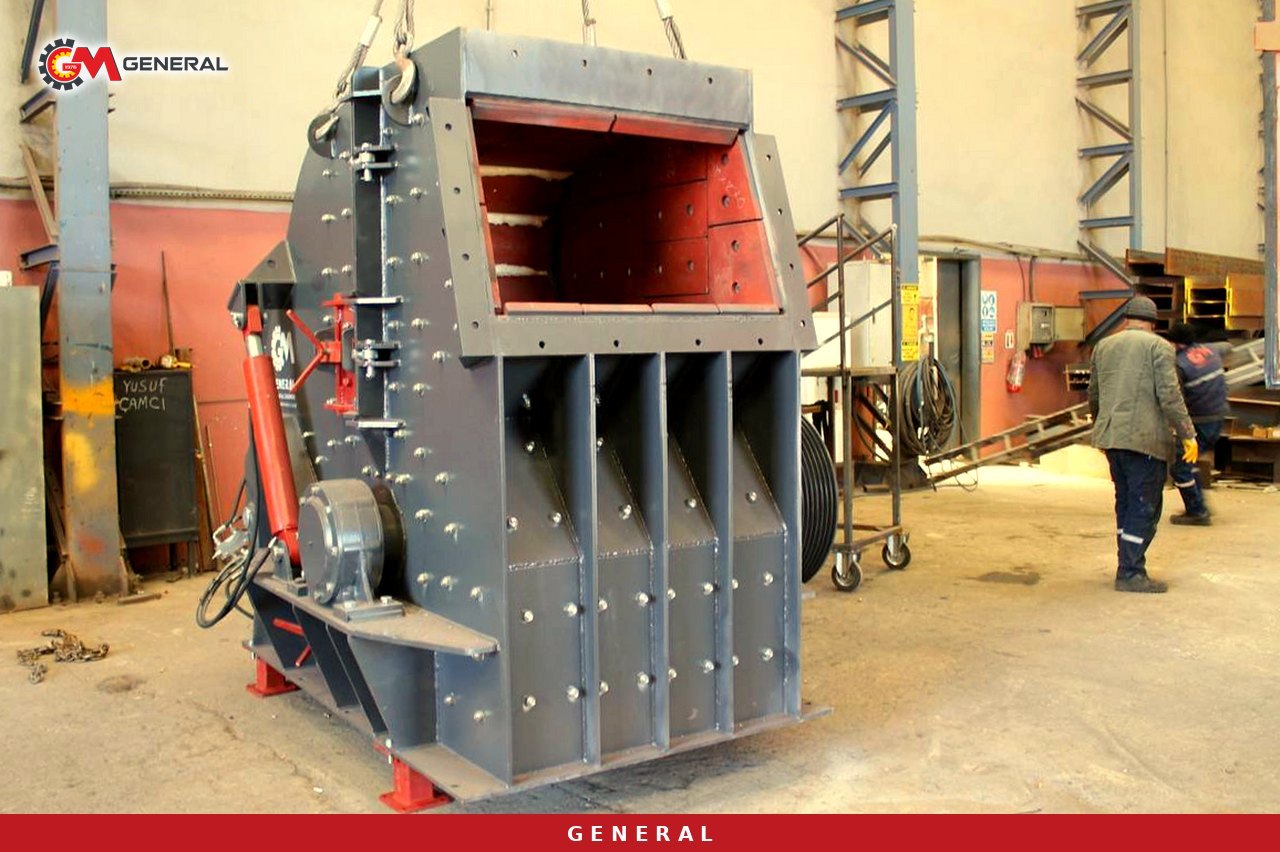
The GNR DMK series gives cubical, well-graded chippings; the DMK03 has a 1100×1500 mm rotor, 800 mm feed, 250-300 TPH capacity and a 250 kW motor. Typical reduction is around 10:1. As the catalogue states plainly, though, a cone crusher is preferred for high-silica granite and basalt. If the gneiss around Nacala is moderately abrasive, the DMK03 does the job. As quartz content rises, a cone secondary line becomes the right move.
There is a middle option. The Mobile Pre-Screening DMK takes 0-100 mm feed, delivers a 0-30 mm product and runs at 40-300 TPH. Its pre-screen keeps ready-sized fines out of the crusher, so fewer blow bars are used for the same tonnage. Two crushing chambers and manganese bars that can be turned and used on both sides stretch the change interval. The hydraulically opening housing lets liners be checked between shifts.
A simple logbook is enough to track wear on site: the date each blow bar set was fitted, tonnes crushed since then and the remaining profile at removal. Unit wear cost is followed with one formula: price of the part set divided by tonnes crushed per set. If that figure keeps climbing over several sets, the rock does not suit the secondary type.
From Nacala port to the quarry: shipping, power and the rainy season
The machines come by sea from Izmir and are unloaded at Nacala port. The GNR-MC110 primary chassis is 3000×13500 mm and 55,000 kg; the secondary chassis is 4200×18300 mm and 55,000 kg. The General 944 measures 4130×20350×4500 mm and weighs 70,000 kg. Bridge load limits and bends between port and quarry should be checked with a local haulier beforehand; the chassis dimensions give all the data that check requires.
Most corridor quarries are far from the grid, so the on-board generator of a wheeled plant becomes decisive. In the hot, dusty months the generator air filter and radiator cores need frequent cleaning, and dust seals on the cabin and panel must be checked. In the rainy season the problem is moisture: grizzly gaps clog with clayey material and fine screen decks blind. Opening the grizzly gap and servicing belt scrapers more often during this period protects output.
File to prepare before ordering:
- Estimated size distribution of the muckpile and the target share set aside as riprap
- Los Angeles, water absorption, abrasiveness and flakiness results
- Chippings fractions and riprap weight classes in the specification
- How long the quarry will work at the same spot (for the mobile or stationary decision)
- Whether grid power is available or all power will come from generators
- Bridge and road restrictions on the route from port to quarry
Frequently asked questions
Is a separate machine needed for riprap?
Usually not. Blocks are picked from the pile by excavator and the grizzly feeder removes the fines. Extra investment is mostly limited to an attachment and stockpile area.
Can the GNR-MC110 handle hard granite?
The jaw primary group works with granite without trouble. For the DMK03 secondary the decision depends on the abrasion test. If the value is high, two General 944 units with a cone secondary give lower parts cost.
What warranty and certificates apply?
Our machines carry ISO 9001 and CE. The warranty is 1 year, excluding wear parts.
What determines the price?
Configuration (single set, twin units or stationary line), secondary type, screen decks, generator and shipping scope set the price. A figure is given in a quotation once quarry data is clear.
A short note for the decision
Getting riprap and chippings from one quarry on the Nacala corridor rests on sorting blocks at the muckpile and crushing the rest with the right secondary. In moderately abrasive rock the GNR-MC110 gives 200-300 TPH as one set, in quartz-rich granite two General 944 units consume fewer parts, and for a long-life quarry a stationary line comes first. Send your lab results, specification fractions and route details through our contact page; we will prepare the layout and quotation that fit your quarry.
Definitions of technical terms: Glossary