EN — English
 TR — Türkçe
 DE — Deutsch
 RU — Русский
 FR — Français
 ES — Español
 AR — العربية
 SR — Српски

Chad Oilfield Roads Crushing and Screening Plant 150-250 TPH
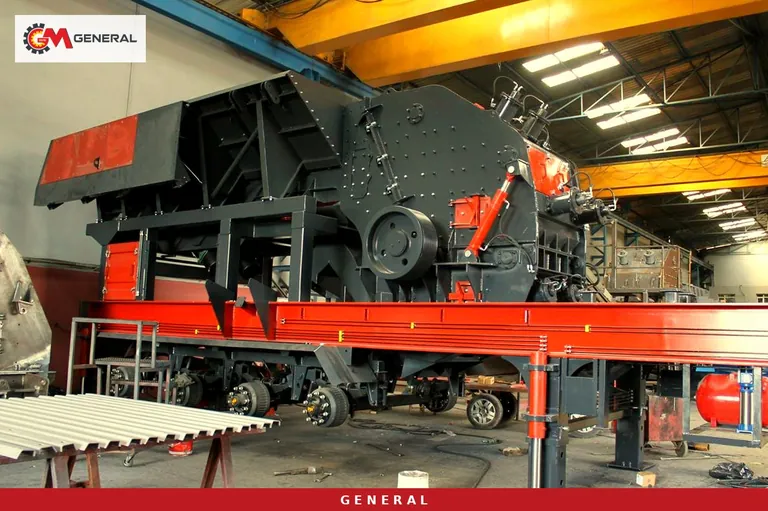
Most of Chad's oil comes from the Doba basin in the south, and the crude leaves the country through the pipeline that crosses Cameroon to an offshore terminal near Kribi on the Atlantic coast. For a contractor working in the field, the daily problem is roads rather than the pipeline: heavy trailers moving drilling rigs, service vehicles running to wellheads, fuel tankers supplying camps and yards. A road that carries this traffic through the rainy season needs well-interlocked crushed stone laid over the laterite fill. This article explains how to set up a crushing and screening plant producing 150-250 TPH of crushed aggregate for oilfield roads in Chad, which General Makina models fit that range, and which site-specific measures belong in the contract. Road cross-section values must be confirmed from the operator's or main contractor's specification on every project; the technical figures below are catalogue values from our product pages.
Aggregate demand on an oilfield road, layer by layer
An oilfield road is loaded differently from an intercity highway. Vehicle numbers are low, axle loads are high, and the trucks usually run in the same wheel track. During a rig move, dozens of heavy trips can pound the same section within a few days. The life of the road is therefore set less by its surfacing and more by the bearing capacity of the subbase and base layers.
A typical section places a subbase on natural ground or laterite fill, then a crushed stone base; some stretches receive a surface dressing or a concrete slab. Well pads, pipe yards and camp roads use the same material with different layer thicknesses. Culverts, bridge piers and equipment plinths also need clean, screened fine and medium fractions for concrete.
So the plant is expected to deliver several fractions at once, not a single product. On lines with a four-deck screen, the typical catalogue product groups are 0-5, 5-12, 12-19 and 19-40 mm; base material is obtained by blending these fractions or directly by changing the screen meshes. The target grading curve is written in the specification, and the screen apertures are chosen at the order stage to match it.
Rock and laterite around the Doba basin
Southern Chad's oil basins lie beneath a thick sedimentary cover. Sand, clay and red laterite dominate the surface, and laterite gravel has long been used in the region as road fill. The catch: a laterite surface that behaves well in the dry months softens with rain and ruts under heavy wheels. That is where the demand for a crushed stone base comes from.
Laterite overburden and clayey run-of-mine
Where a quarry is opened, a thick weathered zone often sits on top of the sound rock. During excavation this overburden mixes into the feed and turns it sticky and wet. A conventional vibrating feeder clogs in this material, and lumps build up in the jaw opening. There are two ways out: strip the overburden and stockpile it separately, or strengthen pre-screening on the feed side. In quarries with a high clay content, the mobile jaw crushing unit with wobbler feeder separates the earthy fraction with its rotating eccentric discs before it reaches the crusher, and it works in the 250-450 TPH range.
Crystalline basement rock: granite and gneiss
Hard rock outcrops are scarce inside the basin itself. Durable stone is usually sought in the crystalline basement areas on the basin margins, for example the granite and gneiss hills of Mayo-Kebbi in the southwest. These rocks contain free quartz and are abrasive. A jaw crusher, which breaks by compression, is the right primary choice here; an impact primary pays off in brittle, low-silica stone such as limestone and dolomite. For any specific quarry, the final decision should follow abrasion and crushability tests on a sample.
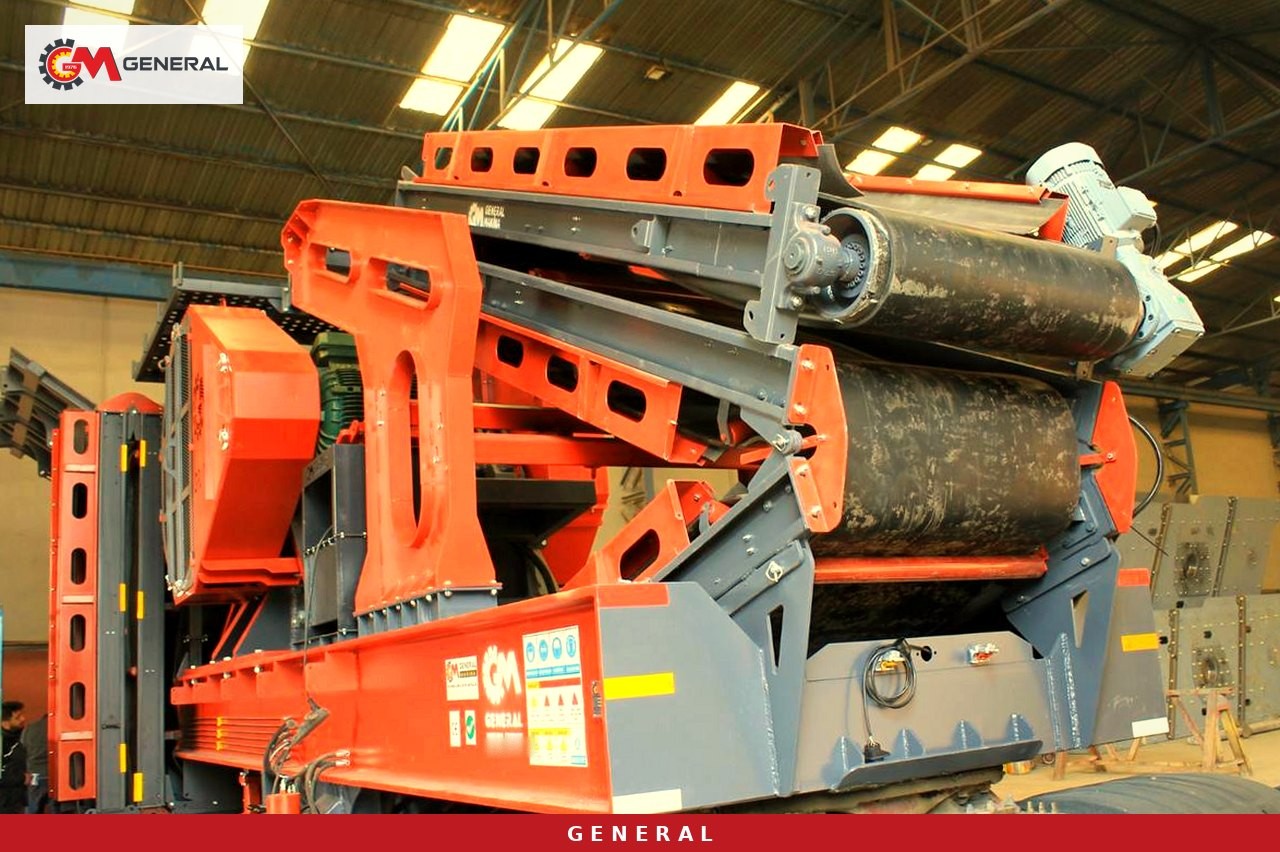
Our workshop also builds units meant for soft material. The mobile roll crusher takes 0-50 mm feed and delivers a 0-10 mm product; it is designed for brittle materials such as coal, lime and potash. Producing road base from granite is not its job.
Matching models to the 150-250 TPH target
The range in the title is a target band. Its lower end stands for the weeks when rain restricts access to the quarry; its upper end for busy periods when rig moves and pad construction overlap. The real options that cover this band are listed below.
| Configuration | Crusher arrangement | Capacity (t/h) | Feed | Power / weight |
|---|---|---|---|---|
| GNR-MC110, dual chassis | GPJ 110 jaw + DMK03 impact, 2000×6000 mm 4-deck screen | 200-300 | 900 mm | 750 kVA; two chassis, 55,000 kg each |
| Towed unit chain | GNR 110 primary jaw + M-DMK 02 secondary impact + separate screen | 180-300 / 150-250 | 0-1100 mm / 0-350 mm | 55,000 kg / 200 kW, 38,000 kg |
| Jaw unit with wobbler feeder | Pre-screening + primary jaw, single chassis | 250-450 | — | — |
| M-PDK02, primary impact | HSI primary with feed hopper | 200-300 | 0-1200 mm | 250 kW, 45,000 kg |
GNR-MC110 for a single line
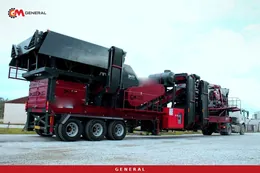
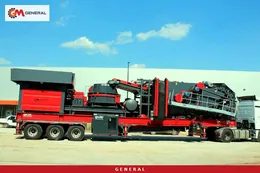
For a contractor who wants 150-250 TPH from a granite or gneiss quarry, the most complete answer is the GNR-MC110. The primary chassis carries the feed hopper and the GPJ 110 jaw crusher; the secondary chassis carries the DMK03 impact crusher and the 4-deck screen. Hauling the two chassis separately helps on routes that need heavy load permits. Because the primary group can run on its own, the site gains flexibility: while the quarry is being opened, only the primary works and produces coarse fill, and the secondary group comes in once base material is needed.
A towed chain built unit by unit
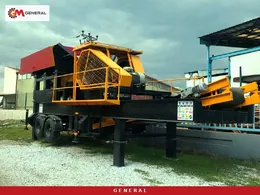
Some contractors prefer to split their equipment between sites. For them, a GNR 110 primary jaw unit (180-300 TPH) is linked to an M-DMK 02 secondary impact unit (150-250 TPH), followed by a multi-deck vibrating screen sized for the project. The bypass screen on the M-DMK feeder table removes the earthy fines of laterite origin before they enter the crusher; blow-bar wear drops and the road base product comes out cleaner. The primary unit sets up on hydraulic legs without foundations, which speeds up moving to a new quarry as the road advances.
The M-PDK02 is placed last in the table on purpose. An impact primary can give a cubical product in one stage with reduction up to 20:1 in limestone, but in high-quartz granite the blow-bar life falls fast. If your quarry is a low-abrasion stone such as sandstone or limestone, the M-PDK02 is worth considering.
Moving the plant as the road advances
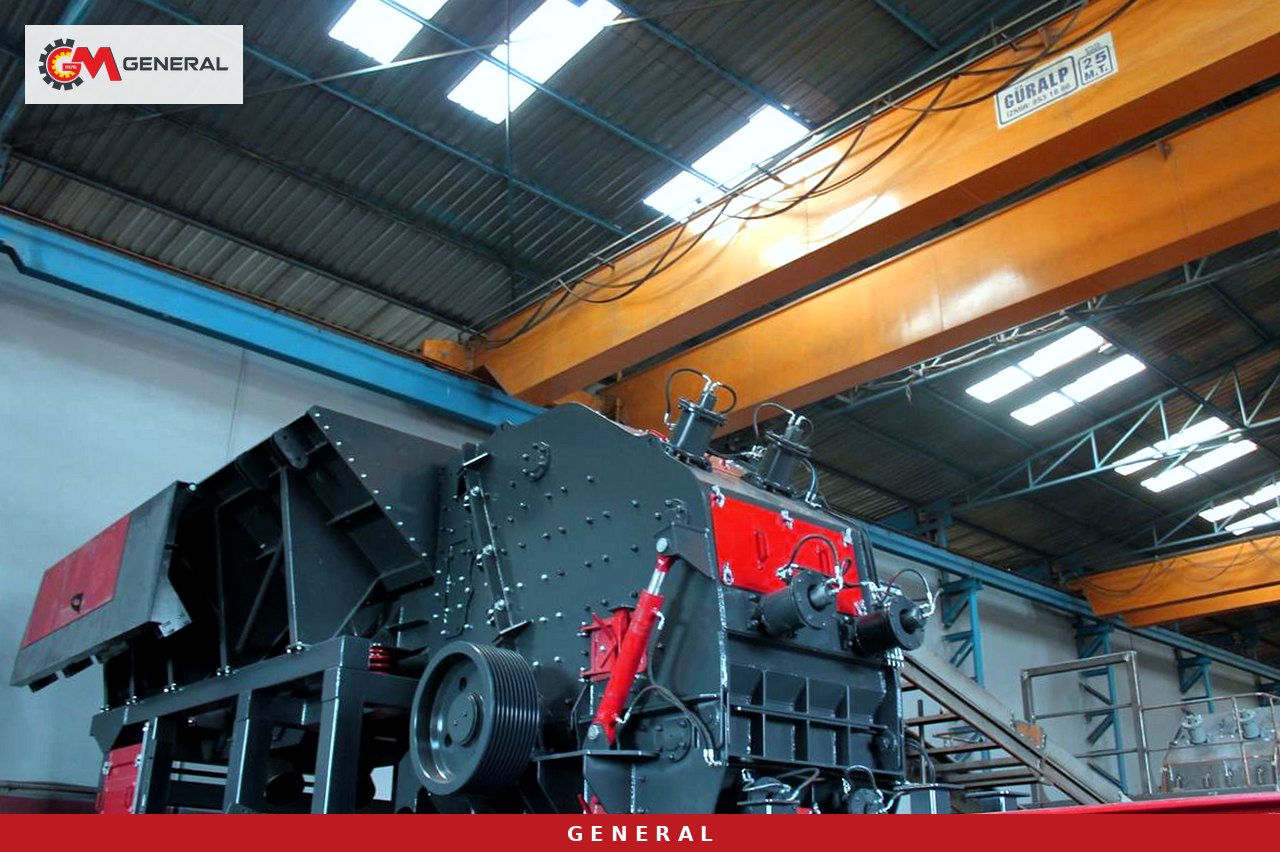
Oilfield roads do not end at one point; they branch from the main access road towards the well pads. The plant does not have to stay at one quarry for years, but every relocation costs production. Choosing a quarry near the centre of gravity of the road network means trucks carry screened product instead of run-of-mine and each trip does more work. Building up stockpiles before the rains is another safeguard: when dirt roads close, the plant may keep running while the product cannot reach the site. Group relocations in the dry months as far as possible.
Chad is landlocked. For a machine shipped from Türkiye, the usual route is the port of Douala in Cameroon followed by a long road haul. Bridge and axle limits along the way decide whether a chassis travels in one piece or in sections. Loading dimensions and part weights should be handed to the freight company at the quotation stage.
Operating on a hot, dusty site without grid power
Oilfield plants usually run on generators. The GNR-MC110 catalogue power unit is 750 kVA; for a towed chain, the generator is sized by adding the motor powers of the primary and secondary units. At midday the generator and engine cooling packs are under strain, and radiator cores clogged with dust add to the load. Measures that can be selected per project include heavy-duty air filters, cyclone pre-cleaners, regular core cleaning and a shaded control cabin.
Dust affects more than the machine; it reaches neighbouring oilfield facilities too. Water sprays at belt transfer points, belt covers and placing stockpiles according to the prevailing wind are practical measures. Where water is limited, concentrate the sprays on the points that generate the most dust, such as the crusher discharge and the top of the screen.
On wear parts, the jaw plates are austenitic manganese steel (Mn13/Mn18) that work-hardens under impact. On impact crushers, blow-bar material is chosen by rock type: high-chrome cast iron for clean, abrasive feed, manganese or martensitic steel where tramp iron is a risk. Sending at least one spare set of jaw plates and blow-bars with the plant to a remote site turns a possible stoppage from days into hours.
Information to prepare before requesting a quote
- Rock type of the quarry sample, with abrasion and crushability test results
- Overburden thickness and an estimate of clay content in the feed
- Subbase, base and concrete aggregate gradings from the specification
- Daily operating hours and separate target tonnage for the dry and rainy seasons
- Whether grid power exists and, if not, the generator preference
- Bridge and axle limits on the route from Douala to site
- Water available on site and environmental conditions regarding dust
- Planned number of relocations and distance between quarries
A quote prepared with this information also fixes the screen apertures, wear part material and spare set list alongside the machine. For other road material configurations, see our guide to road construction and sub-asphalt material.
Frequently asked questions
Does a laterite pit also need a crushing and screening plant?
Laterite gravel can often be used after screening alone. If there are hard oversize lumps, or the specification requires a set share of crushed faces, a secondary crusher is needed. For the main base layer, crushed hard rock is preferred.
Can a single machine reach 250 TPH in a granite quarry?
The GNR-MC110 catalogue capacity is 200-300 TPH, so this target can be met with one line. Actual tonnage varies with rock hardness, feed size and the required fractions, which is why a sample test is requested.
Would a line with a cone crusher suit better?
In very abrasive quartzite or gneiss, a cone secondary extends metal life. The General 944 combines a GPJ 90 jaw with a GM430 cone crusher, but its capacity is 120-180 TPH; 250 TPH would need two lines.
What about warranty, certificates and price?
Our machines carry ISO 9001 and CE certification and a 1-year warranty excluding wear parts. Price depends on the configuration, generator, screen and spare parts scope, and is given in a written quotation.
Conclusion
For 150-250 TPH on oilfield roads in Chad, the decision starts with the quarry rock. In granite and gneiss, the jaw-primary GNR-MC110 or the GNR 110 plus M-DMK 02 chain stands out; in a quarry with clayey overburden, the wobbler-feeder unit does. For other options, see our wheeled mobile crushing and screening plants and towed crushers. Send us your quarry data and specification and we will prepare a quote for the right configuration: contact us.
Definitions of technical terms: Glossary