EN — English
 TR — Türkçe
 DE — Deutsch
 RU — Русский
 FR — Français
 ES — Español
 AR — العربية
 SR — Српски

Mozambique LNG Infrastructure Aggregate Crushing Plant 250-375 TPH
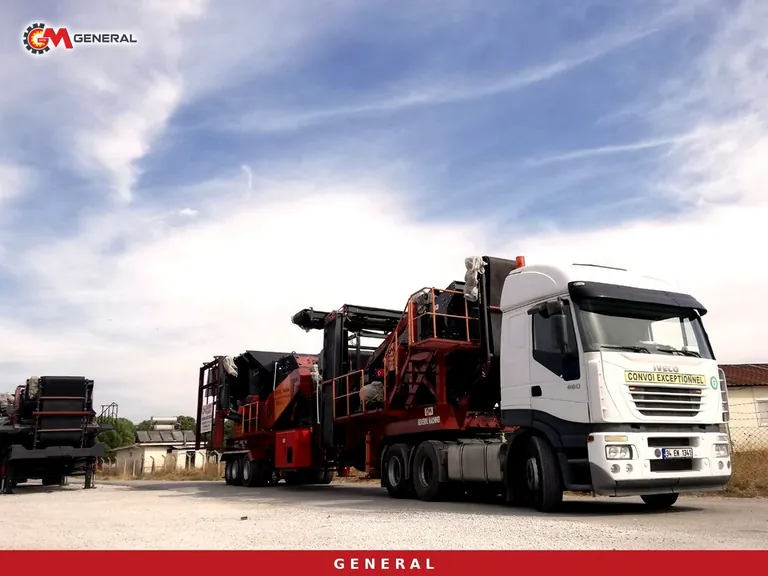
When people talk about the LNG investments tied to Rovuma basin gas off the Cabo Delgado coast in northern Mozambique, the conversation usually turns to liquefaction trains and carriers. On the ground, though, most of the work runs on stone: tank and process foundations, jetty and quay concrete, heavy-haul roads that carry the modules, the workers' camp, laydown yards and drainage channels. Every one of these items consumes crushed aggregate, and the main contractor's plan very often calls for a crushing and screening plant that delivers steady fractions in the 250-375 TPH band. Below we explain which real machines can meet that target, how the quarry rock changes the choice, what to watch for with concrete aggregate, and how the logistics work from the port to the site. All technical values are catalogue data from our product pages. Volumes, schedules and specifications belonging to the project itself must always be confirmed with the owner or the main contractor.
Why does aggregate demand fluctuate on an LNG site?
Building a liquefaction facility does not create a single, uniform demand for aggregate; the demand changes shape with each phase of the work. If the plant is not selected with this shift in mind, you end up with surplus capacity in one period and a bottleneck in the next.
Early works: roads, camp and platforms
The first months consume mostly coarse material. Site roads, heavy crane pads and the fill under the camp and laydown areas need 19-40 mm and coarser crushed stone. In this phase particle shape and good compaction matter most; cleanliness of the fine fraction comes second.
Heavy civil works: tank, process and jetty concrete
Once foundation pours begin, demand moves to fine and medium fractions: 0-5 mm sand plus 5-12 and 12-19 mm chippings. Expectations change here; cubical particles, low clay and dust content and a consistent grading sit at the heart of the specification. To pull two different product profiles out of the same quarry, plan a multi-deck screen and, where needed, a washing line.
If you share the tonnage split between these two phases as percentages at the quotation stage, the screen decks, crusher type and stockpile area can be sized correctly. A simple formula is enough for the hourly capacity requirement: required hourly capacity = monthly target tonnage ÷ (working days per month × net production hours per day). Always include losses for maintenance, rain and shift changes when you calculate net hours.
Quarry rock in Cabo Delgado: coastal sediment or inland crystalline rock?
Along the coastal strip of northern Mozambique you find sedimentary rocks such as limestone, coral-derived limestone and sandstone. Moving inland, old crystalline basement rocks such as gneiss and granite take over. This distinction is the first question in machine selection. In soft, low-abrasion limestone an impact crusher gives both a high reduction ratio and a cubical product. In gneiss and granite with a high silica content, however, the blow bars and aprons of an impact crusher wear out quickly; a jaw primary followed by a compression-type cone secondary stays more economical.
Limestone deposits close to the shore carry another risk: porous, weak beds and clay pockets can lower the quality of concrete aggregate. Taking samples from several points before the quarry is opened and testing compressive strength, abrasion (Los Angeles) and clay-silt content clarifies both the crusher type and the need for washing. Given the strict aggregate criteria of an LNG specification, picking a machine on guesswork is the most expensive mistake you can make.
Building the 250-375 TPH target with real models
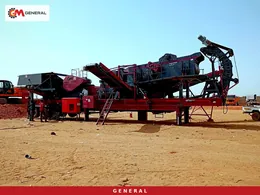
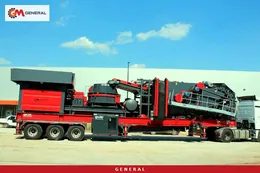
The model that covers the headline band on its own is the General 03: with a GPS 1415 primary impact crusher, a 2400×5000 mm four-deck screen and a 750 kVA generator, it produces 250-375 t/h. Because it is an impact unit, though, it is meant for limestone and similar low-abrasion stone. If the quarry turns out to be gneiss or granite, the answer is a jaw-primary line or two units working together. You can compare all wheeled options on the mobile crushing and screening plants page.
| Configuration | Capacity | Crushers | Max. feed | Screen | Generator | Suitable rock |
|---|---|---|---|---|---|---|
| General 03 (single unit) | 250-375 t/h | GPS 1415 primary impact | 900 mm | 2400×5000 mm, 4 decks | 750 kVA | Limestone, low-abrasion stone |
| General 02 (single unit) | 250-300 t/h | GPS 1413 primary impact | 1000 mm | 2000×5000 mm, 4 decks | 660 kVA | Limestone, coastal quarry with large blocks |
| GNR-MC110 (twin chassis) | 200-300 t/h | GPJ 110 jaw + DMK03 impact | 900 mm | 2000×6000 mm, 4 decks | 750 kVA | Hard rock, mixed feed |
| GNR-MC110 + General 944 | 320-480 t/h (combined) | GPJ 110 + DMK03 / GPJ 90 + GM430 cone | 900 / 800 mm | 2000×6000 mm + 1600×5000 mm | 750 + 550 kVA | Gneiss, granite |
| Stationary line (GNR 140 feeder + GNRK 130 jaw + cone stage) | Primary stage 400-500 t/h | GNRK 130 jaw + cone | — | Project-specific | — | Long-life hard rock quarry |
If the quarry is limestone: a simple single-unit layout
The General 03 arrives on site as a single chassis and is set up with folding hydraulic conveyors and support legs, without any concrete foundation. Its four-deck screen separates 0-5, 5-12, 12-19 and 19-40 mm fractions in a single pass, which makes it easy to take coarse material for the early works and fine material for the concrete phase from the same machine. If the quarry yields a high share of large blocks and tonnage will stay around 300 t/h, the General 02 with its 1000 mm feed opening is also worth considering.
If the quarry is gneiss or granite: two units, one flow
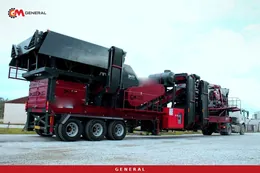
The GNR-MC110 consists of two separate chassis: the primary chassis carries the hopper with feeder and the GPJ 110 jaw crusher, while the secondary chassis holds the DMK03 impact crusher and a 2000×6000 mm four-deck screen. It delivers 200-300 t/h, and the primary group can also run on its own. Adding the General 944 with its GPJ 90 jaw and GM430 cone crusher, brings another 120-180 t/h. The cone secondary extends wear-metal life in siliceous rock and produces cubical particles for concrete aggregate. Together the two lines give 320-480 t/h, leaving headroom above the 375 t/h target; while one unit is under maintenance, the other keeps producing.
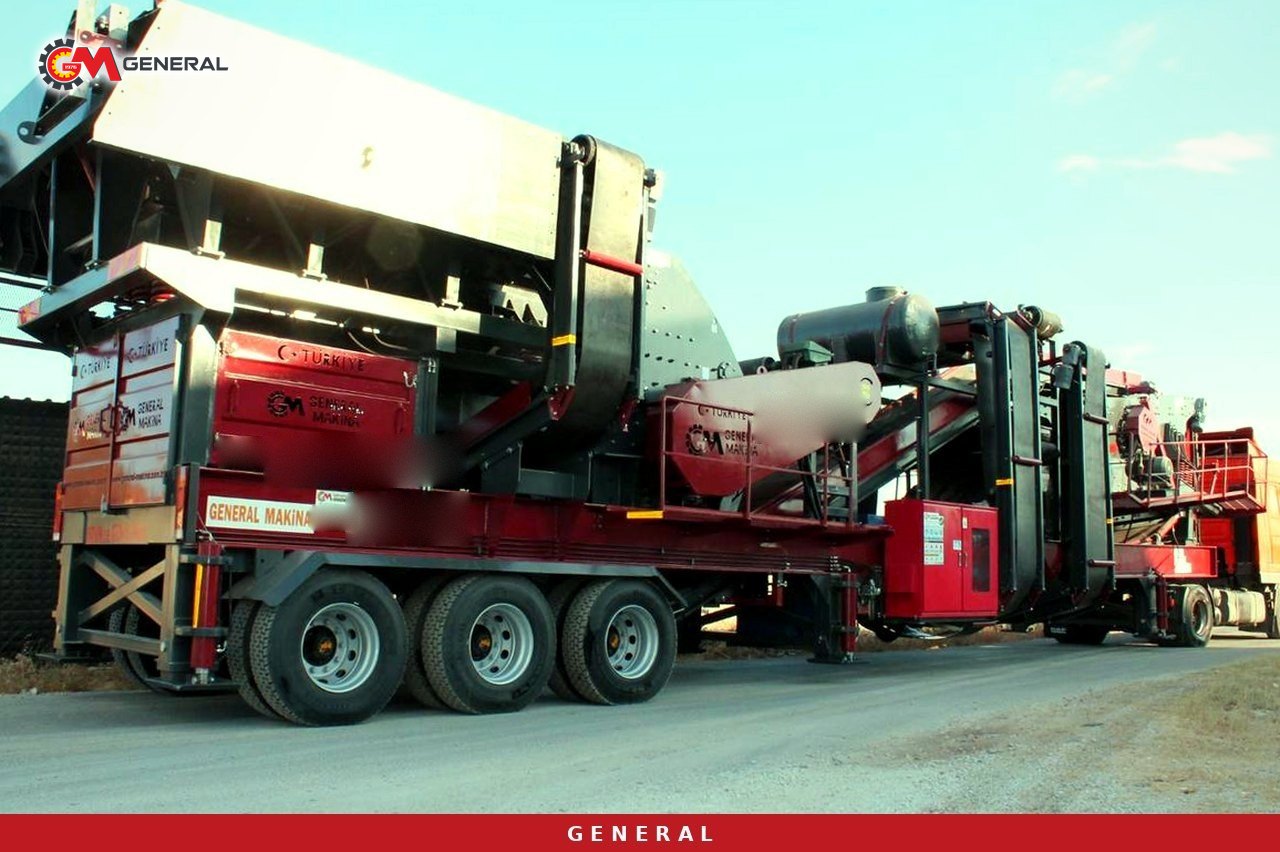
If the quarry will serve more than one contract over several years, stationary stone crushing and screening lines should also be on the table. A primary stage built around the GNR 140 feeder (350-600 t/h) and the GNRK 130 jaw crusher (400-500 t/h) carries the 375 t/h target comfortably; the secondary and tertiary stages and the screen sizes are then engineered from the quarry data.
Concrete aggregate specification: what comes after the crusher?
Concrete specifications on LNG facilities are usually strict, and laboratory reports decide whether aggregate is accepted. Even with the right crushing plant, problems can appear at these points:
- Fines and clay: If coastal limestone and the weathered rock overburden contain a lot of clay, 0-5 mm sand can exceed the acceptance limit. In that case you need a sand washing unit; the options are on the mobile sand washing and dry screening plants page.
- Particle shape: Flaky and elongated particles spoil the workability of concrete. A cone or impact secondary, correct feeding and closed-circuit operation give a cubical product.
- Grading consistency: To keep fractions on the same curve every day, screen meshes must be checked regularly and a torn mesh replaced the same day.
- Stockpile separation: Without dividing walls or enough distance between fractions, rain and loader traffic will mix the stockpiles.
If the aggregate is turned into concrete on the same site, the crushing line and the concrete batching plants should be planned together. That way the capacity of the aggregate bins and the daily output of the crushing plant are matched to each other.
From Pemba and Nacala ports to site: shipping, layout and climate
Machines shipped from Türkiye usually arrive in northern Mozambique at the port of Pemba or Nacala and are then towed to site by road. The advantage of wheeled plants is that they travel on their own chassis. Even so, the route must be planned around the transport dimensions:
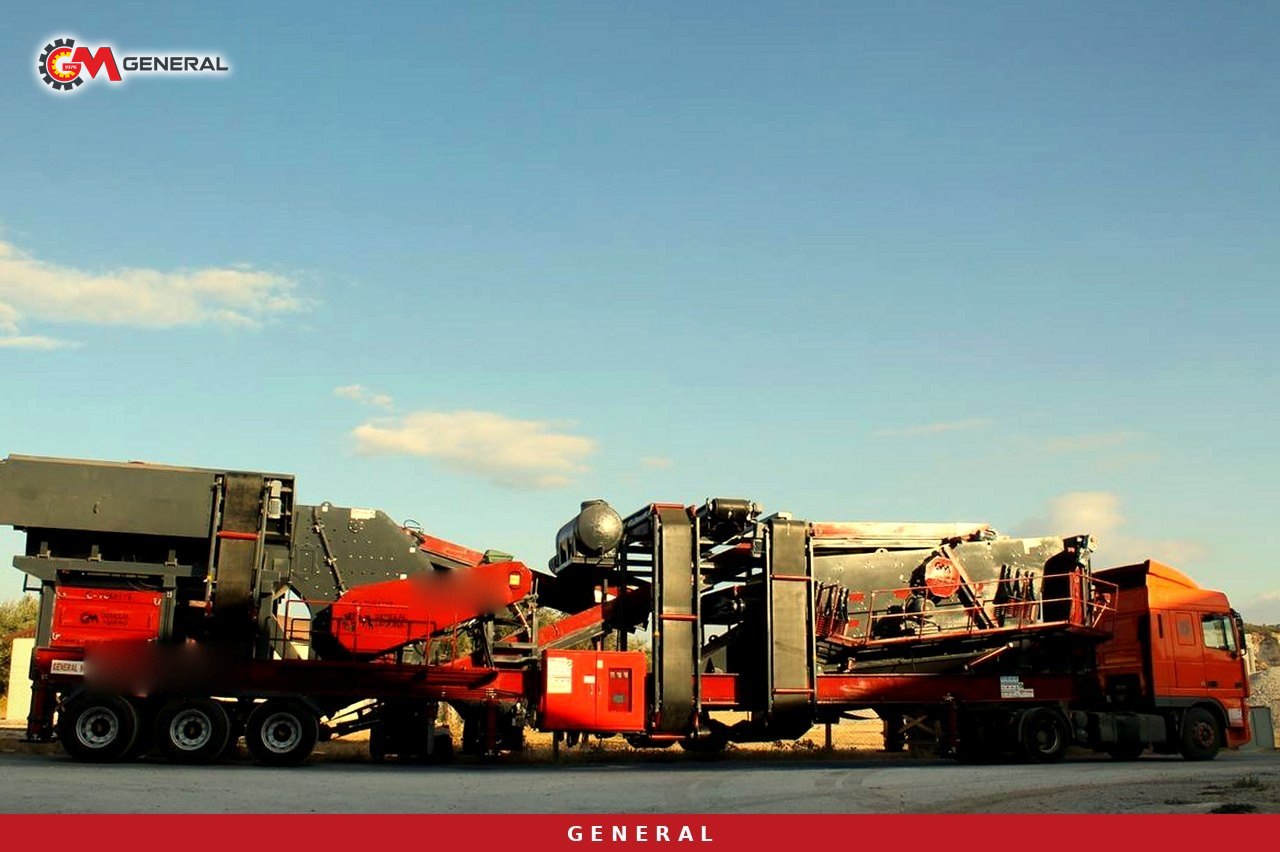
The General 02 has a transport size of 4340×20600×4500 mm and weighs 76,000 kg. The General 03 sits on a four-axle international transport chassis. On the GNR-MC110 the load is split over two chassis: the primary chassis is 3000×13500 mm and 55,000 kg, the secondary chassis 4200×18300 mm and 55,000 kg. With these figures, bridges, culverts and tight bends between the port gate and the quarry must be checked in advance, and axle loads and abnormal-load permit conditions confirmed with the relevant road authority. The ground at the installation spot must be stabilised so that it can carry the heavy chassis in the rainy season too.
Operating in a tropical coastal climate: humidity, rain and salt air
The coastal belt of Cabo Delgado has a distinct rainy season and high humidity all year round. These conditions stress a crushing plant in three ways. Wet, clayey feed blinds grizzly bars and screen meshes; in the wet period you need to reduce the feed rate and clean the scalping section often. Salt air from the sea speeds up corrosion on unpainted surfaces, electrical panels and connection points, so panel sealing and regular cleaning belong in the maintenance plan. In the dry months, water spraying at conveyor transfer points for dust suppression is a measure that can be chosen per project.
On a remote site grid power is often unavailable, so wheeled plants run on their own generators. The catalogue values are 750 kVA for the General 03 and the GNR-MC110, and 550 kVA for the General 944. In a two-unit setup, fuel logistics, tank capacity and a stock of spare filters must be calculated from the start. The same logic applies to wear parts: keeping jaw plates, blow bars and cone liners as spares on site means that waiting for parts from the port does not turn into lost production.
Information pack to prepare before requesting a quote
- Quarry location and rock type; compressive strength, abrasion and clay content test reports if available.
- Fraction split by phase: coarse material for roads and fill, and the 0-5, 5-12, 12-19 mm shares for concrete.
- Daily operating hours, number of shifts and target monthly tonnage.
- The relevant clauses of the concrete aggregate specification and whether washing is required.
- Port of arrival, route from port to site and road restrictions.
- Power source: generator or grid connection?
- Whether the plant will move to another quarry once the LNG work is finished.
Frequently asked questions
Can a single General 03 reach 375 t/h?
The catalogue capacity of the General 03 is 250-375 t/h. Getting close to the upper limit is possible with low-abrasion, dry feed such as limestone. We do not recommend an impact crusher for gneiss or granite; in those rocks the GNR-MC110 and General 944 combination gives the right result.
What happens to the plant when the project ends?
Because the wheeled units are not tied to a fixed foundation, they can be towed to another quarry or another infrastructure job. On fixed-duration projects such as LNG, this is the most practical way to avoid tying the investment to a single contract.
Which certificates and warranty are offered?
Our machines carry ISO 9001 and CE certification. The warranty period is 1 year, excluding wear parts. General Makina has been manufacturing in İzmir since 1976.
What determines the quoted price?
The selected model and number of units, the need for washing, additional conveyors and stockpile belts, the generator choice, the spare wear-parts package and the delivery terms set the price. For a firm figure, simply contact us with the information pack above.
Short assessment
The model for a plant that will supply 250-375 TPH of aggregate to LNG infrastructure in Mozambique is decided by the stone coming out of the quarry: in limestone the General 03 is a simple, single-unit solution; in gneiss and granite the GNR-MC110 together with the General 944 provides both capacity headroom and wear-metal life. Clean concrete aggregate, the route from Pemba or Nacala to site and the humid coastal climate matter at least as much as the model choice. Send your quarry data and fraction requirements through our contact page and our engineers will prepare the right configuration and quotation for you.
Definitions of technical terms: Glossary