EN — English
 TR — Türkçe
 DE — Deutsch
 RU — Русский
 FR — Français
 ES — Español
 AR — العربية
 SR — Српски

Uganda Oilfield Infrastructure Aggregate Crushing Plant 100-200 TPH
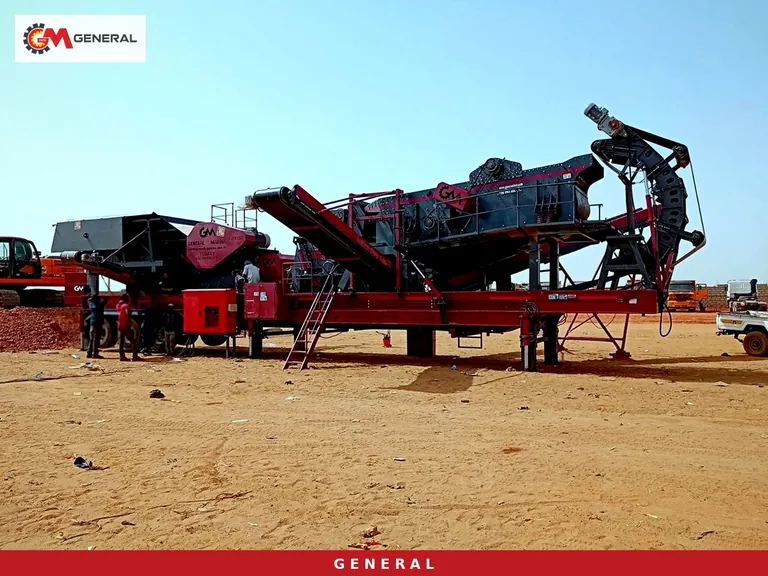
Oilfield infrastructure in Uganda usually brings the pipeline and the processing facility to mind first, yet the work that makes a field usable comes earlier: access roads strong enough for heavy equipment, well pads, and foundations for camps and storage yards. All of them consume well-graded crushed aggregate, and that aggregate has to come from a quarry close to the site, typically at a target of 100-200 tonnes per hour. This article looks at plant selection for a crushing and screening plant serving the oil region around Lake Albert: model choice, the clayey and wet quarry problem, operating on the equator and shipping to a landlocked country, from the viewpoint of an engineer who has run crushing plants in the field. Every figure below is a catalogue value from our product pages; project-specific requirements must always be confirmed with the relevant authority or the main contractor.
Where does aggregate go on an oilfield?
The construction phase of an oilfield produces an aggregate profile that differs from a typical highway job. Most of the tonnage goes into coarse fractions, while fine material is requested separately for concrete and asphalt. If the quarry is not planned around this split, the plant piles up stock in one fraction while the site waits for another.
- Access and in-field roads: sub-base and base layers that carry heavy cranes and drilling rigs; 19-40 mm and coarser material with well-interlocking cubical grains is decisive here.
- Well pads: large-area fill and surfacing layers with high bearing capacity, mostly built from mixed-grade crushed stone.
- Camp, warehouse and facility foundations: concrete aggregate made of 0-5 mm sand plus 5-12 and 12-19 mm chippings; clean, clay-free material is a must.
- Drainage and slope protection: channel fills and rip-rap that keep rainwater away from the road.
Sharing this list with percentage shares at the quotation stage lets the screen deck count and crusher type be chosen correctly. If the specification does not state the split, ask the contractor for it.
Quarry material in the Albertine region: hard rock and red soil
The Albertine Graben in western Uganda is a rift basin framed by old crystalline basement rock. Hard, silica-rich rocks such as gneiss, granite and quartzite are common, while the surface can carry a thick cover of red lateritic soil known locally as murram. These two materials create completely different problems for a crushing plant. Only a laboratory sample reveals the abrasiveness and compressive strength of a given quarry, so machine selection should never rest on assumptions.
Hard, abrasive basement rock
In gneiss and quartzite the blow bars and plates of an impact crusher wear quickly. For these rocks, a jaw crusher in the first stage followed by a cone crusher that breaks by compression gives a more economical result in terms of metal life. If a soft limestone bed turns up, the picture changes and the cubical-product advantage of an impactor takes the lead.
Clay cover and wet feed
Murram mixed into blasted rock turns into a sticky paste in the rainy season. It packs the gaps of a static grizzly, blinds screen meshes and contaminates concrete aggregate with clay. Before the quarry is opened, measure the overburden thickness and estimate how much of the feed will be clayey.
Model matching for 100-200 TPH
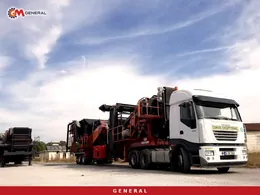
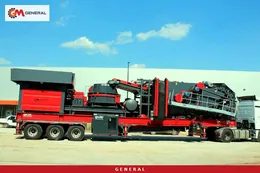
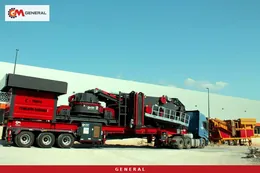
The table below sets the product-page values of our wheeled plants in this capacity band side by side. All of them belong to the wheeled mobile crushing plants group and handle feeding, crushing and screening together on a chassis.
| Model | Crusher(s) | Capacity | Max. feed | Weight | Generator | Screen |
|---|---|---|---|---|---|---|
| General 800 | PDK 1280 primary impact | 80-150 TPH | 600 mm | 35,000 kg | 450 kVA | 1300×4000 mm, 3-deck |
| General 944 | GPJ 90 jaw + GM430 cone | 120-180 TPH | 800 mm | 70,000 kg | 550 kVA | 1600×5000 mm, 3-deck |
| General 950 | GPJ 90 jaw + DMK01 impact | 120-180 TPH | 800 mm | 70,000 kg | 600 kVA | 1600×5000 mm, 3-deck |
| Mobil 90 | GPJ 90 jaw | 90-150 TPH | 800 mm | 45,000 kg | 350 kVA | 1600×5000 mm washing screen |
| GNR-MC110 (twin chassis) | GPJ 110 jaw + DMK03 impact | 200-300 TPH | 900 mm | 2 × 55,000 kg | 750 kVA | 2000×6000 mm, 4-deck |
Hard gneiss and granite: General 944
The General 944 places a GM430 cone crusher behind a GPJ 90 primary jaw and produces 120-180 TPH. In siliceous rock the compression principle of the cone stretches wear-part change intervals; in a remote oil region where parts logistics are slow, that difference shows up directly in running hours. It splits product into 0-5, 5-12 and 12-19 mm fractions. The General 950, which carries a DMK01 impactor on the same frame, is the alternative for deposits where cubical shape matters more and abrasiveness stays moderate.
Low-abrasive stone and a lighter unit: General 800
Where the quarry offers limestone or soft sandstone, the General 800 is the economical end of the band, at 35,000 kg and with a 450 kVA generator requirement. Its PDK 1280 primary impactor gives a high reduction ratio in a single stage and delivers four fractions, 19-40 mm included, for road base. In hard gneiss this model is not recommended; wear costs would wipe out the saving.
Clayey quarries: Mobil 90 and the wobbler feeder
With a high murram content, dry screening rarely yields clean concrete aggregate. The Mobil 90 combines a GPJ 90 jaw crusher, a 1600×5000 mm washing screen and a 600×6000 mm twin screw sand washer on one chassis and recovers 0-5 mm sand without losing it to water. For very sticky feed, wobbler-type crusher feeders that separate mud with rotating elliptical shafts prevent pegging at pre-screening instead of a grizzly; the catalogue GWB1136 model has an 18.5 kW motor and a 75-600 TPH feed capacity.
How to reach the 200 TPH upper limit
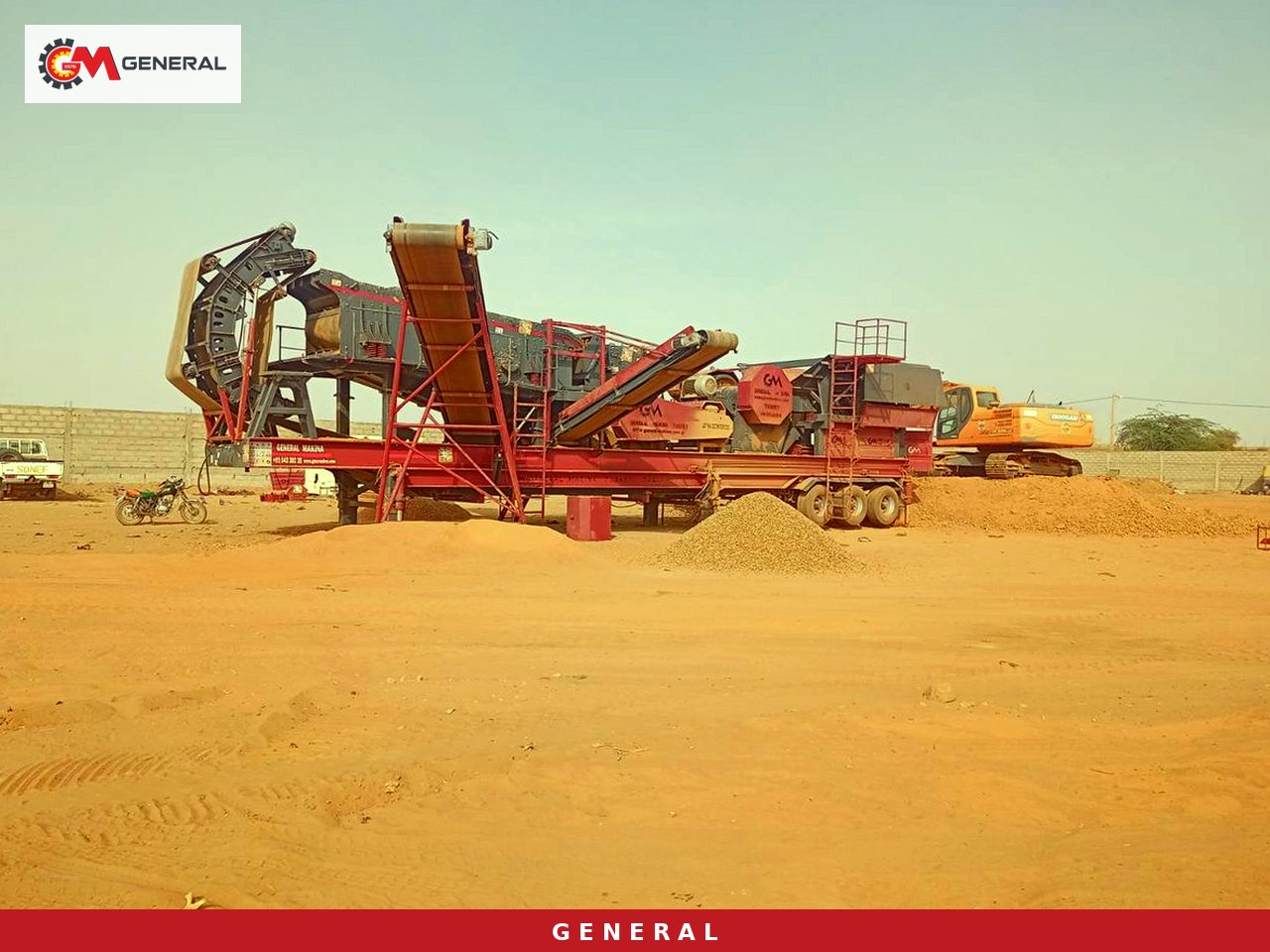
None of the single-chassis plants in the table reaches 200 TPH in the catalogue; the highest figure is 180 TPH for the 944 and 950. If the top of the target is needed continuously, there are two routes. The first is the GNR-MC110: chassis one with the GPJ 110 jaw and chassis two with the DMK03 impactor and 2000×6000 mm four-deck screen work separately and deliver 200-300 TPH together. During the first months of construction, coarse fill can be produced with chassis one alone and chassis two added later; details are on the GNR-MC110 page. The second route is two independent units, for example a General 944 for dry aggregate and a Mobil 90 for concrete sand. Combined, this exceeds the band, but its real value is that the site does not stop completely when one unit is in maintenance.
Operating on the equator: rain, mud and dust
Uganda straddles the equator and sees heavy rain in two separate seasons a year; in the dry months between them red soil turns into fine dust. The plant will work on a site that swings between these two extremes.
- Rainy season: stockyard drainage, a stone-reinforced feed ramp and effective pre-screening of clayey feed. A pre-screen with adjustable bar spacing keeps by-pass material away from the crusher.
- Dry season: water-spray dust suppression at crusher discharge and conveyor transfer points, plus belt covers at quarries near camps and drilling sites. These are project-specific options and should be listed separately in the quotation.
- Power: off-grid, the plant runs on a generator; the kVA value in the model table is the starting point for fuel logistics and the decision on a standby set.
- Wear parts: planning a spare set of manganese jaw plates, cone liners and screen meshes with the first shipment saves time on the long import route.
Shipping to a landlocked country and setting up on site
Uganda has no coastline; machinery coming from Türkiye is usually discharged at Mombasa in Kenya or Dar es Salaam in Tanzania and trucked inland. That is why weight and transport dimensions are as important as capacity. The General 800 travels at 3600×15500×4500 mm and the General 944 at 4130×20350×4500 mm; the 944 and 950 weigh 70,000 kg. Bridge and axle limits on the route, transit permits and any abnormal-load requirements should be confirmed in advance with the haulier and the relevant authorities.
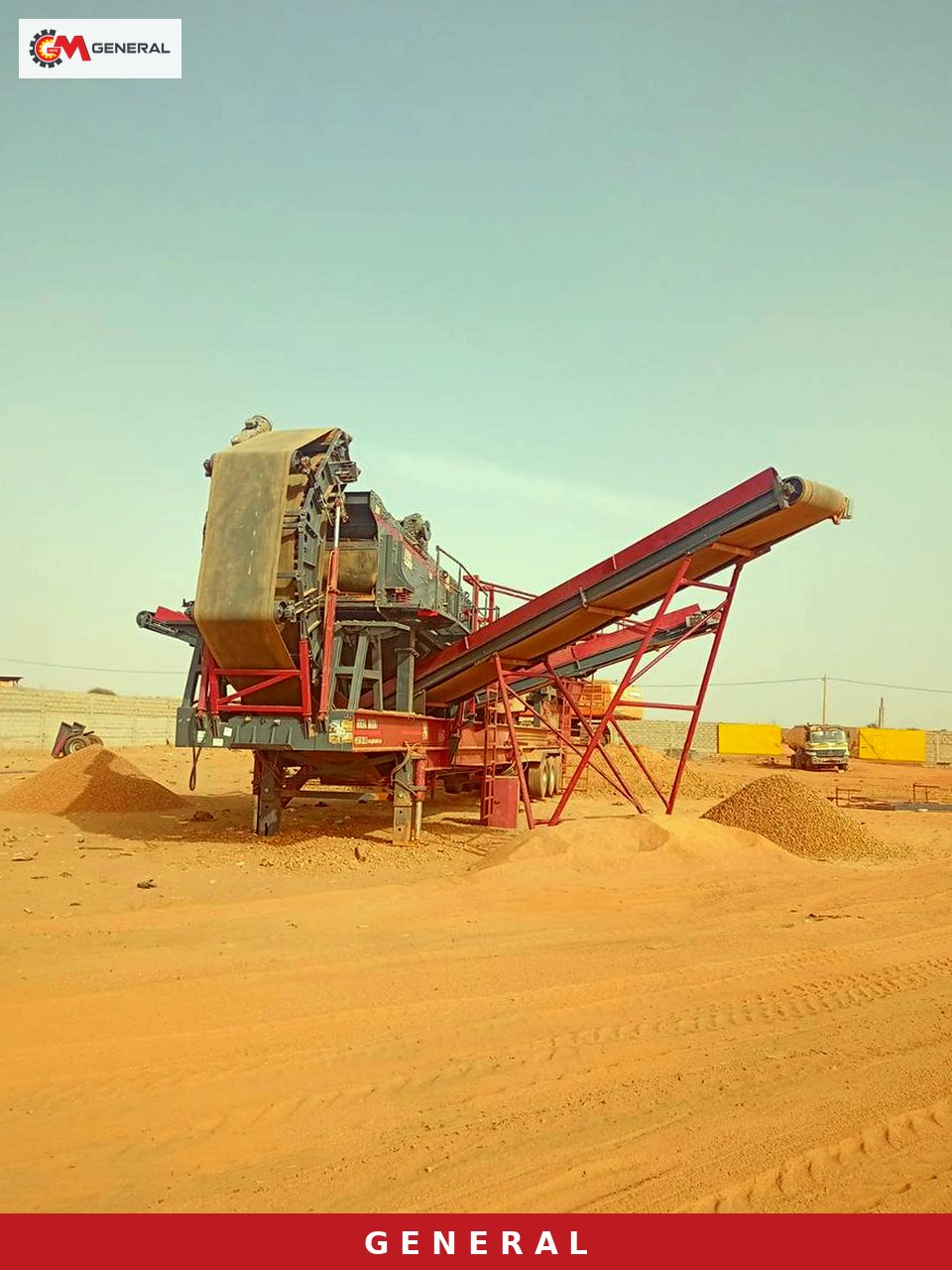
On site, a wheeled chassis sets up on hydraulic legs without a concrete foundation. During oilfield construction the quarry location can shift as the road advances, and towing the plant to the next point takes far less time than dismantling and moving a stationary plant.
Checklist for the quotation file
- Laboratory results of the quarry sample: compressive strength, abrasiveness, clay content.
- Monthly aggregate demand per fraction and the grading curves in the specification.
- Daily operating hours and number of shifts, giving the real hourly capacity target.
- Overburden thickness and the estimated share of clayey material in the feed.
- Whether a water source is available (for the washing plant decision).
- Generator or grid power, and the fuel delivery point.
- Port of arrival and the road route to site.
A quotation built on this data bases crusher type and screen decks on measurement rather than guesswork.
Frequently asked questions
Should I choose an impact or a cone plant for oilfield roads?
The rock decides. In abrasive gneiss, granite and quartzite the jaw + cone General 944 has the edge on metal life. In low-abrasive material such as limestone, an impactor gives more cubical product and a higher reduction ratio.
Will clayey murram stop the plant?
Without countermeasures it blinds the grizzly and the screens. Pre-screening with a wobbler feeder and, where needed, a washing plant such as the Mobil 90 keep clay out of the crusher and the concrete aggregate.
What warranty and certificates apply?
Our plants carry CE and ISO 9001 certification, with a 1-year warranty excluding wear parts. The company has been manufacturing in İzmir since 1976.
What determines the price?
The model and crusher combination, number of screen decks, washing unit, generator, spare wear set and the transport mode to the port of arrival. The exact figure comes in a quotation prepared with the checklist data above.
Conclusion
For a 100-200 TPH aggregate crushing plant serving Uganda's oilfield infrastructure, the order is: rock and clay content first, fraction split second, shipping and power last. The General 944 for hard rock, the General 800 for low-abrasive stone, the Mobil 90 for clayey quarries and the GNR-MC110 or a two-unit layout for continuous output above 200 TPH are sensible starting points. Send your quarry sample data and demand list through our contact page and we will prepare the matching configuration and quotation.
Definitions of technical terms: Glossary