EN — English
 TR — Türkçe
 DE — Deutsch
 RU — Русский
 FR — Français
 ES — Español
 AR — العربية
 SR — Српски

Morocco Phosphate Sites Heavy-Duty Crushing and Screening Plant 250-450 TPH
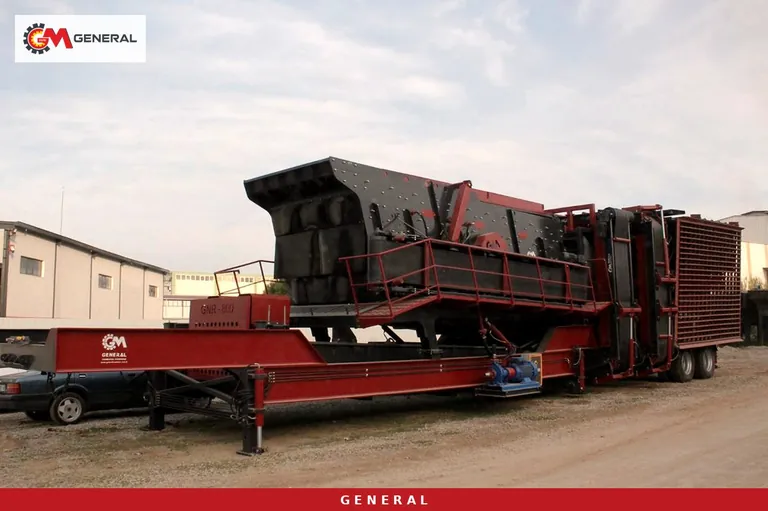
In Morocco, phosphate ore does not arrive at the crusher as a single, uniform rock the way limestone does in an aggregate quarry. One bucket can hold friable phosphate, sticky marl and clay interbeds and, here and there, very hard chert (silica) bands. A heavy-duty crushing and screening plant rated for 250-450 TPH therefore has to be designed around how these three materials behave together, long before the capacity figure is fixed. Using the general feed character of phosphate basins such as Khouribga, Benguerir-Gantour and Boucraa as a geographic frame, this article covers the real models that meet the target range, feeder selection, the wear-part plan, power and control, and shipping. The ore analysis, size specification and operating rules of any specific site must always be confirmed with that site's operator and process specification.
How phosphate ore reaches the crusher: feed character in the basins
Moroccan phosphate is sedimentary; ore-bearing layers usually alternate with limestone, dolomite and marl. After the overburden is stripped, run-of-mine material tipped into the hopper by excavator or loader carries components that behave very differently from one another. Their proportions change every decision, from crusher type and feeder to screen media and liner alloy. The first step of any quotation is therefore to have representative samples from different faces tested in a laboratory for moisture, clay content, free silica and Bond abrasion index (Ai). Choosing a plant from a single sample means designing for the site's best day, not its worst.
Clay and moisture in the interbeds
Marl and clay cause dust problems in dry months and stick to grizzly openings in the wet season. On a fixed-bar grizzly feeder this is called blinding: fines cannot be separated, the crusher carries unnecessary load and plant output drops unexpectedly. Sticky material can also build up on the breaker plates of an impact crusher and on the top deck of the screen, narrowing the flow path. If the share of clayey material changes with the season, the feeding stage should be sized for the worst case.
Chert bands and abrasiveness
The phosphate layer itself is relatively soft, but siliceous nodules and bands between layers change the picture. According to our product data, feed with more than 10% free silica or a Bond Ai above 0.15 wears the blow bars of an impact crusher very quickly. Below that threshold, in ore whose clay is manageable, a primary impactor gives a high reduction ratio; above it, a jaw crusher working on the compression principle is the better starting point. Seeing both conditions on the same site is normal, so a plant is sometimes planned with two different crushing routes.
Real configurations for the 250-450 TPH range
Read this range not as a single number but as the path between today's tonnage and the tonnage the operation wants to reach in a few years. The table below compares four routes using manufacturer data from our product pages.
| Configuration | Main crusher | Capacity (t/h) | Max. feed (mm) | Power | Best suited to |
|---|---|---|---|---|---|
| Stationary line, impact primary | GNR PDK01 (rotor 1400×1500 mm) | 250-500 | 1000 | 315 kW crusher motor | Low-silica, clayey ore; wobbler feeder in front |
| Stationary line, jaw primary (lower-mid band) | GNRK 110 (opening 1100×850 mm) | 200-350 | — | 110/132 kW | Ore with pronounced chert bands |
| Stationary line, jaw primary (upper band) | GNRK 130 (opening 1300×1000 mm) | 400-500 | — | 160 kW | Hard, abrasive feed approaching 450 t/h |
| Single mobile unit | General 03, GPS 1415 impactor | 250-375 | 900 | 750 kVA power unit | Advancing face, low-abrasion seam |
| Two mobile units | General 03 + General 640 (GPJ 60 jaw + GNR 50 impactor) | 310-475 (combined) | 900 / 500 | 750 kVA + 300 kVA (optional) | Two separate faces, one siliceous |
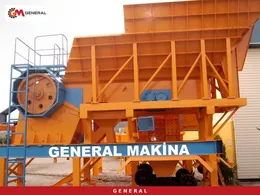
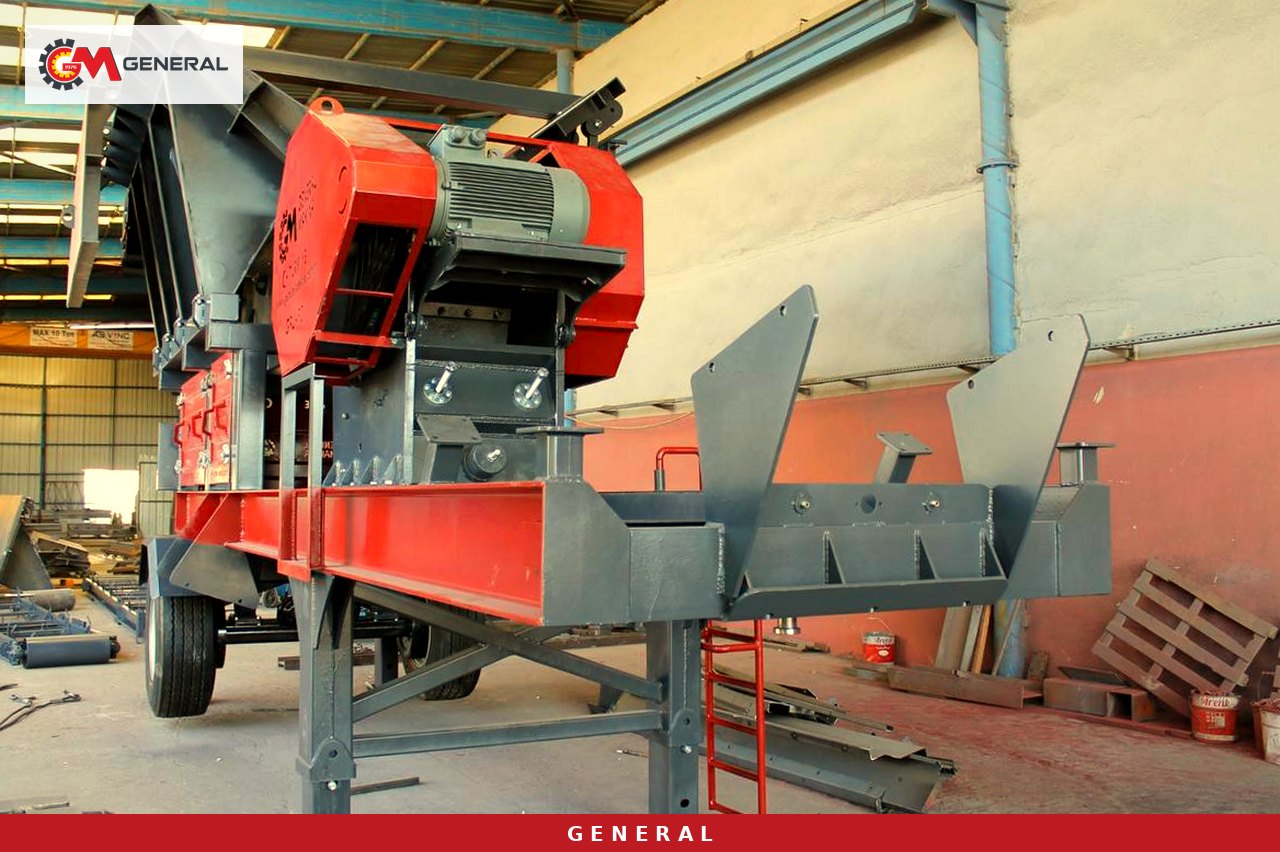
A stationary line is the sturdiest layout for an operation that will stay at the same pit for many years: it is built on a concrete foundation, and with no chassis transport limit it can use a larger crusher and a wider screening area. In high-clay, low-silica ore, a GNR PDK01 primary impact crusher placed behind a wobbler feeder covers the whole range with one machine. Where chert bands are pronounced, the main crusher becomes a jaw: the GNRK 110 suits the 250-350 t/h band and the GNRK 130 suits the upper band approaching 450 t/h. On the screening side a wide circular-motion screen such as the GNR 2460 (2400×6000 mm, 22 kW) is considered, keeping in mind that each additional deck reduces capacity by roughly 10%. The general layout of these arrangements is shown on our fixed crushing plants page.
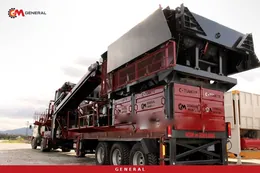
For operations that want to move the crusher closer to the ore as stripping advances, the mobile route comes first. The General 03 produces 250-375 t/h with its GPS 1415 primary impactor, a 2400×5000 mm four-deck screen and a standard 750 kVA power unit; its folding hydraulic conveyors and support legs mean no excavation or concrete foundation is needed. If 450 t/h must be reached, a second unit is added: the General 640 carries a GPJ 60 jaw and a GNR 50 impactor on one chassis, contributes 60-100 t/h and brings the benefit of jaw pre-crushing to a secondary face where chert is concentrated. Other options are listed under wheeled mobile crushing plants.
Feeder selection: plant output is decided under the hopper
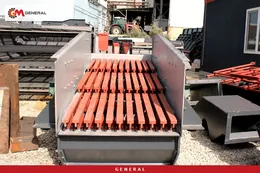
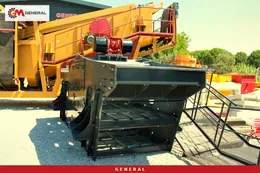
On a phosphate line, capacity is most often lost at the feeder rather than at the crusher. A vibrating grizzly feeder works well on dry, abrasive run-of-mine: the GNR 110 model offers 200-300 t/h and the GNR 140 model 350-600 t/h of feed capacity, and the grizzly by-pass section removes fines before they reach the crusher. Jaw and rotor liners are therefore not loaded for nothing. In wet, clayey feed, however, the same grizzly loses its function as soon as its openings fill up.
For that condition the wobbler feeder is the right tool. In the GWB1136 model (1100×3600 mm, 18.5 kW, motor-gearbox-chain drive), synchronised elliptical disc shafts act as a moving grizzly; the rotating discs clean themselves, letting muddy fines drop while carrying large rock on to the crusher. It accepts material up to 1500 mm and, with a feed range of 75-600 t/h, sits comfortably in front of a 250-450 TPH line. The rule is simple: if samples show significant clay and moisture, choose the wobbler; if the ore is dry and hard, choose the vibrating grizzly feeder. Whether the separated clayey fines go to a stockpile or to the process should also be agreed in advance according to the operator's ore specification.
What heavy-duty really means: wear metallurgy and liner planning
"Heavy-duty" is not an adjective but the sum of specific design and material choices. On a phosphate site, what makes it concrete is the alloy of each wear part and the replacement plan. The right yardstick is not the unit price of a part but wear cost per tonne crushed, which is set by part price, replacement frequency and the downtime that each change causes. Because the warranty does not cover wear parts, this plan has to start on day one.
- Jaw crusher plates: austenitic manganese steel (Mn13/Mn18/Mn22). It work-hardens under impact, raising surface hardness from 200 HB to 550 HB; Mn18 or Mn22 is preferred as silica content rises.
- Impact crusher blow bars: high-chrome white cast iron (about 700-800 HB) for clean, abrasive feed. Being brittle, it risks breaking when the feed contains large blocks or tramp metal.
- Ceramic-reinforced MMC: in abrasive service it lasts roughly 2-3 times longer than high chrome and is worth evaluating on faces where chert bands are frequent.
- Feeder body: bolted, replaceable wear plates and wear-resistant by-pass grizzly bars protect the structure and shorten change-outs.
Practical advice: plan at least one spare set of liners and blow bars per crusher for the first year, measure the wear profile at the first change and choose the alloy for the second order based on that measurement. The real abrasiveness of the phosphate seam is then documented with field data instead of a laboratory estimate.
Power, control and climate: continuous operation on a remote site
Some phosphate basins lie in hot, dusty inland areas far from the grid. On mobile units the power unit can be part of the package: 750 kVA is standard on the General 03 and a 300 kVA generator is optional on the General 640. On a stationary line, installed power is listed item by item, from the crusher motors (for example 315 kW for the PDK01 and 160 kW for the GNRK 130) to the screen and conveyor motors, and the grid connection or generator capacity is selected from that list.
On the control side, the automation system brings two concrete benefits. First, when crusher current approaches its threshold the feeder slows down and speeds up again once current returns to normal, so the crusher rides through a sudden clayey surge without choking. Second, equipment starts in reverse flow order, from the stockpile conveyor back to the feeder, and when one machine stops the upstream stages stop too, so no conveyor ever starts under load. Because alarm history and shift tonnage are recorded, the service team can make a preliminary diagnosis of a fault over a remote connection.
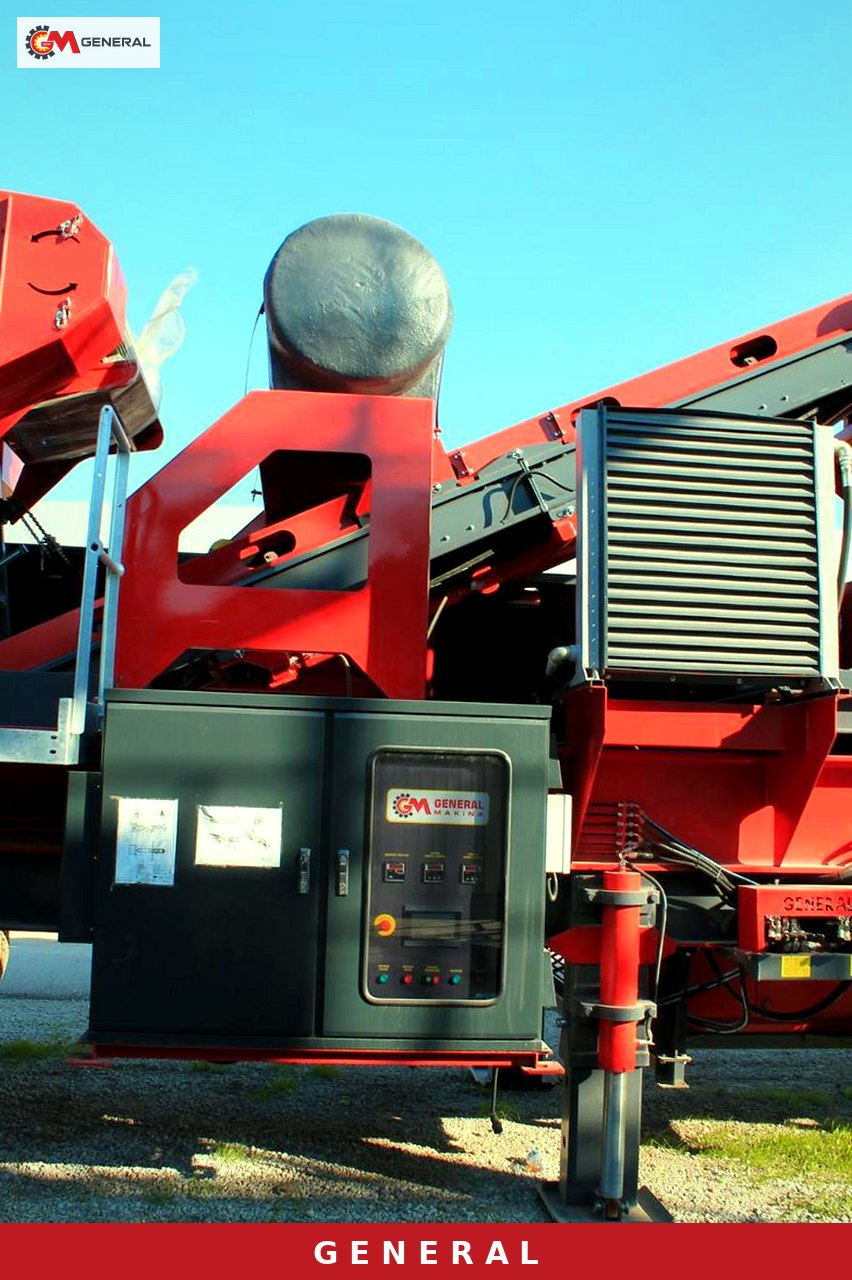
Dust and heat measures are chosen per project: water-spray dust suppression at transfer points, conveyor covers, filtered ventilation for cabinets and regular cleaning of motor coolers. These are not standard equipment on every model and should be listed separately at the quotation stage according to site conditions. For a real plant working in a comparable climate, see our 250 t/h GNR PDK 02 stationary plant in Saudi Arabia.
From port to pit: shipping and a pre-quotation checklist
Equipment leaving Izmir reaches Morocco by sea and, after Atlantic ports such as Casablanca, Jorf Lasfar or Safi, travels inland by road; for sites around Boucraa, the port of Laayoune is geographically closer. The General 03 travels on its four-axle chassis built to international transport standards, while the General 640, at 38,000 kg and a loading size of 3500×17000×4500 mm, is compact enough to fit on a single truck. A stationary line is shipped in modules and needs a concrete foundation on site; the foundation design and installation schedule should be discussed together with the quotation.
If you include the following in your enquiry, the configuration can be settled in the first round:
- Target capacity: today's and future t/h, plus daily operating hours.
- Sample results: moisture, clay content, free silica and Bond Ai.
- Largest run-of-mine block size and extraction method (excavator or blasting).
- Output size and number of fractions required by the beneficiation plant.
- Power source: grid or generator, and the installed power limit.
- Whether the plant will stay in place or move as the face advances.
- Port of arrival and road conditions from port to site.
Frequently asked questions
Should phosphate go through an impact or a jaw primary crusher?
The samples decide. If free silica stays below 10% and Bond Ai below 0.15, an impact primary gives high reduction and a cubical product; the GNR PDK01 covers the range alone at 250-500 t/h. If chert bands exceed that threshold, starting with a jaw crusher (GNRK 110 or GNRK 130) prevents excessive blow bar consumption.
Can a grizzly feeder be used on clayey ore?
It can work in the dry season, but in wet, sticky feed the grizzly blinds. On faces where clay content stays high all year, the GWB1136 wobbler feeder is the safer choice.
Can a mobile plant reach 450 TPH?
The upper limit of a single wheeled unit is 375 t/h with the General 03. Reaching 450 t/h requires a second unit; together the General 03 and General 640 provide a 310-475 t/h band. If the operation will run continuously around 450 t/h, a stationary line should also be evaluated.
How are warranty, certification and price determined?
The equipment carries ISO 9001 and CE certification, and a one-year warranty applies, excluding wear parts. Price and delivery schedule are set in a project-specific quotation based on the chosen configuration, optional equipment and shipping terms.
Conclusion
The right layout for a 250-450 TPH heavy-duty line on a Moroccan phosphate site rests on three questions: how much clay is in the ore, how abrasive are the chert bands and will the operation stay in one place? High clay points to a wobbler, high silica to a jaw primary, a fixed site to a foundation-mounted line and a moving face to the General 03, plus a second unit when needed. Our team, manufacturing in Izmir since 1976, can prepare the plant layout and wear plan from your sample results; for a quotation, reach us through our contact page.
Definitions of technical terms: Glossary