EN — English
 TR — Türkçe
 DE — Deutsch
 RU — Русский
 FR — Français
 ES — Español
 AR — العربية
 SR — Српски

Jordan Phosphate Heavy-Duty Crushing and Screening Plant 250-450 TPH
Jordan's phosphate deposits spread across the desert plateau in the centre and south of the country. Along the belt that runs from the older workings around Al-Hasa and Al-Abiad to the Eshidiya basin, ore is ripped from open pits and hauled by truck to the crushing plant. When choosing a line that will crush and screen 250-450 tonnes per hour, the first thing to study is not the crusher but the mix landing in the hopper: soft phosphorite, hard chert nodules, limestone caps and patches of marl. This article sizes the plant inlet, the primary crusher, the screening stage and desert operation for that mix, using the real values published on our product pages. Target particle size, process flow sheet and site rules must be confirmed with the mine operator's technical specification and the relevant authority.
How Jordanian phosphate behaves in front of the crusher
Jordanian phosphorites are sedimentary. At most sites the ore beds alternate with chert, limestone and marl. The phosphate grain breaks apart easily, yet the same excavator bucket also brings siliceous blocks as hard as flint. That second group is what loads the crusher and writes the wear-part bill.
Chert nodules and limestone caps
Chert is almost pure silica. Its Bond abrasion index comes out high, and it shortens part life noticeably in machines that work by impact. Hard limestone beds in the overburden or above the ore seam break off as large slabs. These slabs can bridge on the feeder grizzly and directly affect the required primary crusher inlet size.
Marl, fine dust and soil
The desert climate usually keeps the material dry, but fines from marly interbeds are a source of both dust and sticking. If the fine fraction is removed before the crusher, the crusher does no wasted work and its liners wear more slowly. We therefore recommend testing samples from several faces for moisture, clay content, free silica and abrasion index before a quotation. Sizing a line from a single sample ignores the site's bad days.
Building the plant inlet: hopper, feeder and grizzly
In a phosphate line of 250-450 TPH, throughput is largely decided underneath the hopper. Trucks arrive irregularly and the ore mix changes within a shift. The feeder has to absorb these swings and keep the crusher mouth full at all times.
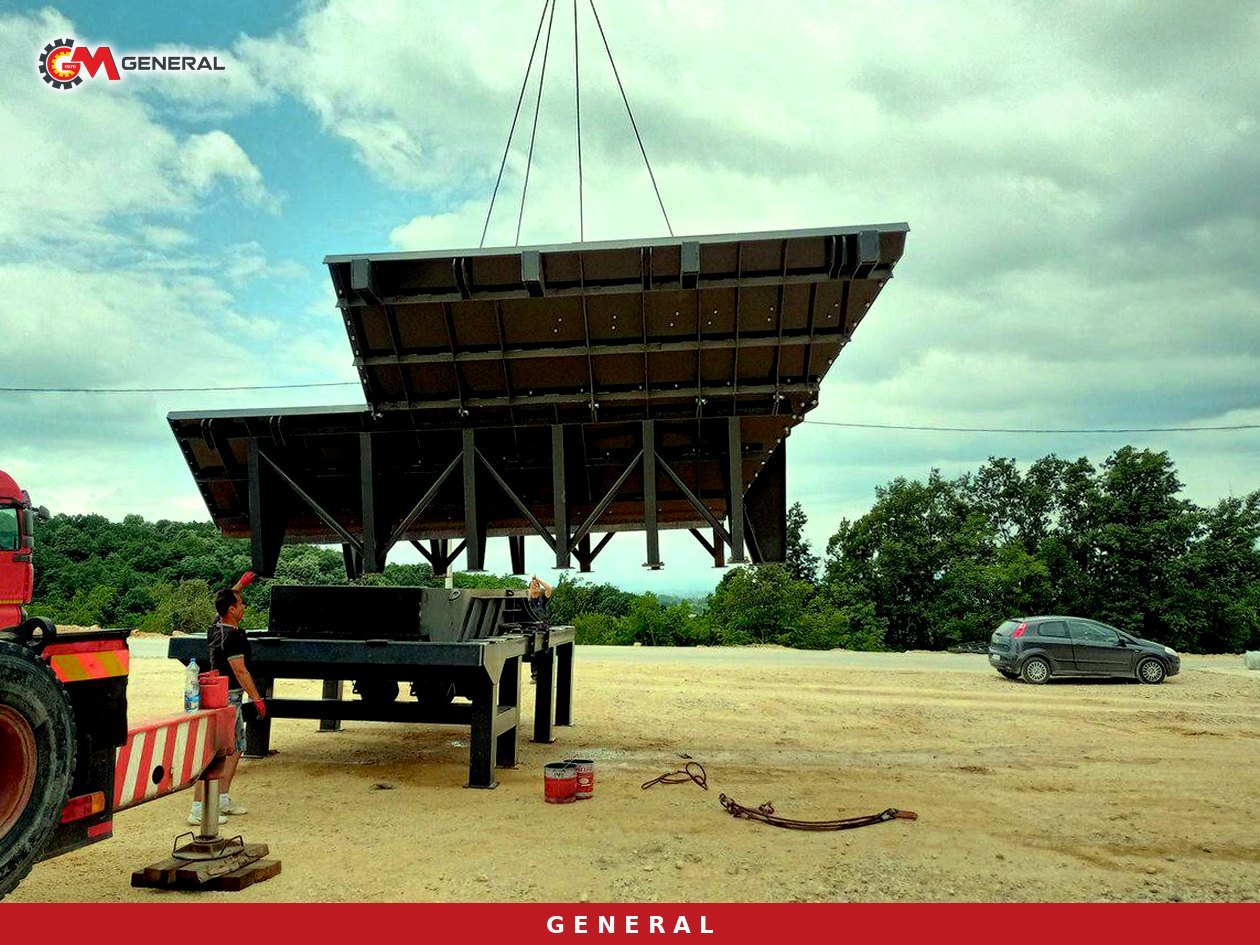
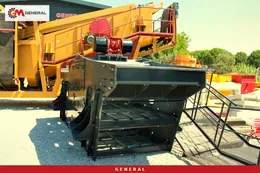
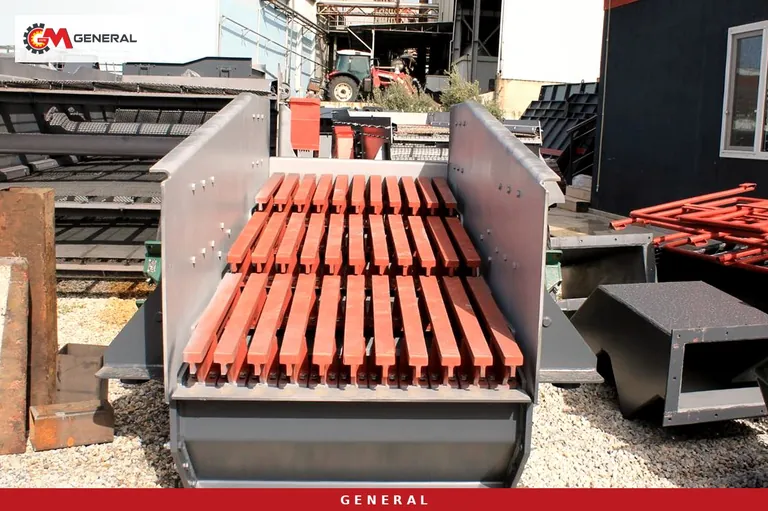
The GNR vibrating grizzly rock feeder accepts run-of-mine rock up to 1500 mm and is supplied with a 15-100 m³ hopper on every model. Two models suit this range: GNR 110 (1100 × 4750 mm, 200-300 t/h, 2 × 7.5 kW) and GNR 140 (1400 × 5000 mm, 350-600 t/h, 2 × 9.2 kW). Above 400 t/h, GNR 140 is the natural choice. For a line that stays at 250-300 t/h, GNR 110 is sufficient and matches the crusher inlet more evenly.
Vibrating grizzly or wobbler
For dry, abrasive feed the vibrating grizzly feeder is the right tool: its by-pass grizzly separates fines and soil ahead of the crusher. On faces with a high marl share that turn damp in the rainy period, the grizzly gaps can blind. On such a site the GWB1136 wobbler feeder with elliptical disc shafts (1100 × 3600 mm, 18.5 kW, 75-600 t/h) takes over thanks to its self-cleaning action. Most Jordanian phosphate faces can be expected to deliver dry feed, but the decision should follow the sample results.
When a separate grizzly screen is needed
With a high fines share, the feeder's by-pass area may not be enough. A G-type grizzly scalping screen is then installed between the feeder and the primary. The ELKG-1930 has a 1200 × 3000 mm screening area, an 11.5 kW drive and weighs 6500 kg. Its bars are cast in high-manganese austenitic steel with adjustable gaps, so the by-pass size can follow the real particle distribution of the ore. The grizzly screen range works at 100-400 t/h, which means that at a 450 t/h target the by-pass duty is shared with the feeder grizzly rather than placed on one unit. To keep post-primary fines away from the secondary, the M-type ELKM-1640 (1600 × 4000 mm, 15 kW) can be used.
Primary crusher decision: jaw or horizontal-shaft impactor
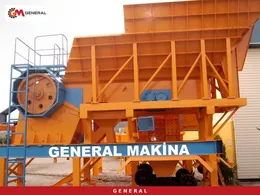
Phosphorite itself is soft, and an impact crusher reduces it strongly in a single stage. The issue is chert. The GNR PDK product page states plainly that material with more than 10% silica or a Bond Ai above 0.15 consumes blow bars quickly. On a clean ore bench with little chert, GNR PDK01 (1400 × 1500 mm rotor, 1000 mm feed, 250-500 t/h, 315 kW) makes a sensible primary. Where chert nodules are pronounced, the GNRK jaw crusherwhich breaks by compression, keeps metal wear low.
Among the jaw options, GNRK 110 (1100 × 850 mm inlet, 110/132 kW, 200-350 t/h) and GNRK 130 (1300 × 1000 mm inlet, 160 kW, 400-500 t/h) cover this range. Since the maximum feed size is roughly 0.8-0.9 times the inlet width, the large slabs from limestone caps enter the GNRK 130 more easily. With siliceous feed, Mn18 or Mn22 jaw plates are preferred over standard Mn13, and wear-part cost should be calculated per tonne crushed.
Suggested layouts for 250-450 TPH
The table below compares layouts that meet the target range, using product page values. Unknown values are left blank.
| Layout | Feeder | Primary crusher | Primary capacity (t/h) | Feed / inlet (mm) | Primary motor | Suitable ore |
|---|---|---|---|---|---|---|
| Fixed A | GNR 110 | GNRK 110 jaw | 200-350 | 1100 × 850 | 110/132 kW | Chert-bearing, abrasive |
| Fixed B | GNR 140 | GNRK 130 jaw | 400-500 | 1300 × 1000 | 160 kW | Chert-bearing, large slabs |
| Fixed C | GNR 140 | GNR PDK01 impactor | 250-500 | 1000 | 315 kW | Clean, low silica |
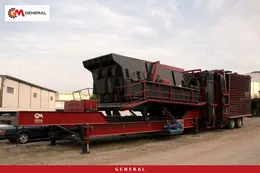
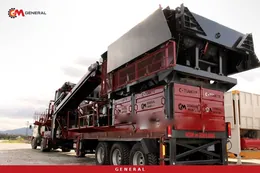
| Mobile | Hopper + vibrating feeder | General 03 (GPS 1415 impactor) | 250-375 | 900 | — | Soft, temporary face |
Layout B reaches the 450 TPH target on a single line and belongs to our fixed crushing plantsinstalled on a concrete foundation. In the mobile option, General 03 delivers 250-375 t/h on one chassis with a 2400 × 5000 mm four-deck screen and a 750 kVA power unit. This route is worth considering if the face moves often or if fixed investment is postponed in the first years of the mine, but because the primary is an impactor, the chert share still decides.
Screening stage and product split
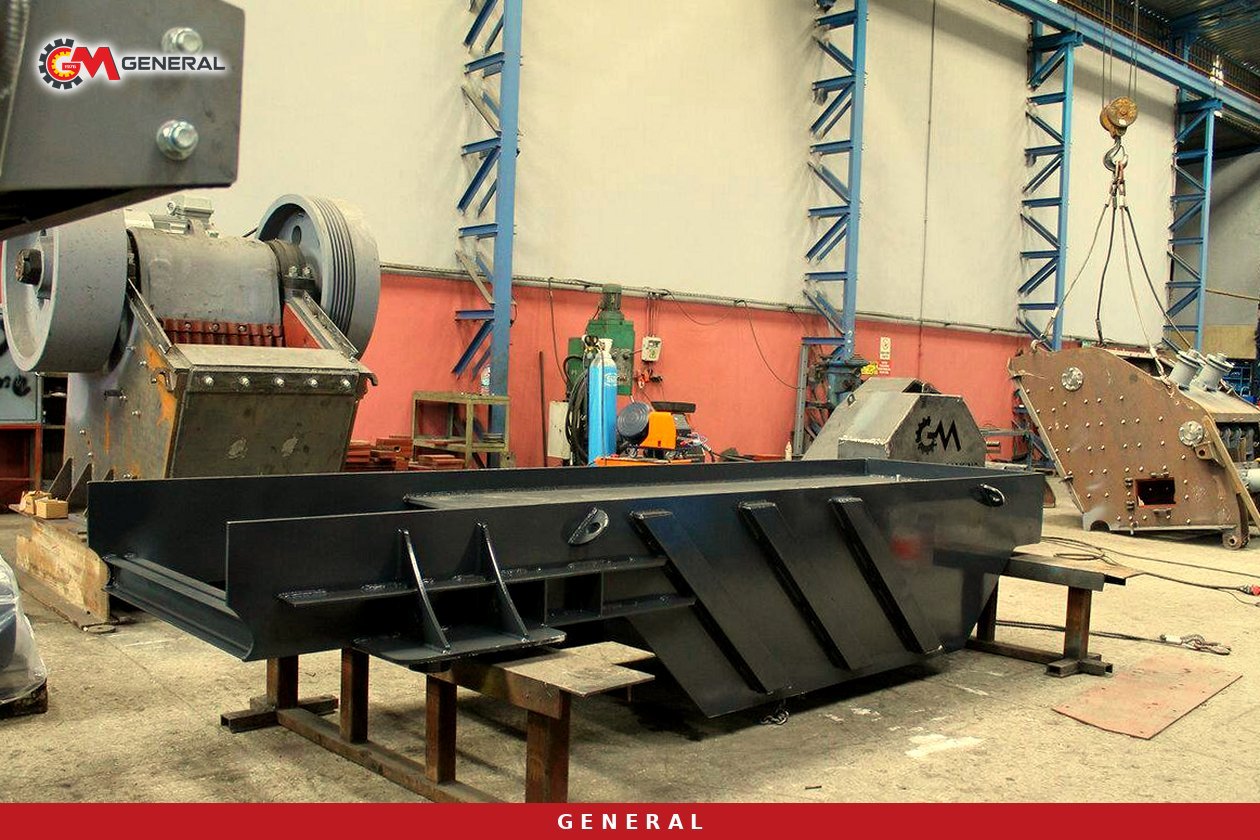
In a phosphate line the screen usually separates the size that goes on to the next beneficiation step. That size is set by the operator's process flow sheet. To split 350-450 t/h without overloading a single deck, the circular-motion GNR 2460 (2400 × 6000 mm, 22 kW) or a twin screen for high-tonnage fixed plants can be used. Compare deck count and screen size in the tables on our vibrating screens page. Belts under an impact crusher should use EP 125, four-ply belting.
Operating on the desert plateau: dust, heat and power
The Eshidiya and Ma'an area is hot, dry and windy. Phosphate dust is fine and light; it spreads quickly at the crusher discharge, over the screen and at transfer points. Measures that can be selected per project include water-spray dust suppression at transfer points, covered conveyors, heavy-duty filters on engine and generator air intakes, and climate control in electrical panels. These items are not part of the standard scope and should be written into the specification one by one.
On a site far from the grid, power comes from generators. On General 03 the 750 kVA power unit is standard equipment. On a fixed line, installed power is calculated at the design stage from the sum of feeder, primary, screen and conveyor motors. A PLC-based automation system handles sequential start-up and overload stops. Letting the operator monitor a dusty line from the cabin or remotely also makes life easier for the maintenance team.
Shipping via Aqaba and the quotation file
Equipment arriving in Jordan by sea is usually unloaded at the port of Aqaba and trucked to sites in the south or centre of the country. The dimensions of fixed plant modules are planned around this road haul; heavy parts may need separate transport permits. The duration and terms of these permits should be obtained from the local authority.
Sending the following information together with your enquiry lets us define the right layout in the first round:
- Hourly target tonnage and daily operating hours
- Largest block size and thickness of the limestone caps
- Sample analysis from several faces: moisture, clay, free silica, Bond Ai
- Required product sizes and the fraction sent to beneficiation
- Whether grid power is available on site
- Operating rules on dust and the environment
- Installation type: fixed line on a foundation or a mobile unit following the face
All feeder and hopper options are listed in our crusher feeders group.
Frequently asked questions
Phosphate is soft, so why do you recommend a jaw primary?
The phosphate grain is soft. The chert arriving in the same feed is rich in silica and wears out impactor blow bars in a short time. If the chert share is low, GNR PDK01 can be chosen; the sample results make that call.
Is one line enough for 450 TPH?
Yes. A GNR 140 feeder paired with a GNRK 130 jaw crusher falls in the 400-500 t/h range on the primary side. Screen area must be sized accordingly; if one screen is not enough, a twin screen is considered.
What warranty and certificates apply?
Our machines carry ISO 9001 and CE certification. A 1-year warranty is given, excluding wear parts. We have been manufacturing in Izmir since 1976, and the Middle East is one of our export regions.
What determines price and delivery time?
Price depends on the layout, fixed or mobile installation, number of screen decks, dust measures, power source and shipping scope. A quotation built on this information is project-specific; there is no price list on the website.
Final word
A 250-450 TPH line on a Jordanian phosphate site runs without trouble once the chert share and fines are read correctly: a suitable feeder and grizzly at the inlet, a primary that matches the ore, and enough screen area at the end. Send your sample results and target tonnage through our contact page and our engineers will prepare a layout and quotation for you.
Definitions of technical terms: Glossary