EN — English
 TR — Türkçe
 DE — Deutsch
 RU — Русский
 FR — Français
 ES — Español
 AR — العربية
 SR — Српски

Which Rock Types Do Mobile Jaw Crushers Handle Most Efficiently?
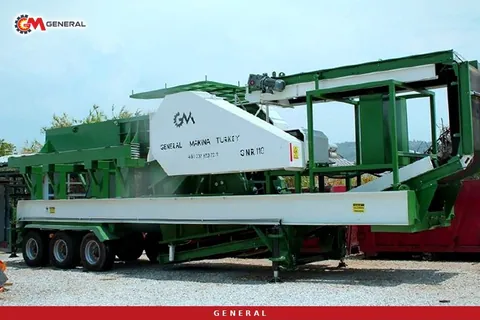
How well a jaw crusher performs on site depends less on the capacity range in the brochure than on how the rock entering its mouth actually breaks. The same mobile jaw unit that splits angular granite blocks cleanly on every stroke can struggle to clear its cavity when the quarry face delivers clay-bound material, and it turns laminated rock into flat slabs. This article walks through the rock types one by one: how the jaw behaves in each, what drags efficiency down and which feed arrangement prevents the loss, using the values in the product tables of General Makina's mobile jaw units.
How is jaw crusher efficiency measured?
A jaw crusher breaks rock by compression. A piece caught between the fixed jaw and the moving jaw, driven by the eccentric shaft, drops a little lower on every stroke until it leaves through the closed side setting (CSS). Three things decide efficiency in this mechanism: whether the rock grips between the jaws without slipping, whether broken material flows down without packing the cavity, and how much metal the liners lose per tonne crushed.
That is why the question of an "efficient rock" differs from the question of hourly tonnage. Four indicators matter on site: the real t/h achieved at the chosen CSS, the share of oversize slipping past the setting, whether the feeder is waiting on the crusher, and the total tonnage crushed before the jaw plates are changed. Rock type pushes each of these in a different direction; one can improve while another gets worse.
The product pages give a typical reduction ratio of 4:1 to 9:1 for the GNR series. The rock decides which end of that range you can work at. In brittle, uniform rock the ratio can be pushed up; with material that slides or behaves plastically, capacity drops quickly as the setting is closed and the jaw needs longer to crush the same tonnage.
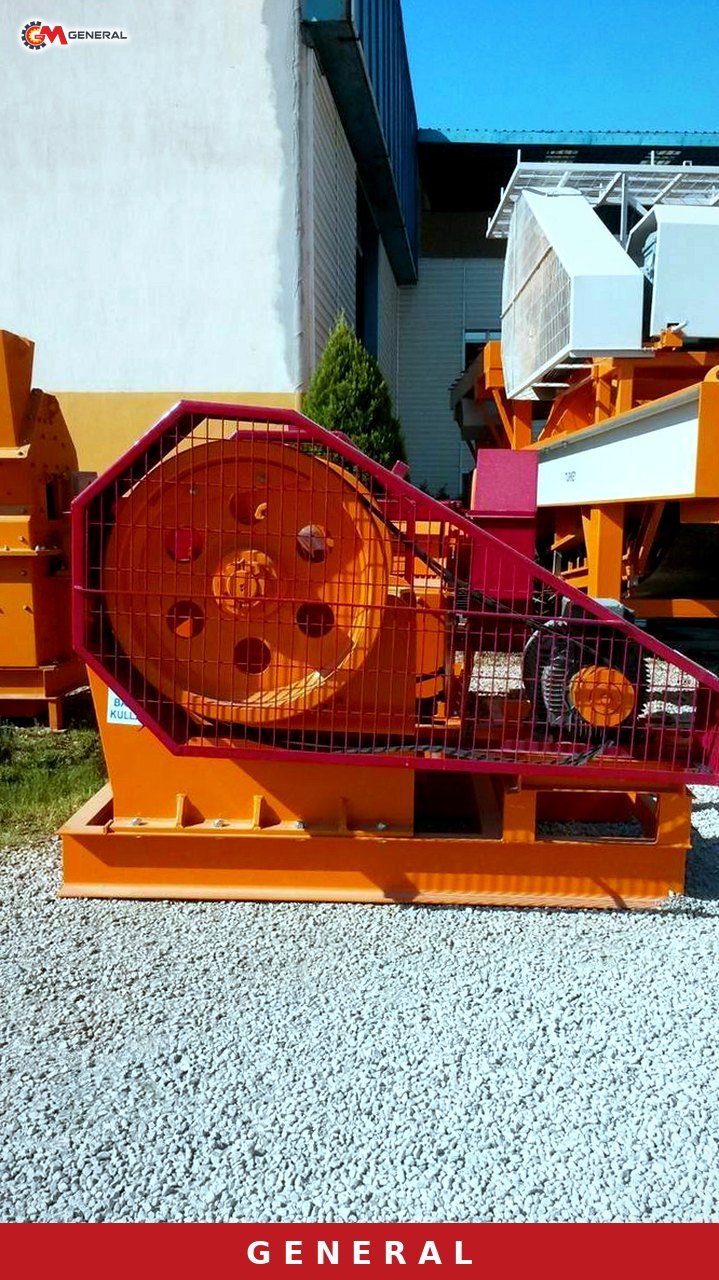
Hard and abrasive rock: granite, basalt, quartzite
This is where a jaw crusher is most at home. Hard, brittle rock fractures along its natural cracks under compression, the piece grips between the jaws without slipping and travels through the cavity in an orderly way. Fracture surfaces are clean, so dust and fines stay low and nothing sticks inside the cavity.
On wear the advantage is also with the jaw. In compression crushing the rock does not rub across the liner at high speed; the austenitic manganese (Mn13/Mn18) jaw plates of the GNR series work-harden at the surface under pressure and impact. In a primary impactor, the same quartz-rich rock strikes the blow bars at speed and wears them out quickly. That is why mobile lines in granite and basalt quarries almost always start with a jaw primary. For monitoring plate wear and planning changes, see our article on crusher maintenance and wear control.
In this group the main efficiency killer is oversize blocks from the face that do not fit the feed opening. A single block bridging the mouth stops the feeder and pulls hourly output down, so blast design and pre-sorting with the excavator should be planned around the crusher size. In hard rock the jaw product can be somewhat flaky; if the target is concrete or asphalt aggregate, cubical shape is given in the secondary stage.
Limestone and dolomite: the jaw crushes them, but may not be enough alone
Limestone and dolomite break easily in a jaw; the question here is economics rather than crushability. Because these rocks are low in abrasion, an impact crusher can deliver high reduction and cubical product in a single stage. With a jaw primary, the output usually has to pass through a second crusher.
The cases where a jaw is the right call in a limestone quarry are clear: large blocks from the face, siliceous nodules or hard interbeds in the deposit, or a unit that will later move to a harder site. Under those conditions the jaw is a safe primary. In a fully soft, uniform limestone, investing only in a jaw makes a second stage unavoidable, and that adds to the total cost of the line.
With dolomite, watch the fines. Brittle dolomite can generate a lot of dust under compression. If natural fines are removed by a grizzly feeder before the crusher, the jaw does not re-crush them and spends its capacity on the coarse fraction.
Materials that challenge the jaw, and the fixes
Laminated and slabby rock
Schist, slate and thinly bedded limestone split along their bedding planes. The jaw breaks them into thick slabs; a slab wider than the CSS when viewed from above can still slip through on edge. The result is more oversize and flaky pieces in the product. The jaw can serve as the primary in this material, but an impact or cubitzer secondary must be planned to meet particle-shape specifications. Trying to fix flakiness by closing the jaw setting cuts capacity and overloads the plates for no gain.
Rounded river gravel
River gravel is hard but smooth and rounded. Rounded stones struggle to grip between the jaws, can ride upward during the stroke, and some strokes are wasted. For primary crushing of large cobbles and boulders the jaw is the right choice, but sending already small, rounded gravel through it is pointless. The grizzly feeder should bypass small gravel past the primary so that only large stones enter the jaw.
Clay-bound, wet and sticky feed
No material lowers jaw efficiency faster. Clay does not break like rock under compression; it deforms plastically and sticks to the narrow lower section of the cavity. As moisture rises, the discharge opening effectively shrinks, crushed rock cannot flow down and the crusher chokes on its own product. A grizzly feeder also blinds in this material and cannot remove fines and clay.
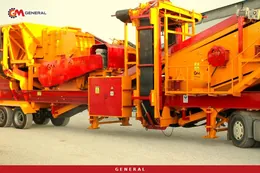
The answer to this problem is pre-separation with a wobbler feeder ahead of the crusher. In the mobile jaw unit with wobbler feeder stones tumble as they travel over the rotating shafts and clay and fines are released from their surfaces, so cleaner rock enters the jaw. The product page lists 250-450 t/h for this unit. If clay only coats the stone surface, consider this arrangement before moving to washing; if clay is mixed through the material and the specification demands clean aggregate, washing is required.
Concrete and asphalt rubble
Recycling feed is not uniform; it may contain rebar, timber and other foreign objects. The compression principle gives a safe pre-crush in this mixed feed. The GM 90JP product page lists concrete and asphalt recycling among the jobs this tracked unit suits. Picking out foreign material before feeding protects both the jaw and the belts.
Decision matrix by rock type
The table below brings together, for the rock types met most often on site, how the jaw behaves, the main factor that lowers efficiency and the recommended feed and stage layout. If the face contains more than one rock type, design for the most difficult one.
| Rock type | Jaw behaviour | Efficiency killer | Recommended layout |
|---|---|---|---|
| Granite, basalt, quartzite | Clean fracture, low metal loss | Oversize block that does not fit | Jaw primary + shaping secondary |
| Limestone, dolomite | Crushes easily, may create fines | Need for a second stage, dust | Jaw if large blocks or hard interbeds; grizzly pre-screening |
| Schist, laminated rock | Produces flat slabs | Flaky oversize slipping past | Jaw primary + impact or cubitzer secondary |
| Rounded river gravel | Struggles to grip the stone | Slippage, wasted strokes | Grizzly bypass; jaw only for large stones |
| Clay-bound, wet material | Cavity packs and sticks | Feeder blinding | Wobbler pre-separation; washing if needed |
| Concrete and asphalt rubble | Safe pre-crushing | Foreign objects | Pre-sorting + tracked jaw |
Model selection: knowing the rock lets you read the capacity table
Capacities in the product tables are given as ranges; rock type, feed size and CSS largely decide where you land between the lower and upper end. Do not expect to approach the top in clay-bound or slabby rock; in clean, hard rock the upper part of the range is a realistic target. The values below come from the respective product pages.
| Model | Chassis | Capacity (t/h) | Feed arrangement | Weight (kg) |
|---|---|---|---|---|
| GNR 60 (GNRK 60 jaw) | Wheeled, single chassis | 20-80 | 700×3000 mm feeder | 15,000 |
| GNR 90 (GNRK 90 jaw) | Wheeled, single chassis | 70-180 | 1000×3800 mm feeder | 25,000 |
| GNR 110 (GNRK 110 jaw) | Wheeled, single chassis | 180-300 | 1100×4750 mm feeder | 55,000 |
| GM 90JP (GNR 90 jaw, 95 kW) | Tracked | 70-180 | 10 m³ hopper, 820×3000 mm grizzly feeder | 35,000 |
| Jaw unit with wobbler feeder | Single chassis | 250-450 | Wobbler with pre-screening | — |
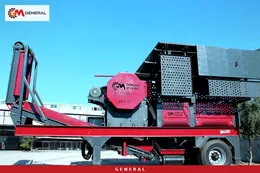
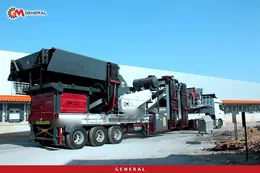
If the unit will work in one hard-rock quarry for a long period, the wheeled GNR series mobile primary jaw crusher is a sensible starting point; with its armoured feeder and hydraulic legs it is commissioned without foundations. All unit options are listed under portable rock crushers. If the face advances often, the ground is poor or the job is a recycling yard, the GM 90JP among the track-mounted mobile crushers stands out: it accepts feed up to 700 mm, runs on a 250 kVA power unit and its grizzly feeder removes fines before the crusher.
Rock and site checklist before requesting a quote
- Representative rock samples from different points of the face, including the most difficult zone.
- Largest block size coming from the face and the extraction method (blasting, breaker, excavator).
- Clay and moisture conditions, and the difference between wet and dry seasons.
- Whether the rock is laminated and tends to break into slabs.
- Required product fractions and particle-shape specification.
- Target hourly tonnage and daily operating hours.
- Power source: grid connection or generator.
- How often the unit will relocate on site; whether wheels or tracks are needed.
Frequently asked questions
Can a jaw crusher break any rock?
In terms of hardness it breaks almost every rock, including granite, basalt and quartzite. Efficiency problems come from how the material behaves, not from hardness: with clay-bound, wet, laminated or rounded feed, capacity and product quality drop. In these cases the choice of feeder and secondary stage matters as much as the crusher itself.
Is a washing plant mandatory in a clay-rich quarry?
If clay only coats the stone surface, pre-separation with a wobbler feeder is often enough to relieve the jaw. If clay is spread through the material and the specification calls for clean aggregate, washing is needed. Base the decision on a sample taken in the wet season.
Jaw or impact crusher for a limestone quarry?
In uniform, soft limestone an impact crusher can produce more cubical product in a single stage. If large blocks come from the face, the deposit has siliceous or hard interbeds, or the unit will later move to harder rock, a jaw primary is the safer investment.
What determines the price of a mobile jaw crusher?
Model and capacity class, wheeled or tracked chassis, feeder type (grizzly or wobbler), power unit and the secondary stage the line needs. A project-specific quotation is prepared from the rock sample and the target product data.
Conclusion: know your rock first, then choose the model
A mobile jaw crusher is the most efficient primary for hard, brittle and abrasive rock; in limestone and dolomite it is a safe choice that usually needs a second stage. With clay-bound, laminated and rounded feed, the efficiency loss is solved by the feed arrangement rather than the crusher: grizzly bypass, wobbler pre-separation and the right secondary stage. Share your rock sample, largest block size and target products through our contact page and we will define the jaw unit and stage layout that fit your quarry.
Definitions of technical terms: Glossary