EN — English
 TR — Türkçe
 DE — Deutsch
 RU — Русский
 FR — Français
 ES — Español
 AR — العربية
 SR — Српски

Road Transport Dimensions of a 120-180 TPH Mobile Crushing & Screening Plant
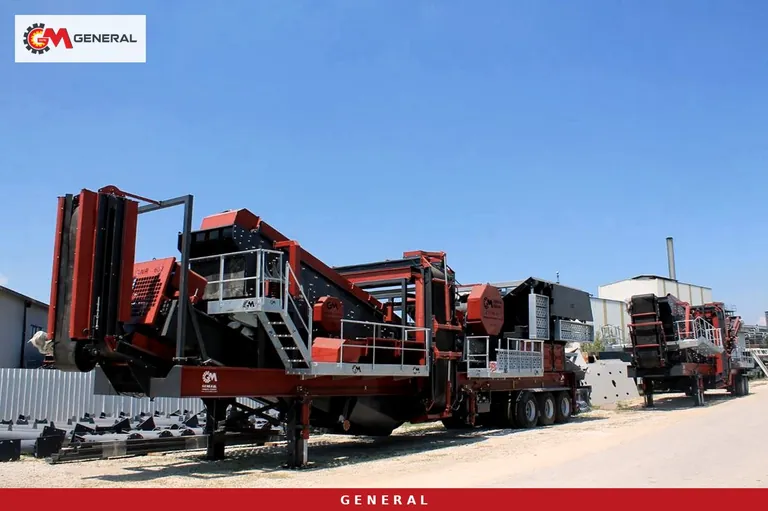
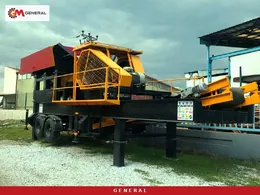
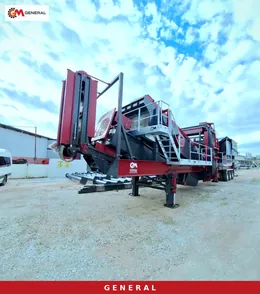
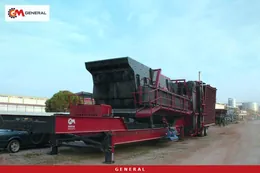
Getting a mobile crushing and screening plant from the factory gate to the quarry is the part of a purchase that buyers discuss least and that upsets budgets most often. Wheeled plants in the 120-180 TPH class measure 18.5-20.4 metres long, 4.1-4.3 metres wide and weigh 55-70 tonnes in travel position. On public roads they are not standard freight: they move as abnormal (oversize) loads, under permit and, on most routes, with an escort. This article puts the loading dimensions and weights published on our product pages into one table and explains, from the dispatch yard, how those figures shape the route survey, the choice of tractor unit and the port shipment.
Note: width, height and axle-load limits differ between countries and, within one country, between road classes. What follows is a general framework. Confirm exact limits and permit conditions with the road authority of every country on the route.
Loading dimensions and gross weight: reading three numbers correctly
The value shown on product pages as "loading dimensions" or "dimensions" is the outer envelope of the plant in travel position, written as width × length × height. Travel position means conveyors folded, support legs retracted and the plant ready to couple to the tractor. Once the belts are unfolded on site the plant covers a much larger footprint, but the haulage plan is built on the travel dimensions only.
The same distinction applies to weight. The figure on the page is the mass of the plant itself. What crosses the weighbridge is that mass plus the tractor unit, and the authority looks at how this total is spread over the axles. At quotation stage, ask in writing for the number of axles on the chassis and the load on the fifth wheel (king-pin), not just the total weight.
Height tends to get the least attention, yet it is the number compared with the lowest bridge, overpass or power line on the route. For all our wheeled models in the 120-180 TPH class the travel height is given as 4500 mm. Because the plant rolls on its own axles, no trailer deck height is added to that figure. Tracked machines are a different case and are covered separately below.
Transport profile of the models in the 120-180 TPH class
The table below gathers the transport values published on the product pages of the wheeled and tracked models in this capacity class. Values not given on the pages are shown as "—". We do not fill these cells with estimates; they are fixed in the order-specific technical file.
| Model | Capacity (t/h) | Running gear | Loading dimensions W × L × H (mm) | Weight (kg) | Max. feed (mm) |
|---|---|---|---|---|---|
| General 01 | 120-180 | Wheeled, single chassis | 4300 × 18500 × 4500 | 55,000 | 700 |
| General 944 | 120-180 | Wheeled, single chassis | 4130 × 20350 × 4500 | 70,000 | 800 |
| General 950 | 120-180 | Wheeled, single chassis | 4130 × 20350 × 4500 | 70,000 | 800 |
| GM 90JP | 70-180 | Strickland tracks | — | 35,000 | 700 |
| GM 100 | 100-180 | Strickland tracks | — | 42,000 | 600 |
General 01: the shortest and lightest wheeled chassis in the class
General 01 uses a GPS 1210 impact crusher that handles primary and secondary reduction in one housing, so it carries no second crusher. The transport consequence is plain: at 18,500 mm long and 55,000 kg it is the shortest and lightest wheeled plant in the class. Its width, 4300 mm, is 170 mm more than the 944 and 950, and that is the first figure to check at narrow bridges and toll lanes. For a road contractor who moves often and feeds limestone or mixed material, General 01 puts the lightest demand on the haulage side.
General 944 and 950: over 20 metres long, 70 tonnes
Hard, abrasive rock such as basalt and granite needs a second crusher behind the jaw. Behind the GPJ 90 jaw, the General 944 carries a GM430 cone and the 950 a DMK01 impact crusher. The price of two crushers on one chassis is 20,350 mm of length and 70,000 kg. Both models have identical dimensions and weight, so the choice of secondary crusher does not change the haulage plan. The 950 product page states that it travels on a single truck and starts producing within 30 minutes on site. That time covers commissioning on site; route permits and the journey itself are separate.
A vehicle longer than 20 metres sweeps a wide path through roundabouts and on winding mountain roads. The route survey has to check how far the rear axle group cuts towards the inside of each bend, and the height of kerbs and central islands. One sharp turn on a quarry access road can demand more preparation than hundreds of kilometres of motorway.
Tracked GM 90JP and GM 100: machines that ride a low-bed trailer
Tracked machines have no road axles of their own. They travel on a low-bed trailer and walk down a ramp on their own tracks at the site. The GM 90JP product page describes exactly this: unloaded from the truck and driven into position, with no hydraulic legs or concrete foundation needed. At 35,000 kg it is the lightest machine in the table, but it does primary crushing only; if a second stage is required, a separate secondary unit and its own transport enter the plan. The GM 100 weighs 42,000 kg and carries an integrated 3-deck screen.
For these two machines, overall height is machine height plus the trailer deck. Travel dimensions are not published on the product pages, so ask for a dimensioned transport drawing before the route survey. For the general tracked-versus-wheeled decision see our article tracked mobile crusher or towable semi-mobile crusherand for the full range see track-mounted mobile crushers.
Route survey: width, height and turning space
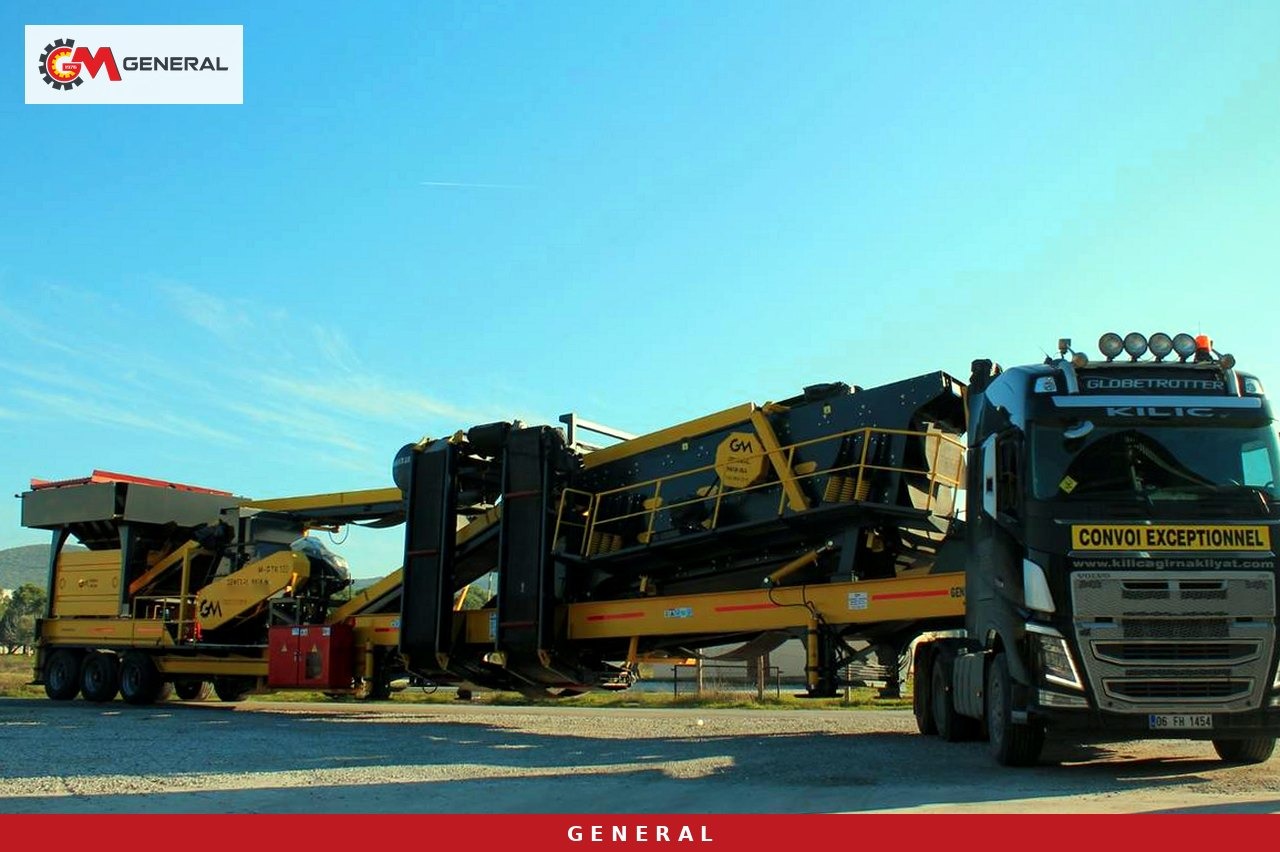
A load 4.1-4.3 metres wide exceeds standard vehicle width in most countries and needs an abnormal load permit. Applications usually ask for a dimensioned drawing of the plant, the total weight, the axle loads and the proposed route. On a multi-country journey each country issues its own permit. For road shipments through the Balkans, or port shipments to North Africa, the permit schedule can take longer than the drive.
The haulier should check these points at the desk before anyone goes out on the road:
- The lowest bridge, overpass and tunnel clearance on the route, compared with the plant's 4500 mm travel height.
- Points where power and telecom lines sag over the carriageway.
- Bridge load classes and the permitted load per axle.
- Lane widths at toll plazas, border crossings and weighbridges.
- The swept path of an 18-20 metre vehicle at junctions and bends, with temporary traffic control where needed.
- Country-specific time limits such as escort vehicles, night-only movement or weekend bans.
The last stretch into a quarry or site is often harder than the paved route. Soft fill, steep ramps and narrow culvert crossings strain the tractor more than the plant. Having the site owner grade the access road, and compact it where necessary, removes surprises on delivery day. In the wet season the bearing capacity of earth roads drops, and choosing the dispatch date with that in mind is part of the plan.
Axle load, tractor unit and weight distribution
Road authorities look at load per axle more than total weight, because that is what stresses pavements and bridges. The weight of a 55-70 tonne plant rests on two points: the tractor's fifth wheel at the front and the plant's own axle group at the rear. Wherever the crusher, hopper and screen sit on the chassis, the centre of gravity follows. Two plants with the same total weight can therefore show different axle loads.
The arithmetic is simple. The load on the rear axle group is the plant weight minus the share transferred to the tractor; divide that by the number of axles to get load per axle. A hypothetical example: if X kg of a 70,000 kg plant is transferred to the tractor, (70,000 − X) kg remains on the rear group and is shared across its axles. The real value of X comes from the plant's weight distribution sheet; request that sheet with the quotation.
Axle count is not published for every model. For the larger siblings it is stated: General 02 sits on a 2-axle chassis and General 03 on a 4-axle chassis built to international transport standard. The axle layout of the models in the 120-180 TPH class is fixed with the order. Heavy-duty 6x4 tractor units with a high fifth-wheel rating are the usual choice; tractor selection and permit compliance are the haulage company's responsibility.
Export through a port and arrival on site
For plants going to North Africa and the Middle East, part of the journey is by sea. Wheeled plants can be towed onto a ro-ro vessel on their own axles; no crane is needed and the plant leaves the ship the way it arrived. Tracked machines and separately packed parts go on flat rack containers or as breakbulk cargo. Which method suits depends on the equipment at the destination port and on the line's sailings; settle this with the forwarder before booking.
Before loading, the plant is cleaned, loose parts are secured and the locking pins of folded conveyors are checked. Hydraulic cylinder rods and exposed mating surfaces that will face salt air at sea are coated with protective compound. For customs at the destination port, keep the packing list, certificate of origin and a technical file matching the plant serial number ready. General Makina's ISO 9001 and CE certificates belong in that file.
Unloading and set-up on site
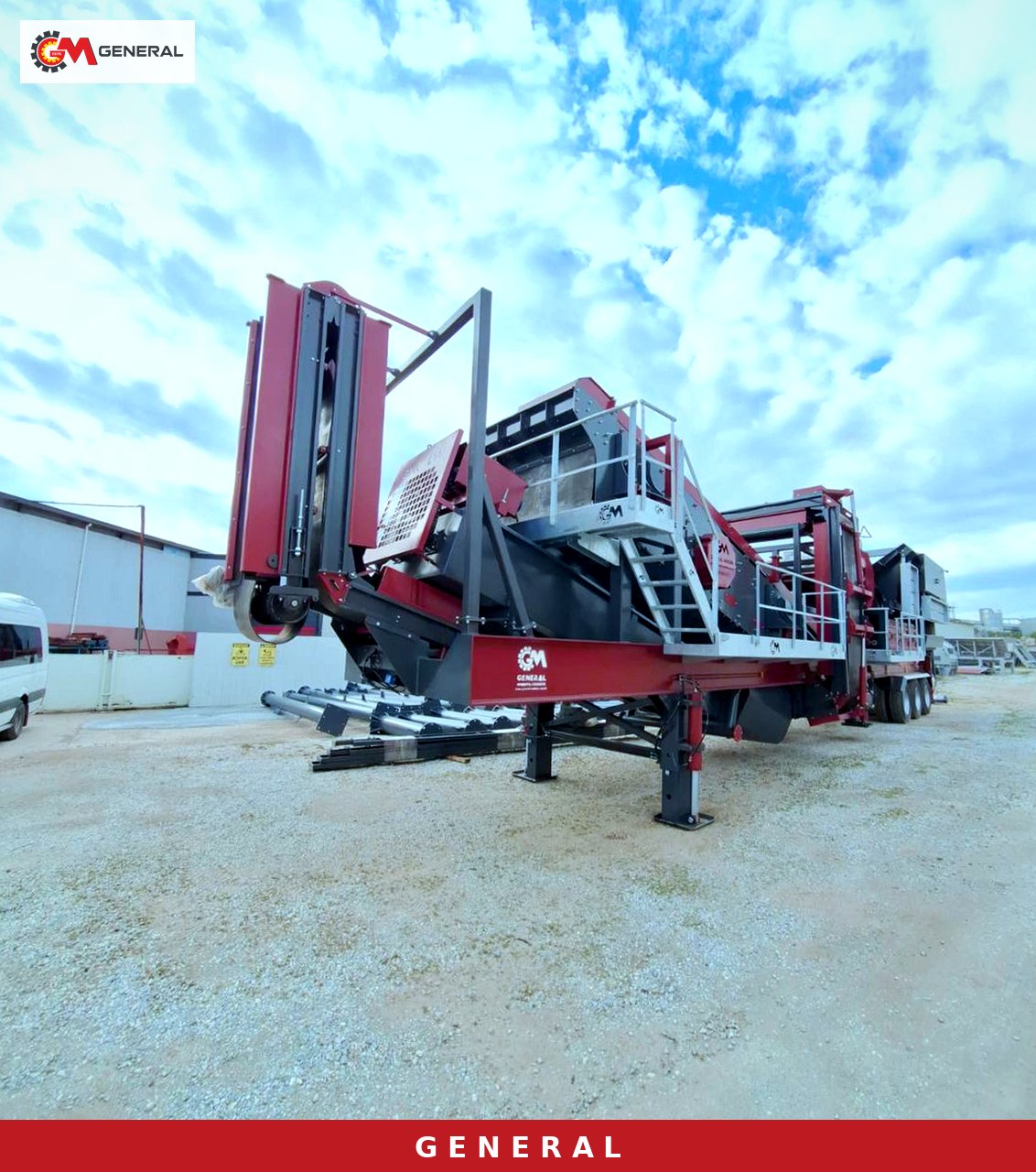
Once the wheeled plant is uncoupled, the hydraulic support legs are lowered, the conveyors unfolded and the chassis levelled. No concrete foundation is needed, but the bearing capacity of the ground under the legs matters; on soft ground, steel plates or compacted fill go under each leg. A tracked machine walks off the low-bed trailer and drives to its working point. Before the first start, check bolts that may have loosened on the road, belt tension and screen springs.
What the buyer should prepare before dispatch
The manufacturer and the haulier carry most of the transport work, yet some information sits only with the buyer. Settling the following in writing at quotation stage removes most of the problems that otherwise get chased by phone while the plant is on the road:
- Site address, photos of the final access stretch, gradient and ground information.
- Destination port, customs broker and the list of documents required for import.
- Delivery terms (ex works, port delivery or site delivery) and the point at which insurance changes hands.
- A separate packing list for spare wear parts and accessories shipped with the plant.
- Loader, crane or operator available on site for unloading and set-up.
- If the generator travels separately, its own dimensions and weight, added to the plan as a separate transport item.
If you have not settled on a model yet, use transport dimensions as a selection criterion. On a remote site with narrow roads, the difference between 18.5 and 20.4 metres can become the second deciding factor after rock type. All wheeled models in the class are listed side by side on the wheeled mobile crushing plants page.
Frequently asked questions
Can a wheeled mobile plant travel without a permit like a standard truck?
At 4.1-4.3 metres wide and 55-70 tonnes, our wheeled models in the 120-180 TPH class count as abnormal loads in most countries. Permit and escort requirements are set by the road authority of each country on the route.
Why does a tracked machine need a separate trailer?
Tracked machines have no road axles. They are loaded onto a low-bed trailer and walk down a ramp on their own tracks at the site, which is why the trailer deck is added to the height calculation.
Can transport dimensions change after the order?
Product page values refer to the standard configuration. Extra belts, a different screen or optional equipment can change travel dimensions and weight. The binding value is the dimensioned drawing in the order technical file.
What determines the transport cost?
Distance, number of countries crossed, permit and escort conditions, the loading method for the sea leg and the site access road. The figure is quoted once the route is defined.
Conclusion
A mobile plant crushing 120-180 TPH becomes, on the road, an abnormal load 18.5-20.4 metres long, 4.1-4.3 metres wide and 55-70 tonnes heavy. Putting these figures on the table during model selection lets you plan permits, tractors and the port leg early and correctly. Send your site address, destination port and rock type through our contact pageand we will quote the right model with its transport drawing and weight distribution.
Definitions of technical terms: Glossary