EN — English
 TR — Türkçe
 DE — Deutsch
 RU — Русский
 FR — Français
 ES — Español
 AR — العربية
 SR — Српски

Tracked Mobile Crusher or Towable Semi-Mobile Crusher?
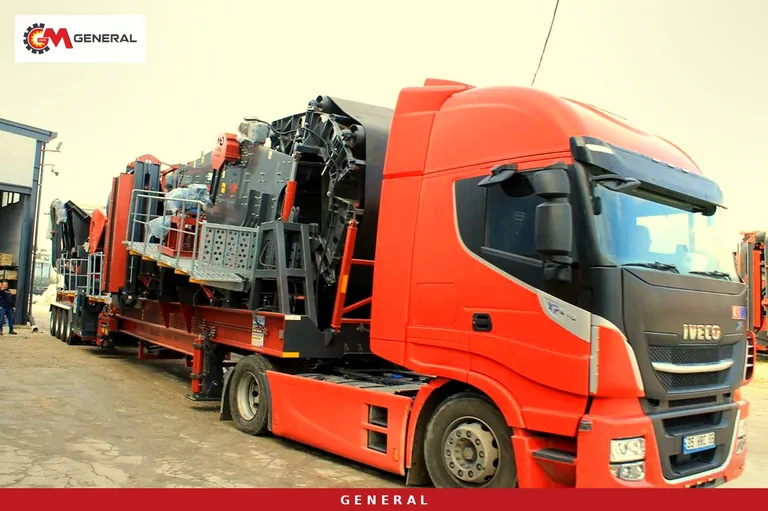
Two quotations are on the table: one for a crusher that walks on its own tracks, the other for a plant that hooks behind a tractor unit, travels by road and sits on hydraulic legs once on site. The crusher type and capacity range may look similar, yet the two machines arrive through different logistics chains, relocate at a different rhythm and build a different crushing circuit. This article does not compare wheels and tracks in the abstract. It compares how each machine will move through your work schedule: mobilisation day, relocation frequency, power and weight, and how complete the crushing circuit is. Every figure below is published on a General Makina product page and is given together with the model it belongs to.
What "semi-mobile" means, and what "tracked" means
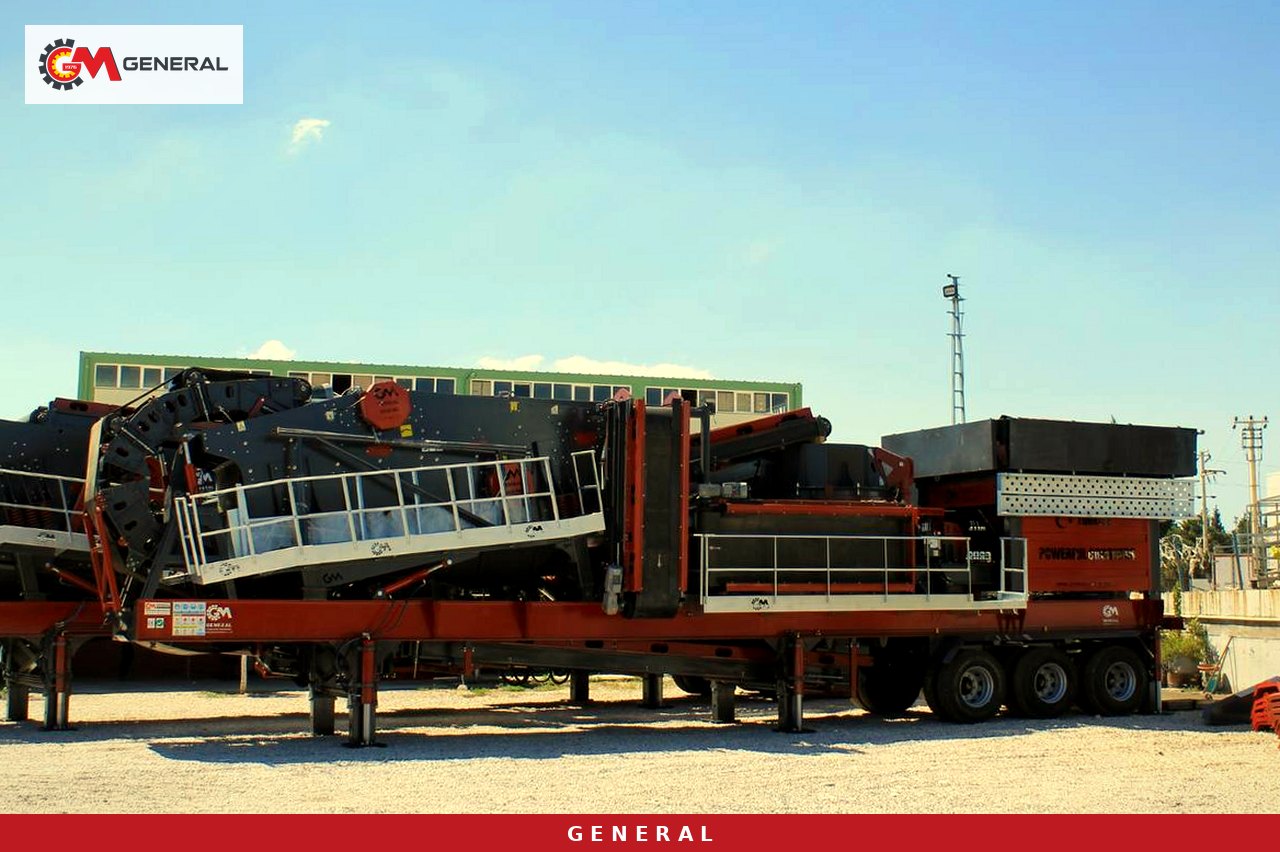
"Semi-mobile" does not describe one single thing on the market. Some sellers use it for skid-mounted modules erected by crane; in this article it means a plant built on an axled chassis and towed on public roads by a tractor unit. The word "semi" says the machine is mobile on the road and stationary on site: once positioned, the hydraulic legs come down, the conveyors unfold and the plant stays there for the production campaign. General Makina's towable mobile crushing plants belong to this group; the hopper, the crusher or crushers, the screen and the stockpile conveyors share one chassis.
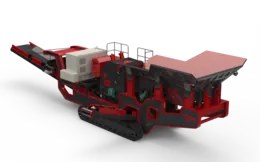
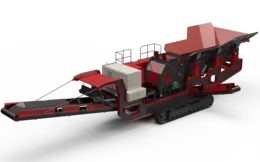
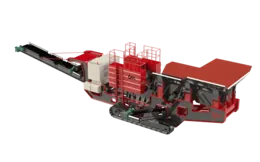
A tracked machine works the other way round. It cannot travel on the road by itself and reaches the site on a low-loader, but once unloaded it moves under its own power on a Strickland crawler undercarriage. The GM 90JP, GM 100 and GM 125 in the track-mounted mobile crushers range are built this way and, according to their product pages, need no ground preparation, hydraulic legs or concrete foundation. In short, the towable plant is the more mobile one on the road, the tracked machine the more mobile one inside the site. The decision depends on which of these two movements you make more often.
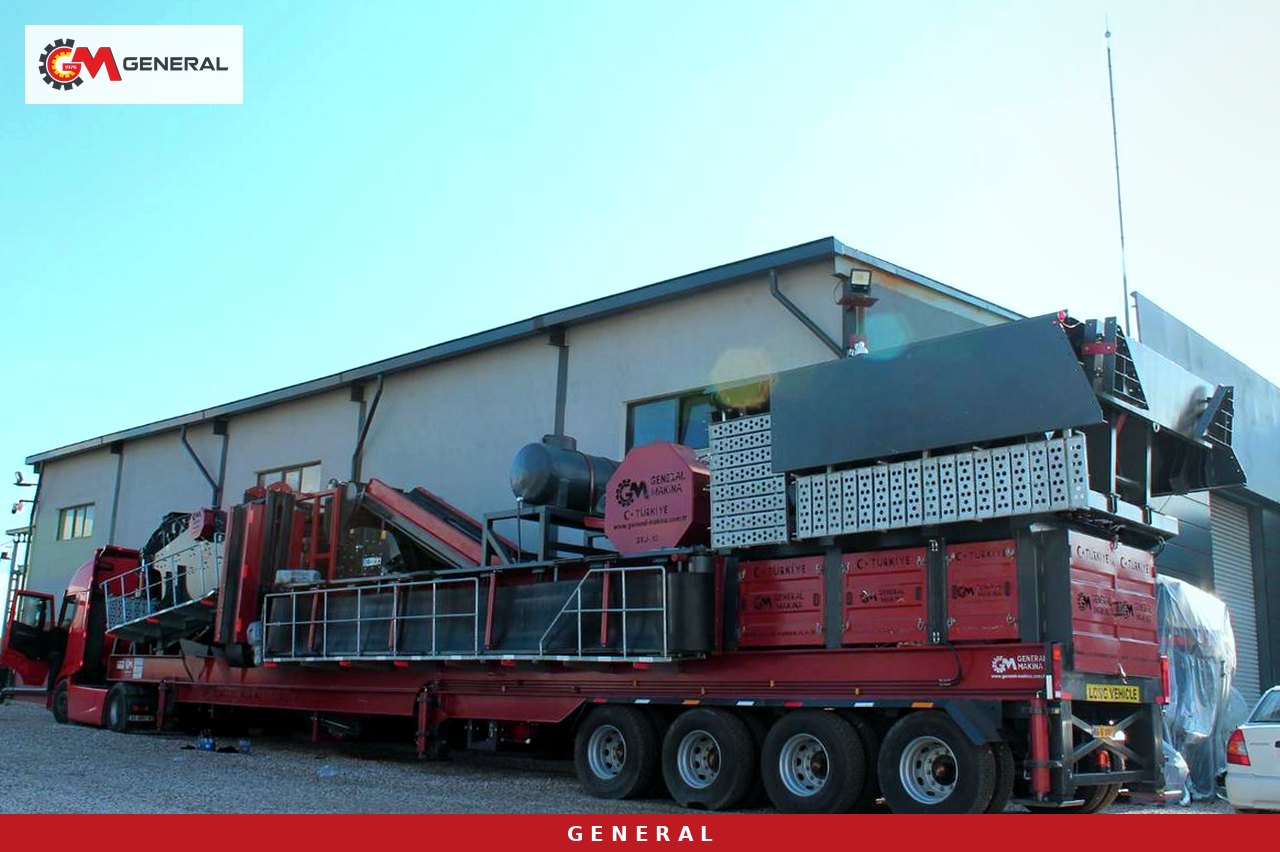
Mobilisation day: how each machine is set to work
"Easy installation" is a phrase heard in every sales meeting. It is more useful to write down the steps that must happen, in order, before the first production hour. The typical sequence for each machine:
Tracked machine
- Pick a flat, firm area for the low-loader ramp.
- The machine drives off the trailer on its tracks and walks to the working point.
- The feed direction is set with the tracks to suit excavator or loader access.
- Conveyors go into working position and the power unit is started.
Towable plant
- Open a lane where the tractor unit can manoeuvre and the long chassis fits.
- Reverse the chassis into position and uncouple the tractor.
- Lower the hydraulic legs and level the chassis; ground bearing capacity becomes critical here.
- Unfold the conveyors and set the stockpile positions and the return conveyor.
For the towable plant, ground and manoeuvring space matter more; for the tracked machine, the low-loader has to be planned separately for every transfer. Rather than guessing which sequence is shorter for you, ask the manufacturer for a step-by-step mobilisation plan for your own site at the quotation stage.
Relocation frequency: the simple calculation that settles it
The on-site difference between the two machines accumulates in the production time lost at every relocation. You can write it for your own operation as:
Annual non-productive time difference = N × (Ttowed − Ttracked)
N is the number of in-site relocations per year, Ttowed the hours the towable plant stands idle per relocation, and Ttracked the hours the tracked machine needs for the same move. Multiply the result by your own hourly tonnage to see the tonnage missed over the year.
Hypothetical example, not a real value: with N = 40, Ttowed = 4 hours and Ttracked = 1 hour, the difference is 40 × (4 − 1) = 120 non-productive hours. If the same operation relocates only 3 times a year, the difference falls to 3 × 3 = 9 hours and the advantage of tracks on this item loses its weight.
The equation also has a road side. If long transfers between job sites are frequent, the towable plant leaves with a single tractor unit, while the tracked machine needs a low-loader and tractor booked together every time. So note two numbers side by side: in-site moves and road transfers between sites. A high first number favours tracks; a high second number favours the towable plant.
Power, weight and dimensions: published data side by side
The table lists the three tracked models and three towable plants. The columns are chosen for the logistics and power decision: power unit, weight and transport dimensions. Values not published on the product page are shown as "—" and have not been filled in by estimate.
| Model | Mobility | Power | Weight | Transport dimensions | Crushing layout | Capacity | Max. feed |
|---|---|---|---|---|---|---|---|
| GM 90JP | Tracks | 250 kVA | 35,000 kg | — | GNR 90 jaw, 95 kW | 70-180 t/h | 700 mm |
| GM 100 | Tracks | 450 kVA | 42,000 kg | — | GNR-01 impact, 160 kW | 100-180 t/h | 600 mm |
| GM 125 | Tracks | 550 kVA | 48,000 kg | — | GNR PDK02 impact, 200 kW | 150-250 t/h | 700 mm |
| General 640 | Towable chassis | 300 kVA (optional) | 38,000 kg | 3500×17000×4500 mm | GPJ 60 jaw + GNR 50 impact | 60-100 t/h | 500 mm |
| General 800 | Towable chassis | 450 kVA | 35,000 kg | 3600×15500×4500 mm | PDK 1280 primary impact | 80-150 t/h | 600 mm |
| General 950 | Towable chassis | 600 kVA | 70,000 kg | 4130×20350×4500 mm | GPJ 90 jaw + DMK01 impact | 120-180 t/h | 800 mm |
Three practical conclusions follow. First, in the same tonnage band a tracked machine can stay lighter: the GM 100 weighs 42,000 kg, whereas the General 950, carrying two crushers on one chassis, weighs 70,000 kg. That gap decides things on sites where bridges, ramps and ground bearing capacity are questioned. Second, the transport dimensions of the towable plants are published and all three are 4500 mm high, which you can use directly for route planning. Transport dimensions of the tracked models are not on their product pages, so request them separately in the quotation. Third, the power unit grows with the crushing layout: the single-stage GM 90JP runs on 250 kVA, while the two-stage General 950 needs 600 kVA. On sites without grid power, size the generator from this value.
Crushing circuit: a single unit or a full line on one chassis?
This is the difference most often overlooked. Most towable plants are designed to produce saleable fractions on a single chassis. The General 950, for example, carries a GPJ 90 primary jaw and a DMK01 secondary impact crusher on the same chassis, delivers 0-5 / 5-12 / 12-19 mm products through a 1600×5000 mm triple-deck screen and returns oversize in closed circuit. The General 640 likewise carries a jaw stage and an impact stage side by side.
On the tracked side the picture depends on the model. The GM 90JP is a primary crusher with a 10 m³ hopper, an 820×3000 mm grizzly feeder, a 1000×2000 mm double-deck screen and a 600×6000 mm bypass conveyor. It removes fines up front, but more than one saleable fraction requires a secondary stage and screening behind it. The GM 100 runs its GNR-01 impact crusher in closed circuit with a 1500×5500 mm triple-deck screen and produces graded material with one machine in limestone, low-abrasive rock and concrete/asphalt recycling. The GM 125, with a 200 kW impact crusher and a 600×5000 mm bypass conveyor, offers the highest tonnage of the family; a screening plan for grading has to be set up separately.
Material shapes this picture too. In hard, abrasive rock (granite, basalt, quartz) a jaw primary makes sense; the impact crusher stands out for cubical product and high reduction in soft, low-abrasive material. If you follow the face in a basalt quarry, a GM 90JP plus a separate secondary line fits; if you process the same rock at one stockpile area, a two-stage towable plant such as the General 950 delivers the same product with fewer machines.
Decision matrix and pre-purchase checklist
| Site condition | Tracked | Towable |
|---|---|---|
| Blast face advances every week | Stands out | Tractor and leg work at every move |
| A few long road transfers per year | Low-loader needed for every transfer | Stands out |
| Sloped, rough ground with no tractor access | Stands out | Ground levelling may be needed |
| Several fractions from one machine | Possible with the GM 100 | Stands out with two-stage plants |
| Weight limits on bridges, ramps, ground | Lighter models available | Weight rises with twin-crusher plants |
Before requesting a quotation, answer these questions in writing:
- How many times a year will you move within the site, and how many times between sites?
- Is the material hard and abrasive or soft and low-abrasive; what is the largest feed size?
- How many fractions will you sell, and are you ready to add a separate screening line for them?
- Is grid power available, or will a generator be sized from the power unit's kVA rating?
- Do bridges, tunnels and height limits on the route match the transport dimensions? Confirm oversize-load rules with the relevant local authority.
- Do you plan to add a secondary or screening unit behind the crusher later?
Our earlier article on tracked or wheeled mobile crushers covers the question through the model families; this one focuses on relocation frequency and mobilisation.
Frequently asked questions
Does a towable plant need a concrete foundation?
No. Towable plants work standing on hydraulic legs. The ground under the legs must still be firm and level; on loose fill it becomes harder to keep the plant level.
Can a tracked machine drive on public roads by itself?
No. Tracks are designed for movement within the site. Transfers between sites need a low-loader and a tractor unit. If you will make long transfers often, include this item in the quotation comparison.
Which is more affordable for the same tonnage?
Price is driven less by the undercarriage than by scope: number of crushers, screen decks, power unit, number of conveyors and options. A single-stage tracked crusher and a complete two-stage line cannot be compared on the same basis. For a fair comparison, request both quotations for the same product fractions and the same tonnage target.
Can a tracked crusher later be combined with a towable line?
Yes. According to the product pages, GM series tracked crushers can be combined with an additional secondary crusher, screen and concrete plant in one project. A common setup is primary crushing at the face with a GM 90JP and secondary crushing and screening at a plant in the stockpile area.
Conclusion
A tracked machine stands out for work that relocates often on difficult ground; a towable plant stands out for work that moves between distant job sites and stays long at each one. Choose by your relocation count, the scope of the crushing circuit and the ground, not by crusher type and capacity alone. General Makina has built crushing and screening plant equipment in İzmir since 1976, holds ISO 9001 and CE certification and gives a 1-year warranty on its machines, excluding wear parts. Share your material, tonnage target and yearly transport plan through our contact page, and we will prepare a comparative quotation for both configurations.
Definitions of technical terms: Glossary