EN — English
 TR — Türkçe
 DE — Deutsch
 RU — Русский
 FR — Français
 ES — Español
 AR — العربية
 SR — Српски

Mobile Crusher Models with the Shortest Site Transport and Setup Time
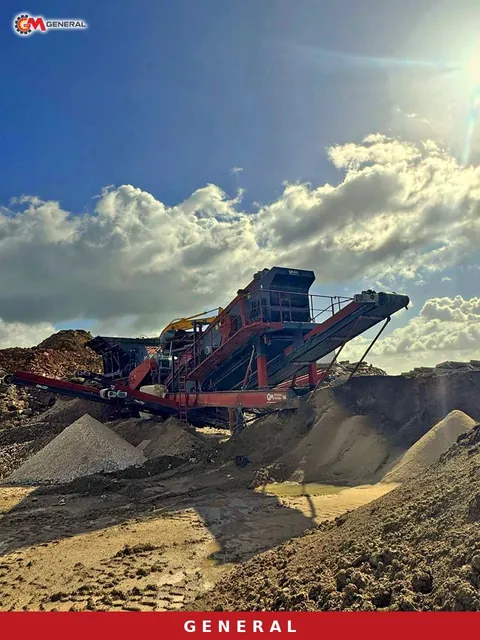
Moving a mobile crusher from one job to the next does not end when the tractor unit leaves the gate; it ends when the first truck on the new site is loaded with saleable product. Brochures give that interval one sentence. At the purchasing table it has to be read through the chassis, weight, transport dimensions, power source and the number of parts that must be unfolded on site. This article lines up General Makina's wheeled and tracked models against exactly those criteria and separates the design details that genuinely shorten setup from those that only look good on paper. Every technical value comes from the product page tables and is stated together with the model it belongs to.
Reading "shortest" correctly: three separate clocks
Taking the word "shortest" in the title as a single stopwatch figure is misleading. Transport and setup time is the sum of three separate clocks, and each is governed by a different design decision.
Road time: set by how many transport units the machine splits into, its transport dimensions and its weight. A plant built on one chassis leaves with one tractor unit; a two-chassis line needs two separate shipments. As width and height grow, route permits and escorts may be required; confirm those rules with the competent authority in your country.
Rig-up time: levelling the chassis, bringing the conveyors into working position, connecting power and setting the feed direction. Folding hydraulic conveyors and hydraulic legs are the real mechanism that shortens this item; conveyors that have to be placed one by one with a crane lengthen it.
Tuning time: the period from start-up until the target fraction is reached. If screen mesh apertures and the output setting were defined for the material at the ordering stage, this is short; if screen media has to be changed on site, the first day is lost.
So claiming a model sets up in the "shortest" time only makes sense if you can show an advantage on all three clocks. That is why the comparison below is built on mechanisms, not on hours.
Five design features that shorten setup
One chassis, one transport unit
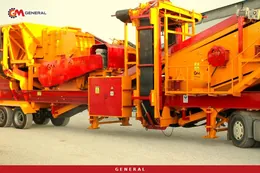
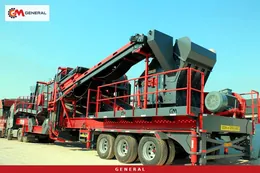
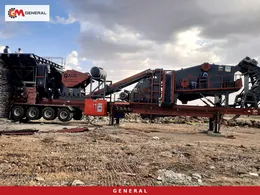
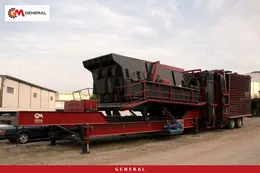
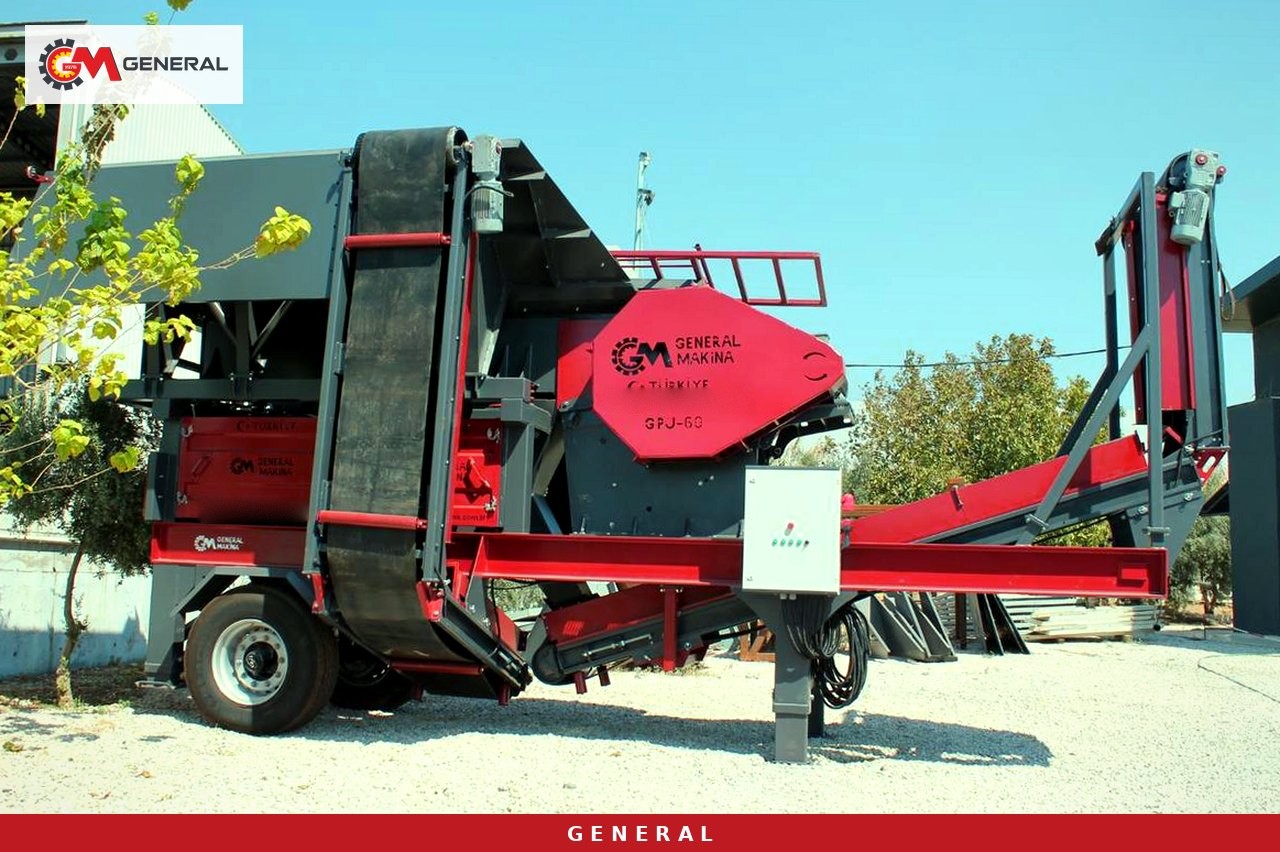
When the feeder hopper, crusher, screen and stockpile conveyors share one chassis, there is no intermediate conveyor to connect on site. The General 640, General 800, General 01 and General 950 follow this architecture. The product page states that the General 640 is compact enough for a single truckload, and that the General 950 is moved by one truck.
Folding hydraulic conveyors and stabiliser legs
On the General 800, folding hydraulic conveyors and hydraulic stabiliser legs sit on a single synchronised chassis. On the General 03 the same solution is described as what allows setup with no excavation or concrete foundation. The General 640 likewise relies on hydraulic legs to be lifted from one job and placed on the next.
A power unit already on the chassis
A generator that arrives with the plant removes the risk of waiting for a separate power project on site. The tables list 450 kVA for the General 800, 600 kVA for the General 950 and 750 kVA for the General 03; on the General 640 the 300 kVA generator is optional. Where it is optional, a mains connection or an external generator has to be added to the setup schedule.
Two stages in one crusher body
The GPS 1210 impact crusher on the General 01 carries out primary and secondary work in one body. One crusher instead of two means one less transfer point to align on site.
Self-propelled on tracks
According to their product pages, the tracked GM 90JP and GM 100 need no ground works, hydraulic legs or concrete foundation. The GM 90JP is unloaded from the low-loader and driven into position; on the GM 100 the integrated three-deck screen and stockpile conveyors mean no extra assembly on site.
Model comparison: transport and setup data
The table below collects the data that directly affects setup time, model by model. Cells with no published value are shown as "—"; ask for those figures in writing at quotation stage.
| Model | Running gear / chassis | Weight | Transport dimensions | Power unit | Capacity | Setup-shortening feature |
|---|---|---|---|---|---|---|
| General 640 | Wheeled, single chassis | 38,000 kg | 3500×17000×4500 mm | 300 kVA (optional) | 60-100 t/h | Single-truckload size, hydraulic legs |
| General 800 | Wheeled, single synchronised chassis | 35,000 kg | 3600×15500×4500 mm | 450 kVA | 80-150 t/h | Folding hydraulic conveyors, stabiliser legs |
| General 01 | Wheeled, single chassis | 55,000 kg | 4300×18500×4500 mm | 550 kVA | 120-180 t/h | Primary and secondary in one crusher |
| General 950 | Wheeled, single chassis | 70,000 kg | 4130×20350×4500 mm | 600 kVA | 120-180 t/h | Moved by one truck; product page states "working within 30 minutes" |
| General 03 | Wheeled, 4-axle chassis | — | — | 750 kVA | 250-375 t/h | Folding hydraulic conveyors and legs, no foundation |
| GNR-MC110 | Wheeled, twin chassis | 55,000 + 55,000 kg | 3000×13500 mm / 4200×18300 mm | 750 kVA | 200-300 t/h | Primary chassis can run independently |
| GM 90JP | Tracked, self-propelled | 35,000 kg | — | 250 kVA | 70-180 t/h | No ground works or foundation |
| GM 100 | Tracked, self-propelled | 42,000 kg | — | 450 kVA | 100-180 t/h | Integrated three-deck screen, no extra assembly |
The first conclusion from the table: the lightest and shortest bodies are also the lowest-tonnage models. At 35,000 kg and 15500 mm long, the General 800 has the most compact transport envelope in the wheeled group. As tonnage rises, the chassis either gets longer and heavier (General 950), gains axles (General 03), or splits into two chassis (GNR-MC110). There is a trade-off between setup speed and capacity, and you have to make it according to your rock.
Shortlist by scenario
Frequent moves, medium tonnage
For a crew rotating between road maintenance, utility lines or short crushing jobs, ease of transport comes first. On low-abrasive stone such as limestone, the General 800 is the most compact member of the mobile crushing and screening plant range: its PDK 1280 primary impact crusher takes 600 mm feed and produces 80-150 t/h. On hard, abrasive rock the General 640 carrying a jaw and an impact crusher together, is the better fit as the entry-level model with 500 mm feed and 60-100 t/h. Note that the generator on the 640 is optional: if the power source is undecided, electricity, not the machine, will set the setup time.
Fast commissioning on hard rock
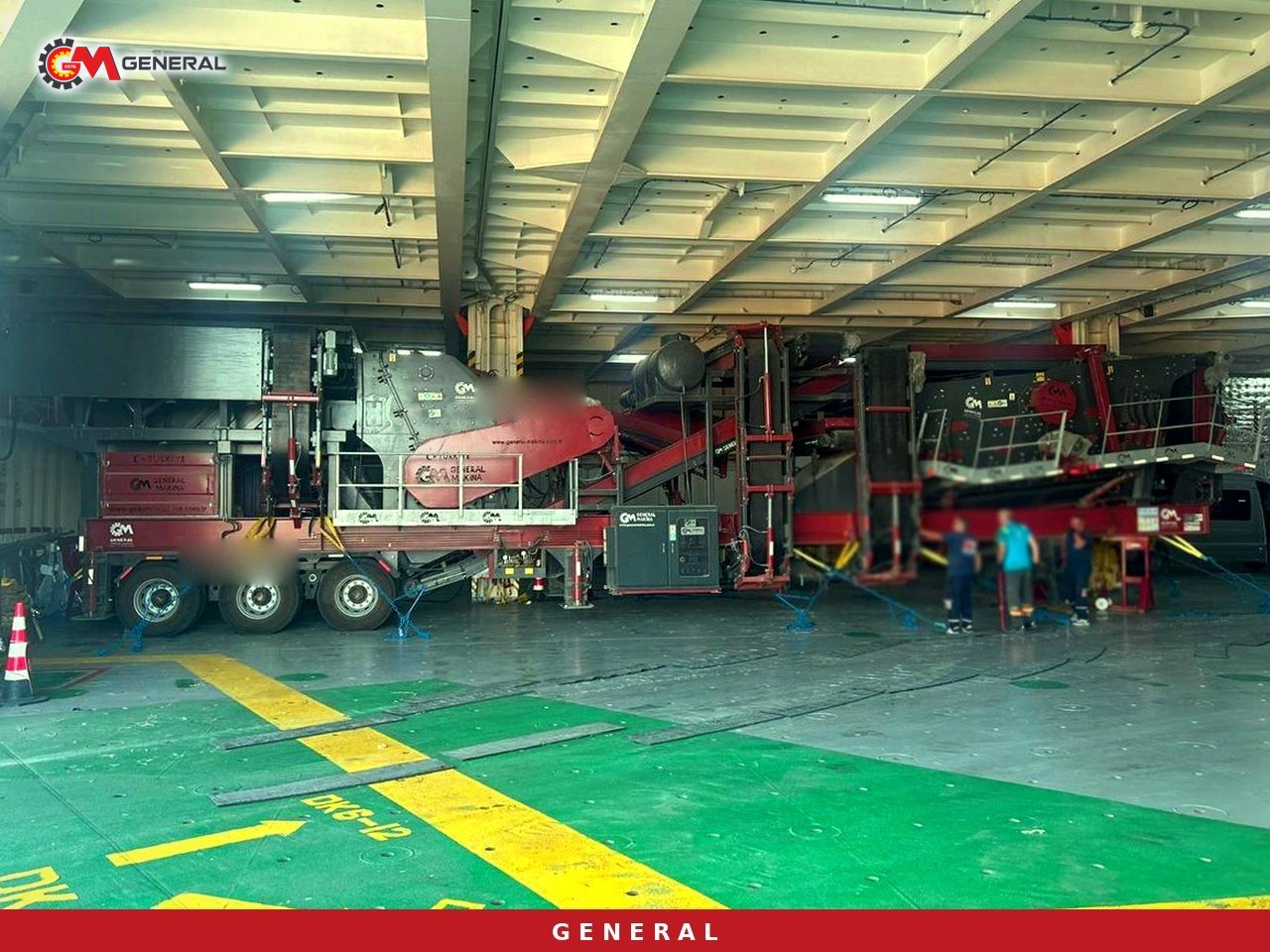
For basalt, granite and quartz, the General 950 carries a GPJ 90 jaw primary and a DMK01 impact secondary on one chassis, takes 800 mm feed and produces 120-180 t/h. Its product page states that it is moved by one truck and is working within 30 minutes. Read that as a design target on a site where the ground is ready, the loading equipment is in place and the screen setting was fixed at ordering; it is not a value guaranteed on every site. If the ground is soft or the feed direction is reconsidered on site, it takes longer. The General 944, identical in size and weight, uses a cone secondary to favour wear-part life on abrasive rock; in transport terms the two are the same.
Constant relocation inside a quarry
When the crusher has to follow an advancing face, waiting for a tractor unit at every move is the biggest time loss. This is where track-mounted mobile crushers should be considered. The GM 90JP, with its GNR 90 jaw crusher, takes 700 mm feed and does primary crushing in the 70-180 t/h band; the GM 100 produces 100-180 t/h with a GNR-01 impact crusher and integrated screen. Bringing a tracked machine to site still requires a low-loader; its advantage lies in relocation within the site, not on the road. For the wider wheels-versus-tracks criteria, see our tracked or wheeled comparison.
Portability at high tonnage
Above 250 t/h, expecting single-chassis compactness is unrealistic. The General 03 carries 250-375 t/h on a 4-axle chassis built to international transport standard and sets up without foundations on folding conveyors. The GNR-MC110 splits 200-300 t/h across two chassis; that means two shipments, but because the primary chassis can run on its own, coarse crushing can start before the second chassis arrives. The wobbler-fed mobile jaw crushing unit is a further primary option, packing 250-450 t/h onto a single chassis for sticky, wet and clayey feed.
Site-side causes that stretch setup time
However fast the machine unfolds, the first day is lost if any of the items below is missing. Tick them off on site before dispatch:
- Is the area where the chassis will stand a level, compacted platform that does not hold water?
- Are the access road and a turning area for reversing the plant into position clear?
- Is the power source settled: on-board generator, mains or external generator? Does the required kVA match the power unit in the quotation?
- Has the feed direction been set according to excavator or loader access?
- Are stockpile areas and the truck loading route marked out?
- Were screen apertures and the output setting finalised at ordering for the rock to be processed?
- Have route permits and local regulations been confirmed with the relevant authority?
What to request in writing at quotation stage
- Transport dimensions (width × length × height) and total weight, especially for models showing "—" in the table.
- Number of axles and how many transport units the plant splits into.
- Whether the generator is standard or optional, and its kVA rating.
- Whether the conveyors fold hydraulically, and whether any part still needs a crane.
- The step-by-step setup sequence and the site conditions it assumes.
- Whether screen and crusher settings are made at the factory or on site.
When you compare two quotations on setup, put the answers to these six points side by side. Check any "quick setup" claim in the quote against those answers.
Frequently asked questions
For which General Makina model is a setup time published?
Only the General 950 product page gives a time in minutes: it is moved by one truck and is working within 30 minutes. For the other models the pages describe the mechanisms that shorten setup (folding hydraulic conveyors, hydraulic legs, tracks) rather than a time.
Does a tracked machine always set up faster?
No. The GM 90JP and GM 100 need no ground works or foundation and move under their own power on site, but they travel by road on a low-loader. If most moves are within one site, tracks win; for moves between towns, a single wheeled chassis has the edge.
Does the twin-chassis GNR-MC110 lengthen setup?
Two chassis mean two shipments and two positioning operations. On the other hand, since the primary chassis runs independently, coarse crushing can begin with whichever group arrives first; that is the price of a weight that does not fit on one chassis in the 200-300 t/h class.
Do price and delivery depend on setup speed?
Price is driven by generator scope, chassis design, crusher combination and screen equipment. No figures are given here; request a quotation with your material and capacity to receive both in writing.
Conclusion
Short transport and setup does not come from a single model but from the combination of one chassis, folding hydraulic conveyors, on-board power and a properly prepared site. At medium tonnage the General 800 and General 640, for fast commissioning on hard rock the General 950, for constant relocation inside a quarry the GM 90JP and GM 100, and at high tonnage the General 03 and GNR-MC110 head the shortlist. Share your material, target capacity and site conditions and request a quotation from General Makina; ask for transport dimensions and setup steps in writing.
Definitions of technical terms: Glossary