EN — English
 TR — Türkçe
 DE — Deutsch
 RU — Русский
 FR — Français
 ES — Español
 AR — العربية
 SR — Српски

Choosing a Mobile Crusher Chassis and Undercarriage: Heavy-Duty Track Systems
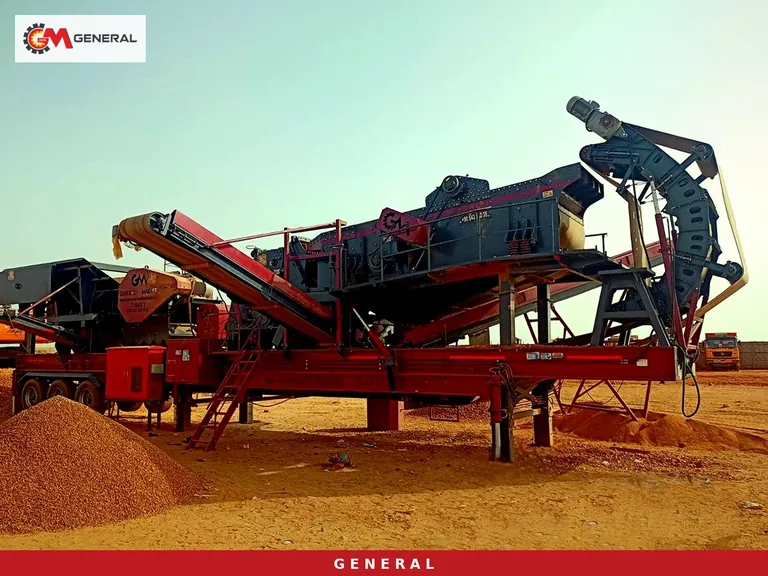
When buyers assess a mobile crusher, they usually look first at the feed opening, the capacity range and the screen size. Yet how the machine ages over the years depends largely on the structure that carries it: the chassis, the axles or the track undercarriage. This frame absorbs the crusher's impact, the screen's vibration, the weight of the power unit and the load of a full hopper all at once. It also sets the road-transport dimensions and the load passed into the ground on site. This article is not another "tracks or wheels" comparison; we covered that question in our tracked versus wheeled mobile crusher comparison. Here we explain how to read the chassis and undercarriage on a data sheet, what the axle, chassis and track figures published by General Makina actually tell you, and which questions to ask at quotation stage. Every figure comes from the product page of the model named next to it.
The chassis is a load-bearing frame: read the load path first
On a mobile crushing and screening plant, loads come from three sources. The first is static load: crusher body, screen, conveyors, power unit and material in the hopper. The second is dynamic load: the swing of a jaw crusher, the unbalance of an impact rotor and the constant shaking of a vibrating screen. The third is feed impact: the sudden hit of a large block dropped from an excavator bucket or a loader into the hopper. The chassis has to pass all three loads into the legs, axles or tracks without cracking its welds.
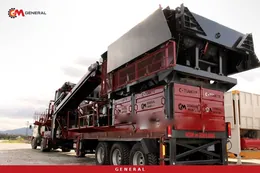
Chassis strength is rarely stated in one line on a data sheet; you read it from indirect signs. Looking at total weight together with crusher type and power unit shows how much load the frame carries. For example, the General 01 has a capacity of 120-180 t/h, a 550 kVA power unit, a weight of 55,000 kg and a transport size of 4300×18500×4500 mm. The General 02 moves up to 660 kVA and 250-300 t/h, weighing 76,000 kg with dimensions of 4340×20600×4500 mm. As capacity and power grow, both the length of the chassis and the mass it carries increase, and this directly affects the axle layout and the transport plan.
Before buying, ask the manufacturer for a layout drawing that shows the load path: where on the chassis the crusher, screen and power unit sit, and where the hydraulic legs or tracks are relative to that centre of gravity. When heavy components are evenly spread between the axle group and the legs, the chassis is under less stress both on the road and in operation.
What the number of axles tells you on a wheeled chassis
On a wheeled mobile plant, the number of axles shows how many points pass the mass into the road. With total weight fixed, more axles mean less load per axle. The data published by General Makina shows this relationship clearly:
- General 02: 2-axle chassis; 250-300 t/h.
- General 03: 4-axle chassis, described on the product page as built to international transport standard; 250-375 t/h and a 750 kVA power unit.
- Mobil 90: 3-axle chassis with twin tyres; jaw crusher, washing screen and sand screw on the same chassis, 45,000 kg in total.
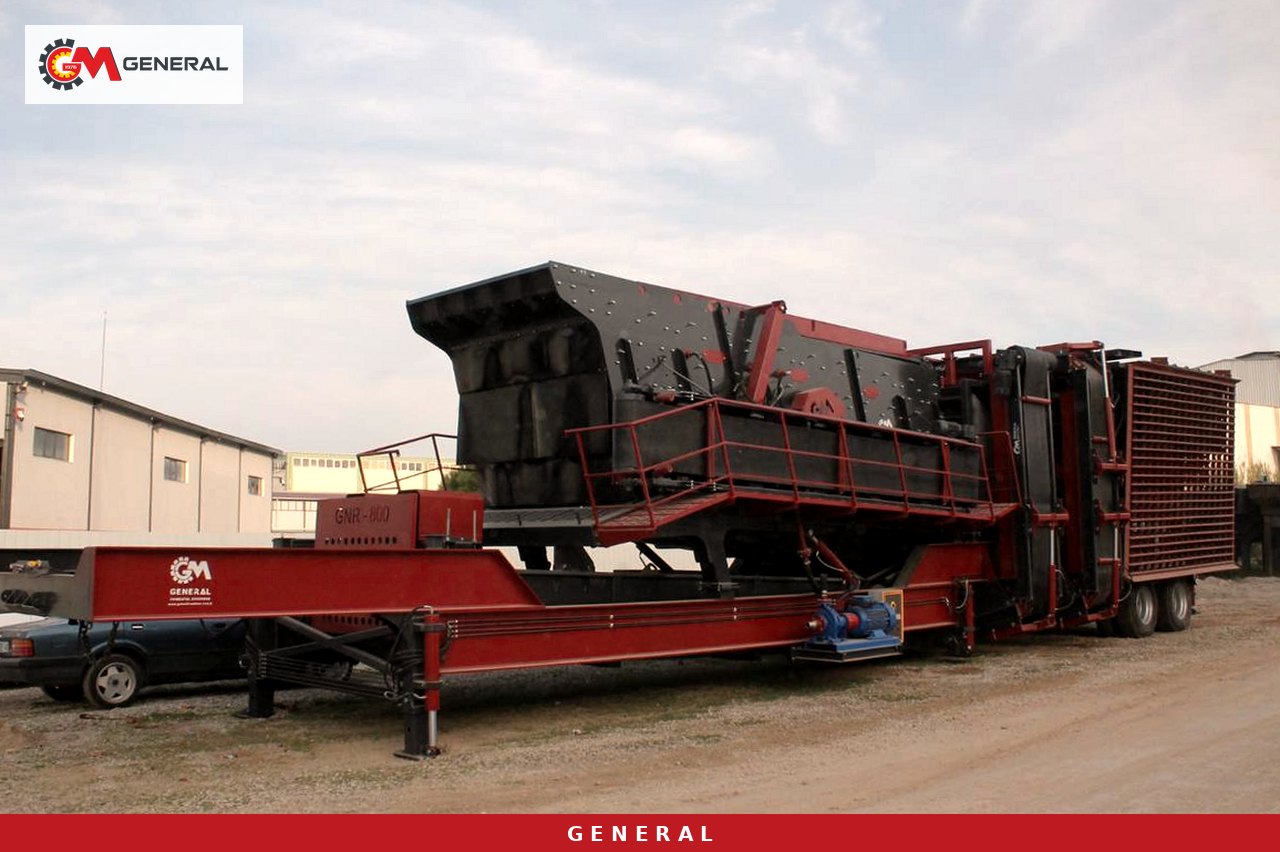
- GNR ME2060: twin-axle mobile chassis; the rear axle is used for manoeuvring.
Reading axle count simply as "more is better" is misleading. More axles make the chassis longer, widen the turning radius and can make tight site entrances harder to negotiate. The manoeuvring rear axle on the GNR ME2060 is one answer to that problem. If you plan cross-border transport, the 4-axle layout of the General 03 helps spread axle loads. Even so, permitted axle loads and abnormal-load permits differ from country to country; confirm the local rules for your route with the relevant authority.
There are three points to raise about the axle group: tyre size and availability of spares, compatibility of the braking system with the tractor unit, and whether lighting and signalling meet the rules of the destination country. These items rarely appear in a catalogue; ask for them to be written into the quotation.
When the weight will not fit on one chassis: the twin-chassis solution
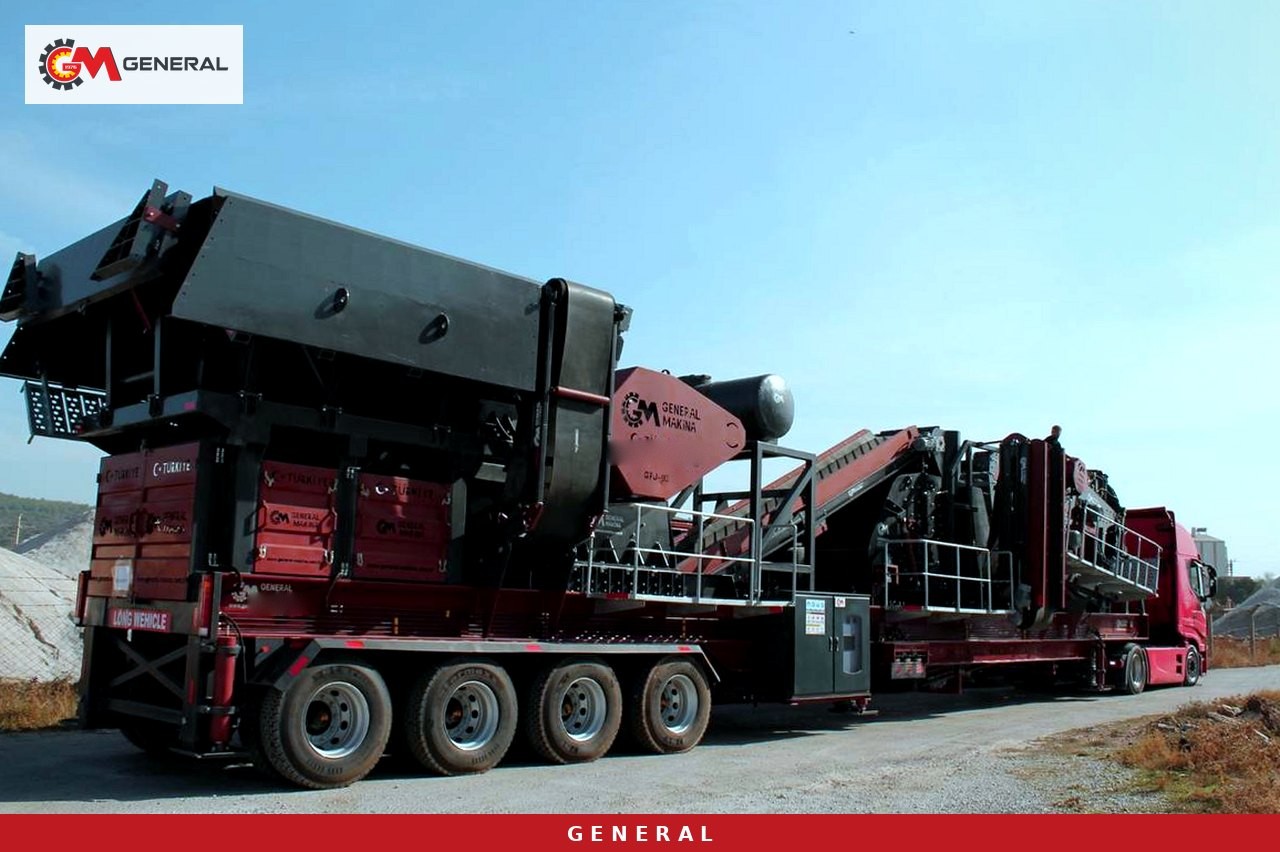
As capacity rises, the mass and road dimensions a single chassis can carry reach a limit. The GNR-MC110 gets past that limit by splitting the line in two. According to its product page, the primary chassis measures 3000×13500 mm and weighs 55,000 kg; it carries the feeder hopper and the GPJ 110 jaw crusher. The secondary chassis measures 4200×18300 mm and also weighs 55,000 kg; it carries the DMK03 impact crusher and the 2000×6000 mm four-deck screen. The plant runs at 200-300 t/h with a 750 kVA power unit.
A twin chassis has three consequences for the frame. First, each platform carries its own load, so no single chassis becomes excessively long or heavy. Second, because the primary group can work on its own, a buyer can start with the primary chassis and add the secondary later. Third, it takes two separate transports, so the mobilisation plan must allow for two tractor units and for aligning the two platforms on site.
Track undercarriage: the data published for the GM series
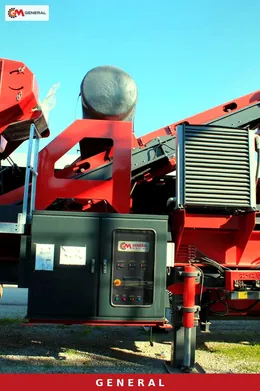
All three models in the track-mounted mobile crushers range run on a Strickland track undercarriage. According to the product pages, these machines move on their own tracks and need no ground preparation, hydraulic legs or concrete foundation. On a tracked machine, the chassis load goes straight into the track chain and rollers rather than into legs. The ratio between machine weight and track size therefore takes the place of the axle calculation used for wheeled plants.
| Model | Undercarriage | Weight | Power unit | Hopper | Capacity | Ground pressure |
|---|---|---|---|---|---|---|
| GM 90JP (jaw) | Strickland tracks | 35,000 kg | 250 kVA | 10 m³ | 70-180 t/h | — |
| GM 100 (impact) | Strickland 3800×400 | 42,000 kg | 450 kVA | 3.6 m³ | 100-180 t/h | — |
| GM 125 (impact) | Strickland tracks | 48,000 kg | 550 kVA | 6 m³ | 150-250 t/h | — |
Two things stand out in the table. The GM 125 is the heaviest model in the range and puts 48,000 kg onto its tracks; the GM 90JP is the lightest at 35,000 kg but has the largest hopper (10 m³). A full hopper shifts the machine's centre of gravity forward and upward, so emptying it before tramming matters, especially on slopes. Ground pressure, track contact length and travel speed are not published on the product pages; request these values in writing at quotation stage.
Check the bearing capacity of the ground yourself
Once the manufacturer gives you the track contact length (L) and the track shoe width (B), you can roughly estimate average ground pressure as p ≈ G ÷ (2 × L × B)where G is the operating weight of the machine. Compare the result with the bearing capacity of the fill or clay ground on site. This is an average; when the load moves forward during feeding, pressure at the front of the track rises above it. Also ask the manufacturer to confirm which dimensions the "3800×400" figure published for the GM 100 refers to.
Turning "heavy duty" into questions you can check
"Heavy duty" in the title is not a class name; it describes a working condition: large and hard feed, frequent moves, poor ground and long shifts. How long an undercarriage will last under those conditions cannot be promised with a single number; it depends on material, ground and operator habits. What you can do is check whether the machine has mechanisms that reduce that load.
- Grizzly pre-screening: the GM 100 has a 1000×1500 grizzly and the GM 125 a 1360×2160 grizzly. Fines are removed before the crusher, so the crusher, and with it the chassis, works under less strain.
- Bypass conveyor: the GM 125 has a 600×5000 mm bypass conveyor and the GM 90JP a 600×6000 mm one. Fines leave by a separate route.
- Hopper volume matched to feed size: the GM 90JP takes 700 mm feed into a 10 m³ hopper; a large hopper spreads the impact from the bucket over a wider area.
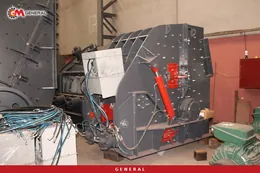
- Crusher type: a jaw crusher (GM 90JP) and an impact crusher (GM 100, GM 125) send different vibration patterns into the chassis. Choosing the right crusher for the material avoids needless strain.
These mechanisms do not guarantee durability on their own, but they are concrete features that reduce the load on the undercarriage and chassis. To shortlist models for your site, try the Design Your Plant.
Reading wheeled chassis data side by side
The same reading should be applied to wheeled mobile crushing and screening plants. The table below contains only the columns that drive chassis and transport decisions. Cells not published on the product page are left as "—".
| Model | Chassis / axle layout | Weight | Transport size | Power unit |
|---|---|---|---|---|
| General 02 | Single chassis, 2 axles | 76,000 kg | 4340×20600×4500 mm | 660 kVA |
| General 03 | Single chassis, 4 axles | — | — | 750 kVA |
| Mobil 90 | Single chassis, 3 axles, twin tyres | 45,000 kg | 3600×15700×4500 mm | 350 kVA |
| GNR-MC110 | Twin chassis (primary + secondary) | 55,000 kg + 55,000 kg | 3000×13500 mm / 4200×18300 mm | 750 kVA |
| GNR ME2060 | Twin axles, manoeuvring rear axle | — | 15 m × 4.10 m × 4.50 m | Generator or grid |
Pay attention to the height column: the transport dimensions above give a height of 4500 mm. Bridge and overpass clearances on the route must be checked together with the deck height of the low-loader. Width needs the same check: above a certain width, many countries require a special permit and an escort. Confirm the threshold for every country on the route with the local authority.
Handover and maintenance checklist for chassis and undercarriage
Record the following points at handover and during the first months of operation:
- Photograph the main chassis welds, especially at the crusher and screen mountings, and compare from the same angle at later inspections.
- Re-check the tightening torque of the crusher and screen mounting bolts at the end of the first working week.
- On tracked machines, measure track tension using the manufacturer's method; an over-tight track wears the rollers, a slack one wears the chain quickly.
- Clear clay and stone packed into the undercarriage at the end of each shift; where freezing is a risk, do it before parking the machine.
- On wheeled chassis, check tyre pressure, wheel nuts and brake connections before every move.
- Inspect the hydraulic leg cylinders and hoses for leaks and make sure the leg pads sit fully on the ground.
- The warranty is 1 year and excludes wear parts. Have the contract state clearly whether track chains, shoes and rollers fall into that category.
Frequently asked questions
How much does the track brand matter?
The brand matters for spare-parts availability. The product pages state that the GM series uses Strickland tracks. The real decision points are whether the track size suits the machine weight and how quickly parts can reach your site; ask about this when requesting a quote.
Is a chassis with more axles always better?
No. More axles reduce the load per axle but lengthen the chassis and can make manoeuvring harder. The General 02 has 2 axles and the General 03 has 4; the right choice depends on the route, national rules and site access.
Why is ground pressure missing from the tracked machine data sheet?
Ground pressure is not published on the GM series product pages. You can ask for track contact length and shoe width and run your own check with the formula above, or request the value directly from the manufacturer in writing.
How do the chassis and undercarriage affect the price?
Axle count, a twin-chassis layout, the track undercarriage and the size of the power unit are among the items that set the price. We do not give figures here; the best route is to request a quotation configured to your needs.
Conclusion
After the crusher itself, the chassis and undercarriage carry the most load on a mobile crusher, and they take up the least space on the data sheet. On wheeled plants, read axle count, weight and transport size together; on tracked machines, read track size, weight and hopper volume together. Ask in writing for values that are not published instead of guessing them. For a configuration that suits your site and your route, get in touch with us and we will prepare your quotation against this checklist.
Definitions of technical terms: Glossary