EN — English
 TR — Türkçe
 DE — Deutsch
 RU — Русский
 FR — Français
 ES — Español
 AR — العربية
 SR — Српски

Middle East Export: Delivery & Setup of a Stone Crushing Plant 120-375 TPH
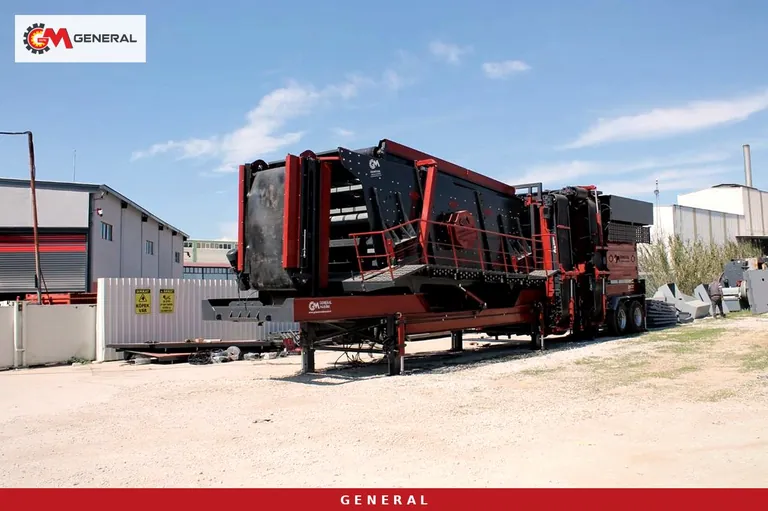
Enquiries from the Middle East almost always open with the same question: "When will the plant be running at our quarry?" The honest answer is that the date depends less on the factory calendar than on how quickly the buyer and the manufacturer close their decisions. For a stone crushing plant producing 120 to 375 tons per hour, the earlier the model, crusher arrangement, screen meshes, power source and transport route are fixed, the less time the machine spends waiting. This article follows a plant from order to first tonnage across the region, from northern Iraq to the Gulf coast, and explains who must prepare what at each step and which mistakes typically stretch the installation.
Note: aggregate specifications, grading curves and acceptance criteria for a particular port, motorway or public works contract are set out in the documents of the relevant authority. The recommendations below cover the machine and logistics side; confirm the project specification with the relevant authority and the tender documents.
Five milestones that decide the delivery time
Delivery time is not a single figure but the sum of five consecutive stages. Each stage can only start when the previous one closes, so the way to shorten the schedule is not to rush production but to close the decision gaps.
- Freezing the technical file: rock type, largest block size, required fractions and hourly target tonnage are confirmed in writing. Until this step is done, the manufacturing list cannot be finalised.
- Manufacturing and assembly: chassis, hopper, crusher, screen and conveyors are assembled at the factory. Project-specific requests (dust suppression, extra conveyor length, grid connection) must be notified before this stage.
- Factory trial run: the plant is run empty; the control panel, motor rotation directions and hydraulic legs are checked. Having the buyer or a representative attend this check reduces surprises on site.
- Documents and shipment: invoice, packing list, certificate of origin and CE declaration of conformity are prepared, and the truck or vessel is booked.
- Installation and commissioning on site: if ground, power and feeding equipment are ready, the plant is positioned, calibrated and tested with material.
The step that loses the most time in this chain is usually the first. "Ship the machine now, we will discuss the rock later" is the shortest route to finding the wrong screen mesh or an unsuitable secondary crusher on site.
Real models for 120-375 TPH and their transport profiles
The range in the title is covered not by one machine but by several configurations. The table below uses data from General Makina product pages to show which model delivers which capacity and what kind of load it creates for shipping. All wheeled options are listed on the mobile crushing and screening plants page.
| Model | Capacity | Crusher arrangement | Max. feed | Screen | Generator | Weight / chassis |
|---|---|---|---|---|---|---|
| General 944 | 120-180 t/h | GPJ 90 jaw + GM430 cone | 800 mm | 1600×5000 mm, 3 decks | 550 kVA | 70,000 kg, single chassis |
| General 02 | 250-300 t/h | GPS 1413 primary impactor | 1000 mm | 2000×5000 mm, 4 decks | 660 kVA | 76,000 kg, single chassis |
| GNR-MC110 | 200-300 t/h | GPJ 110 jaw + DMK03 impactor | 900 mm | 2000×6000 mm, 4 decks | 750 kVA | 2 × 55,000 kg, twin chassis |
| General 03 | 250-375 t/h | GPS 1415 primary impactor | 900 mm | 2400×5000 mm, 4 decks | 750 kVA | 4-axle chassis |
| GNR ME2060 (screening) | 200-350 t/h | No crusher, dry screening | 0-100 mm | 2000×6000 mm, 3 decks | Generator or grid | 15 m length |
If the target is 375 t/h, the model that reaches this tonnage in a single unit is the General 03; but as a primary impactor it is the right choice for limestone and low-abrasion rock. A buyer who wants more than 300 t/h in hard basalt or granite is offered a two-unit solution, for example a GNR-MC110 running in parallel with a General 944. In that case two loads, two document sets and two installation points are planned, and this multiplication drives the schedule.
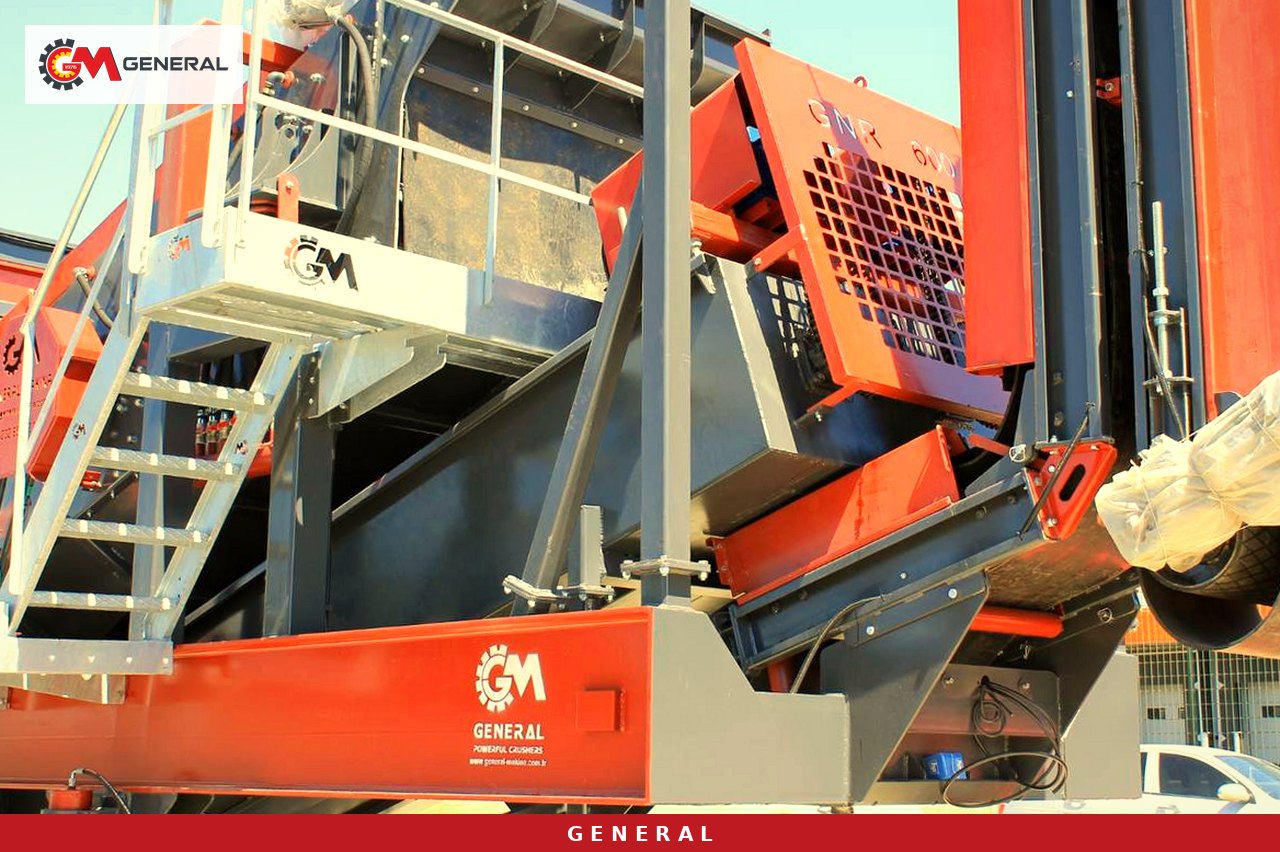
How rock type changes the delivery schedule
The geology of the region is far from uniform. Sedimentary limestone and dolomite quarries are common along the Gulf coast, granite appears in the west of the Arabian Peninsula, basalt in some inland areas, and in the mountainous north of Iraq limestone is often worked together with mixed material from gravel terraces. These differences feed directly into model selection and therefore into the delivery schedule.
Limestone and dolomite: single-stage impact
In low-abrasion rock a primary impactor delivers both reduction and cubic shape in one body. General 02 or General 03 is a single-vehicle load, so shipment, customs and positioning are handled as one item. Choosing the screen meshes for the fractions is enough.
Basalt and granite: jaw plus a second stage
In high-silica rock the wear parts of an impact rotor wear quickly. Here a primary jaw and a cone or impact secondary are required; the General 944 with its cone secondary is designed for exactly this job. To settle the decision, abrasion and compressive strength tests on a quarry sample should be done before ordering. Entering the production queue while waiting for test results means losing time later on a crusher change.
Route plan: road, sea and the last kilometre
A plant leaving the factory in Izmir reaches the Middle East by two main routes. For Iraq and neighbouring markets with land borders, road transport through Türkiye is common; for the Gulf states and the Red Sea coast, sea freight is used, followed by road transport from port to quarry. Which route is chosen depends on the loading dimensions and weight of the machine.
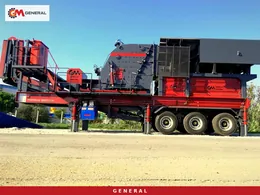
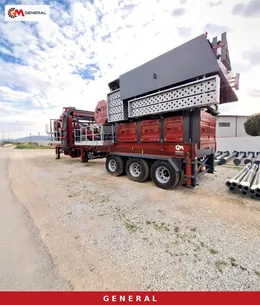
A wheeled single-chassis plant is towed on its own axles; the twin-chassis GNR-MC110 needs two separate tractor units for its primary and secondary groups. The 4-axle chassis of the General 03 is built to international transport standards, yet loads in this class are large. For example, the loading dimensions of the General 02 are 4340×20600×4500 mm, and a vehicle of this size may need an abnormal-load permit in transit countries. The duration and conditions of these permits vary by country and must be confirmed route by route with the haulier.
The last kilometre is usually the least planned part. Bridges on the quarry road, tight bends, soft sand and the height of power lines should be surveyed by the site team before shipment. Without this check the plant can wait for days at the quarry gate.
Document file: preparation that avoids customs delays
Time spent at customs depends largely on document consistency. Serial numbers, weights and model names on the invoice, packing list and bill of lading must match exactly. General Makina plants are produced under an ISO 9001 quality system and carry CE marking; the CE declaration of conformity is added to the file. If the importing country has its own conformity certificate or registration system, its requirements must be confirmed by the buyer and the customs broker at the order stage; a missing document discovered after shipment keeps the machine waiting at the port.
Payment and delivery terms are also part of the file. Ex-works, port delivery or delivery to destination change insurance and the transfer of risk, and the choice determines the loading plan and who issues which document.
Installation at the quarry: ground, power, water and crew
The advantage of wheeled plants is that they need no concrete foundation; even so, site preparation decides how fast installation goes. In the GNR PDK 02 stationary crusher project in Saudi Arabia a 250 t/h plant was installed in desert conditions; buyers planning a permanent installation should look at stationary crushing and screening plants which require different preparation, namely foundations and steel structure erection.
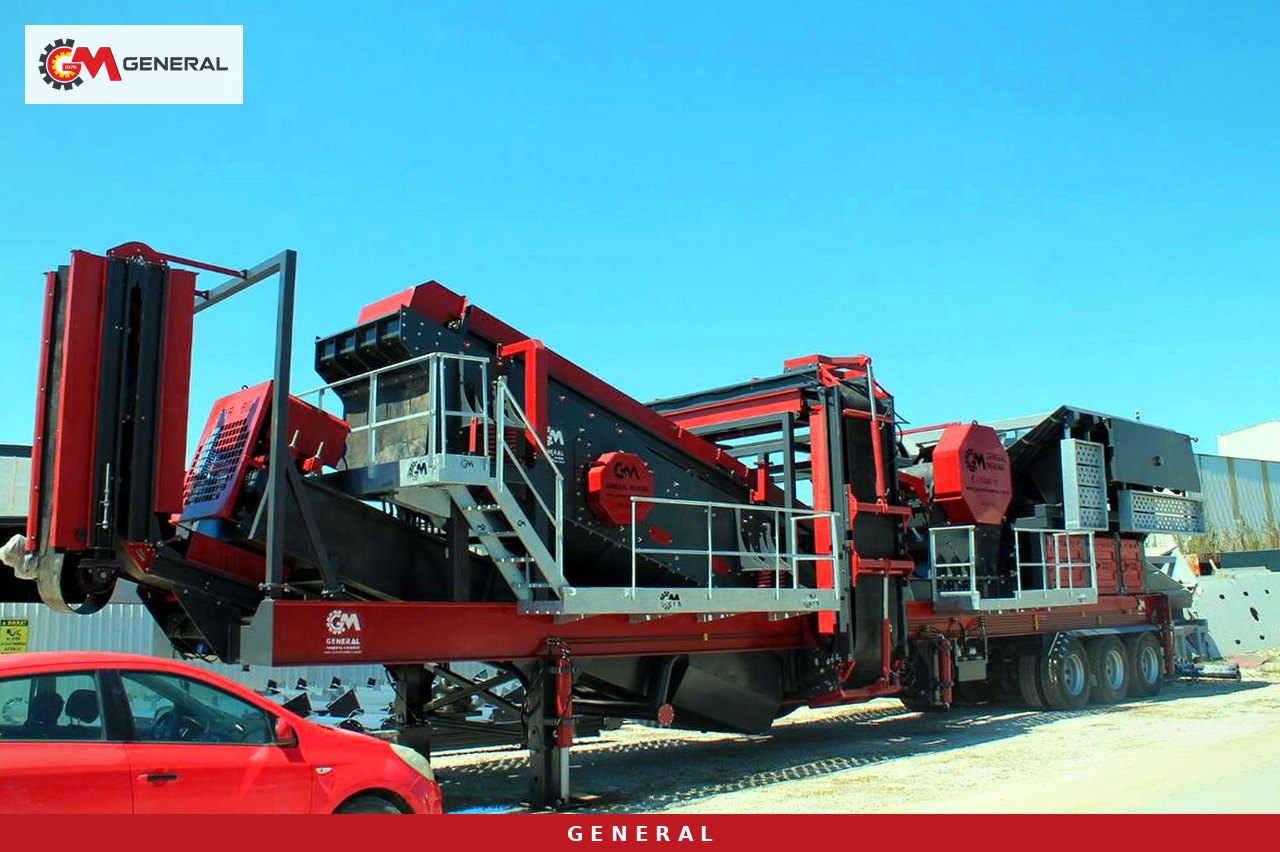
What must be ready on site before the plant arrives
- A compacted, well-drained level area large enough for the plant length, unfolded conveyors and manoeuvring
- A ramp or feeding platform where trucks or loaders can easily reach the hopper
- A fuel tank and a shaded, ventilated place for the generator; if grid power is used, cable of suitable cross-section and a panel connection
- A water source and line for dust suppression; a recovery plan where water is scarce
- Separate stockpile areas so that fractions do not mix
- Lifting equipment arranged in advance for mounting conveyors and additional units
- Names of the operators and maintenance staff who will attend training
First start-up in hot weather
Midday hours put the heaviest strain on equipment in the region. The first start-up and load testing are best scheduled for early morning. The control panel should not stand in direct sun, the generator air intake should not face dusty wind, and engine filters need frequent checks during the first days. A fan-cooled panel is standard on the ME2060; on other models, an extra sunshade or an air-conditioned panel are measures that can be selected for the project.
During calibration, feeder speed, crusher discharge setting and screen meshes are adjusted with real material. Sampling the product grading over the first few shifts shows early whether the output meets the specification. The warranty is 1 year and does not cover wear parts, so ordering a set of spare screen meshes and crusher wear parts with the first shipment avoids waiting at a remote site.
Frequently asked questions
Can the delivery time be fixed in the order?
Once the technical file is approved, the time is stated in the quotation according to the configuration and the production plan at that moment. Project-specific additions and the transport route affect it, so we recommend asking for written confirmation for your configuration rather than a general figure.
Can a single wheeled plant reach 375 t/h?
Yes, the General 03 works in the 250-375 t/h range; but as a primary impactor it is the right choice for low-abrasion rock such as limestone. In hard rock, a two-unit line gives a safer result.
Does a technical team come from the factory for installation?
The scope of installation, commissioning and operator training is defined separately in the quotation. When the team travels to site depends on ground and power preparation being complete.
What determines the price?
Model, crusher arrangement, number of screen decks, power source, extra conveyors, options such as dust suppression, and the delivery terms determine the price. The figure is given in response to a quotation request containing this information.
Conclusion: decisions shorten the schedule
For a 120-375 t/h plant bound for the Middle East, the most effective way to shorten delivery and installation is to close the rock test, fraction list, power decision and transport route before ordering. Share your quarry location, rock type and target tonnage, and we will work out the right configuration and loading plan together: contact us for a quotation and technical discussion.
Definitions of technical terms: Glossary