EN — English
 TR — Türkçe
 DE — Deutsch
 RU — Русский
 FR — Français
 ES — Español
 AR — العربية
 SR — Српски

Middle East 3,000 Tons per Day Crusher and Screener Plant 300-375 TPH
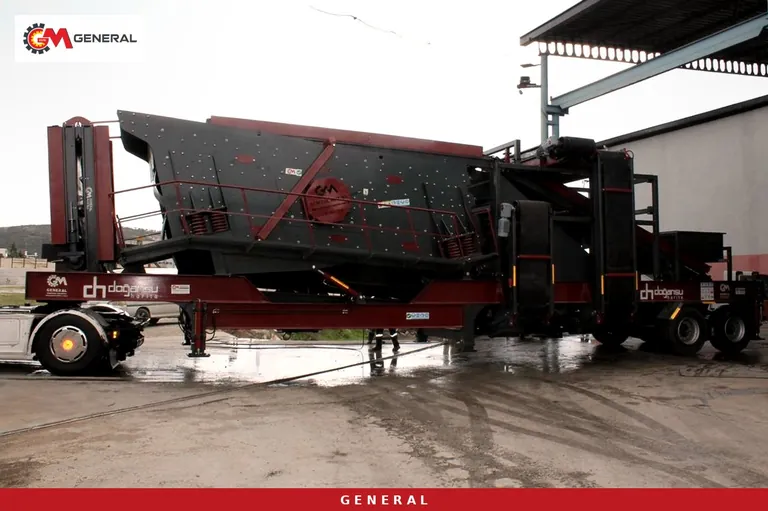
When a road package, a port reclamation job or a large ready-mix supply contract is signed in the Gulf, the aggregate requirement is often written as a single line: 3,000 tons per day. A crushing and screening plant that meets this figure is not chosen by picking the largest machine in the catalogue. What that 3,000 tons is made of, how many net hours the heat allows on site and how the quarry rock behaves under load must be weighed together. This article walks through real model combinations that fit the 300-375 TPH band for limestone and basalt quarries in the Middle East, the load on the screening and stockpile side, and the data that belongs in a quotation request.
Splitting 3,000 tons into products and hours
Write the product mix first
A daily target is not one heap. A ready-mix plant needs clean manufactured sand plus 5-12 and 12-19 mm chippings; an asphalt plant asks for its own grading; road sub-base accepts a wide but controlled 0-40 mm blend. If the screen is chosen before it is clear how much of each fraction will be sold, it either overproduces one product and fills the stockyard or creates a bottleneck on the best-selling size.
A hypothetical example: half of the 3,000 tons is concrete aggregate, one third is sub-base and the rest is asphalt chippings. In this split the 0-5 mm sand fraction is the hardest-working part of the screen deck, because material passes fine apertures more slowly than coarse ones. So before turning the daily target into an hourly capacity, the share of fines must be put on paper too. Without it, the calculation sizes the crusher correctly and the screen wrongly.
Net operating hours on a desert calendar
Working the calculation backwards makes the decision easier: take the hourly output of the chosen line and find how many net hours 3,000 tons requires. The formula is net hours needed = 3,000 ÷ hourly output of the line. A line producing 300 t/h needs 10 net hours; one producing 375 t/h needs 8. Net hours are what remains after truck queues, screen mesh changes, crusher adjustment and refuelling, so the shift is always longer.
At many Middle East sites, summer work moves to early morning and evening; midday breaks get longer and some quarries stop completely. A 3,000-ton day that is easily reached on a single winter shift can become a struggle with the same line in summer. Plan against the operating window of the hottest month: a line that hits the target then runs with spare capacity for the rest of the year. Choosing a line close to the lower limit of the band, 300 t/h, means every minute of downtime comes straight back as a daily shortfall.
The quarry rock picks the crushing principle
Two main rock groups stand out in the region, and they need different crushers. For a firm decision, compressive strength, abrasiveness and silica content of a sample from your quarry should be measured by an accredited laboratory; the split below is for pre-selection only.
Limestone and dolomite on the coast and plateaus
Limestone and dolomite, common along the Gulf coast and on inland plateaus, are low in abrasion. In this rock an impact crusher delivers a high reduction ratio and cubical particles in a single stage; a separate shaping stage is often unnecessary. The impact route shortens the line and cuts the number of conveyors and transfer points needed for a 3,000-ton target.
Volcanic basalt fields and hard rock in the mountain belt
The volcanic areas of the Arabian Peninsula hold basalt, and the mountain belt contains hard rock such as gabbro. As silica and abrasiveness rise, blow bar consumption in an impact crusher strains the operating budget. Here a jaw primary followed by a cone secondary, both working by compression, keeps metal wear under control. If concrete aggregate is to be made from basalt, whether a shaping crusher is added as the last stage depends on the sample results.
Four set-ups that cover 300-375 TPH
The table below compares options for this band using only the technical data on our product pages. Values not given on a product page are shown as "—".
| Set-up | Capacity | Primary crusher | Max. feed | Screen | Power / motor |
|---|---|---|---|---|---|
| General 03 (wheeled, single chassis) | 250-375 t/h | GPS 1415 impact | 900 mm | 2400×5000 mm, 4-deck | 750 kVA generator |
| General 02 + GNR ME1650 | 250-300 t/h + 120-180 t/h screening | GPS 1413 impact | 1000 mm | 2000×5000 mm, 4-deck + ME1650 screen | 660 kVA + grid or generator |
| Stationary impact line: GNR 140 feeder + GNR PDK01 | 250-500 t/h (PDK01) | PDK01, 1400×1500 mm rotor | 1000 mm | GNR 2460, 2400×6000 mm | 315 kW (crusher motor) |
| Stationary hard rock line: GNR 140 feeder + GNRK 130 + cone crusher | 400-500 t/h (GNRK 130) | GNRK 130 jaw, 1300×1000 mm opening | — | GNR 2460, 2400×6000 mm | 160 kW (jaw motor) |
Wheeled route: General 03, or General 02 with an extra screen
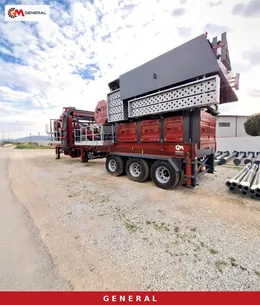
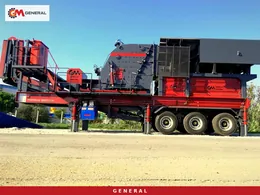
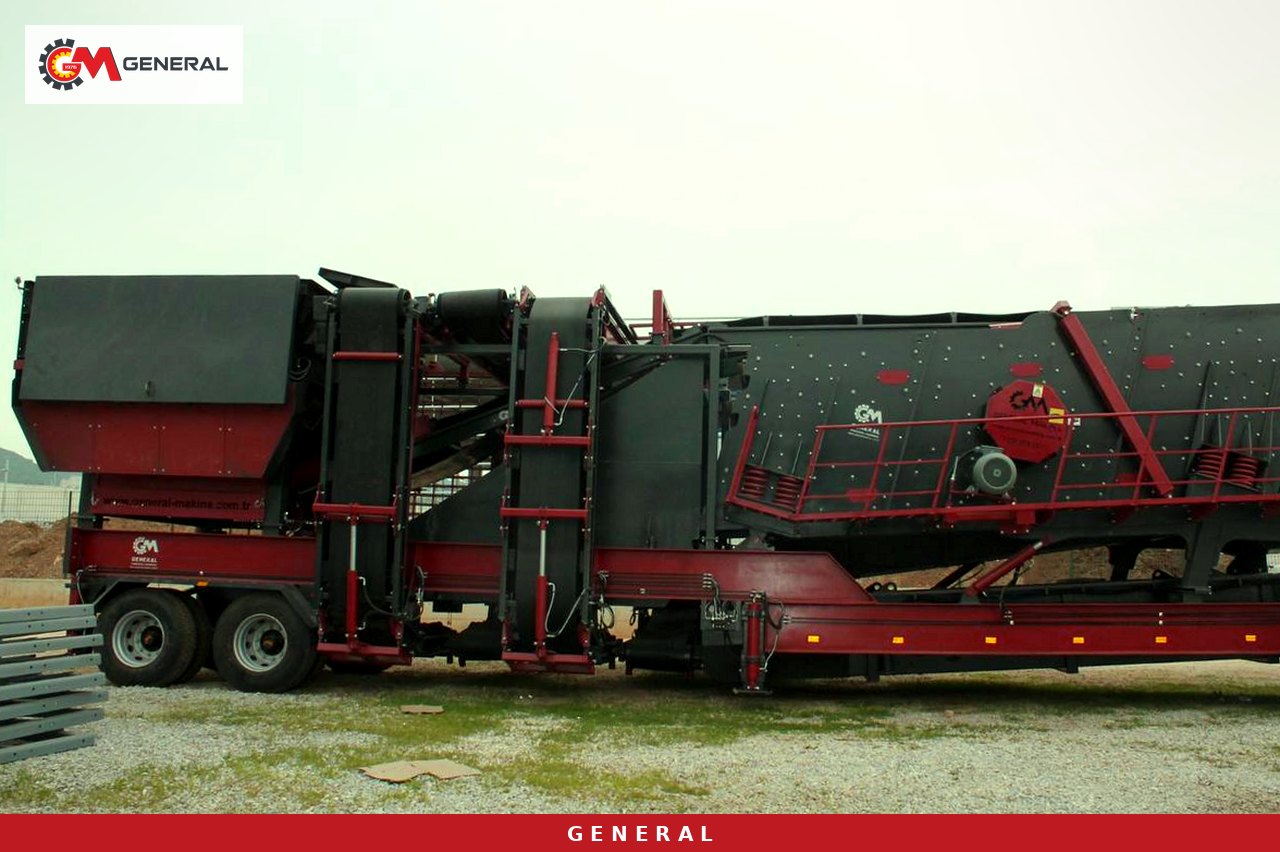
The General 03 covers the whole band on a single chassis at 250-375 t/h. Its GPS 1415 primary impactor accepts feed up to 900 mm, the discharge setting is 0-100 mm and the 2400×5000 mm four-deck screen splits 0-5, 5-12, 12-19 and 19-40 mm fractions in one pass. The 750 kVA power unit is standard, so a quarry without grid access needs no separate power project. The 4-axle chassis is built to international transport standards, which simplifies route and permit planning for the road haul from port to quarry.
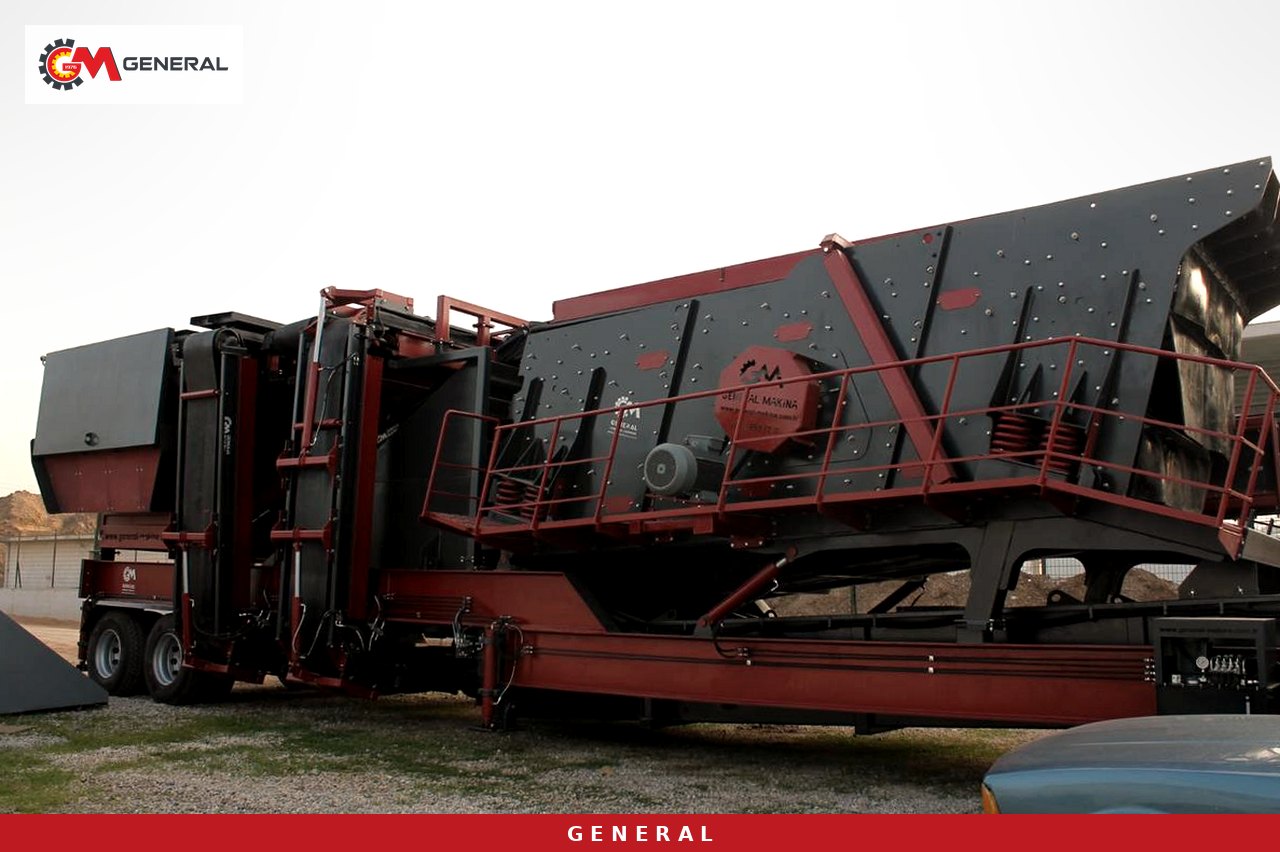
The other route is to choose the General 02 from our wheeled mobile crushing plants (250-300 t/h, GPS 1413, 1000 mm feed, 2000×5000 mm four-deck screen, 660 kVA) and add a GNR ME1650 mobile dry screening plant. The ME1650 separates 0-100 mm material at 120-180 t/h through a sand hopper, vibrating screen and stockpile conveyors; its 18,000 kg single chassis runs on grid or generator power. It is used to relieve the main plant's screen, to re-grade mixed stockpiles or to separate natural material that can be screened without crushing. Bear in mind that it does not wash: clayey or wet material calls for the washing and screening range.
Impact and jaw backbones for a stationary line
When the quarry has a long life and production will stay at the same point for years, stationary crushing plants come to the fore. In limestone, a GNR 140 vibrating grizzly feeder (350-600 t/h, 1400 mm wide) is paired with the GNR PDK01 primary impact crusher: with a 1400×1500 mm rotor, 1000 mm feed and a 315 kW motor it gives 250-500 t/h and up to 20:1 reduction in a single stage on limestone. The regional reference for this backbone is the GNR PDK 02 stationary plant producing 250 t/h in desert conditions in Saudi Arabia. For basalt and gabbro, a GNRK 130 jaw crusher (1300×1000 mm opening, 160 kW, 400-500 t/h) is matched with a cone secondary. The GNRK 110's upper limit of 200-350 t/h falls short of the 375 t/h target, so it leaves no margin in this band.
Screens and stockpiles: what daily tonnage means on the ground
3,000 tons is a pile volume that builds up every day and melts away with dispatch. On the screening and stockpile side, these decisions set the real capacity of the line:
- Screen area: on a stationary line, wide bodies such as the GNR 2460 (2400×6000 mm, 22 kW) or GNR 2470 (2400×7000 mm, 30 kW) leave capacity margin when the product mix carries a high share of fines.
- Number of decks: a four-deck screen if four products are sold at once; a second screening unit for more.
- Surge pile: an intermediate pile between primary and secondary keeps the second stage running when the primary stops.
- Dispatch rhythm: the truck loading area is sized to cover the tonnage pulled from stock in the busiest hour.
The discharge height of the stockpile conveyors decides pile volume. A low conveyor needs frequent loader work and adds machine traffic in the hot hours. On multi-product sites, a separate mobile screening unit gives the flexibility to re-grade stockpiled material without stopping the main line.
Power, heat and dust on a Gulf site
At remote quarries power usually comes from generators. The 750 kVA unit on the General 03 and the 660 kVA unit on the General 02 are sized for the plant's own load; if a screening unit, lighting or site cabins are added, the total load must be calculated separately. On a stationary line, motor ratings (315 kW for the PDK01, 160 kW for the GNRK 130) are the base data for a grid connection application.
In hot, dusty weather, measures that can be selected per project include moving the electrical panel into a shaded or air-conditioned cabin, suitable filters on engine air intakes, dust suppression nozzles at transfer points and covers on wind-exposed conveyors. These are not standard equipment but options defined for the site at quotation stage. Where water is scarce, the source and daily volume of dust suppression water must also be planned from the start.
Data for your quotation file
The right configuration starts with the information sent in the first message. Send the following together:
- Laboratory report on the quarry rock: compressive strength, abrasiveness, silica content.
- Largest block size from blasting and the share of soil and fines in the run-of-mine feed.
- Product mix: fractions and the daily tonnage of each.
- Planned net operating hours for summer and winter.
- Power source: grid capacity or generator.
- Water source and dust suppression expectations.
- Quarry life and whether the plant may later move to another site.
- Port of arrival and the road route from port to site.
Frequently asked questions
Is a single wheeled plant enough for 3,000 tons per day?
With 250-375 t/h, the General 03 reaches the target in 8 net hours at 375 t/h and in 10 at 300 t/h. That is achievable in limestone and dolomite; in abrasive rock such as basalt and gabbro, a jaw and cone line should be considered instead of a single impact chassis.
Should I choose mobile or stationary?
If the quarry life is long and the plant will not move, a stationary line allows wider screens and larger crushers. If the plant must move to another project when the contract ends, the wheeled option makes setup and relocation easier.
Have you delivered in the Middle East before?
The references published on our site include the GNR PDK 02 stationary plant running at 250 t/h in desert conditions in Saudi Arabia. Our export regions are the Middle East, North Africa, Russia, the Turkic republics and the Balkans.
What determines the quoted price?
The chosen set-up, the number of crushers and screens, generator needs, dust and heat measures, conveyor lengths and the shipping route all shape the price. That is why the figure is calculated per project once the data list above has been received.
Conclusion
3,000 tons per day means a line in the 300-375 TPH band and a plan built on the net hours of the hottest month. In limestone the General 03 or a stationary PDK01 line stands out; in basalt and gabbro, a stationary line with a GNRK 130 and a cone secondary. Manufacturing in İzmir since 1976, General Makina supplies ISO 9001 and CE certified equipment with a 1-year warranty (wear parts excluded). Send your quarry data through our contact page and we will finalise the configuration together for your rock and product mix.
Definitions of technical terms: Glossary