EN — English
 TR — Türkçe
 DE — Deutsch
 RU — Русский
 FR — Français
 ES — Español
 AR — العربية
 SR — Српски

Generator or Grid Power for a 100-200 TPH Mobile Stone Crusher Plant
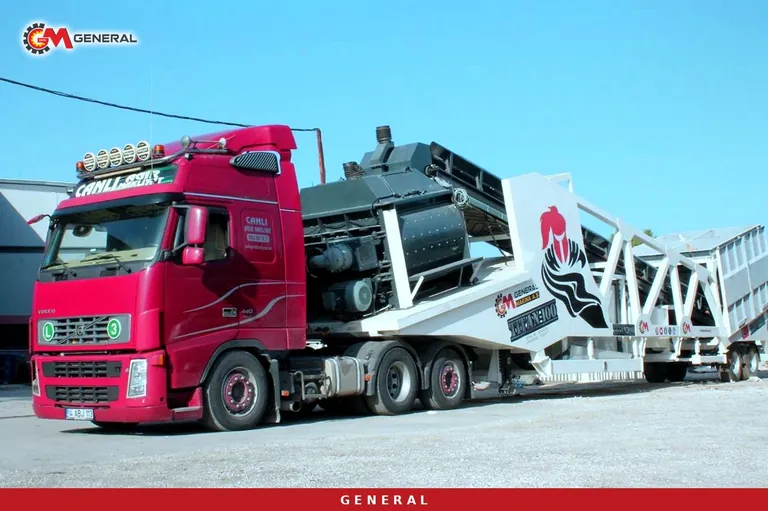
When a buyer compares quotes for a 100-200 TPH mobile crusher, energy is the line item that gets the least discussion, yet it is the only cost that arrives with every shift for as long as the plant runs. Our wheeled plants come with their own power unit, in other words a diesel generator. If a medium-voltage line passes near the quarry, the same plant can also be connected to the grid. Which option is cheaper depends less on the unit price of diesel or electricity and more on how many hours you will run, how long the plant stays in one place and how reliable the line is. This article builds the calculation step by step from the real power ratings of our models, and instead of invented consumption figures it gives formulas that work with values you measure on your own site.
From the kVA label to the actual site load
The 550 kVA printed on a datasheet does not mean the plant draws 550 kVA every hour. It is the maximum apparent power the power unit can deliver. The real working power (kW) is the kVA value multiplied by the power factor (cosφ) on the generator nameplate. Load falls when the crusher idles and rises when the hopper is full and the rock is hard. Sizing either a generator or a transformer means answering two separate questions: what is the average draw in continuous operation, and how high is the momentary peak when the largest motor starts.
The starting peak is usually well above the average. A large motor started direct-on-line asks for several times its rated current for a short moment. On a generator this shows up as voltage dip and frequency swing; on the grid it pushes up the transformer and fuse rating. The General 01 control panel includes a soft starter and frequency control. That equipment spreads the starting peak, helping both the generator and the grid connection to be sized for a lower peak. Whichever source you choose, settle the start sequence and the starting method at the quotation stage.
Models in the 100-200 TPH band and their power ratings
The table below lists the wheeled and tracked models that fit the target range, with the values from their product pages. Where one model does not cover the whole range, look at where two models overlap: GM 100 sits at 100-180 t/h, General 01, General 944 and General 950 at 120-180 t/h, and GM 125 at 150-250 t/h.
| Model | Capacity (t/h) | Crusher layout | Max. feed (mm) | Power unit (kVA) | Weight (kg) |
|---|---|---|---|---|---|
| General 01 | 120-180 | GPS 1210 impact (primary+secondary) | 700 | 550 | 55,000 |
| General 944 | 120-180 | GPJ 90 jaw + GM430 cone | 800 | 550 | 70,000 |
| General 950 | 120-180 | GPJ 90 jaw + DMK01 impact | 800 | 600 | 70,000 |
| GM 100 (tracked) | 100-180 | GNR-01 impact, 160 kW | 600 | 450 | 42,000 |
| GM 125 (tracked) | 150-250 | GNR PDK02 impact, 200 kW | 700 | 550 | 48,000 |
The kVA values in the table are also the starting point for a grid connection: if the transformer is rated below that figure, the plant trips at full load. On the tracked models the crusher motor power is stated separately. The crusher motor, 160 kW on the GM 100 and 200 kW on the GM 125, carries the largest share of total consumption, with feeder, screen and conveyor motors on top. For model details see our wheeled mobile crushing and screening plants and track-mounted mobile crushers.
What generator operation really costs
The generator bill does not end with fuel. To see the energy cost per tonne correctly, track three items separately.
Fuel and part load
A diesel power unit burns less fuel per kWh produced when it is loaded close to its rating. A generator that runs for long periods at low load produces each kWh at a higher cost and can develop maintenance issues such as unburnt fuel build-up. Putting an oversized power unit on a site that will produce 120 t/h may look safe on paper, yet it costs money in operation. If feeding is irregular, for instance when a loader fills the hopper in bursts, the generator keeps dropping to part load. Feed regularity is therefore a direct fuel item.
Service, oil and filters
A generator needs oil, oil filters, fuel filters and air filters according to its running hours. In a dusty quarry the air filter loads up ahead of schedule, so a filter check belongs on the start-of-shift list. These costs rise in a straight line with running hours. A grid-connected plant has no such item; transformer and panel maintenance replace it and occur far less often.
Fuel logistics and stock
At a quarry far from town, the fuel tanker, storage tank, dispensing arrangement and theft control form a separate work package. If a tanker is late, the plant stops. To measure that risk, calculate how many shifts of consumption the on-site storage covers and compare it with the supply lead time.
The hidden items of a grid connection
Grid electricity usually looks cheaper than diesel per kWh. What distorts the calculation are the items outside the kWh price.
Connection investment
Running a line to the quarry, installing a transformer, adding a metering and protection panel, cabling and earthing are one-off investments. That investment is divided by the time the plant stays at that location. If the mobile plant will move to three different sites in a year, each one needs its own connection and the grid advantage melts away quickly. If the plant stays in the same quarry for years, the connection cost per tonne becomes negligible. Connection terms and lead times vary by country and by distribution company; get them in writing from the relevant utility.
Demand charges, reactive energy and outages
Many tariffs add a separate charge for contracted capacity or peak demand on top of the kWh consumed. A plant with a high starting peak inflates this charge. Plants with large motors may need a power factor correction panel; without it, penalties land on the bill. Then there is the outage risk. If the line drops often, the crusher stops full, the chamber has to be cleared before restarting, and the lost hours take back what the cheap kWh saved. In areas with frequent outages, keeping the generator on site as a backup is a common solution.
Working out energy cost per tonne on site
To compare like with like, convert both options to cost per tonne. The formulas below use letters instead of numbers; enter the values from your own trial run and tariff. We write "unit" instead of a currency.
For generator operation: cost per tonne = (Q × Y + B) ÷ T. Q is the fuel burned in one hour (litres), Y the fuel price per litre (units), B the oil, filter and service share per hour (units), and T the product leaving the belts in the same hour (tonnes).
For grid operation: cost per tonne = (E × Z + G + K ÷ S) ÷ T. E is the hourly meter reading (kWh), Z the price per kWh, G the demand and reactive charges divided per hour, K the one-off connection investment, and S the total hours the plant will run at that point.
A hypothetical example shows the logic: suppose that for the same plant E × Z in the grid formula comes out at half of Q × Y on the generator. If the plant stays only a few months, the K ÷ S term grows and can close that gap; if it stays several years, K ÷ S shrinks and the grid pulls clearly ahead. The decision often hinges on that single term. To speed up the calculation, use our energy and wear cost calculator. We cover the difference between electric and diesel-hybrid drives in this energy analysis.
Find Q and E by measurement, not by guesswork. After taking delivery, read the fuel meter or the electricity meter over a full shift and record tonnage on the weighbridge or belt scale in the same shift. Energy per tonne varies noticeably between hard granite and soft limestone; a value taken from one rock type does not transfer to another quarry.
Site conditions that change the choice
The list below sets out the information to collect from site before asking for a quotation. Without these answers an energy comparison stays on paper.
- How many months or years will the plant run at the same point, and will it then move to another site?
- How far away is the nearest medium-voltage line, and what capacity can the distribution company supply?
- How often did line outages occur in the area over the past year?
- How many shifts per day and how many days per week will the plant run?
- How will fuel reach the site, and is there space and security for storage?
- What rock is in the quarry, and has a laboratory sample been taken?
- Is it planned to feed a concrete batching plant or a washing unit from the same energy source later on?
The last point is often skipped. If a concrete plant will join the crushing plant, the grid connection is sized for the combined load of both, and the connection investment is split across two production lines. When several items of plant equipment are run from one station, an automation and control system limits peak load through sequential starting, which brings down both the generator size and the contracted capacity.
For work that moves often, a generator is the practical choice: the plant is set up without depending on the grid and produces from day one. In a long-life quarry with a fixed location, a grid connection comes out ahead in most calculations. In between, using the grid as the main source with the power unit as backup keeps both outage risk and the fuel bill under control. On models such as the General 01 and GM 125 the power unit comes with the plant; when grid supply is wanted, the connection panel is engineered separately for the project.
Frequently asked questions
Can a mobile crusher supplied with a generator be connected to the grid later?
Yes, with a suitable connection panel and a transformer of adequate rating. The plant's kVA value and start sequence are the basis of transformer selection. The connection should be made by a licensed electrical contractor and approved by the distribution company.
Which model will have the lowest fuel consumption?
Fuel consumption is set by rock type, feed regularity, product size and load factor, so we do not give a figure in litres. A model that reaches the same tonnage with a smaller power unit usually has the edge; still, the right comparison is a trial measurement with your own rock.
Does it make sense to use grid and generator together?
It does in regions with frequent outages. The grid becomes the main supply and the generator takes over during an outage. With this arrangement, separate planning on the control side is needed so that the changeover happens safely while the crusher is loaded.
Does the quotation change with the energy choice?
It does. The scope of the power unit, the connection panel and the control equipment affect what the quotation contains. Exact price and delivery information is given in a quotation prepared from your site data.
A short route to the decision
Before choosing the energy source, write down how long the plant will stay at one point, the line capacity and the outage frequency; then fill in both formulas with your own values. Our team, building crushing and screening plants in Izmir since 1976, can show power unit and grid connection options side by side in the same quotation for models in the 100-200 TPH band. Contact us with your site details.
Definitions of technical terms: Glossary