EN — English
 TR — Türkçe
 DE — Deutsch
 RU — Русский
 FR — Français
 ES — Español
 AR — العربية
 SR — Српски

Riyadh & Jeddah Construction Mobile Aggregate Crusher Plant 150-250 TPH
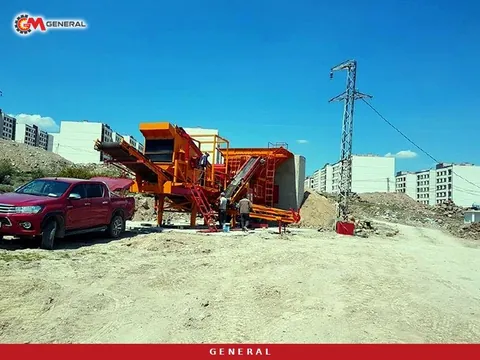
A wide stretch of desert separates Riyadh from Jeddah, and the crushed stone that feeds each city's ready-mix plants usually comes from very different rock. Quarries around Riyadh mostly work sedimentary limestone and dolomite, while the hills east of Jeddah belong to the Arabian Shield, with hard igneous rock such as granite, diorite and basalt. That is why "a 150-250 TPH mobile crusher for Saudi Arabia" has no single answer: the same tonnage target is met with an impact crusher in Riyadh and with a jaw-led line in Jeddah. This article walks a contractor or quarry operator through the figures that matter when choosing a wheeled crushing and screening plant to supply aggregate for housing, roads and infrastructure in both cities, model by model.
The short recommendation: for a limestone-fed site near Riyadh, General 01 or General 02; for a hard-rock site near Jeddah, General 950/944 or the twin-chassis GNR-MC110. The details, and the situations that could change this choice, follow below.
Riyadh limestone, Jeddah igneous rock: the stone picks the crusher
An impact crusher breaks material by throwing it with rotor-mounted blow bars against breaker plates. In low-abrasive limestone this gives high reduction and cubical grains in a single stage, with reasonable wear-part consumption. In high-silica granite and basalt the same blow bars wear very quickly. As our product pages state plainly, such hard and abrasive rock calls for a sequence that starts with a jaw and continues with a cone or impact secondary stage.
Limestone beds in quarries north and west of Riyadh may contain chert or siliceous bands in places. On the Jeddah side, a single quarry can move from granite into basalt dykes. In both cases the final word belongs to the laboratory: we recommend taking a representative sample from the face and testing it for abrasion index (Ai), compressive strength and silica content. These three values directly determine the crusher type and the wear-part alloy.
Which fractions do city jobsites ask for?
Housing blocks, commercial buildings and urban road works in Riyadh and Jeddah demand several products at once. A ready-mix plant wants sand plus two or three sizes of chippings; an asphalt plant expects finer chippings with a tighter grading; road sub-base and fill accept material with wider tolerances. The number of screen decks on a mobile plant therefore matters as much as its tonnage.
- 0-5 mm: manufactured sand for concrete and plaster; fine aggregate in asphalt mixes.
- 5-12 and 12-19 mm: the main coarse aggregate sizes for ready-mix concrete.
- 19-40 mm: mass concrete, drainage and sub-base layers.
General 01, General 02 and GNR-MC110 split these four groups in a single pass with a 4-deck screen. General 944 and 950 carry a 3-deck horizontal screen with a standard output of 0-5 / 5-12 / 12-19 mm; if a 19-40 mm product is also needed, the screen arrangement should be discussed at the order stage. Do not finalise screen apertures until you have the specified grading curve in writing from the relevant authority or the concrete producer.
Wheeled models that cover the 150-250 TPH target
The range in the title is the target for a configuration chosen to suit the site, not for one machine. The table below places five wheeled options side by side, using values taken only from our product pages.
| Model | Best fit | Capacity | Crusher sequence | Screen | Max. feed | Weight | Generator |
|---|---|---|---|---|---|---|---|
| General 02 | Riyadh, upper band | 250-300 t/h | GPS 1413 primary impact | 2000×5000 mm, 4 decks | 1000 mm | 76,000 kg | 660 kVA |
| General 01 | Riyadh, lower band | 120-180 t/h | GPS 1210 impact (primary+secondary) | 1600×5000 mm, 4 decks | 700 mm | 55,000 kg | 550 kVA |
| GNR-MC110 | Jeddah, upper band | 200-300 t/h | GPJ 110 jaw + DMK03 impact | 2000×6000 mm, 4 decks | 900 mm | 55,000 kg + 55,000 kg (two chassis) | 750 kVA |
| General 950 | Jeddah, lower band | 120-180 t/h | GPJ 90 jaw + DMK01 impact | 1600×5000 mm, 3 decks | 800 mm | 70,000 kg | 600 kVA |
| General 944 | Jeddah, abrasive rock | 120-180 t/h | GPJ 90 jaw + GM430 cone | 1600×5000 mm, 3 decks | 800 mm | 70,000 kg | 550 kVA |
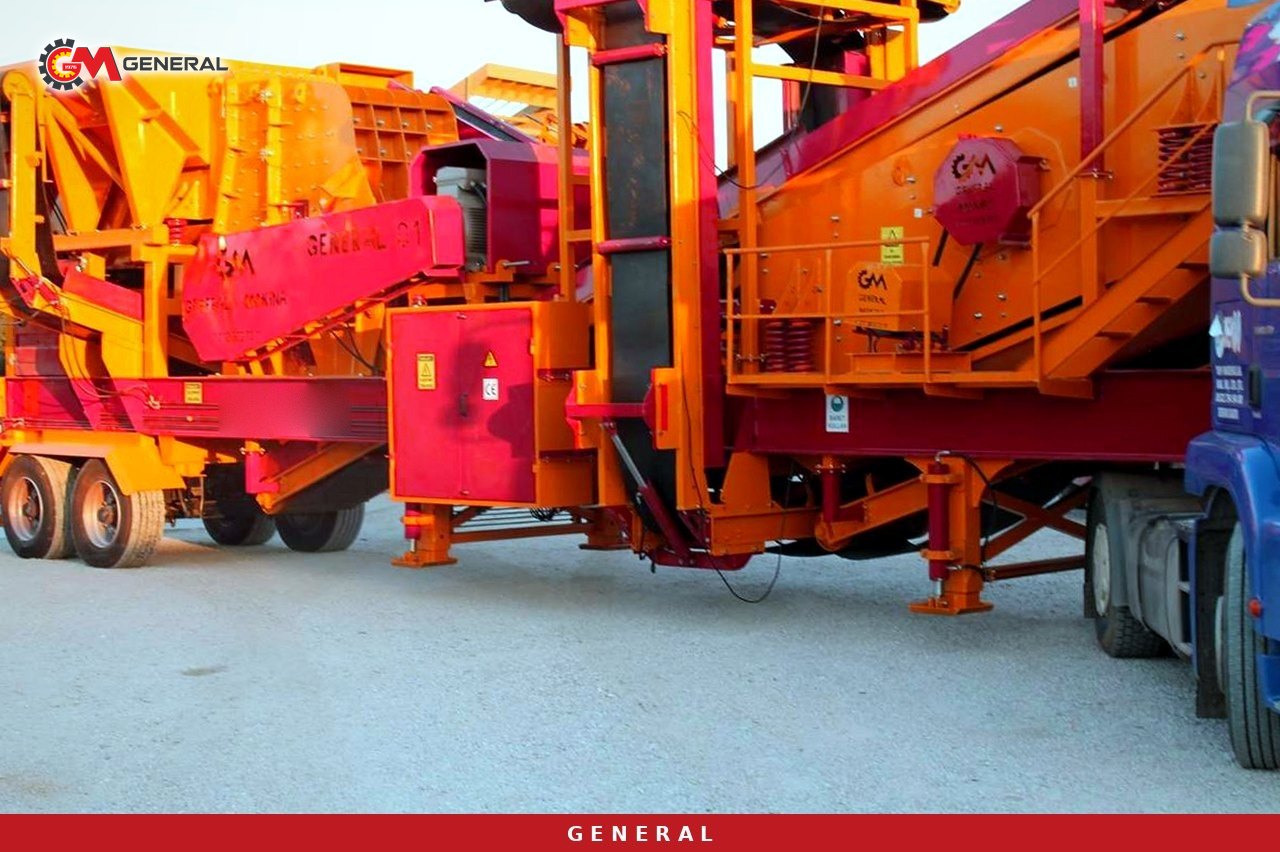
Riyadh side: impact-based General 01 and General 02
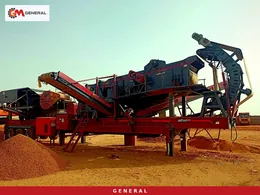
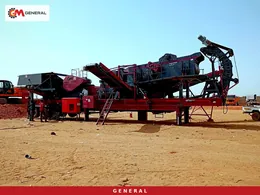
On a site fed with clean limestone, General 02 covers the top of the band on its own with 250-300 t/h capacity and a 1000 mm feed opening. Its GPS 1413 crusher belongs to the same family as the PDK02 working in our GNR PDK 02 stationary plant project in Saudi Arabia which produces 250 t/h in desert conditions. If the target is around 150 t/h, General 01 is enough: its GPS 1210 rotor handles primary and secondary duty in one body, so no separate second crusher is needed. If the quarry has dense chert bands, reassess the impact choice after the abrasion test.
Jeddah side: jaw first, second stage as required
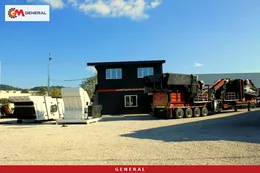
For granite and basalt feed in the lower band, General 950 and General 944 share the same GPJ 90 jaw, the same 800 mm feed size and the same 120-180 t/h output. The difference lies in the second stage: the GM430 cone on the 944 works by compression and extends metal life in abrasive rock, while the DMK01 impactor on the 950 gives higher reduction and a more cubical grain. For the upper band, GNR-MC110 offers the highest jaw-primary capacity in the family, with 200-300 t/h and a 900 mm feed. Because its two chassis can run independently, it is also possible to start with the primary group alone and add the secondary later.
Two cities, one or two units: configuration options
If one contractor runs jobs in both Riyadh and Jeddah, two separate units are almost always the more sensible route; moving a plant between the cities over and over costs both time and transport permits. In that case an impact-based General goes to Riyadh, a jaw-led line goes to Jeddah, and each unit keeps its own spare-parts list.
Demand approaching 250 t/h in a single city can be met in two ways: one large unit (General 02 in Riyadh, GNR-MC110 in Jeddah) or two smaller units running in parallel. Two units keep half of production going while one is under maintenance, but they need two operators, two generators and two stockpile areas. If the site will be permanent and the feed is limestone, a stationary layout is also worth considering; the options are on our crushers page.
Set-up and shipping on the urban fringe
Along the growth corridors of Riyadh and Jeddah, new residential districts are moving ever closer to the quarries. If you plan to set the plant up on a plot near housing, confirm noise and dust conditions, working hours and the truck route in advance with the local municipality and the relevant authority. Here the advantage of a wheeled plant is clear: since no concrete foundation or excavation is required, the unit can be towed to a new plot when the site changes.
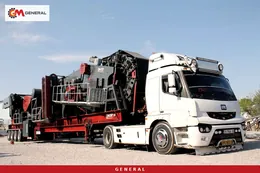
For shipments from Türkiye, Jeddah, as the Red Sea port, is the natural point of entry; a unit bound for Riyadh continues by road from there. Transport dimensions become important at this point: 4300×18500×4500 mm is given for General 01, 4340×20600×4500 mm for General 02 and 4130×20350×4500 mm for General 944 and 950. The two chassis of GNR-MC110 travel separately (primary 3000×13500 mm, secondary 4200×18300 mm). Plan heavy and oversize load permits together with your haulage company.
Heat, dust and continuous generator operation
On Saudi jobsites the plant usually runs on a generator, far from the grid. The power units in the table (550-750 kVA) vary by model; for the generator to deliver full load at high ambient temperatures, size it according to its manufacturer's derating values and clean the radiator regularly against sand build-up.
Dust is a critical issue both for neighbours on the urban fringe and for machine life. Measures that can be selected for the project include water spray nozzles at the crusher discharge and conveyor transfer points, screen and belt covers, filtered ventilation for the electrical panel and more frequent air filter changes. The touch panel of General 01 includes a soft starter and frequency control; internet-based remote monitoring is offered as an option and makes it easier to track stoppages on site during the hottest hours.
The site file to prepare before requesting a quote
For an accurate model recommendation, it is enough to send the following information together:
- Site location (around Riyadh or Jeddah) and the expected operating period.
- Rock type and laboratory results: abrasion index, compressive strength, silica content.
- Largest block size of the run-of-mine feed and its clay/soil content.
- Hourly target tonnage and number of daily shifts.
- Required fractions and the approximate share of each (concrete, asphalt, sub-base).
- Power source: generator or grid connection?
- Site surface, access road and stockpile area dimensions.
To see a wider range of models that might fit your needs, you can also browse our wheeled mobile crushing plants page.
Frequently asked questions
Would a jaw plant be the wrong choice for a limestone quarry near Riyadh?
Not wrong, but it often adds an unnecessary stage. On clean limestone, a primary impactor gives high reduction and cubical product in one body. If the quarry has dense siliceous bands, or there is a chance of processing hard rock on the Jeddah side later, a jaw-led sequence can be the more flexible investment.
Should a Jeddah site choose the 944 or the 950?
Both have the same tonnage and dimensions. If the stone is very abrasive and wear-part cost is your priority, choose the 944 (cone secondary); if cubical grain and high reduction for concrete come first, choose the 950 (impact secondary).
What warranty and certificates apply?
General Makina has been manufacturing in Izmir since 1976; the machines carry ISO 9001 and CE certification. The warranty period is 1 year, and wear parts are excluded from warranty cover.
What determines the price?
The model, type of second stage, number of screen decks, generator rating, options such as extra conveyors and dust suppression, and the shipping method all shape the quote. A project-specific offer is prepared once your site file is received.
Decision summary
In Riyadh's limestone quarries the impact-based General 01 and General 02 stand out; in Jeddah's igneous rock the jaw-led General 944, General 950 and GNR-MC110 lead. A single mid-size unit makes sense for around 150 t/h, General 02 or GNR-MC110 for demand approaching 250 t/h, and two separate units for simultaneous work in both cities. Contact us with your sample results and target fractions, and we will settle the right configuration for your site together.
Definitions of technical terms: Glossary