EN — English
 TR — Türkçe
 DE — Deutsch
 RU — Русский
 FR — Français
 ES — Español
 AR — العربية
 SR — Српски

Botswana Road Building Mobile Stone Crusher Plant 120-180 Ton Per Hour
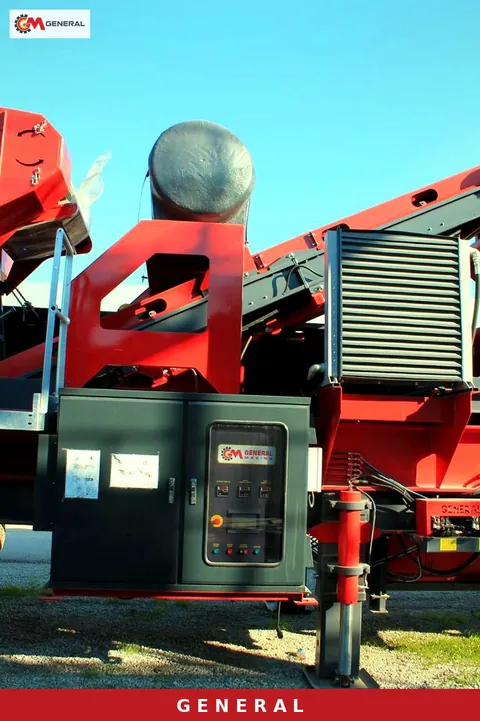
For a contractor who has just won a road tender in Botswana, the first problem is not the crusher but where the rock is. The Kalahari sand that covers the west and centre of the country leaves mile after mile of alignment without a single sound outcrop; hard rock surfaces mainly in the eastern Hardveld belt, around the Gaborone–Francistown corridor. Between the two lies a material every local road builder knows well: calcrete. When you plan a 120-180 TPH mobile stone crusher plant, these three facts have to be considered together: the hard stone may have to travel a long way, calcrete needs screening and blending more than crushing, and the plant must move as the road advances. Below we compare the real models that fit this picture using catalogue figures, explain which equipment should follow the crusher, and list the information to prepare before asking for a quotation.
Note: the Trans-Kalahari Highway, the A1 route or any other corridor named here is a geographic frame only. Layer thicknesses, grading envelopes and material requirements for a specific road job must be confirmed in the specification of the relevant road authority.
Sand, calcrete and hard rock: mapping road aggregate in Botswana
A road cross-section needs different materials for the subbase, the base and the surfacing seal. In Botswana the sources for these layers separate clearly by geography. Calcrete, widespread beneath and along the edges of the Kalahari cover, has long been used in the region as subbase and, where its properties allow, as base material. The old crystalline basement in the east holds granite, gneiss, dolerite dykes and quartzite; chippings for surface seals, concrete aggregate and high-strength base course usually come from there.
The practical result: on an alignment heading west, long truck haulage of hard aggregate may be unavoidable, while calcrete is often taken from borrow pits right beside the road. The mobile plant is positioned where these two flows meet. A map will not tell you which pit gives which value; take samples and have abrasion, plasticity and grading tests carried out in a laboratory.
Which material needs which crushing layout?
When one road project has two material streams, forcing both through a single crusher pushes both the equipment choice and the budget in the wrong direction. First separate what each material actually requires.
Calcrete: mostly a screening and blending job
Calcrete ranges from soft nodular material to hardened crust. In the soft, nodular zones you need a grizzly to remove oversize and blending to correct the grading more than you need a crusher. Hard calcrete boulders can go to the crusher, but if the fine, plastic fraction is high, crushing will not fix it; stabilisation with a binder may be required. So the first decision for calcrete is whether it will meet the specified envelope by screening, by blending, or with cement or lime.
Dolerite, granite and quartzite: genuine two-stage crushing
The hard rocks of the east are abrasive, and surface seals need cubical, clean chippings. Here a jaw primary, a second crushing stage and a multi-deck screen are essential. Whether the second stage should be a cone or an impact crusher depends on the silica content of the rock and the particle shape target.
Three models that sit in the 120-180 TPH band
Our wheeled mobile range has three plants whose catalogue capacity covers this tonnage. All three are rated at 120-180 t/h; they differ in crushing principle, feed opening and number of screen decks.
| Value | General 944 | General 950 | General 01 |
|---|---|---|---|
| Capacity | 120-180 t/h | 120-180 t/h | 120-180 t/h |
| Primary crusher | GPJ 90 jaw | GPJ 90 jaw | GPS 1210 impact (primary+secondary) |
| Second stage | GM430 cone | DMK01 impact | In the same body |
| Maximum feed | 800 mm | 800 mm | 700 mm |
| Screen | 1600×5000 mm, 3-deck horizontal | 1600×5000 mm, 3-deck horizontal | 1600×5000 mm, 4-deck |
| Product fractions | 0-5 / 5-12 / 12-19 mm | 0-5 / 5-12 / 12-19 mm | 0-5 / 5-12 / 12-19 / 19-40 mm |
| Generator | 550 kVA | 600 kVA | 550 kVA |
| Weight | 70,000 kg | 70,000 kg | 55,000 kg |
| Transport dimensions | 4130×20350×4500 mm | 4130×20350×4500 mm | 4300×18500×4500 mm |
If wear-part life is the priority in siliceous stone such as dolerite and quartzite, the General 944 is the right starting point: its GM430 cone works by compression and gives longer part life in abrasive rock than an impact rotor. If particle shape and a high reduction ratio matter most for seal chippings, the General 950 built on the same chassis size, is the one to assess. If most of the material is calcrete or less abrasive stone and the base course also needs a 19-40 mm fraction, the General 01 is a lighter option with two stages in one body and a 4-deck screen. All three have a 0-100 mm output setting; screen apertures are fixed at order stage according to the specified grading. For other tonnages, see our wheeled mobile crushing plants.
A pugmill behind the crusher: mixing the base course on site
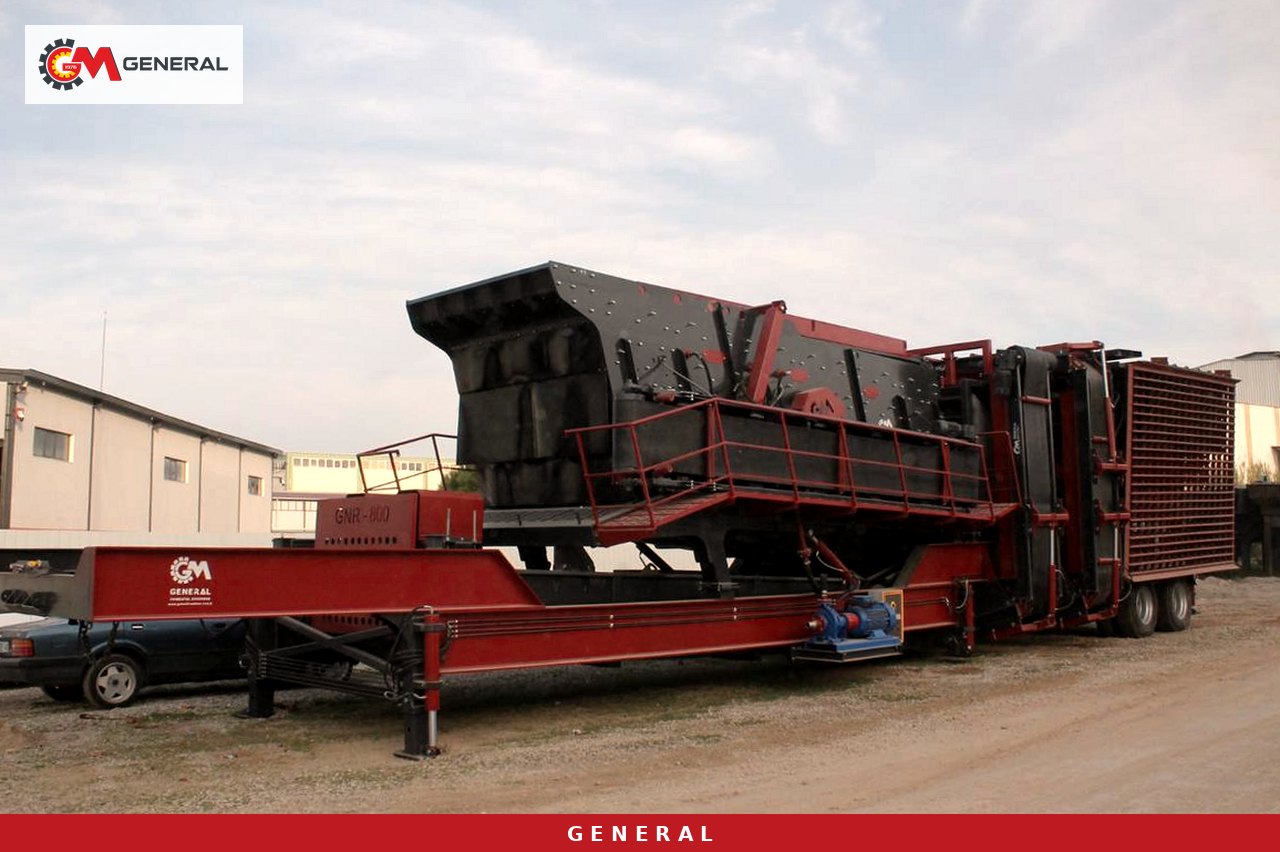
On Botswana road jobs a crushing plant alone is often not enough. When calcrete has to be blended with crushed hard aggregate, or a cement-bound base is specified, you need a plant that weighs and mixes the fractions coming from the crusher. A mobile pugmill plant does this: 3-5 cold bins dose different fractions separately, cement is added by bulk dosing, a twin-shaft mixer (2×22 kW) homogenises the mix and the product is loaded into trucks from a 25 m³ loading hopper. Its capacity is 200-600 t/h.
That figure matters: the mixing capacity of the pugmill is above the 120-180 t/h crushing line. So the pugmill is not coupled directly behind the crusher; the crusher produces to stockpiles, and the pugmill draws from these stockpiles and from the calcrete borrow pit. This layout stops the two plants from waiting on each other. For projects that want a permanent base, options are in the pugmill plants for road base category.
Relocating the plant as the alignment advances
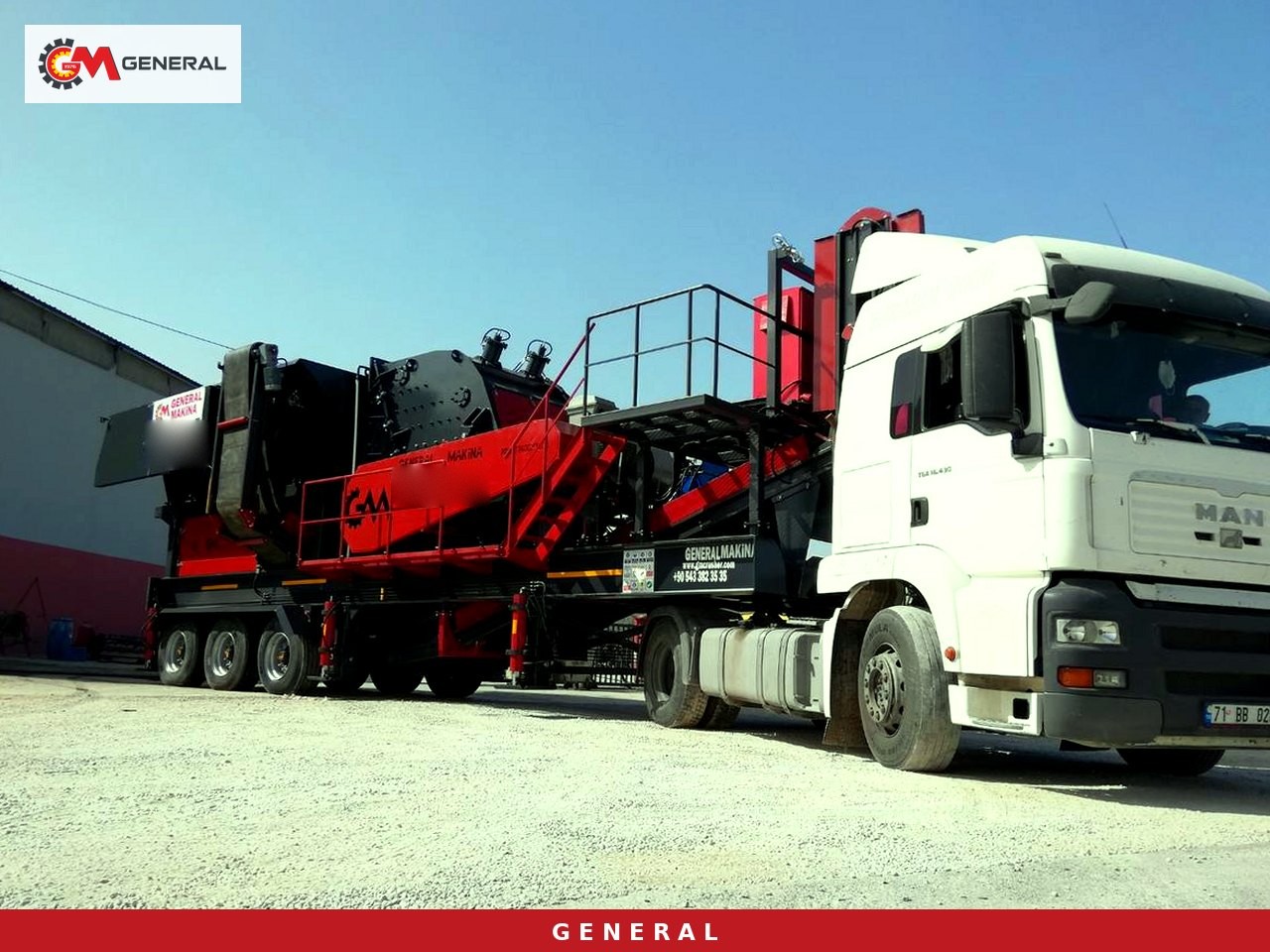
Fixing the plant at one point on a linear road job means hauling base material a little further with every kilometre. This is where a wheeled chassis pays off: the plant is hitched to a tractor unit, taken to the next stockpile area and set up on hydraulic legs and folding conveyors without a concrete foundation. Transport planning is based on these values: 70,000 kg and 4130×20350×4500 mm for the General 944 and 950, 55,000 kg and 4300×18500×4500 mm for the General 01. Check in advance with the haulier that bridges and passages on the route accept these dimensions and weights, together with heavy-load permits.
When choosing a set-up location, balance the distances to the hard rock quarry and to the calcrete borrow pit. A good rule: put the plant close to the source of the material that moves the most tonnes.
Dry air, dust and production off the grid
Most of Botswana has a semi-arid climate, and in the dry season fine dust strains both environmental compliance and the machine itself. Because road alignments are often far from the grid, power also comes from a generator: 550 kVA for the General 944 and 01, 600 kVA for the General 950. Measures that can be selected per project: water-spray dust suppression at transfer points, conveyor covers, pre-filters for the generator and hydraulic unit, and radiator cleaning on the daily checklist. If water is scarce, the volume needed for dust suppression and its storage should be discussed separately at quotation stage.
Pre-quotation checklist
- Grading envelopes from the specification (subbase, base, seal chippings).
- Laboratory results for hard rock and calcrete samples: abrasion, plasticity, grading.
- Daily target tonnage and shift pattern; how much is crushing and how much is blending.
- Distances between the pits and the alignment, and any haul road restrictions.
- Power source: grid available or generator?
- Water access and dust suppression requirements.
- Whether a pugmill or cement-bound base is needed.
How these points translate into a road job is covered in detail in our article on plant configuration for road construction and sub-asphalt material.
Frequently asked questions
Does calcrete always need a crusher?
Not always. Soft, nodular calcrete often meets the specification with grizzly screening and blending; hard boulders need a crusher. The decision follows the sample tests.
Can the same plant produce both chippings and base material?
Yes, the screen decks and apertures are chosen for it. The 4-deck screen of the General 01 delivers four fractions including 19-40 mm; the General 944 and 950 produce 0-5, 5-12 and 12-19 mm with a 3-deck screen.
What do the warranty and certificates cover?
Our plants carry ISO 9001 and CE certification. The warranty is 1 year excluding wear parts; jaw plates, cone liners and blow bars should be planned as consumables.
What determines the quoted price?
The chosen model, whether the generator is included, any extra screen or pugmill, and the shipping route. Once you send these details, a project-specific quotation is prepared.
Conclusion
For a 120-180 TPH road plant in Botswana, the right choice starts by separating the materials: General 944 for hard, siliceous stone, General 950 when particle shape comes first, General 01 for calcrete-heavy work that needs 19-40 mm. Where blending or a cement-bound base is required, a mobile pugmill joins the crusher. Send your specification gradings and sample results through our contact page and we will define the right line for your alignment together.
Definitions of technical terms: Glossary