EN — English
 TR — Türkçe
 DE — Deutsch
 RU — Русский
 FR — Français
 ES — Español
 AR — العربية
 SR — Српски

Liberia Monrovia Rainy-Season Crusher and Screener Plant 80-150 TPH
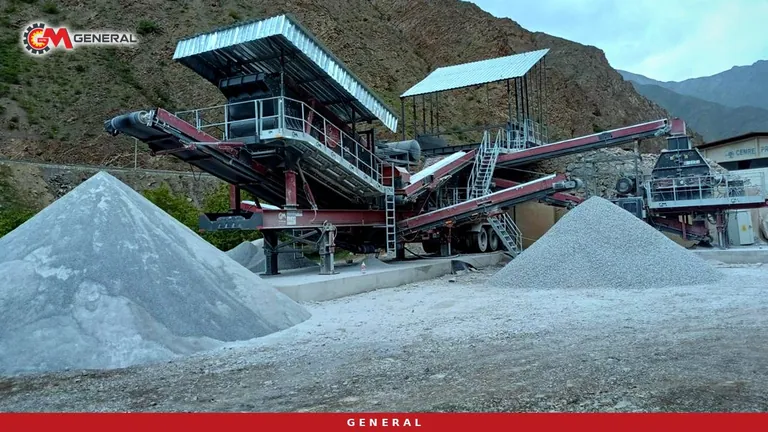
A contractor who opens a quarry near Monrovia, or who needs chippings for a road package, usually gets a misleading picture in the first dry month: belts run clean, the screen stays open and the tonnage holds. Once the rains arrive, the same machine slips below its 80-150 TPH target because red laterite mud bridges the feed hopper, fine clay blinds the screen cloth and wet belts start to slip. This article explains which machine layout, which feeder and which site arrangement keep a crusher and screener plant producing through the Liberian wet season, using only figures published on our product pages.
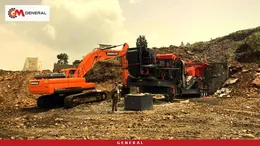
Hard rock in Liberia is mostly basement rock such as granite and gneiss, covered by a lateritic soil mantle whose thickness changes from place to place. In the dry season that overburden can be stripped and pushed aside. In the rainy season the stripping face, the haul roads and the stockpile area are all coated with the same mud, and every excavator bucket brings rock with wet clay stuck to it. That clay load is the parameter that really changes the crusher choice. The final decision should rest on a sand equivalent (SE) or methylene blue (MBV) test and a rock strength analysis of a sample from your own quarry.
Where does the rainy season stop a crushing line?
Most wet-season stoppages do not happen inside the crusher; they happen on the way into it and on the way out. These are the five choke points we meet most often on site:
- Hopper and grizzly: sticky, clayey fines pack the gaps between static grizzly bars, the by-pass stops working and mud goes straight into the crusher.
- Crusher mouth: in a jaw crusher clay smears onto the jaw plates and narrows the discharge setting; in an impactor it builds up behind the breaker plates.
- Screen cloth: wet 0-5 mm material closes the apertures of the bottom deck, the product gets contaminated with fines and the return belt carries useless load.
- Belt transfer points: mud accumulates in chutes, belts slip and scrapers cannot keep up.
- Ground: soil softens under the hydraulic legs, the chassis loses level and trucks cannot reach the hopper.
So the right question around Monrovia is not “which crusher?” but “where will the clay be removed before it reaches the crusher?”. The options below give three different answers to that question.
Three routes, chosen by clay load
Heavy clay: crushing, washing and screening on one chassis
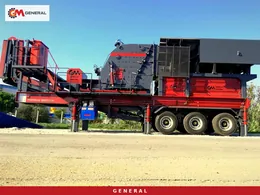
If clean aggregate is impossible without washing the clay off the rock, look at the Mobil 90 crushing, washing and screening plant which does all three jobs on one vehicle instead of adding a separate wash plant to a dry mobile crusher. Its GPJ 90 primary jaw accepts feed up to 800 mm; a 1600×5000 mm 3/4-deck washing screen both washes the material and splits it into fractions; a 600×6000 mm twin screw washer recovers the 0-5 mm sand instead of losing it to the water. Capacity is 90-150 tph, covering most of the title band with one unit. Products come out as 0-5, 5-20 and 20-60 mm. If finer or more cubical product is needed, a secondary cone or impact crusher can be added, as the product page states.
Moderate clay: a feeder built for wet feed, with dry crushing
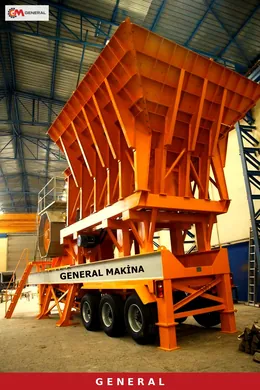
When the clay is a thin coating on the rock and the specification does not call for washing, the problem is often solved at the feeder. A vibrating grizzly feeder is the right tool for dry, abrasive material; on wet and sticky feed its grizzly blinds. The wobbler feeder works like a self-cleaning moving grate with continuously rotating elliptical disc shafts: muddy fines drop through, coarse rock travels on to the crusher. The GWB1136 model is 1100 mm wide and 3600 mm long, has an 18.5 kW motor, a feed capacity of 75-600 tph and a maximum feed size of 1500 mm. It is placed ahead of a crusher unit as a line component, engineered per project.
Clean rock, heavy rain: dry mobile plant plus site discipline
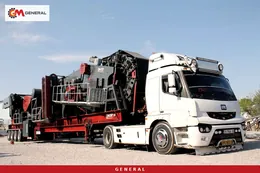
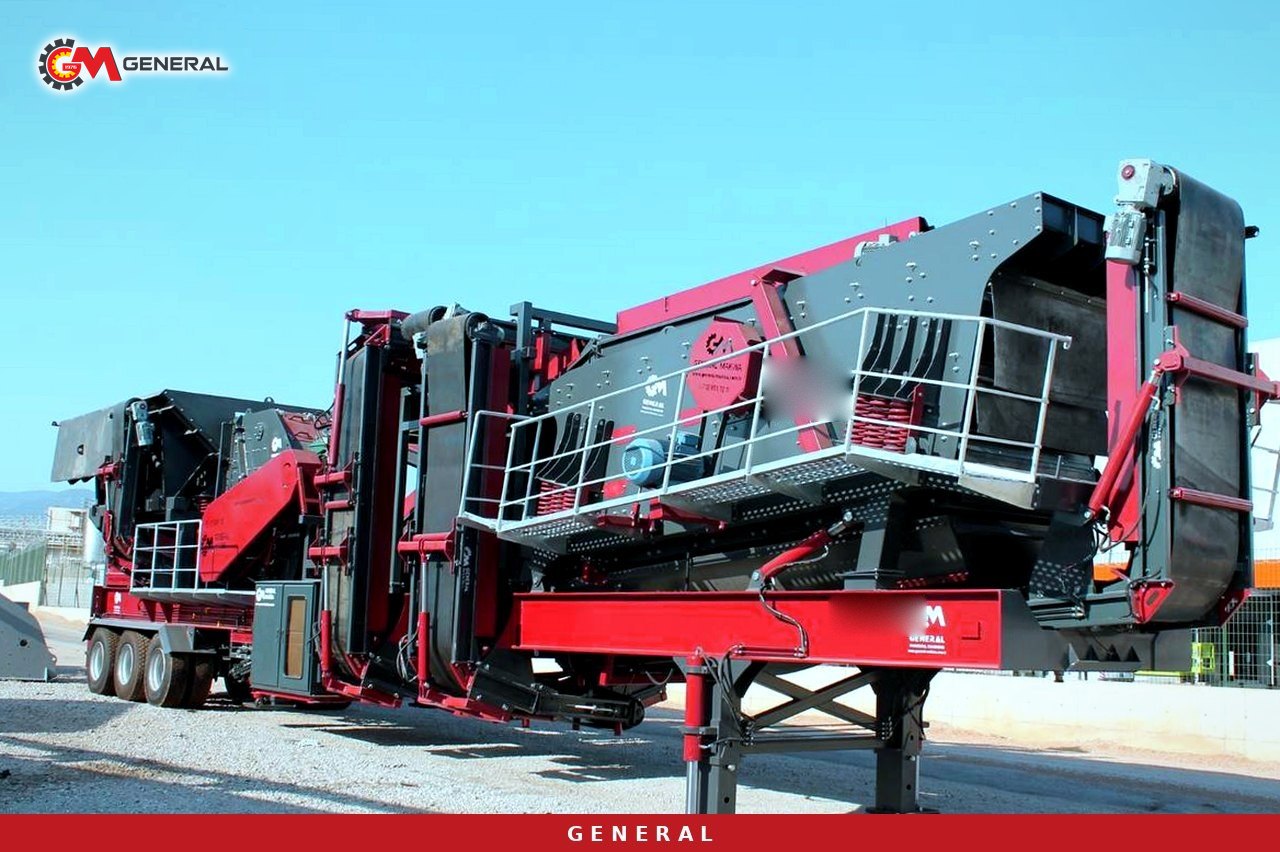
If the rock comes out of the deeper benches clean, the problem is mostly drainage, stockpiles and ground. In that case the General 800 which sits exactly in the 80-150 tph band, or the General 950 for hard, abrasive rock such as granite, comes into play. Which one fits depends on the rock type; the table in the next section shows the difference.
Comparing models in the 80-150 TPH band
The values in the table are taken unchanged from the relevant product pages. Screen apertures and final gradation are set per order for the material. We do not estimate values that are not listed.
| Model | Capacity | Max. feed | Crusher | Screen / washing | Generator | Weight |
|---|---|---|---|---|---|---|
| Mobil 90 | 90-150 t/h | 800 mm | GPJ 90 jaw | 1600×5000 mm washing screen + 600×6000 mm twin screw | 350 kVA | 45,000 kg |
| General 800 | 80-150 t/h | 600 mm | PDK 1280 primary impact | 1300×4000 mm triple-deck, no washing | 450 kVA | 35,000 kg |
| General 950 | 120-180 t/h | 800 mm | GPJ 90 jaw + DMK01 impact | 1600×5000 mm triple-deck, no washing | 600 kVA | 70,000 kg |
| General 944 | 120-180 t/h | 800 mm | GPJ 90 jaw + GM430 cone | 1600×5000 mm three-deck horizontal, no washing | 550 kVA | 70,000 kg |
| GWB1136 wobbler feeder | 75-600 t/h | 1500 mm | — | Pre-scalping on rotating disc shafts | (18.5 kW motor) | — |
The practical reading is this: on abrasive granite and gneiss the breaker plates of the primary-impact General 800 wear fast, and its product page recommends it for limestone and low-abrasive stone. On Liberia's basement rock, a jaw-first layout (Mobil 90, 950 or 944) makes more sense. The 950 and 944 start above the lower end of the band; for an 80-100 tph need they run at part load and stress the metal less, but they are also heavier and need more generator power.
Preparing a Monrovia-area site for the wet season
No machine gets through the rains comfortably on a pad where water collects. Finish these points in the dry months when choosing the set-up location:
- Compacted, sloped pad: fill and compact the area under the hydraulic legs and chassis with coarse crushed rock so surface water runs away from the plant.
- Perimeter drainage: dig ditches around the pad and, with a wash plant, route muddy water to a settling pond.
- Haul road: if the hopper ramp and turning area are not reinforced with stone, truck traffic is the first thing to stop in the rain.
- Stockpile layout: put the fine product (0-5 mm) on high, drained ground; it holds water when soaked and upsets the water ratio of the material going to a batching plant.
- Generator and panel: set the generator and control panel on raised ground out of reach of flood water and keep cable runs away from puddles.
- Stripped overburden: stockpile the laterite cover away from the feed area. If rain washes that heap back onto the quarry floor, the feed gets contaminated.
Operator habits that prevent blockage and overload are covered in detail in our article on preventing blockage and overload in mobile crushers. In the wet season those rules matter twice as much.
Port and road: shipping to Monrovia
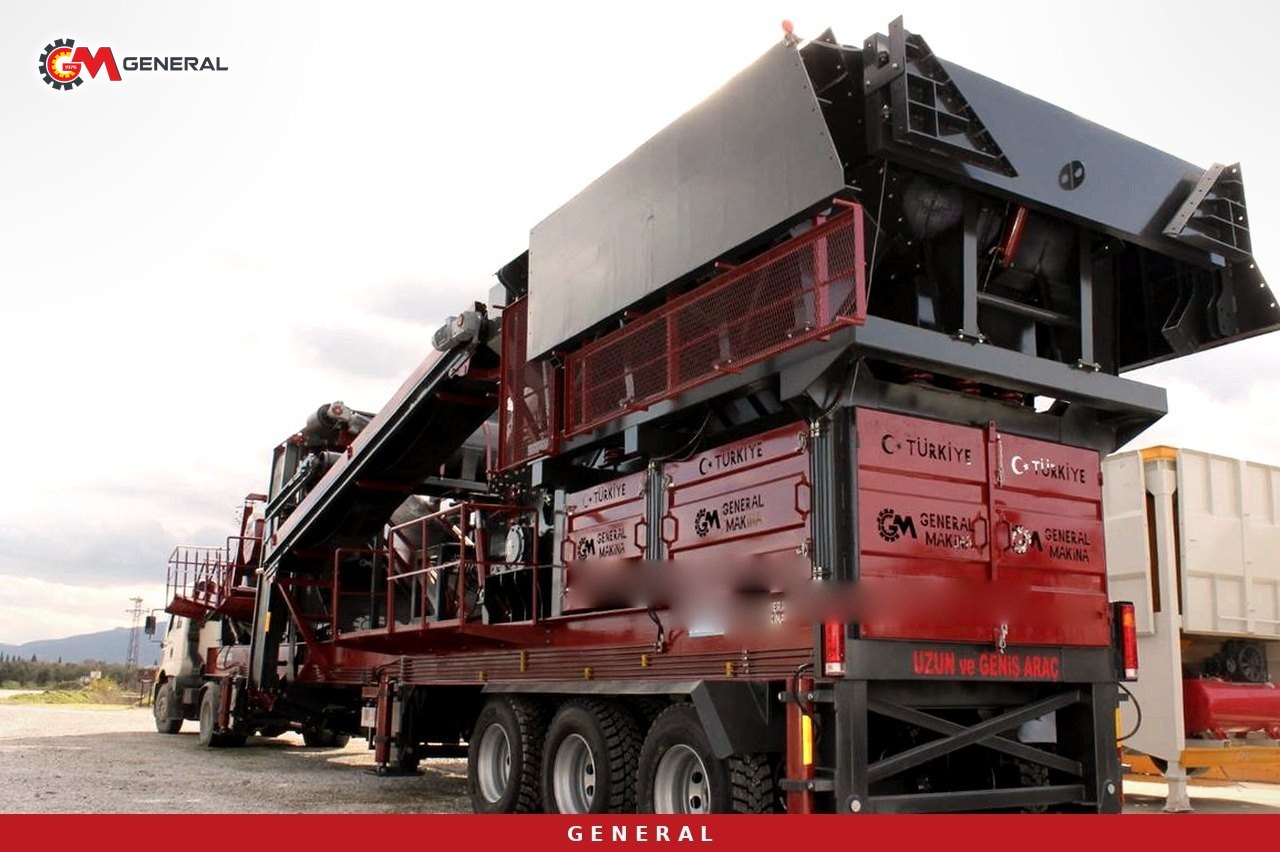
Wheeled plants leaving Izmir travel by sea to the port of Monrovia and from there by road to site. This plan carries two rain risks. First, laterite roads outside the city become difficult for heavy, long vehicles in the wet season, so have the tractor-trailer route and the last kilometre to site checked during the dry period. Second, once a wheeled chassis is set up, moving it in the rain is risky. If you plan to relocate the plant, schedule site changes for the dry months.
Transport dimensions are listed on the product pages: 3600×15700×4500 mm for the Mobil 90, 3600×15500×4500 mm for the General 800, and 4130×20350×4500 mm for the 950 and 944. Crushing, screening and washing plants can come from a single builder on one order, so responsibility and the spare-parts chain stay in one hand. All dry and wet options are listed under wheeled mobile crushing plants and sand washing and dry screening plants.
Wear and daily maintenance in the wet season
Wet clay raises wear in two ways: sandy mud scours belt scrapers and chute liners like sandpaper, and clay reaching a jaw crusher coats the crushing faces and lowers efficiency. In practice this means washing down the hopper, chutes and underside of the screen at the end of each shift, checking scraper adjustment daily and reviewing screen apertures at the first sign of blinding. On a washing plant such as the Mobil 90, the capacity of the water source and settling pond directly limits output, so plan the water together with the machine. Our products carry a 1-year warranty; wear parts are excluded.
Frequently asked questions
Which model covers 80-150 TPH most safely in the rainy season?
If the rock carries clay that must be washed off, the Mobil 90 (90-150 tph) does it on one chassis. If the rock is clean and soft like limestone, the General 800 (80-150 tph) fits; if it is hard and abrasive, the General 950 or 944 (120-180 tph) is the better match. The final choice should follow a sample test.
Can a wobbler feeder be added to any mobile plant?
The GWB1136 wobbler feeder is a line component placed ahead of a crusher through project engineering. Which crusher it pairs with and which hopper volume it uses (within 15-100 m³) depend on your site and crusher model.
How is power supplied on an off-grid site in Liberia?
The models in the table are configured to run on a generator: 350 kVA for the Mobil 90, 450 kVA for the General 800, 600 kVA for the 950 and 550 kVA for the 944. Fuel use depends on the rock, load ratio and operating hours, so we do not quote a fixed figure.
What determines price and delivery time?
Model, washing equipment, feeder type, generator, screen configuration and the shipping method to Monrovia set the price. Delivery time depends on the production schedule at the time of order. We give both in a written quotation.
Conclusion and quotation
Producing 80-150 TPH through the Liberian rainy season starts with deciding where clay leaves the flow before it reaches the crusher: crushing, washing and screening on one chassis for heavy clay, a dry line with a wobbler feeder for moderate clay, and a rock-matched dry mobile plant with good drainage for clean rock. As a manufacturer building in Izmir since 1976, we will work out the right layout with you once you send sample data from your quarry, target product fractions and site conditions. For a quotation, write to us through our contact page.
Definitions of technical terms: Glossary