EN — English
 TR — Türkçe
 DE — Deutsch
 RU — Русский
 FR — Français
 ES — Español
 AR — العربية
 SR — Српски

Khartoum Road Projects Wheeled Stone Crushing Plant 150-250 TPH
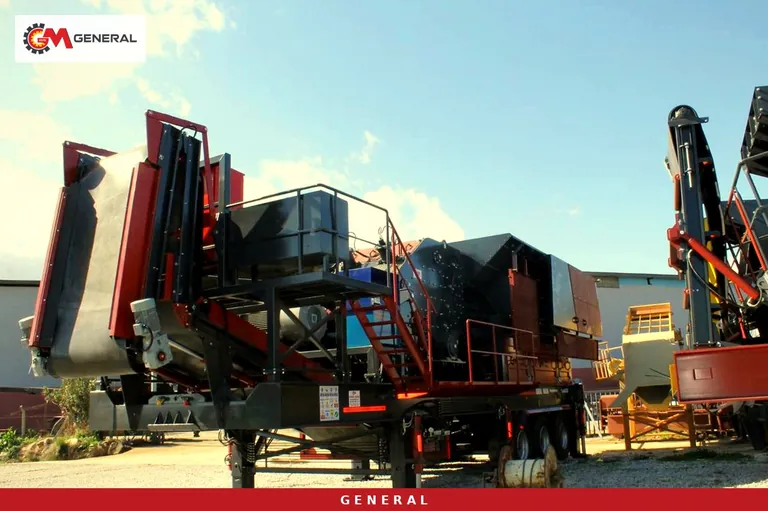
For a contractor working on the road network linking Khartoum, Omdurman and Bahri, aggregate supply cannot be settled with a single tonnage figure. The same alignment needs separate fractions for sub-base, base course, asphalt binder and wearing course, plus culvert concrete, and each calls for a different crushing stage and a different screen aperture. This article reads a 150-250 TPH target against the variety of rock between the Nile valley and the desert margin, and against the need to move a wheeled chassis along the route. Every model and figure quoted comes from the technical tables on our product pages; the project's own specification must always be confirmed with the relevant authority.
Working back from the road layers: the fraction list for Khartoum projects
Machine selection should start from the road cross-section, not from the crusher. The sub-base layer is filled with a coarser mix that tolerates wider limits; the base course needs material that sits on a defined grading curve, with coarse and fine particles meeting in the right proportion. Aggregate for the asphalt layers arrives with a tighter specification still: particles must be cubical, flaky and elongated content must stay limited and surfaces must be free of clay and dust. Culverts, bridge piers and ditch linings add their own demand for 5-12 and 12-19 mm.
On a long road section most of the tonnage goes into base and sub-base. Asphalt aggregate is smaller in volume but narrower in specification. A plant working in the 150-250 TPH band should therefore produce mainly base material during the day while stockpiling asphalt and concrete fractions separately. The four-deck screen fitted to most of our wheeled plants splits 0-5 / 5-12 / 12-19 / 19-40 mm in a single pass and covers that need.
If the base course is to be cement-stabilised, a pugmill is added downstream of the crushing and screening line. The mobile soil stabilization plant works at 200-600 t/h, dosing aggregate from 3-5 cold silos and blending it with cement and water in a 2×22 kW twin-shaft mixer. Plan the crushing plant's output so that it can feed the pugmill's demand; otherwise the pugmill will sit idle.
Rock around Khartoum: sandstone, basement rock and Nile gravel
Quarry candidates around Khartoum generally fall into three groups. Which one is used depends on haul distance to the alignment and on the abrasion limits in the specification. Once a source is chosen, have samples tested by an independent laboratory for abrasion loss, crushing strength and abrasiveness; the assessments below do not replace those tests.
Sandstone quarries
The sandstones that are common in the region span a wide range of hardness. Weakly cemented beds break up easily in an impact crusher and generate plenty of fines; they serve the base course but often fall short for an asphalt wearing course. Dense, silica-rich beds, on the other hand, can consume impactor blow bars faster than expected. Do not commit to an impact primary until the sandstone class is known.
Basement rock such as granite and gneiss
Hard, abrasive basement rock such as the granite and gneiss outcropping further north is a more dependable raw material for asphalt aggregate. In this stone a jaw crusher working by compression is the right first stage, because jaw plates do not wear as fast as the parts of an impact primary. In the second stage an impactor gives cubical particle shape, while a cone puts metal life first.
Nile valley gravel deposits
Riverside gravel deposits arrive round-grained and usually mixed with sand, silt and clay. Rounded particles weaken interlock in asphalt, so they must be crushed to an angular shape. Where clay content is high, consider removing fines with grizzly pre-screening ahead of the crusher and, if necessary, adding washing.
Real models for a 150-250 TPH target
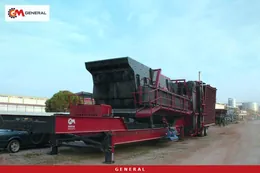
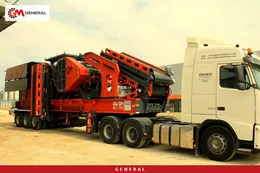
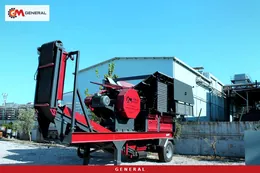
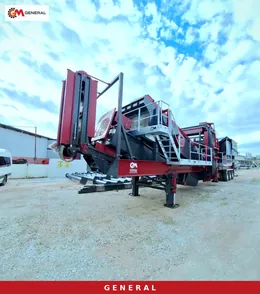
The single-chassis and two-unit configurations that cover this band are set side by side below. Figures are taken from the product pages in the wheeled mobile crushing plants and single-chassis mobile crusher units categories; unknown cells are marked "—".
| Configuration | Capacity | Max. feed | Crushers | Screen | Generator | Weight |
|---|---|---|---|---|---|---|
| GNR-MC110 (twin chassis) | 200-300 t/h | 900 mm | GPJ 110 jaw + DMK03 impact | 2000×6000 mm, 4-deck | 750 kVA | 55,000 kg + 55,000 kg |
| General 03 | 250-375 t/h | 900 mm | GPS 1415 impact | 2400×5000 mm, 4-deck | 750 kVA | — |
| General 02 | 250-300 t/h | 1000 mm | GPS 1413 impact | 2000×5000 mm, 4-deck | 660 kVA | 76,000 kg |
| General 950 | 120-180 t/h | 800 mm | GPJ 90 jaw + DMK01 impact | 1600×5000 mm, 3-deck | 600 kVA | 70,000 kg |
| GNR 110 primary jaw unit + M-DMK 02 | 180-300 t/h + 150-250 t/h | 0-1100 mm | GNRK 110 jaw + secondary impact | — | — | 55,000 kg + 38,000 kg |
If asphalt aggregate is to be made from hard basement rock, the GNR-MC110 sits at the centre of this table. Because it carries the jaw primary and the impact secondary on two separate chassis, the weight is split across two platforms and the primary group can run on its own. If the alignment needs only sub-base in the first months, the primary chassis can go to site first and produce coarse material, with the secondary chassis added when required.
If sandstone tests show low abrasiveness, single-chassis impact-primary plants such as the General 03 or General 02 open a more economical route. The General 03 is set up on folding hydraulic conveyors and hydraulic legs without excavation or a concrete foundation; run in the lower part of its 250-375 t/h band, it covers the top end of the 150-250 TPH target with reserve. The General 950 delivers 120-180 t/h on its own: enough for the lower end of the target, while two units can be planned together for the upper end.
The combination in the last row needs a separate screening unit for full gradation. It makes sense for contractors who want to buy the crushing stages individually and grow the line step by step. Our hard-rock selection guide covers model choice for basalt and granite in more detail.
What a wheeled chassis means along the route
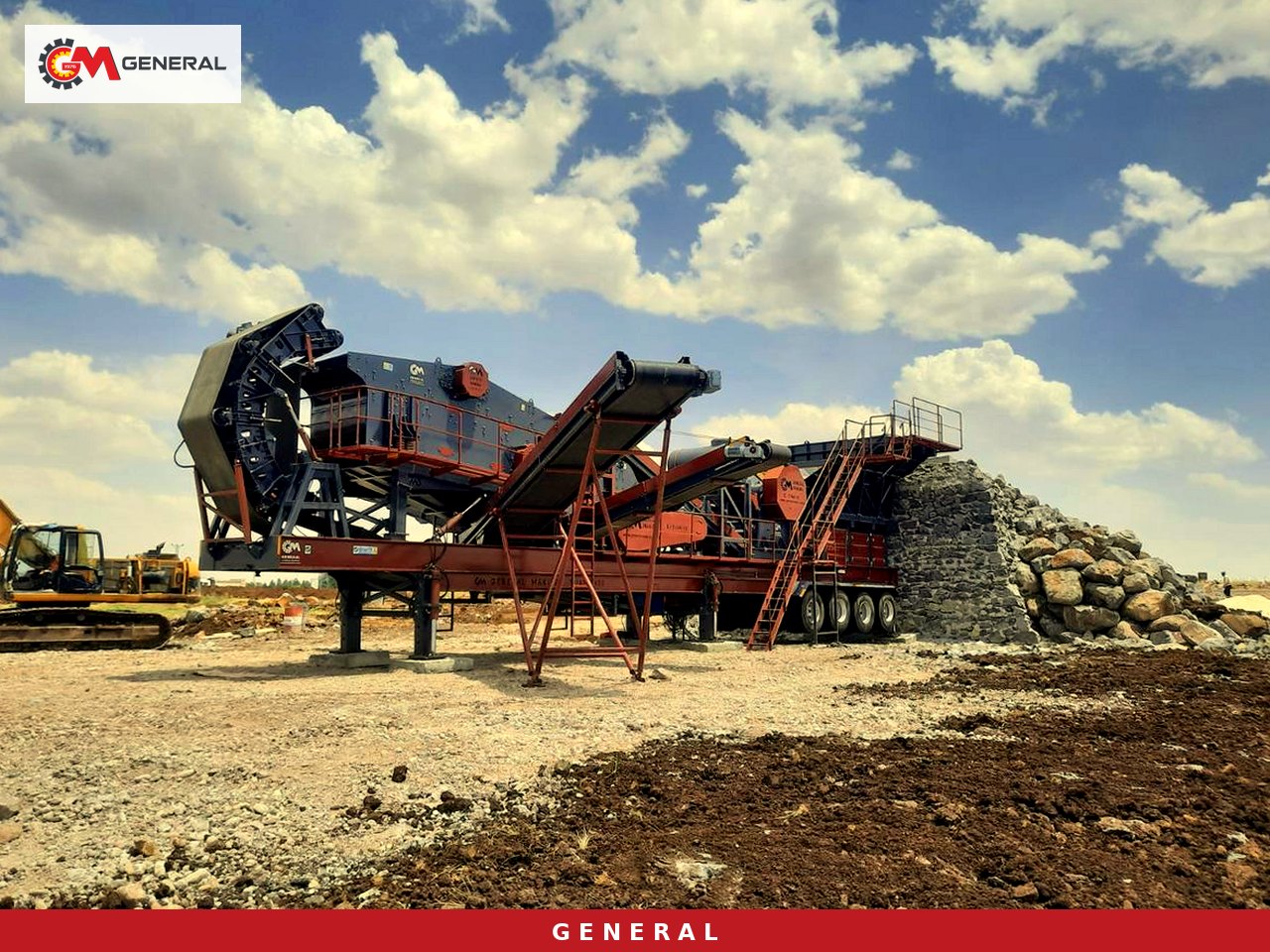
On a road project the quarry rarely stays fixed. As the alignment advances, haul distance grows and the cost per truckload rises; beyond a certain point it becomes more sensible to move the crusher to a new quarry or to a roadside cut surplus. A wheeled chassis simplifies that decision: the plant is hitched to a tractor unit, set down on hydraulic legs at the new location and starts work without waiting for a concrete foundation.
Two points stand out in transport planning. The first is the road leg from the seaport to Khartoum for equipment arriving by sea; check with the haulier beforehand whether bridges and bends on the route accept the axle load and chassis length. The split weight of the GNR-MC110 is an advantage here. The second is the ground on site: in sandy, loose soil, compacted fill or steel plates under the legs stop the plant from settling under vibration.
Heat, dust and running on a generator
Most remote quarries around Khartoum have no grid connection, so the plant runs on its own generator. The kVA values in the table are the standard power units of each model. In hot weather, however, generators and electric motors can lose output, so confirm generator and panel selection with the manufacturer for the actual site conditions.
Dust governs the life of both the machine and the crew. Measures that can be selected per project include water-spray dust suppression at the crusher mouth and transfer points, conveyor covers, heavy-duty filters on engine and compressor intakes, and fan or air-conditioned cooling for the electrical panel. After a sandstorm, filter checks and idler cleaning belong on the daily checklist.
Wear parts are tied directly to climate. In dry, abrasive dust the life of jaw plates, blow bars and screen meshes can shorten. Planning manganese cast jaw plates, a blow-bar material suited to the site and an adequate wear-part stock in the first order prevents production from stopping for days at a remote site.
Site data to settle before requesting a quote
The more completely you send the following information, the more accurately we can propose a configuration:
- Quarry rock type and any laboratory results (abrasion loss, crushing strength, abrasiveness)
- Largest block size of the run-of-mine material and its clay-silt content
- Fractions in the specification and the daily or monthly demand for each
- Daily operating hours and number of shifts
- Whether grid power exists and, if so, voltage and frequency
- Road route from port to site and any known axle-load or height limits
- Expected relocation frequency along the alignment and distance between quarries
- Pugmill requirement if the base course will be stabilised
Frequently asked questions
Is an impact primary enough for sandstone around Khartoum?
If tests show low abrasiveness, yes; impact-primary plants such as the General 03 or General 02 run economically in that case. In hard, silica-rich sandstone, a jaw-primary GNR-MC110 or General 950 is the safer choice.
How often should the plant move as the road advances?
The balance between truck haulage cost and relocation plus re-setup cost decides it. As a hypothetical example: because haulage cost per tonne rises with distance, moving to a new quarry pays once total haulage cost exceeds the cost of relocating.
What determines generator capacity?
Each model's standard power unit is sized for its crushers, screen and conveyors: 750 kVA on the GNR-MC110 and General 03, 660 kVA on the General 02. If extra equipment (washing, pugmill, lighting) is added on site, the power demand must be recalculated.
Which items determine the quoted price?
The chosen crushing stages, number of screen decks, options such as generator and dust suppression, the spare wear-part package and the shipping method set the price. Our plants carry ISO 9001 and CE certification and a 1-year warranty (wear parts excluded).
Conclusion
There is no single right model for a 150-250 TPH target on road projects around Khartoum; the quarry stone and the fraction list in the specification give the answer. The GNR-MC110 leads in hard basement rock, the General 03 or General 02 in low-abrasion sandstone, and a combination of single-chassis units where staged growth is planned. Our team, building crushing and screening plants in Izmir since 1976, finalises the configuration with you once your site data are in. For a quote and a technical discussion, reach us through our contact page.
Definitions of technical terms: Glossary