EN — English
 TR — Türkçe
 DE — Deutsch
 RU — Русский
 FR — Français
 ES — Español
 AR — العربية
 SR — Српски

Libya Road Base Aggregate Crushing Plant 150-250 TPH for Plant-Mix
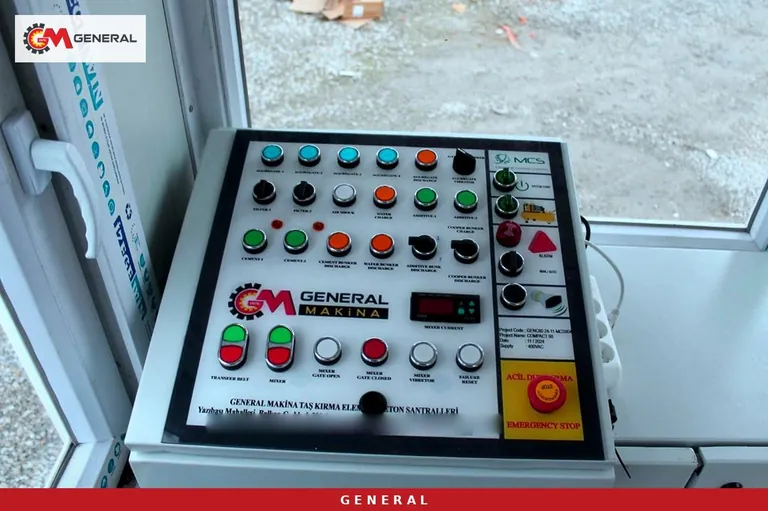
For a contractor taking on a highway or urban road rehabilitation job in Libya, the real bottleneck is often not the asphalt but the plant-mix base layer laid beneath it. That layer is made by blending crushed stone that sits on a defined grading curve with cement or binder and water; every load that drifts outside the curve loses bearing capacity after compaction. This article walks through a crushing and screening plant producing plant-mix aggregate at 150-250 TPH, the conditions on a Libyan site, and the control logic that ties the crushing line to the mixing unit.
The crusher's real job on a plant-mix line: the curve, not the tonnage
At an aggregate quarry the value of what is sold is mostly measured in tonnes. Plant-mix is different: the fine, medium and coarse proportions entering the mixer must stay inside the specification envelope. So the first question in crusher selection is not "how many tonnes per hour?" but "which fractions does it produce, in what ratio, and how consistently?"
In practice three things decide the outcome. First, particle shape: impact crushers give cubical, well-graded product in limestone, which helps interlock during compaction. Second, the number of screen decks: the more fractions you have, the more room the pugmill's cold silos have to correct the blend. Third, continuity of feed: if soil and clay are not removed at pre-scalping, the plasticity of the fine fraction rises and lab results fail. Because the grading and plasticity limits applied by Libyan road authorities and their consultants can vary from project to project, always confirm the exact envelope in the relevant authority's technical specification.
Raw material in Libya: coastal limestone and harder rock inland
Along Libya's Mediterranean coast and around the Jebel Akhdar, limestone and dolomitic limestone quarries are common. Further south and inland, basaltic volcanic fields and sandstone units appear. That split directly determines the crusher type, and different sections of the same road project may even draw on different quarries.
Limestone and low-abrasion stone
If a road section near Tripoli, Misrata or Benghazi is fed from a limestone quarry, the impact crusher leads. It delivers a high reduction ratio in one stage, produces cubical product and often removes the need for a secondary crusher. The point to watch with this material is separating clay and topsoil from the overburden at the grizzly feeder.
Basalt, quartzite and hard sandstone
Inland, high-silica rock consumes impactor hammers and liners quickly. Here a layout with a jaw crusher up front and a cone or impact secondary behind it makes more sense. For the abrasiveness and compressive strength of a particular quarry, we recommend sampling and lab testing before crushing; the crusher type should be decided on those results.
Real configurations for 150-250 TPH
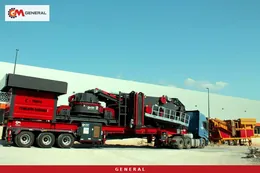
The target range covers two different needs. The lower band (150-180 TPH) can be met with a single wheeled mobile unit. The upper band (around 250 TPH) needs either a larger unit or two units in parallel. The table below contains only values from the manufacturer's data.
| Configuration | Capacity | Crushers | Max. feed | Screen | Product fractions | Generator |
|---|---|---|---|---|---|---|
| General 01 (single unit) | 120-180 t/h | GPS 1210 impact (primary+secondary) | 700 mm | 1600×5000 mm, 4-deck | 0-5 / 5-12 / 12-19 / 19-40 mm | 550 kVA |
| General 950 (single unit) | 120-180 t/h | GPJ 90 jaw + DMK01 impact | 800 mm | 1600×5000 mm, 3-deck | 0-5 / 5-12 / 12-19 mm | 600 kVA |
| General 944 (single unit) | 120-180 t/h | GPJ 90 jaw + GM430 cone | 800 mm | 1600×5000 mm, 3-deck | 0-5 / 5-12 / 12-19 mm | 550 kVA |
| 2 × General 01 (parallel) | 240-360 t/h (combined) | 2 × GPS 1210 impact | 700 mm | 2 × 1600×5000 mm | 0-5 / 5-12 / 12-19 / 19-40 mm | 2 × 550 kVA |
| General 02 (single unit) | 250-300 t/h | GPS 1413 impact | 1000 mm | 2000×5000 mm, 4-deck | 0-5 / 5-12 / 12-19 / 19-40 mm | 660 kVA |
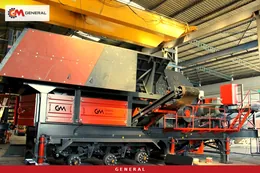
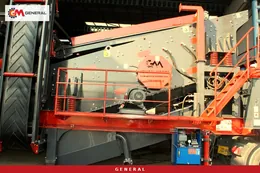
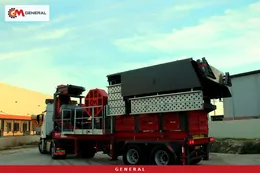
For a road project fed from a limestone quarry the General 01 stands out: its four-deck screen delivers separately the four fractions that form the skeleton of a plant-mix blend, and at 55,000 kg with a 4300×18500×4500 mm transport envelope it travels by road in one piece. In hard rock, the General 950 or General 944 is preferred; both carry a three-deck screen, so how the 19-40 mm coarse fraction will be obtained should be settled at order stage together with the screen apertures. In the upper band, the General 02 gives 250-300 TPH on a single chassis, whereas two General 01 units let one keep producing while the other is under maintenance. You can compare other options on the wheeled mobile crushing plants page.
If the same quarry will be worked for ten years or more, a stationary plant also belongs on the table. In that case the vibrating grizzly feeder, primary and secondary crushers, screen and conveyors are sized one by one to the quarry's topography, and capacity is calculated per project.
From crusher to mixer: stockpile buffer, cold silos and dosing
The second half of a plant-mix line is the mobile pugmill plant. According to the manufacturer's data the mobile plant runs at 200-600 TPH and includes 3-5 cold silos, a 20×4 = 80 m³ aggregate bunker, a 25 m³ loading bin, a 2×22 kW twin-shaft mixer and mass (bulk) cement dosing. The stationary version comes with 200-750 TPH, a 25×4 = 100 m³ bin and a 2×37 kW mixer. Its product is stabilized granular road base, not ready-mix concrete.
Because the crushing line produces 150-250 TPH while the pugmill's lower limit is 200 TPH, the two should not be hard-coupled. The right layout sends each fraction to its own stockpile and feeds the pugmill's cold silos from those piles by loader. The buffer pays off twice: a short stop at the crusher does not halt paving, and the pugmill can run in campaigns matched to the laying crew's pace. When the gradation needs correcting, the cold-silo ratios are changed instead of touching the quarry. Pugmill options are listed in the mechanical stabilization plants category.
Holding the gradation steady with PLC and SCADA
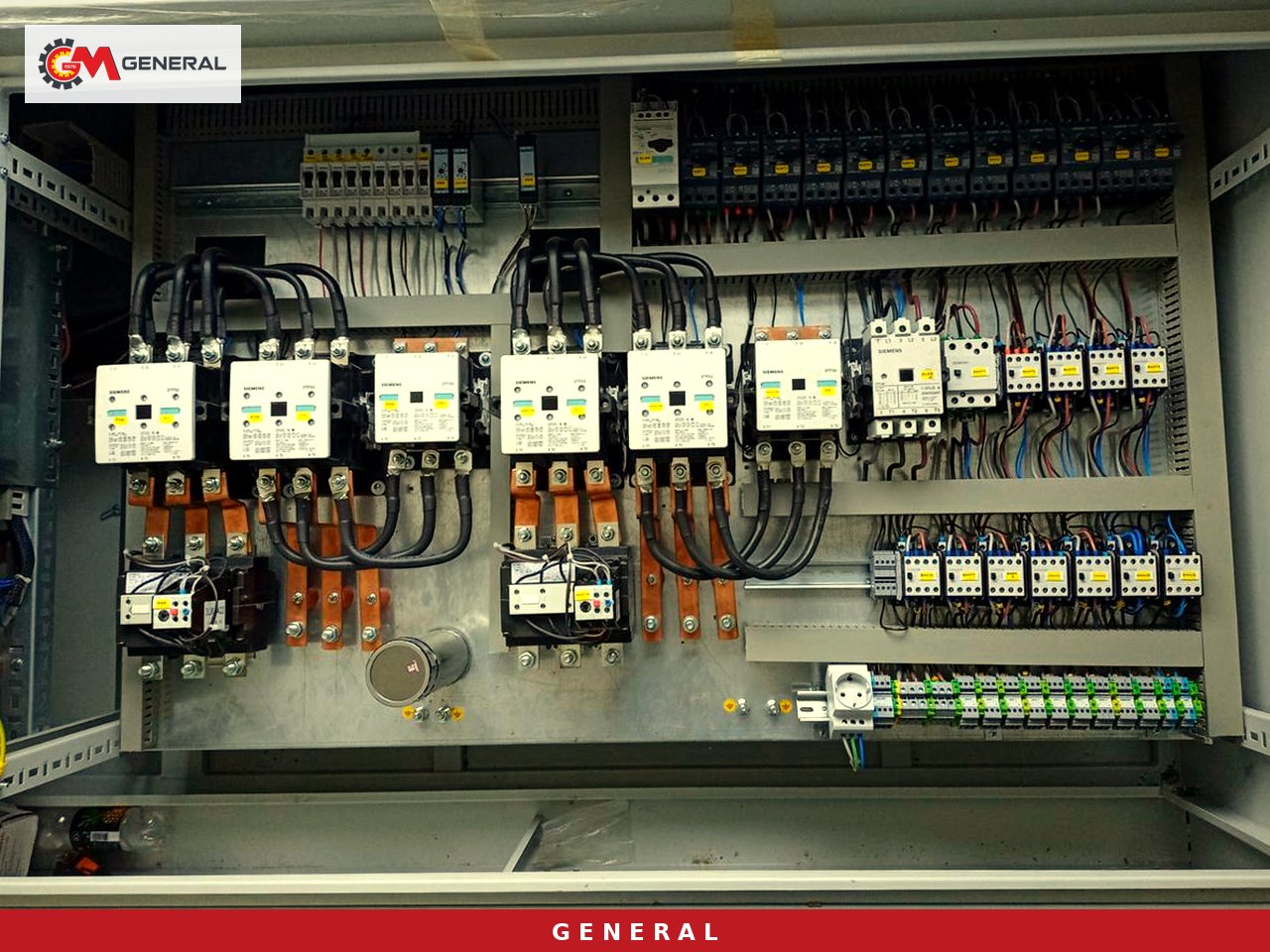
On a manually run line the operator sets the feeder by eye; when crusher current rises, feed is cut, and when it drops, feed resumes. That swing keeps changing the load on the screen and therefore the fraction ratios. An automation and control system closes the loop: as crusher current nears its limit the feeder slows through a variable frequency drive, and once current is back to normal the speed rises again. The screen then works under steady load and the fine fraction drifts less.
Sequential start-up and interlocks
The PLC brings machines on in the opposite direction to material flow, from the stockpile conveyor back towards the feeder. If one machine stops, every stage before it stops automatically, which prevents starting a loaded belt and blockages at transfer points. Level sensors, belt drift and speed switches, and temperature and vibration sensors gather signals from the field.
Cabin and remote monitoring
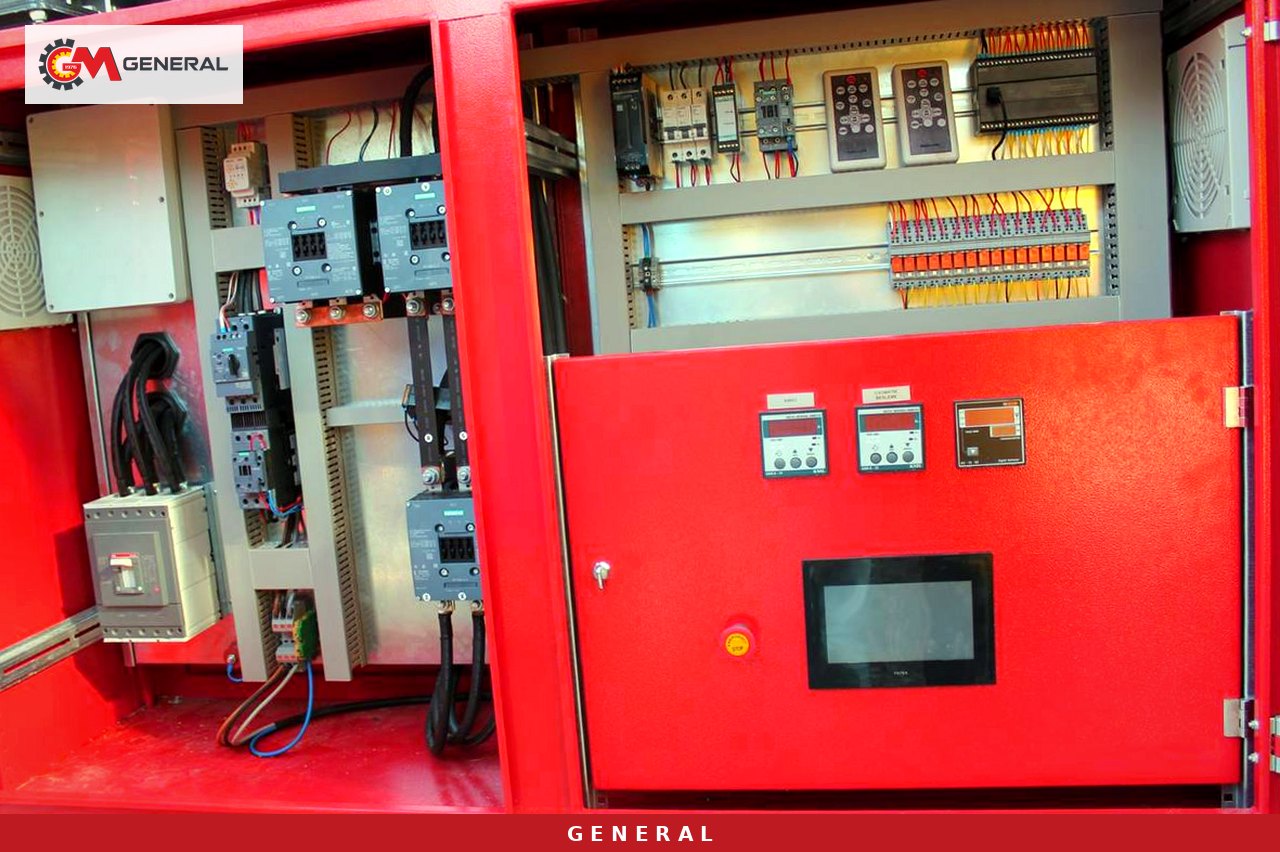
The SCADA screen shows the line diagram with the status, current draw and alarms of every machine on one display. When the panel is networked, shift reports, tonnage produced, downtime and alarm history are logged. For the General 01, a touchscreen panel, soft-starter and internet-linked remote monitoring can be added as options. Where the quarry and pugmill are far apart in Libya, these records make it easier for the site manager to match daily crushing output to the pugmill campaign.
Operating on a Libyan site: heat, dust, power and shipping
Road projects usually advance along routes that are off-grid, dusty and very hot in summer. Humid air from the north and the sand-laden ghibli wind from the south can both occur in the same season. To specify the line for these conditions, settle the following at project start:
- Power: the generators of the wheeled units are stated in the manufacturer's data (550 kVA for the General 01, 660 kVA for the General 02); separate power for the pugmill and lighting must be calculated.
- Cooling and filtration: sand-resistant filters for the generator radiator, hydraulic oil cooler and electrical cabinet ventilation are measures that can be chosen per project.
- Dust: water-spray suppression at transfer points and belt covers should be considered for worker health and to limit loss of fines.
- Wear parts: keeping a spare set of manganese and high-chrome castings on site shortens downtime on a remote route.
- Shipping: wheeled chassis can be towed by road from the ports of Tripoli, Misrata or Benghazi; check bridges and narrow passages on the route in advance.
One of General Makina's deliveries to Libya appears on the site as GNR series mobile crushing plants; see the project page for capacity and configuration details.
Frequently asked questions
Should I choose an impact or a jaw + cone layout for plant-mix?
In limestone and low-abrasion stone an impact crusher gives cubical, well-graded product, and the General 01 is designed for exactly that. In hard rock such as basalt or quartzite, the General 944 with its cone secondary gives longer wear-part life. Base the decision on sample testing.
Can I couple the crushing line directly to the pugmill?
Not recommended. The pugmill's capacity range differs from the crushing line, and a single stop halts the whole chain. Stockpiling fractions separately and feeding the cold silos from them also makes gradation correction easier.
One large unit or two smaller ones for 250 TPH?
The General 02 gives 250-300 TPH on one chassis and is simple to set up. Two General 01 units reach a combined 240-360 TPH and keep half of production going while one is in maintenance. On remote, single-quarry projects the second option carries less risk.
How are price and delivery time determined?
Price is set by crusher type, number of screen decks, automation level, generator, dust measures and the spare parts package. The delivery plan is given in writing in the quotation, based on the production schedule at order time and the port of shipment.
Decision summary and pre-quote checklist
A line producing plant-mix base in Libya should be designed around the specification's grading envelope before the crusher is chosen. Prepare the following before asking for a quote:
- Quarry rock type and any lab results (abrasiveness, compressive strength).
- The authority's plant-mix grading envelope and plasticity limit.
- Daily laying target and number of shifts.
- Distance between quarry and pugmill, and stockpile area.
- Power source: grid or generator?
- Port of shipment and road route to site.
With this information we can plan the crushing line, pugmill and automation within one engineering scope. Contact General Makina manufacturing in Izmir since 1976 with ISO 9001 and CE certification, for a quotation tailored to your project.
Definitions of technical terms: Glossary